



Why rules matter
A D/s dynamic without rules is an idea. Rules make it real. They create the points of contact between the power exchange and everyday life — the moments where the submissive feels the dynamic and the Dom(me) sees it in action.
Rules serve multiple purposes simultaneously. At the most basic level, they define expectations. The submissive knows what is required. The Dom(me) knows what to look for. This clarity alone reduces anxiety on both sides — the submissive is not guessing what the Dom(me) wants, and the Dom(me) is not wondering whether the submissive is engaged.
But rules do more than define expectations. They create ritual. A morning check-in rule is not just about confirming the submissive is awake. It is a daily act of submission — a moment where the dynamic is consciously acknowledged. Over time, these rituals become the heartbeat of the relationship, providing rhythm and meaning to what might otherwise be an ordinary day.
Rules also build trust through predictability. When a rule exists and is consistently tracked, both people can rely on the dynamic being present. The submissive trusts that the Dom(me) is paying attention. The Dom(me) trusts that the submissive is participating. Each completed rule is a small deposit in the trust account.
Finally, rules create accountability — and accountability is the mechanism that separates a D/s dynamic from a fantasy about having one. Without something to be accountable for, the power exchange has no grip. Rules provide that grip.
Types of rules
Standing vs. situational
Standing rules apply continuously — every day, or on a recurring schedule. "Send a morning message before 9am" is a standing rule. "Write a weekly reflection every Sunday" is a standing rule. They form the baseline of the dynamic, the things that happen whether anyone is feeling inspired or not.
Situational rules apply in specific contexts. "When we are out together, walk on my left side." "When I give a specific command, respond with this phrase." "When you feel anxious, follow this protocol." Situational rules add depth to the dynamic without adding to the daily workload. They activate when relevant and recede when not.
Most dynamics benefit from a mix. Standing rules create rhythm. Situational rules create presence — the sense that the dynamic is alive in various contexts, not just during scheduled check-ins.
Evidence-based vs. honour-based
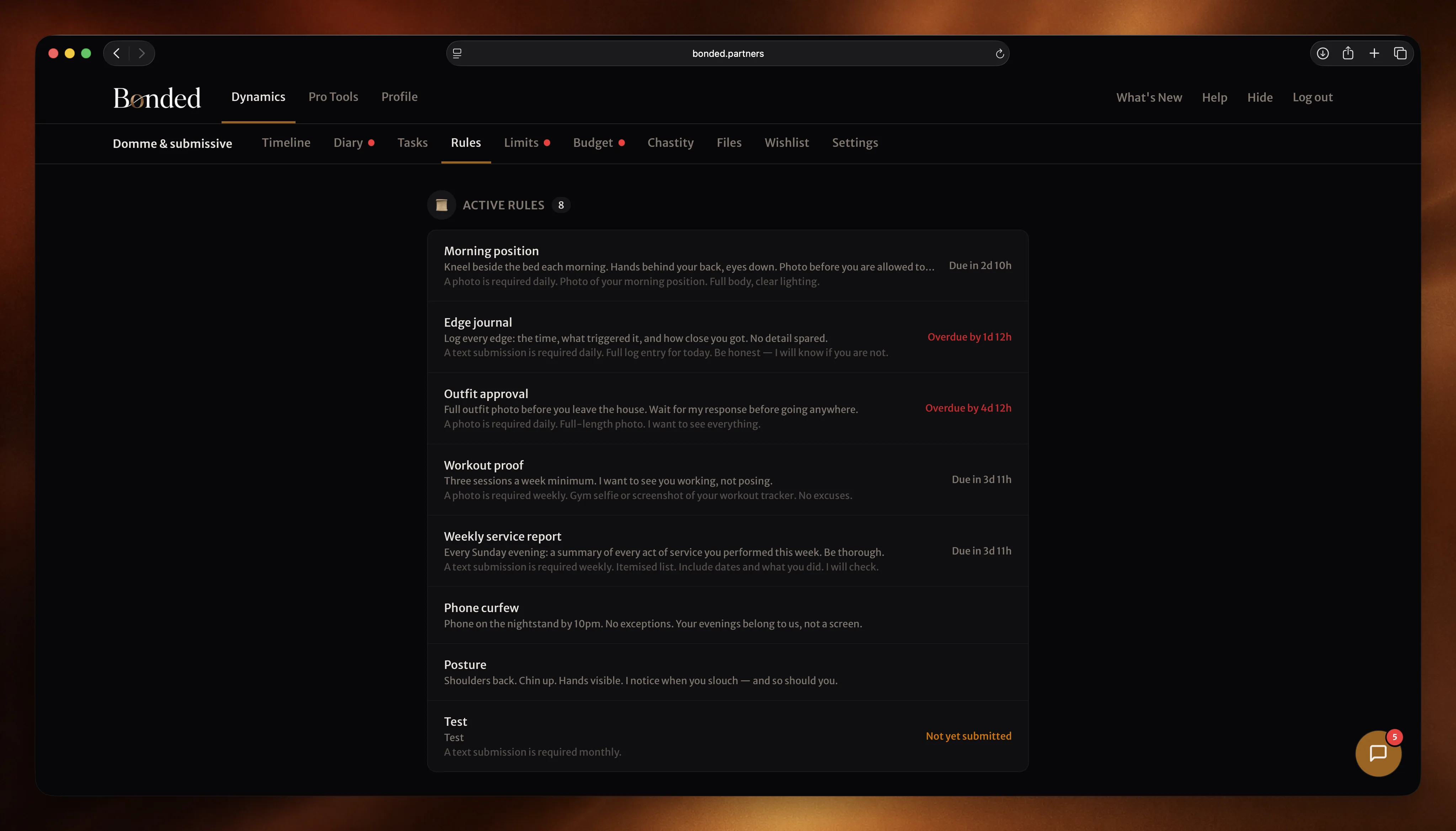
Evidence-based rules require proof of compliance: a photo, a video, a text entry, a timestamp. The submissive completes the rule and submits evidence. The Dom(me) reviews it. The record is clear.
Honour-based rules rely on the submissive's word. The Dom(me) trusts that the rule is being followed without requiring proof. These work well for rules that are difficult to evidence (behavioural rules, internal states) or for dynamics where the trust level is high enough that proof feels unnecessary.
There is no hierarchy between these types. Evidence-based rules are not "stricter" and honour-based rules are not "lazier." They serve different purposes. Evidence-based rules create tangible touchpoints and a visual record of devotion. Honour-based rules express and deepen trust. Many dynamics use both.
Categories
Rules tend to cluster around a few common categories:
- Daily rituals. Morning check-ins, evening reflections, specific greetings or sign-offs. These create the daily heartbeat of the dynamic.
- Self-care. Hydration, sleep, exercise, nutrition. Rules that use the Dom(me)'s authority to support the submissive's wellbeing — building trust through care.
- Protocol. Honorifics, modes of address, specific behaviours in certain contexts. Protocols create the felt sense of power exchange in everyday moments.
- Reporting. Permission-seeking, check-ins before certain activities, financial reporting. These create ongoing touchpoints throughout the day.
- Restriction. What the submissive may not do without permission — spending limits, bedtime, screen time, certain activities. Restriction rules create the tangible sense of the Dom(me)'s authority.
Free course
Learning to build structure in a dynamic? BDSM 101 covers rules, protocols, and accountability in Chapter 8.
Start the course →Writing good rules
A good rule has three qualities: it is clear, achievable, and meaningful. Missing any one of these makes the rule weaker than it should be.
Clear
The submissive should be able to read a rule and know exactly what is expected — without asking for clarification. "Be good" is not clear. "Be respectful" is not clear. "Address me as Sir in all written messages" is clear. "Send a photo of your completed workout by 8pm" is clear.
Ambiguity creates anxiety. When a submissive is not sure whether they have satisfied a rule, they either worry about getting it wrong or stop caring because the standard is unknowable. Both outcomes are worse than having a clear rule in the first place. Be specific about the action, the timing, the format, and the evidence.
Achievable
A rule that the submissive cannot reliably complete erodes the dynamic instead of strengthening it. Repeated failure — especially failure caused by the rule being unreasonable rather than the submissive being negligent — creates resentment, shame, and disengagement.
Consider the submissive's real life when setting rules. Do they have a demanding job? Young children? Health conditions? Time zone differences? A rule that works perfectly for someone with a flexible schedule may be impossible for someone who commutes two hours each way. The rule should challenge, not punish.
Start easier than you think you need to. It is better to have five rules that are completed consistently than fifteen rules that are completed sporadically. Consistency builds the habit and the trust. You can always increase difficulty later — scaling back feels like failure for both people.
Meaningful
Every rule should serve a purpose. If you cannot articulate why a rule exists — what it does for the dynamic, for the submissive, or for the Dom(me) — it probably should not exist. Rules without purpose become chores, and chores breed resentment.
The purpose can be practical (self-care, organisation), relational (creating touchpoints, maintaining connection), or symbolic (reinforcing the power exchange, creating ritual). But it should be identifiable. When a submissive understands why a rule exists, they engage with it differently than when it feels arbitrary.
Evidence and accountability
Evidence is what closes the loop. The submissive does the thing. They submit proof. The Dom(me) reviews it. The rule is acknowledged as completed — or addressed if it was not. Without this loop, rules drift into suggestions.
The type of evidence should match the rule. A self-care rule might need only a text confirmation: "Done." A morning ritual might require a photo. A creative task might require a written submission. The point is not to create busy work — it is to create a tangible record that both people engage with.
Why evidence matters for submissives
Submitting evidence is an act of submission in itself. It is the submissive saying: I did what was asked, and I am showing you. There is vulnerability in that — especially with photo or video evidence. That vulnerability, when met with consistent acknowledgement from the Dom(me), deepens the connection.
Evidence also provides a record of devotion. Over weeks and months, the accumulated evidence tells a story of commitment. For submissives who struggle with feeling "enough," that record can be powerful — tangible proof that they are showing up, day after day.
Why evidence matters for Dom(me)s
Reviewing evidence is one of the most important things a Dom(me) does. It signals attention. It signals that the submissive's effort is seen and valued. A Dom(me) who sets rules but never checks evidence is sending a clear message: this does not matter enough for me to look at.
Consistency matters more than speed. A Dom(me) who reviews evidence reliably — even if it takes a few hours — builds more trust than one who sometimes responds instantly and sometimes forgets entirely. Build evidence review into your routine, not your impulse.
How Bonded handles this
Every rule can require photo, video, audio, document, or text evidence. Submissions are timestamped and tracked with unseen indicators so the Dom(me) knows exactly what needs attention. Evidence lives alongside the rule — no scrolling through chat logs to find it.
See how rules work→Tasks vs. rules
Rules are ongoing. Tasks are one-off. This distinction matters because they serve different purposes and create different effects in the dynamic.
Rules create rhythm and consistency. They are the things the submissive does every day, every week, every time a certain condition is met. They become habits — the background structure of the dynamic that both people can count on.
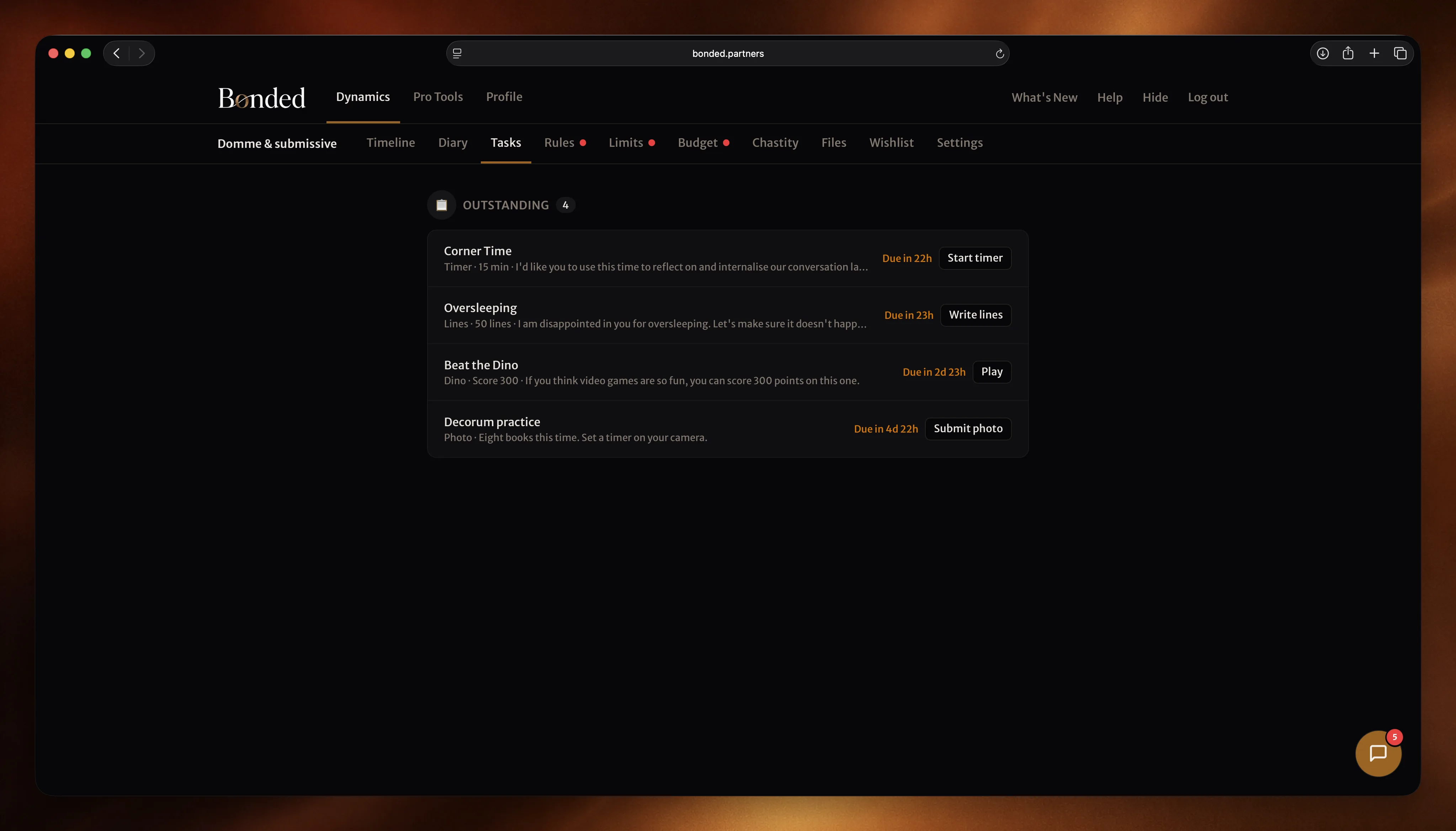
Tasks create variety and challenge. They are the things the Dom(me) assigns for a specific purpose: to push a boundary, to explore something new, to address a specific need, or simply to keep the dynamic interesting. Tasks have a start, a completion criteria, and an end.
A healthy dynamic usually has both. Rules provide stability. Tasks provide stimulation. Too many rules without tasks and the dynamic becomes monotonous. Too many tasks without rules and the dynamic feels chaotic — all variety, no foundation. The balance depends on the people involved, but most dynamics benefit from a solid base of rules with periodic tasks layered on top.
Tasks are also a useful testing ground. Before promoting something to a standing rule, try it as a task first. Assign it once, see how it goes, gather feedback. If it works, it becomes a rule. If it does not, it was just a task — no harm done, and you have both learned something.
Task types
Not all tasks look the same. Different types serve different purposes, and variety keeps the submissive engaged.
Evidence tasks
The submissive completes an activity and submits evidence — photo, video, audio, document, or text. This is the most common task type and works for everything from creative assignments to physical challenges. The evidence requirement creates accountability and gives the Dom(me) something tangible to review and respond to.
Lines
Writing lines is a traditional D/s activity with real psychological depth. The submissive writes a specific phrase a set number of times. The repetition is the point — it forces focus on the words, creates a meditative headspace, and produces a tangible record of effort. Lines tasks work particularly well as reinforcement after a rule is missed, as a mindfulness exercise, or as a way to internalise an intention.
Endurance tasks
Timed tasks where the submissive maintains a position, an activity, or a state for a defined duration. Holding a specific posture. Maintaining silence. Wearing something for a set period. The clock creates the challenge, and completing the duration creates the satisfaction. Endurance tasks test discipline and create a shared experience of time — the submissive counting the minutes, the Dom(me) knowing they are doing so.
Reflective tasks
Written assignments that ask the submissive to process, reflect, or articulate something. "Write 300 words on what submission means to you." "Describe a moment this week when you felt most connected to the dynamic." "List three things you want to explore and explain why." Reflective tasks deepen self-awareness and give the Dom(me) insight into the submissive's internal world.
Service tasks
Tasks that directly benefit the Dom(me): preparing something, organising something, researching something, completing a chore. Service tasks ground the dynamic in tangible acts of devotion and remind both people that the power exchange has real-world expression.
How Bonded handles this
Tasks support photo, video, audio, document, and text evidence, plus lines exercises and timed endurance tasks. Detailed completion reports show what was done and when. Every task is tracked on the timeline.
See how tasks work→Frequency and scheduling
When a rule fires matters as much as what the rule says. The schedule is part of the design.
Daily rules create the strongest sense of presence. Every day, the submissive engages with the dynamic. Every day, the Dom(me) sees evidence. Daily rules work best for things that benefit from consistency: check-ins, self-care, rituals.
Weekly rules work for things that need more time or depth: reflections, reviews, longer creative submissions. They also provide variation within the week — certain days feel different because certain rules apply.
Specific-day rules create rhythm. A rule that applies only on weekends creates a different feel to those days. A rule that applies on Mondays anchors the start of the week. Using specific days allows the dynamic to ebb and flow within the week rather than maintaining constant intensity.
A common mistake is making everything daily. This frontloads the schedule and creates burnout. Consider the total daily time commitment. If a submissive has seven daily rules each requiring evidence, that is significant time and mental bandwidth — every single day. A mix of daily, weekly, and situational rules distributes the load while keeping the dynamic present.
Time-of-day also matters. A morning rule grounds the start of the day. An evening rule closes it. A midday rule provides a touchpoint during the hours that are often most disconnected from the dynamic. Think about when the rule will be experienced, not just what it requires.
When rules need to change
Rules are not permanent. A rule that served the dynamic at three months might be irrelevant at twelve. Changing rules is not failure — it is maintenance. The dynamic evolves; the rules should evolve with it.
Signs that a rule needs attention:
- Chronic non-compliance. If a rule is consistently missed despite genuine effort, it may be unreasonable — wrong timing, wrong frequency, or simply not achievable given current circumstances.
- Indifference. If both people have stopped caring about a rule — the submissive completes it mechanically, the Dom(me) barely reviews the evidence — it has lost its meaning. Retire it or reinvent it.
- Life changes. A new job, a move, a health issue, a change in the relationship. When life changes significantly, the entire rule set should be reviewed for fit.
- Growth. The submissive has mastered a rule so thoroughly that it no longer provides challenge or meaning. It has done its job. Replace it with something that serves the dynamic's current needs.
Changing rules should be a conversation, not a unilateral decision. Both people should have input on what is and is not working. Regular reviews — monthly or quarterly — that explicitly evaluate each rule prevent the accumulation of dead rules that clog the dynamic without serving it.
Common mistakes
Too many rules too soon. The most common mistake in new dynamics. Enthusiasm produces a list of fifteen rules in the first week. By week three, half are being missed and both people feel defeated. Start with three to five. Add one at a time. Let each rule settle before introducing the next.
Vague rules. "Be a good sub." "Show more effort." "Be respectful." These are sentiments, not rules. They cannot be tracked, evidenced, or fairly evaluated. If you cannot explain exactly how the submissive demonstrates compliance, the rule is not specific enough.
Rules without follow-through. Setting a rule and then not checking whether it was completed is worse than not setting it at all. It tells the submissive that the Dom(me) does not care enough to look. It degrades the power exchange. If you set a rule, track it. If you cannot track it, do not set it.
Rules as punishment. Adding rules in anger or as a punitive response to behaviour creates a negative association with the entire rule system. Rules should be thoughtfully designed, not deployed as consequences. They exist to serve the dynamic, not to express the Dom(me)'s frustration.
Never retiring rules. Rules accumulate. Unless you actively remove or replace rules that have served their purpose, the total load grows until the dynamic becomes an obligation rather than a relationship. A rule that no longer serves the dynamic is not sacred. Let it go.
Ignoring the submissive's input. The Dom(me) sets the rules, but the submissive lives them. Disregarding feedback about what is and is not working leads to rules that look good on paper and fail in practice. The submissive's experience of a rule is essential data for deciding whether it stays, changes, or goes.
Confusing quantity with quality. Five deeply meaningful rules that both people engage with every day will do more for a dynamic than twenty rules that exist in a list but are not actively tracked or cared about. Fewer, better rules. Always.
Tools
You can manage rules with a notebook and good intentions. But as the dynamic grows, so does the administration. Which rules were completed today? What evidence needs reviewing? Which tasks are still open? When was the last time a particular rule was missed? These questions become harder to answer from memory as complexity increases.
General tools — spreadsheets, habit trackers, shared documents — handle the tracking part but miss the context. A habit tracker does not know that a rule is something the submissive completes for the Dom(me). It does not support evidence submission. It does not flag unreviewed completions. It does not understand that a task is different from a rule.
Purpose-built tools exist because D/s dynamics have specific needs. The right tool tracks rules and tasks, manages evidence, notifies both people at the right times, and keeps everything in a private space that respects the sensitivity of the content. The tool should reduce the administrative overhead of the dynamic — not replace the dynamic itself, but handle the logistics so both people can focus on the relationship.