



What D/s actually is (and isn't)
D/s — Dominance and submission — is a relationship structure built on consensual power exchange. One person takes authority over certain aspects of the dynamic. The other consents to follow that authority within agreed boundaries. That's it. Everything else — the protocols, the rituals, the intensity — is customisation.
A D/s dynamic can exist within a romantic relationship or outside of one. It can be 24/7 or confined to specific times. It can involve sexual elements or be entirely non-sexual. It can exist between any combination of genders and orientations. There is no single template. The only non-negotiable element is that both parties choose it freely and can withdraw at any time.
What D/s is not: abuse with a label. The distinguishing feature of a healthy dynamic is that the submissive's consent is the foundation everything else is built on. A Dom(me) who ignores limits, punishes safeword use, or isolates their submissive from outside support is not practising D/s. They are practising abuse.
This is worth stating early because the line between power exchange and coercion is drawn by one thing: the submissive's genuine, ongoing, informed consent. If you're starting a dynamic, this principle should be at the centre of every decision you make together.
Understanding roles: Dom(me), submissive, and switch
Roles in D/s describe the direction of power exchange, not the totality of who someone is. Being a Dom(me) does not mean being controlling in every aspect of life. Being a submissive does not mean being passive. These are roles people step into deliberately — and the best practitioners tend to be people who are thoughtful, communicative, and emotionally mature.
The Dom(me)
The Dominant partner takes authority within the boundaries the dynamic defines. They set rules, assign tasks, make decisions, and hold the submissive accountable. But authority in a D/s dynamic is given, not taken. A Dom(me)'s power comes from their submissive's trust — and that trust requires care, consistency, and responsibility.
Good Dom(me)s listen more than they command. They check in. They learn their submissive's signals. They understand that managing a dynamic is work — emotional, logistical, and creative. The fantasy is effortless authority; the reality is that maintaining a healthy dynamic requires deliberate effort.
The submissive
The submissive partner consents to follow the Dom(me)'s authority within agreed limits. They are an active participant — submitting evidence, writing reflections, communicating needs, negotiating boundaries. Submission is not passivity. It is a deliberate, ongoing choice that requires self-awareness and courage.
Submissives are not doormats. They bring their own needs, preferences, and hard limits to the dynamic. A submissive who never speaks up about discomfort is not being "good" — they are creating an unsafe dynamic for both parties. The strength of submission lies in choosing vulnerability with someone who has earned that trust.
Switches
Switches move between Dominant and submissive roles. Some switch between dynamics (Dominant with one partner, submissive with another). Some switch within a single dynamic based on mood, scene, or agreement. Switching is not indecision — it is a broader range of expression within power exchange.
If you're not sure which role fits, that's normal. Many people discover their preference through experience. Start with honest self-reflection: do you feel more drawn to giving direction or following it? Does the idea of being held accountable excite you, or do you prefer being the one who sets expectations? There is no wrong answer, and the answer can change.
The first conversations
Before you write a single rule, you need to talk. And not just once — the initial negotiation is a series of conversations that establish what both of you want, what you're not willing to do, and what the dynamic actually looks like day to day.
What to discuss
Motivations.Why do you each want a D/s dynamic? What do you hope to feel? What needs does it meet? These don't have to be identical — a Dom(me) might want structure and purpose; a submissive might want accountability and safety. Understanding each other's motivations helps you build a dynamic that serves both of you.
Scope. Is this a 24/7 dynamic or something you engage in at specific times? Does it extend to finances, daily routines, sex, communication with others? The scope can expand over time, but starting with clarity prevents misunderstandings.
Safewords. Agree on a safeword system before any power exchange begins. The traffic light system is widely used: green (good), yellow (slow down / check in), red (stop immediately). Whatever system you use, both partners must honour it without hesitation, without question, without consequence.
Check-in rhythm. How often will you step out of your roles and talk as equals about how the dynamic is going? Weekly is a good starting point. Some couples do daily check-ins. The format matters less than the consistency — and both partners should feel free to raise concerns during check-ins without it being treated as a failure.
Deal-breakers. What would cause either of you to end the dynamic? Discussing this upfront is not pessimistic — it is responsible. Knowing the exit conditions makes both partners safer.
Free course
Prefer structured learning? BDSM 101 walks you through your first scene step by step in Chapter 6.
Start the course →Setting limits before you set rules
Limits define the space a dynamic can occupy. Rules define how you operate within that space. The order matters — limits come first, always.
A limit is something you will not do (hard limit), something you're cautious about (soft limit), or something you genuinely want to explore (curious). Every person in the dynamic should have their own limits documented. These are individual — not joint. A Dom(me)'s limits are just as important as a submissive's.
The value of a structured limits conversation is that it surfaces things people might not think to bring up. You might discover you have wildly different comfort levels around financial control, or that you both share a curiosity about protocol you hadn't discussed. A systematic approach — going activity by activity — catches what free-form conversation misses.
Limits should be revisited regularly. What feels like a hard limit in month one might become a curiosity in month six. What felt fine initially might become uncomfortable after experience. Limits are living documents, not contracts signed once and forgotten.
How Bonded handles this
Bonded's limits system covers over 170+ activities across 23 categories. Each person sets their own limits — hard, soft, or curious — and only they can edit them. Changes are flagged automatically so nobody misses an update.
See how Bonded handles this→Your first rules and protocols
Rules give a dynamic its daily texture. They turn the abstract concept of power exchange into something lived. But starting with too many rules is one of the most common mistakes new dynamics make. Three to five rules is plenty for the first few weeks.
What makes a good first rule
A good starting rule is specific, achievable, and meaningful. "Be a good sub" is not a rule — it is a vague aspiration with no way to measure success or failure. "Send a good morning message every day before 9am" is a rule: clear, trackable, and it reinforces the dynamic through daily action.
Good starter rules often fall into a few categories:
- Daily rituals. A morning check-in, an evening reflection, a specific way of greeting your Dom(me). These build the habit of the dynamic into your routine.
- Self-care rules. Drinking enough water, going to bed on time, exercising. These show that the Dom(me)'s authority is used for the submissive's benefit — which builds trust fast.
- Protocols. A specific honorific, a particular way of asking permission, a rule about addressing your Dom(me) in certain contexts. Protocols create the felt sense of power exchange even in mundane moments.
- Reporting rules. Asking permission before spending over a certain amount, checking in before going out, sending a photo at a specified time. These create touchpoints throughout the day that reinforce the power exchange without being burdensome.
Scheduling and consistency
The schedule matters as much as the rule itself. A rule that applies "whenever" is weaker than one with a specific time. "Send a morning message" is vague. "Send a morning message before 9am, every day, with a photo of your morning coffee" is precise. The precision creates both accountability and ritual — and ritual is what turns a rule from an obligation into a meaningful part of the day.
Start with daily rules to build the habit, then add rules with different cadences (weekly reflections, weekend protocols) as the dynamic matures. Consistency in enforcement matters too. A rule that the Dom(me) sometimes checks and sometimes ignores sends mixed signals. If a rule exists, it should be actively tracked.
Punishments and consequences
This is a nuanced area for new dynamics. Punishments for rule violations can reinforce the power exchange — but they can also create anxiety, resentment, or fear if handled poorly. Many experienced practitioners recommend starting without formal punishments. Instead, the consequence of a missed rule is a conversation: what happened, why, and what can be adjusted.
If your dynamic does include punishments, negotiate them in advance. The submissive should know what the consequences are before they apply. Punishments should never cross hard limits, never be given in anger, and never be disproportionate. A punishment is a tool of the dynamic, not an expression of the Dom(me)'s frustration.
Evidence requirements
Rules without evidence are just suggestions. If a rule matters enough to set, it matters enough to verify. Evidence can be a photo, a text confirmation, a timestamp — whatever fits the rule. The point is not surveillance; it is accountability. The submissive knows someone is paying attention, and the Dom(me) has a way to acknowledge compliance or address gaps.
The type of evidence should match the rule. A self-care rule might require a simple text confirmation. A morning ritual might require a photo. A reflection task might require a written entry. Matching evidence to the rule keeps the process meaningful rather than bureaucratic.
How Bonded handles this
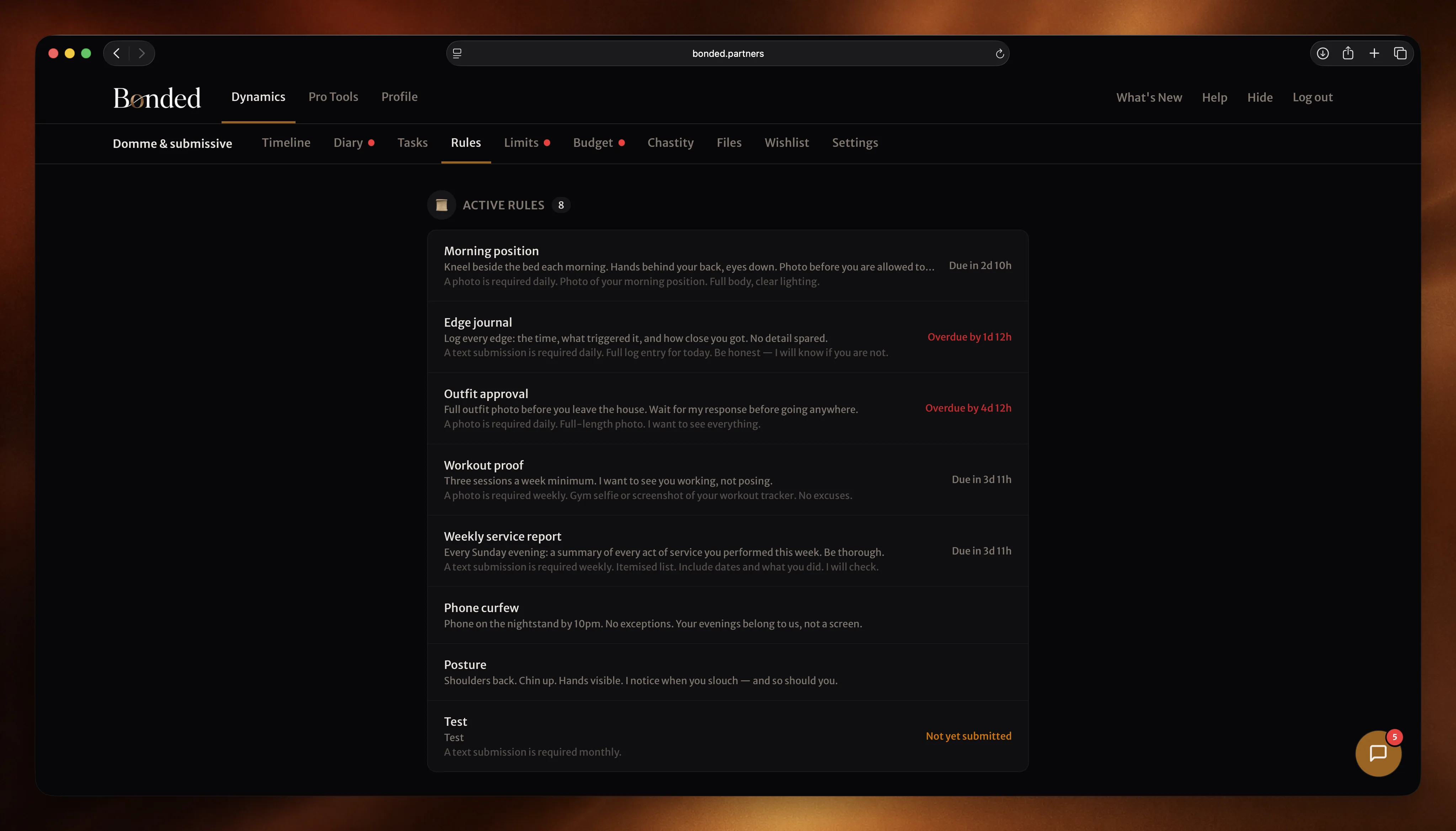
Set standing rules with schedules and evidence requirements. Your sub sees what's expected; you see what's delivered. Photo, video, or text evidence — tracked automatically with unseen indicators.
See how Bonded handles this→Tasks and evidence
Where rules are ongoing expectations, tasks are one-off assignments. Write 500 lines. Complete a specific exercise. Research a topic and present your findings. Tasks add variety to a dynamic and give the Dom(me) a way to direct the submissive's growth.
Effective tasks share a few qualities. They have a clear completion criteria — not just "do something nice" but "write a 200-word reflection on what submission means to you." They have a deadline, even if it's generous. And they have an evidence requirement so completion is documented, not just claimed.
Tasks are also a useful tool for exploring new territory. Before adding a new activity to your regular protocols, assign it as a task first. A one-off assignment with a reflection component gives both partners data about whether something works before committing to it as a rule.
Variety matters. Predictable tasks lose their impact. A mix of service tasks (things that benefit the Dom(me)), self-improvement tasks (things that benefit the sub), creative tasks (things that deepen the connection), and challenging tasks (things that push limits within agreed boundaries) keeps a dynamic engaging for both sides.
How Bonded handles this
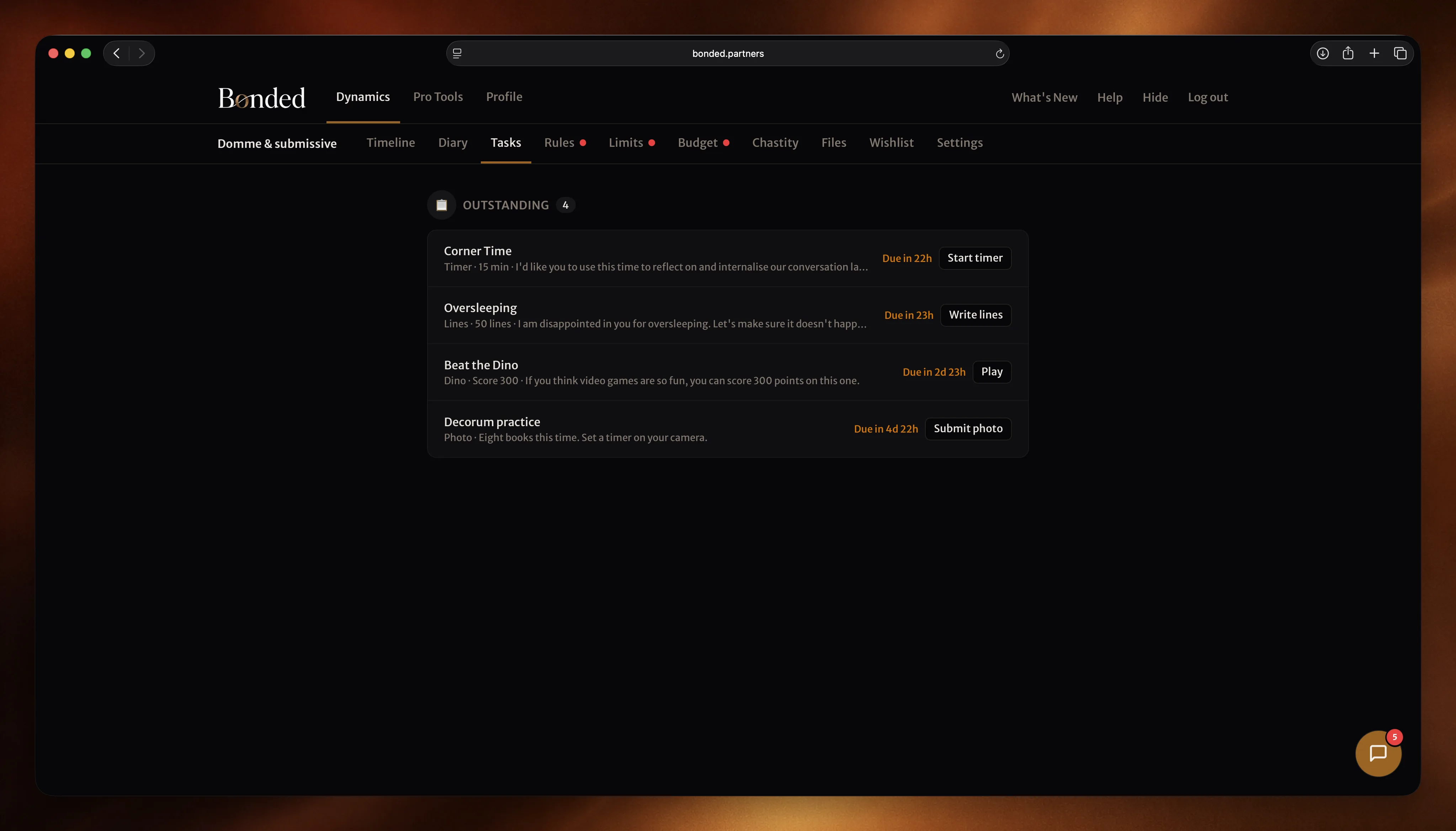
Tasks support photo, video, audio, document, and text evidence, plus lines exercises and timed tasks. Detailed completion reports show exactly what was done and when.
See how Bonded handles this→Communication as the foundation
Every healthy dynamic runs on communication. Not just the initial negotiation, but the ongoing, unglamorous work of checking in, raising concerns, giving feedback, and being honest about how things feel.
In-role vs. out-of-role communication
D/s dynamics benefit from having both modes. In-role communication happens within the power exchange: the sub addresses the Dom(me) with an honorific, asks permission according to protocol, submits reflections. Out-of-role communication happens between equals: discussing what is and isn't working, renegotiating limits, processing difficult experiences.
New dynamics often struggle with the transition between modes. Establish a clear signal — a specific word, phrase, or context — that indicates "we're talking as equals now." This prevents situations where a submissive feels they can't raise a concern because they're "in role," or a Dom(me) receives honest feedback as disobedience.
Reflections and journals
One of the most valuable communication tools in a D/s dynamic is the reflection. A daily or weekly written entry where the submissive processes how the dynamic is going — what felt good, what was hard, what they're thinking about. For the Dom(me), reading reflections provides insight that direct conversation sometimes misses. People often write things they struggle to say out loud.
Reflections also create a record. Looking back at entries from three months ago shows growth, reveals patterns, and reminds both partners how far they have come. This is especially valuable during difficult periods — when the day-to-day feels stagnant, the record often shows meaningful progress.
How Bonded handles this
The diary feature gives submissives a space to write daily reflections, with optional moods and evidence. Dom(me)s review entries, mark them as seen, and add private notes. Real-time chat keeps ongoing conversation in the same space.
See how Bonded handles this→Growing your dynamic over time
The dynamic you have in month one will not — and should not — be the dynamic you have in month twelve. Growth is natural and necessary. The question is whether you grow deliberately or let things drift.
Deliberate growth means periodically reviewing the entire dynamic: what rules are still serving a purpose? Which ones feel stale? Have your limits changed? Are there curiosities you're ready to explore? Is the balance of power still where both partners want it?
Some dynamics deepen gradually — adding more rules, increasing scope, raising the intensity of accountability. Others expand sideways — adding new activities, exploring new kinks, involving financial or domestic elements. Some simplify over time, discovering that fewer, more meaningful rules serve the dynamic better than a long list.
The trajectory does not matter. What matters is that both partners are steering together. A dynamic that grows only because the Dom(me) keeps adding rules without input from the submissive is not growing — it is escalating. Growth requires consent at every new stage, not just the beginning.
Seasonal reviews work well for many dynamics. Quarterly, sit down out of role and discuss: what is working, what isn't, what you want to try next. Treat it like performance review season — for both of you, not just the sub.
Navigating plateaus
Every dynamic hits plateaus — periods where things feel routine rather than exciting. This is normal and does not mean the dynamic is failing. Plateaus are often a sign of stability, which is different from stagnation. The distinction matters.
If a plateau feels like stagnation, shake things up deliberately. Introduce a new rule. Try a curiosity from your limits list. Assign a creative task. Change the check-in format. Small changes can reignite the sense of intentionality that makes power exchange feel alive. The goal is not perpetual intensity — that is unsustainable — but perpetual intentionality.
Integrating D/s with the rest of your life
For many people, a D/s dynamic coexists with jobs, families, friendships, and all the other elements of a full life. Integration is an ongoing negotiation. How visible is the dynamic to people outside it? What happens when work stress makes it hard to maintain protocols? How do you handle periods of illness, travel, or life upheaval?
Healthy dynamics have built-in flexibility for real life. A submissive who is sick should not be stressed about missing a daily check-in. A Dom(me) going through a difficult period at work might need to reduce the intensity of oversight temporarily. Building these pressure valves into the dynamic from the start — rather than treating any deviation as failure — creates a dynamic that survives contact with reality.
Common mistakes and how to avoid them
Going too fast. The most common mistake by far. Enthusiasm is good. But starting with 20 rules, 24/7 protocols, and strict punishments in week one is a recipe for burnout or worse. Start small. Build gradually. Let trust accumulate before intensity does.
Skipping negotiation. "We'll figure it out as we go" works for picking restaurants, not for power exchange. The conversations are not optional. Discuss limits, safewords, scope, and expectations before you start. Revisit them regularly after.
Confusing fantasy with practice. What you find hot in theory does not always work in practice. The mental image of strict 24/7 obedience is different from the reality of maintaining it when you are tired, stressed, or sick. Leave room for reality in your dynamic.
Neglecting aftercare. Aftercare is not just for after intense scenes. Everyday power exchange can create emotional responses that need processing. Check in after implementing new rules. Check in when a task was particularly hard. Check in when a punishment was given. The Dom(me) needs aftercare too — holding authority can be emotionally taxing in ways people rarely discuss.
Comparing to other dynamics. Social media, forums, and fiction create ideas about what a "real" D/s dynamic looks like. Your dynamic is real if it works for both of you. There is no minimum intensity, no required set of activities, no correct amount of protocol. The only metric is whether the dynamic serves the people in it.
Forgetting you are both learning. New Dom(me)s make mistakes. New submissives make mistakes. Grace, patience, and humour are not weaknesses in a dynamic — they are what sustains it. The goal is not perfection. The goal is a relationship that makes both of you better.
Tools that help
You can run a D/s dynamic with nothing but conversation and memory. People have for decades. But tools that provide structure — somewhere to track rules, store limits, record reflections, manage tasks — reduce the administrative overhead and let you focus on the actual dynamic.
Some people use shared documents or spreadsheets. These work but lack privacy features, push notifications, and purpose-built interfaces. General habit trackers can handle rules but miss the D/s-specific elements: limits, evidence submission, chastity management, the relational context that makes a rule different from a habit.
Purpose-built tools exist because D/s dynamics have specific needs that generic solutions handle awkwardly at best. The right tool does not define your dynamic — your dynamic defines what you need from the tool. But having the right infrastructure frees you from admin and lets you invest that energy where it matters: in each other.
Built for exactly this
Bonded is a platform designed specifically for D/s dynamics. Rules, tasks, limits, diary, chastity tracking, chat, budget management, and shared files — everything in one private space.
See how Bonded handles this→