



BDSM Contract Builder
The start of an incredible dynamic is a proper agreement. Build the foundations of your BDSM relationship.
Parties and scope
Safety
Rules
Limits
Tasks and accountability
Communication and aftercare
Additional control
Terms
You'll answer questions across eight sections. Tick boxes, choose from structured options, and add your own where you need to. At the end, the builder generates a formatted agreement with numbered clauses, signature lines, and proper legal-style language. Download it as a PDF and it's yours.
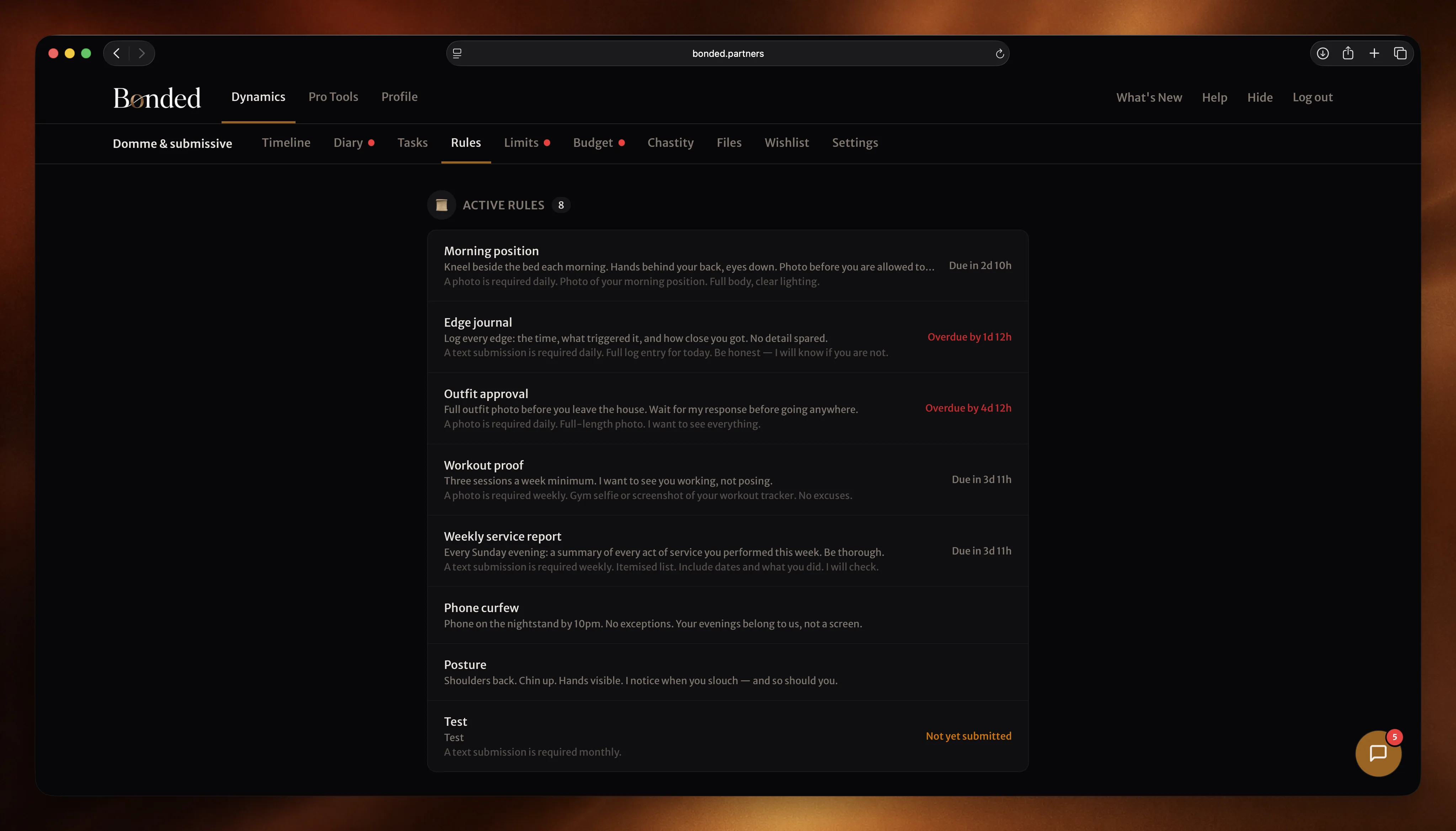
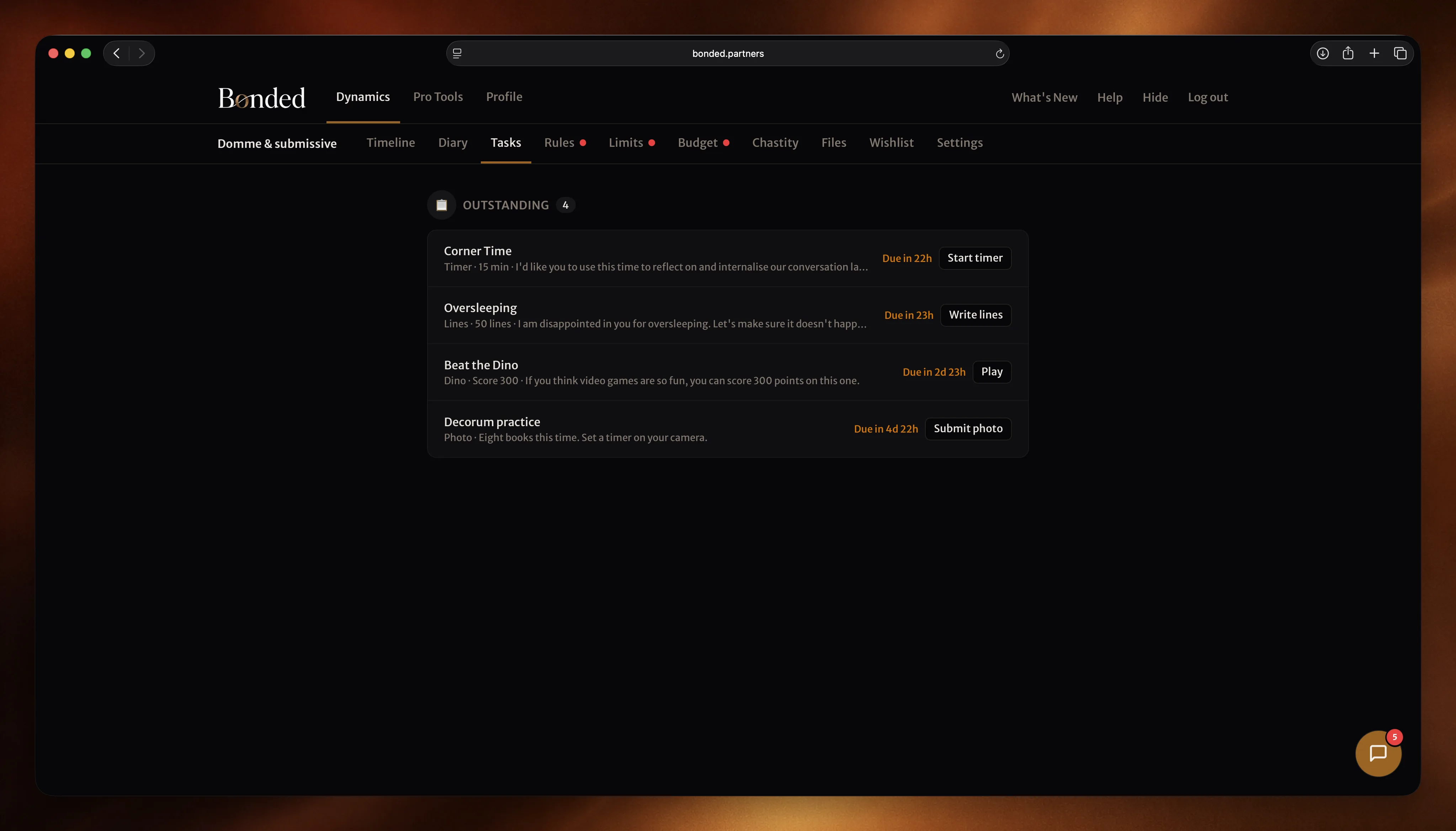
The generated contract also shows you how each clause connects to a feature inside Bonded, the platform built specifically for managing D/s dynamics. Rules, tasks, limits, diary, chastity tracking, budget control, chat, timeline. Everything your contract describes, Bonded makes real.
Built for exactly this.
Bonded is a platform for D/s relationships. Rules with evidence schedules. Tasks with deadlines and completion reports. A daily diary. Limits you both edit in real time. Chastity tracking. Budget oversight. Chat. A complete timeline of everything that's happened in your dynamic. Free to start, private by design, and built by people who live this.
See all features→Why a BDSM contract matters
A BDSM contract is a written agreement between partners in a power exchange relationship. It establishes roles, rules, boundaries, safewords, and expectations before play begins. It is not legally binding. It is something more important than that: a declaration of trust, negotiated between equals, that both people can refer back to when it matters.
The best BDSM contracts cover more than just what happens in a scene. They address daily structure, communication patterns, aftercare needs, financial arrangements if applicable, and how the agreement itself gets reviewed and updated over time. A contract that only covers the bedroom misses the point for most D/s dynamics.
Most couples write their contract in a Google Doc, if they write one at all. The document gets created in a rush of excitement, buried in a folder, and never looked at again. This builder walks you through every section with structured options, tick boxes, and pre-written clauses so you end up with something comprehensive that you actually want to revisit.
What goes in a BDSM contract?
A good Dom/sub contract covers eight areas. First, the parties: who is the Dominant, who is the submissive, and what kind of dynamic are you building? Bedroom only, part-time, lifestyle, or 24/7? The scope matters because it determines how much of daily life the contract governs.
Second, safety. Every BDSM contract needs safewords. A full stop word that ends all activity immediately, a slow-down word that pauses for a check-in, and ideally a non-verbal signal for situations where speech is restricted. The contract should state explicitly that using a safeword is never punishable.
Third, rules. Standing rules that the submissive agrees to follow for the duration of the agreement. These might cover behaviour, communication, appearance, daily routines, or protocols. The more specific the rules, the less room there is for misunderstanding.
Fourth, limits. Hard limits are activities that are completely off the table, no exceptions. Soft limits are activities that require explicit consent each time and should be approached with caution. Curiosities are things both partners are open to exploring. A proper BDSM contract lists all three categories.
Fifth, tasks and accountability. What types of tasks can the Dominant assign? Evidence submissions, written lines, timed endurance challenges? What counts as proof of completion? What happens when a task is not completed or not completed well enough?
Sixth, communication and aftercare. How often do you check in outside of scenes? Is there a diary or reflection requirement? What does aftercare look like, physically and emotionally, for both partners? Aftercare is not optional, and the contract should name specific needs rather than leaving it vague.
Seventh, additional control. Does the dynamic include financial oversight? Spending limits, receipt requirements, budget categories? Does it include chastity or orgasm control? These are the clauses that separate a casual arrangement from a structured power exchange.
Eighth, terms. How long does the contract last? How often is it reviewed? What are the conditions for ending it? A BDSM contract that cannot be ended freely is not a contract. It is coercion. The termination clause is arguably the most important one.
BDSM contract templates vs. a builder
You can find BDSM contract templates online. Most of them are generic PDFs with blank lines. They give you a structure but no guidance. You still have to figure out what to write in each section, and you will inevitably leave things out because a blank field does not prompt you to consider what you have not thought of yet.
This builder is different. Each section presents specific options to choose from. Common rules you can select with a tap. Activities categorised as hard limits, soft limits, or curiosities. Aftercare needs broken into physical and emotional. Financial and chastity terms with pre-written clauses you can opt into. The output is a formatted document with numbered clauses that reads like a real agreement, not a filled-in template.
The generated contract is yours. Nothing is stored on our servers. The agreement exists in your browser until you download it as a PDF.
From contract to living dynamic
A BDSM contract is a starting point. The real challenge is living it. Rules need to be tracked. Evidence needs to be collected. Limits need to be revisited as the relationship grows. The diary needs to be written. Aftercare needs to happen consistently, not just when someone remembers.
That is what Bonded is for. Every clause in the contract you build here maps to a feature in the platform. Your rules become trackable commitments with scheduled evidence. Your limits become a shared table you both update in real time. Your diary becomes a structured space for reflection with timestamps and feedback. Your agreement stops being a document and starts being a dynamic.
Bonded is free to start. If you are serious enough about your BDSM relationship to write a contract, you are serious enough to use a tool built specifically for this.
Frequently asked questions
Is a BDSM contract legally binding?
No. A BDSM contract is a personal agreement between consenting adults. It has no legal standing. Its value is in the negotiation process and the shared reference point it creates.
Do I need a contract for my dynamic?
You do not need one. But writing one forces a conversation about boundaries, expectations, and safety that many couples skip. The contract itself is less important than the process of building it together.
Can I change the contract after signing it?
Absolutely. A good BDSM contract includes a review schedule for exactly this reason. People change. Dynamics evolve. The contract should evolve with them.
What if my partner does not want a contract?
That is worth a conversation in itself. Reluctance to discuss boundaries and expectations is a signal worth paying attention to. A contract protects both people.
Is my data stored anywhere?
No. The agreement is generated entirely in your browser. Nothing is sent to our servers. When you download the PDF, that is the only copy.
The difference between a contract and a lifestyle? Bonded.
You know what you want. Now sign up for the tool that's uniquely designed to help you make it happen.
Not ready yet? Get D/s insights and product updates in your inbox.