



Compare
Bonded vs spreadsheets.
You've tried spreadsheets. Shared docs. Habit trackers built for morning routines, not power exchange. They work — until they don't.
Being honest
Where spreadsheets work.
Total customisation. You design the structure. Want a column for mood alongside your task list? Add it. No tool can match the flexibility of a blank spreadsheet with a creative user.
No dependency. You own the document. It doesn't depend on a third-party platform staying in business.
Zero cost. Google Sheets is free. Notion is free. If budget is a hard constraint, DIY costs nothing beyond time.
Simplicity for simple dynamics. If your dynamic involves three rules and a weekly check-in, a shared note might genuinely be all you need.
The breaking points
Where they fall apart.
Privacy. This is the big one. Your D/s spreadsheet sits in the same Google Drive as your work documents, shared photo albums, and tax returns. One accidental screen-share during a work call. One moment where someone borrows your laptop. The privacy risk is real and ongoing.
Google, Apple, and Microsoft can access the content of your documents. Their employees, their automated systems, their content moderation tools — your intimate data passes through infrastructure designed for business documents and shopping lists.
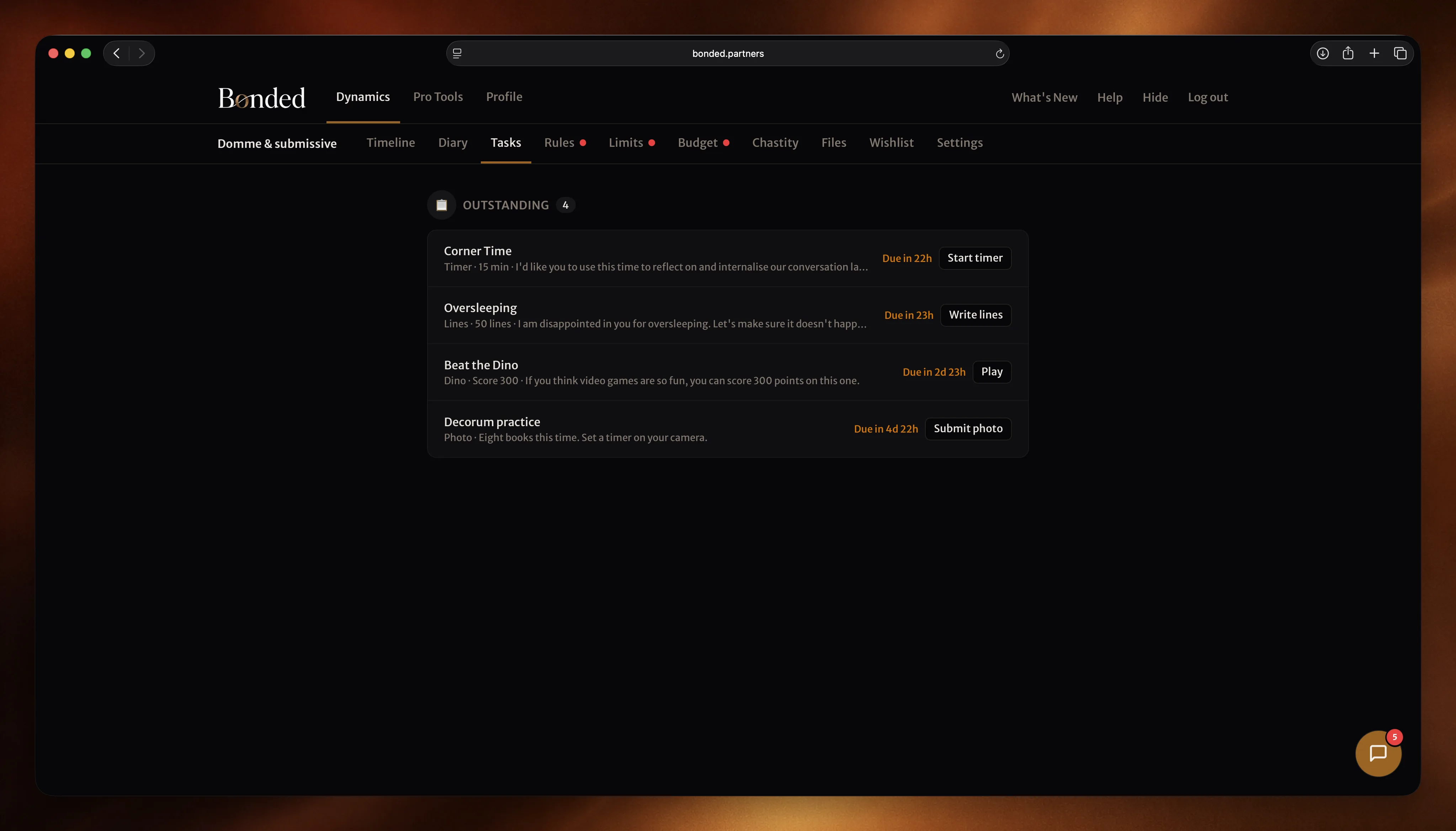
No accountability loop. A spreadsheet doesn't tell your Dom(me) when evidence has been submitted. It doesn't remind your sub that a rule is due. The entire accountability layer — the thing that makes tracking meaningful — is missing.
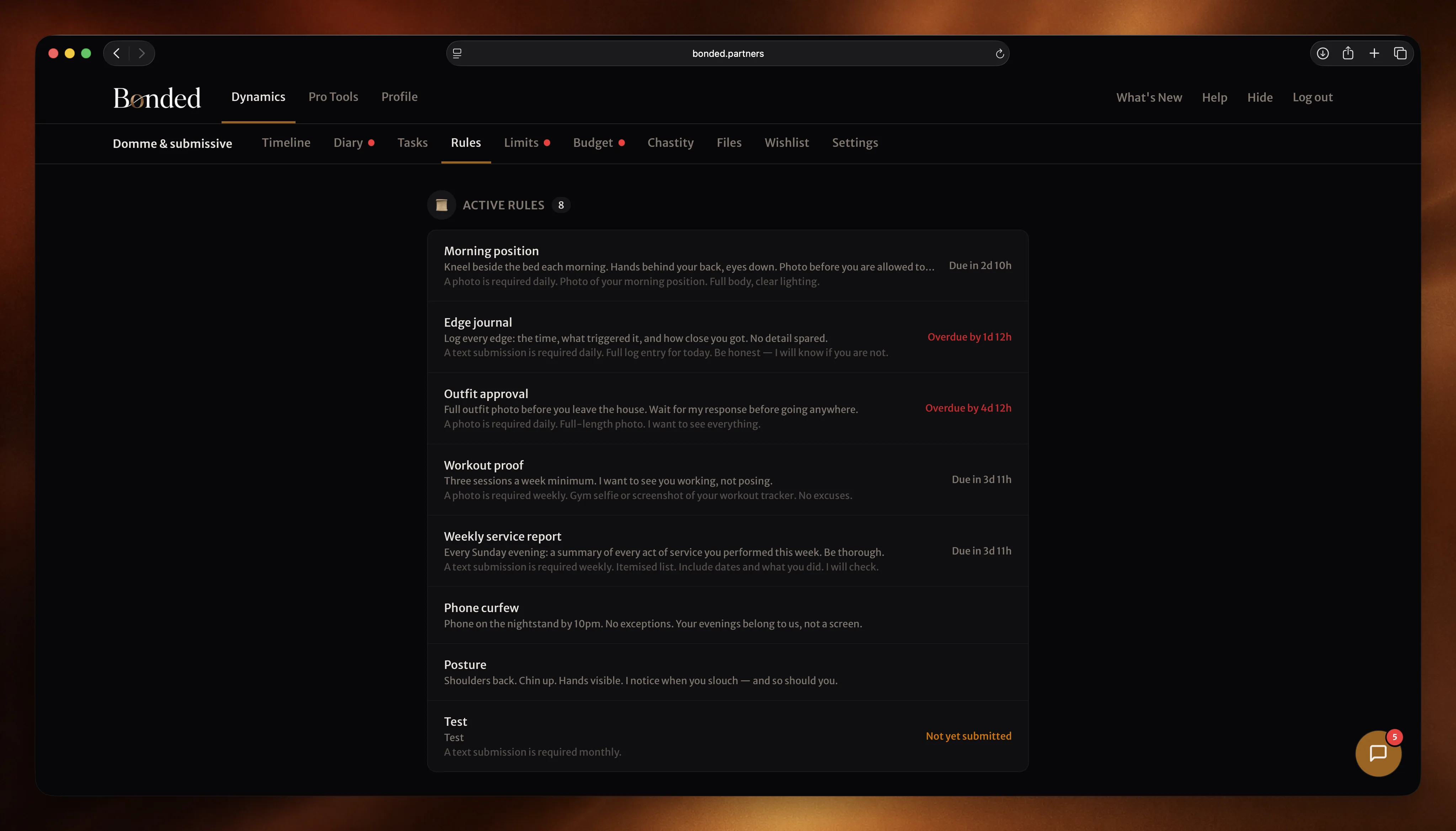
No evidence handling. Rules often require evidence — a photo, a video, an audio clip, a document, a timestamped record. Spreadsheets don't handle file uploads. You end up sending evidence through a separate channel and trying to correlate it. It works once. It doesn't work at scale.
Chastity is a nightmare. Try tracking live sessions in a spreadsheet. Manual timestamps for lock and unlock, manual duration calculations, no live countdown. You check your phone and see a number in a cell, not a ticking timer. The psychological experience is fundamentally different.
It becomes admin. At some point, maintaining the spreadsheet becomes a chore alongside the actual dynamic. Formatting columns, fixing formulas, updating the layout. The tool is supposed to serve the dynamic — but when it requires its own maintenance, you're serving the spreadsheet.
Side by side.
“Build it yourself” means you can, but it takes ongoing effort.
| Bonded | Spreadsheets | |
|---|---|---|
| Rules tracking | Build it yourself | |
| Photo / video evidence | — | |
| Lines tasks | — | |
| Timer tasks | — | |
| Diary with review | Build it yourself | |
| Limits negotiation | Build it yourself | |
| Chastity with live timer | — | |
| Chat | — | |
| Budget tracking | Build it yourself | |
| Push notifications | — | |
| Biometric lock | — | |
| Mobile app | Coming soon | — |
| Auto-deleting evidence | — | |
| Encrypted storage | — | |
| Free tier | ||
| Fully custom structure | — | |
| No platform dependency | — |
“At some point I realised I was spending Sunday evenings reformatting our tracking spreadsheet instead of actually being in the dynamic. That's when I knew something had to change.”
The honest answer.
Stick with spreadsheets if
- Your dynamic is simple — a few rules, occasional tasks
- You have unique tracking needs no app covers
- Budget is a hard constraint
- You've managed the privacy risks
Move to Bonded if
- You don't want D/s data in your regular apps
- Your dynamic involves evidence, chastity, or limits
- You want notifications, not manual checking
- You're tired of maintaining the tool
There's no shame in spreadsheets. Many strong dynamics run on them. But if the spreadsheet is creating work instead of reducing it — or the privacy risk keeps nagging — a purpose-built tool might be the next step.
Retire the spreadsheet.
Free to start. Everything in one place.
Not ready yet? Get D/s insights and product updates in your inbox.