



What punishment means in D/s
Punishment in a D/s dynamic is a pre-negotiated response to a submissive not meeting an agreed expectation. That sentence contains three critical qualifiers: pre-negotiated, agreed, and expectation. Remove any one of them and you are no longer describing punishment within a power exchange framework. You are describing something else entirely.
This is worth stating plainly because the word "punishment" carries weight outside of kink. In vanilla contexts, punishment implies wrongdoing, moral failure, retribution. In D/s, it means none of those things. Punishment is a structural tool. It exists to maintain the framework that both people have chosen to operate within. When a submissive fails to complete a task, breaks a rule, or does not meet a standard, punishment is the mechanism that says: this matters. The structure is real. The expectations are real. And there are consequences for not meeting them.
That said, punishment is not a requirement of D/s. Plenty of dynamics operate without formal punishment structures. Some Dom(me)s prefer to address infractions through conversation. Some submissives respond better to positive reinforcement than corrective measures. There is no universal rule that says a dynamic must include punishment to be valid. What matters is that whatever system you use is explicit, negotiated, and understood by both people.
Punishment is also not anger. This is the most important distinction in this entire guide. A Dom(me) who punishes out of frustration, irritation, or emotional reactivity is not exercising authority. They are losing control of themselves while claiming control over someone else. Punishment administered in anger is not D/s. It is not structure. It is harmful, and the submissive should treat it as a serious concern.
Effective punishment is calm. It is proportionate. It is connected to a specific, known expectation. And when it is over, it is over. The infraction is addressed, the consequence is served, and the dynamic returns to its baseline. Punishment that lingers, that is brought up repeatedly, or that changes the Dom(me)'s emotional disposition toward the submissive is not correction. It is resentment wearing a costume.
Corrective punishments vs funishments
Not all punishments serve the same purpose, and the community draws a useful distinction between corrective punishments and funishments.
Corrective punishment
A corrective punishment is one that the submissive does not enjoy. That is the point. It is meant to be unpleasant enough to reinforce that the behaviour or omission it addresses should not be repeated. Writing lines, corner time, loss of a privilege, early bedtime, essay writing. The discomfort is mild and contained, but it is real. The submissive does not look forward to it, and that is what gives it its corrective function.
Corrective punishments work when the submissive genuinely wants to meet the expectations of the dynamic and experiences the punishment as meaningful feedback. They do not work when the submissive is indifferent to the consequence, or when the punishment is so disproportionate that it creates fear rather than motivation.
The best corrective punishments are also connected to the infraction in some way. A submissive who forgot to send a morning check-in might be required to write a reflection on why the check-in matters to the dynamic. A submissive who was disrespectful in tone might lose speaking privileges for a defined period. The connection between the behaviour and the consequence makes the punishment feel purposeful rather than arbitrary.
Funishment
A funishment is a punishment that both people know the submissive secretly (or not so secretly) enjoys. Impact play as a "consequence" for a submissive who loves being spanked. Being made to kneel for an extended period when kneeling is something the submissive finds deeply fulfilling. Being "forced" to wear something specific when the submissive actually loves the item.
Funishments are not corrective. They are not meant to change behaviour. They are a form of play that uses the punishment framework as a container for activities both people enjoy. There is nothing wrong with funishments. They are fun, they reinforce the power dynamic, and they give both people permission to engage in activities they want to engage in through the lens of authority and consequence.
The issue arises when funishments are the only tool in the dynamic and a genuine corrective need goes unmet. If the submissive is consistently missing expectations and the only response is something they enjoy, the accountability structure breaks down. The submissive learns, consciously or not, that there are no real consequences. Some dynamics are fine with this. Others need both tools.
It also arises when the submissive deliberately misbehaves to earn a funishment. This is called "topping from the bottom" when it becomes a pattern, and it can erode the Dom(me)'s authority if it goes unaddressed. Some Dom(me)s handle this by separating funishments from the punishment system entirely: the enjoyable activities happen on the Dom(me)'s schedule, not as a result of the submissive's behaviour. Misbehaviour gets a genuinely corrective response.
Both types have their place. The important thing is that both people understand which is which, and that the system as a whole actually functions to maintain the structure both people signed up for.
Proportionality and consistency
Proportionality is the principle that the severity of the punishment should match the severity of the infraction. It sounds obvious. In practice, it is one of the hardest things to get right.
A submissive who forgets to send a good-morning text should not receive the same consequence as a submissive who violates a hard boundary of the dynamic. If they do, the punishment system loses its meaning. When everything is treated with the same weight, nothing has weight. The submissive cannot calibrate their behaviour because the signals are indistinguishable.
This is where having a clear tiered system helps. Some dynamics categorise infractions into levels. Minor infractions (forgetting a daily task, being slightly late with a check-in) receive lighter consequences. Moderate infractions (repeated minor infractions, attitude issues, failure to complete assigned tasks) receive stronger consequences. Serious infractions (lying, violating negotiated boundaries, deliberately hiding behaviour) receive the heaviest consequences and typically also require a direct conversation.
You do not need to formalise this into a spreadsheet, though some people do. What matters is that both people have a shared understanding of what constitutes a minor issue versus a serious one, and that the consequences reflect that understanding.
Consistency is the other half of the equation. If a rule is punished on Monday but ignored on Wednesday, the submissive receives a confusing message about whether the rule matters. Inconsistency from the Dom(me) is one of the fastest ways to undermine a punishment system. The submissive begins to feel that compliance is arbitrary, that the rules depend on the Dom(me)'s mood, and that the structure is not real.
This places a responsibility on the Dom(me) to only establish rules and expectations they are willing to consistently enforce. Ten rules that are always tracked and always addressed are more effective than fifty rules that are sporadically noticed. If the Dom(me) sets an expectation, they need to be prepared to follow through. Every time. This is part of the work of holding authority.
Consistency does not mean rigidity. Context matters. A submissive dealing with a family emergency who misses a task should be met with understanding, not with a punishment applied mechanically because the system says so. Consistency means the submissive knows that, under normal circumstances, expectations are real and consequences follow. It does not mean the Dom(me) becomes an unthinking machine.
The balance between proportionality and consistency is where the art of being a Dom(me) lives. Rules provide structure. Judgement provides wisdom. Both are needed.
Common punishment types
What follows is not an exhaustive list, and no single type works for every dynamic. The right punishments are ones that both people have discussed, that the submissive understands, and that the Dom(me) can administer consistently without it becoming a burden on the dynamic.
Lines
Writing lines is one of the most common corrective punishments in D/s dynamics, and for good reason. It is simple, scalable, and effective. The submissive writes a sentence a set number of times. "I will complete my morning check-in before 9am." The repetition forces focus on the specific expectation that was missed. It is tedious by design. It takes time. It cannot be rushed.
Lines scale naturally with severity. Fifty lines for a minor lapse. Two hundred for something more significant. Five hundred for a serious infraction. The Dom(me) can also adjust the sentence to make it more reflective: "I will remember that my morning check-in matters because it starts our day with connection." Longer sentences take more time per line, which increases the weight of the punishment without increasing the count.
Lines are particularly effective in long-distance dynamics where physical punishments are not an option. They can be assigned and completed asynchronously, with evidence submitted when done.
How Bonded handles this
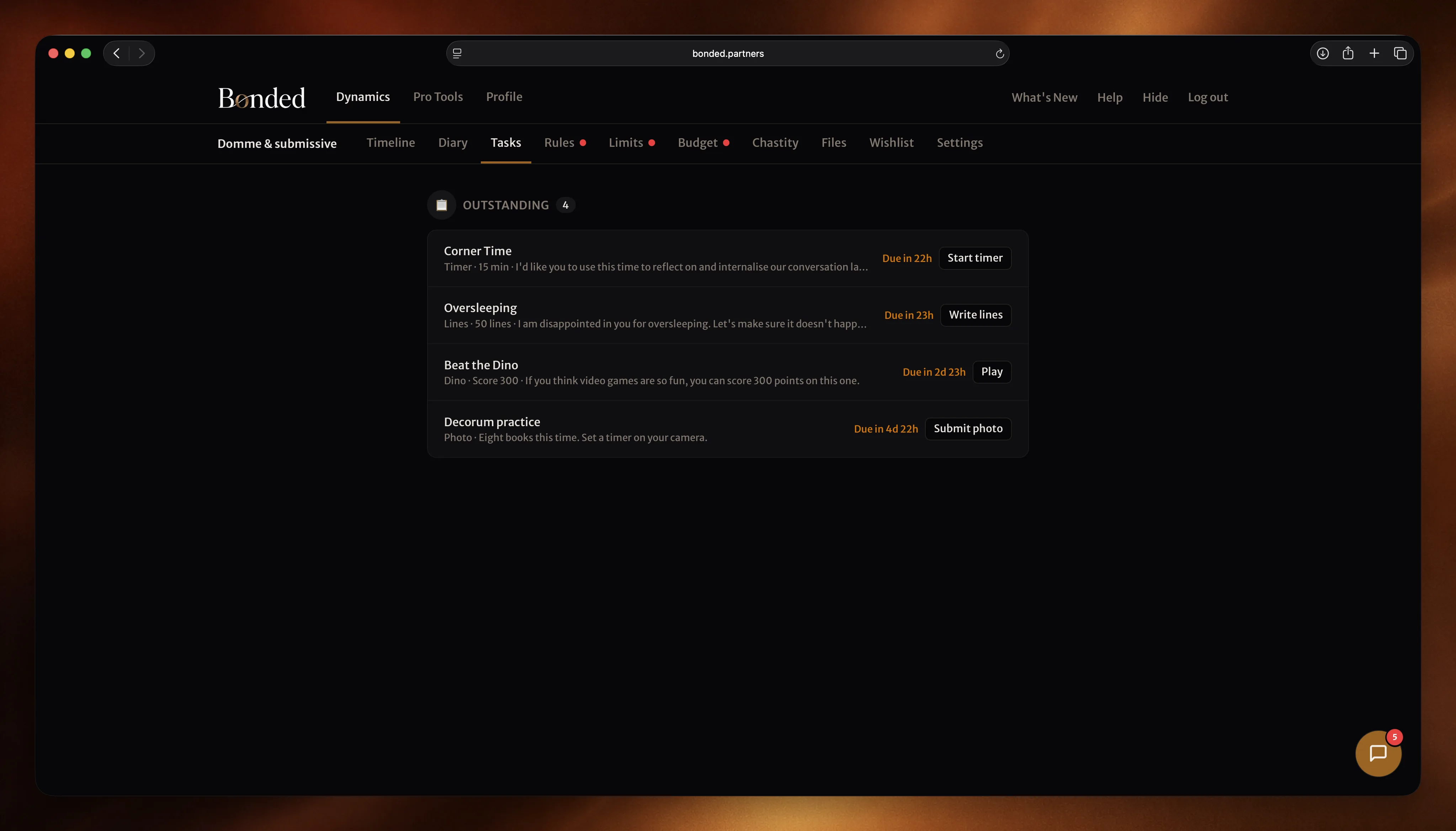
Lines in Bonded are typed character by character. No copy-pasting. No shortcuts. The submissive types each line exactly as written, and the system verifies accuracy in real time. Lines can be assigned as standalone tasks or attached to rules as automatic consequences. The Dom(me) sets the sentence and the count. The submissive sees their progress.
Corner time
Standing or kneeling in a designated spot for a set period of time with nothing to do. No phone. No music. No distraction. Corner time forces stillness and reflection. It is uncomfortable not because of physical pain but because of enforced boredom and the psychological weight of standing in consequence.
Corner time works well for in-person dynamics and can be adapted for remote dynamics with video check-ins or timed photo evidence. The duration should be reasonable. Five to thirty minutes depending on the infraction and the submissive's physical capacity. Kneeling for extended periods on hard surfaces can cause genuine physical harm, so surface, position, and duration all need consideration.
Essay writing
Requiring the submissive to write a reflective essay on the infraction, the rule it relates to, why the rule exists, and what they will do differently. This is a heavier version of lines that demands genuine engagement with the issue rather than mechanical repetition.
Essays work well for more serious infractions or for patterns of behaviour that need deeper examination. They also give the Dom(me) insight into the submissive's thought process. A submissive who writes thoughtfully about why they keep missing a particular rule may surface information that helps the Dom(me) adjust the structure, not just the consequence.
The assignment should be specific. "Write 500 words about why you did not complete the task" is clearer than "write about what happened." Specify the length, the topic, and the deadline.
Orgasm denial
Restricting or denying orgasm for a defined period as a consequence. This is common in dynamics that already incorporate orgasm control and functions as a meaningful consequence because it directly affects something the submissive values. It also serves as an ongoing reminder of the infraction, since the restriction persists over time rather than being a single event.
Orgasm denial as punishment only works in dynamics where orgasm control is already part of the negotiated framework. Introducing it suddenly as a punitive measure without prior negotiation is not appropriate. The duration should be defined upfront. "No orgasm until Friday" is clear. "No orgasm until I say so" can create open-ended anxiety if there is no established pattern of how long such restrictions typically last.
Service tasks
Assigning additional service tasks as a consequence. Cleaning, organising, preparing something for the Dom(me), or completing a task that requires effort and attention. Service tasks as punishment carry the dual function of addressing the infraction and producing something useful, which can feel more purposeful than purely symbolic consequences.
The task should be proportionate and time-bounded. "Deep clean the bathroom by 6pm" is a clear, contained consequence. "Do all the housework this week" can feel punitive in a way that breeds resentment rather than correction.
Removal of privileges
Taking away something the submissive values within the dynamic. Screen time restrictions. Loss of a particular title or honourific for a defined period. Being excluded from a planned activity. Losing the privilege of choosing what to wear. The specific privilege depends entirely on what matters to the submissive in your dynamic.
Privilege removal is effective because it connects the consequence to the structure of the dynamic itself. The submissive is reminded, through the absence of something they value, that the structure has expectations and that meeting those expectations is what grants the privileges they enjoy.
Two cautions. First, never remove aftercare as a punishment. Aftercare is a safety practice, not a privilege. Withdrawing it is harmful regardless of the infraction. Second, be careful about removing forms of connection (communication, pet names, emotional availability) as punishment. These overlap with emotional abuse tactics and can cause genuine distress even within a negotiated framework. If you use this category, keep it to tangible privileges rather than relational ones.
Early bedtime
Requiring the submissive to go to bed earlier than usual. This is simple, mildly unpleasant for most adults, and carries an infantilising quality that reinforces the power differential for dynamics that lean into that aspect. It also has the practical side effect of ensuring the submissive gets more sleep, which rarely hurts.
Physical punishments
Impact play (spanking, paddling, cropping) used as punishment rather than as play. This overlaps with funishment territory for many submissives, which is worth being honest about. If your submissive genuinely enjoys impact, it may not function as corrective punishment regardless of the intent.
When physical punishment is used correctively, it should follow all the same safety protocols as impact play in any other context. Safe areas of the body only. Warm-up where appropriate. Awareness of the submissive's physical state. Aftercare afterward. The fact that it is framed as punishment does not change the body's need for safe practice.
Physical punishment should never be administered when the Dom(me) is angry. This is not a guideline. It is a hard rule. An angry person with implements is a dangerous person, regardless of the framework they are operating within.
Setting expectations first
Punishment only makes sense when expectations are clear. This is a fundamental principle, and ignoring it is the source of most punishment-related conflict in D/s dynamics.
A submissive cannot be meaningfully punished for breaking a rule they did not know existed. They cannot be held accountable for standards that were never articulated. "You should have known" is not a valid basis for punishment. If the expectation was not explicitly communicated, the failure belongs to the system, not the submissive.
This means that before any punishment framework can function, the rules and expectations it enforces must be established. In writing, ideally. Not because D/s is a legal proceeding, but because memory is unreliable and "I thought you said..." conversations erode trust on both sides.
Clear expectations include several components:
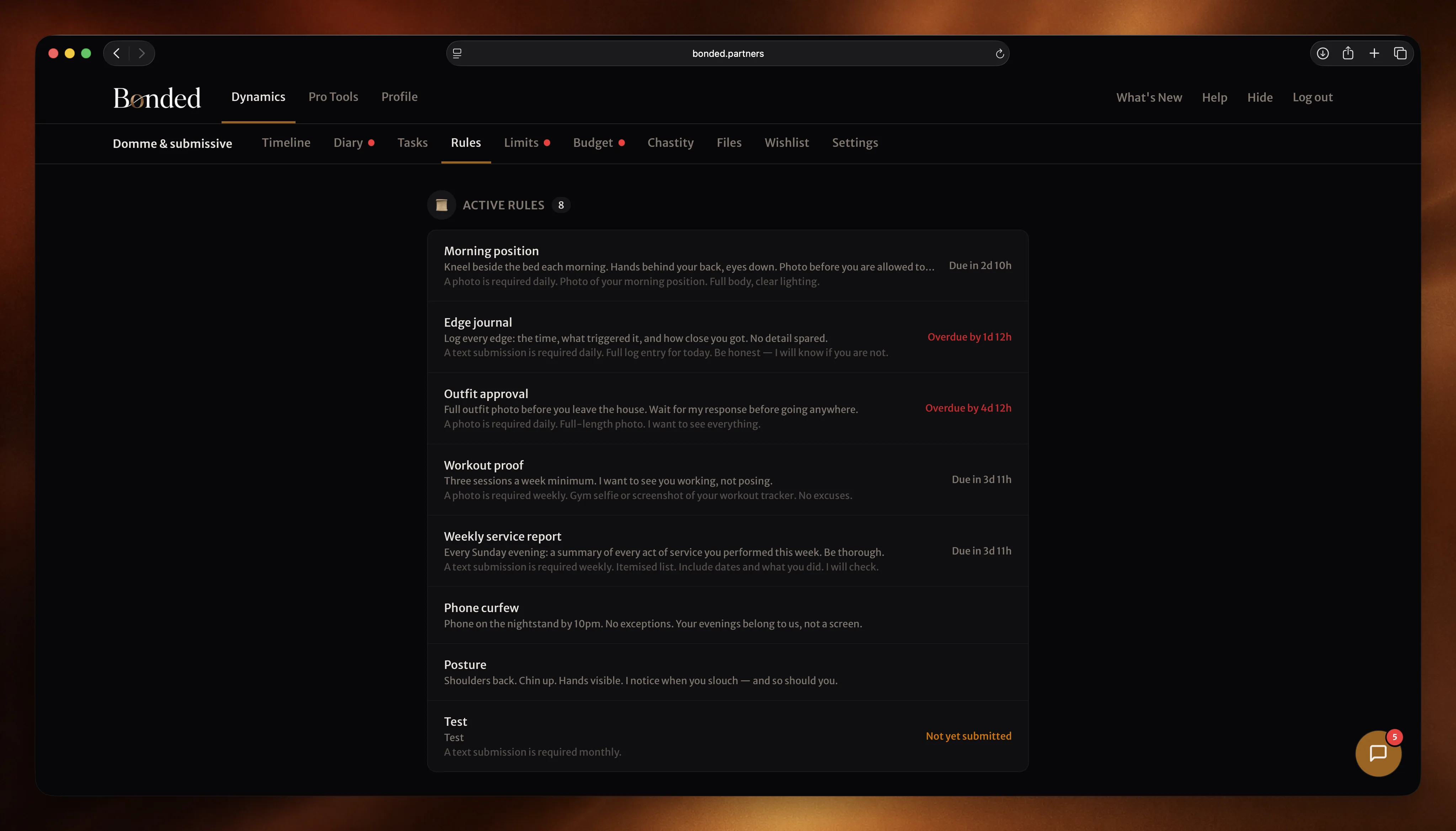
- The rule itself. What the submissive is expected to do or not do, stated specifically. "Be respectful" is too vague. "Address me as Sir/Ma'am in text messages" is specific.
- When it applies. Always? Only during scenes? Only on certain days? A rule without temporal scope creates confusion.
- What counts as compliance. How does the submissive demonstrate they have met the expectation? Photo evidence? A check-in message? Completion of a task by a specific time?
- What happens if it is not met. The potential consequences, or at least the category of consequence. The submissive does not need to know the exact punishment for every possible infraction, but they should know that consequences exist and have a general sense of the range.
- Exceptions and grace. Under what circumstances is a missed expectation understood rather than punished? Illness, emergencies, explicitly communicated bad days. Defining the exceptions prevents the system from feeling mechanical and inhumane.
Rules should also be introduced gradually. A Dom(me) who sets thirty rules on day one has created a system that is almost certain to fail. Start with a few. Let the submissive integrate them. Add more as the dynamic develops and both people understand what is working. Building structure incrementally means each rule receives the attention it deserves, from both people.
For a deeper look at building a rule framework, see the rules and tasks guide.
How Bonded handles this
Every rule in Bonded has a clear description, schedule, and evidence type. The submissive sees exactly what is expected and when. Rules live in a shared space so there is no ambiguity about what was agreed. When a rule is missed, both people see it on the timeline.
Tracking and accountability
A punishment system without tracking is a punishment system that runs on memory and goodwill. Both of those are unreliable over time.
Tracking serves several functions. It creates an objective record of what was expected, what was delivered, and what consequences were applied. It removes the "he said, she said" dynamic that can poison discussions about compliance. It also provides data that helps both people evaluate whether the system is working. If the same rule is being broken every week despite consistent punishment, the problem might not be the submissive's discipline. The problem might be the rule.
Tracking also keeps the Dom(me) honest. When punishments are recorded, patterns become visible. Is the Dom(me) punishing consistently, or only when they are in a certain mood? Are the consequences proportionate across similar infractions, or do they vary based on the Dom(me)'s emotional state? A record makes these patterns obvious in ways that memory alone cannot.
For the submissive, tracking provides a sense of fairness. Knowing that the history is visible to both people, that the record is shared rather than one-sided, reinforces the sense that the system is structural rather than arbitrary. It also provides tangible evidence of growth. Looking back over weeks or months and seeing fewer infractions is motivating in a way that abstract encouragement is not.
What to track:
- Which rule or expectation was not met
- When it happened
- What consequence was assigned
- Whether the consequence was completed
- Any notes or context (was there a mitigating circumstance?)
This does not need to be clinical. Some dynamics keep a simple log. Others use the natural flow of their communication to create this record. What matters is that the information exists and is accessible to both people.
How Bonded handles this
The timeline captures everything: tasks assigned, evidence submitted, rules broken, consequences completed. Both people see the same history. The diary adds a reflective layer where the submissive can write about their experience of the punishment and the Dom(me) can add private notes. Over time, the record tells a story that memory alone cannot.
Emotional safety and aftercare post-punishment
Punishment creates emotional states that need tending. Even mild, proportionate, entirely fair punishment can leave a submissive feeling vulnerable, ashamed, or emotionally raw. This is normal. It is also something the Dom(me) is responsible for addressing.
Aftercare following punishment is not optional. It is the mechanism by which the dynamic returns to safety after a corrective event. Without it, the submissive is left to process the emotional experience alone, and the conclusions they reach in that isolation may not be healthy ones.
Post-punishment aftercare typically includes several elements:
- Closure. Explicit confirmation that the punishment is complete and the matter is resolved. "That's done. You've served your consequence. We're good." The submissive needs to hear that the infraction is behind them and will not be held over their head.
- Reconnection. Physical or emotional reconnection that reaffirms the relationship beneath the power exchange. Holding, words of affirmation, presence. The message is: I corrected you, and I still care about you. Both things are true at the same time.
- Space for processing. Asking the submissive how they are feeling. Listening without defensiveness. Being willing to hear that the punishment was harder than expected, or that it triggered something unexpected. Not every punishment needs a long debrief, but the door should always be open.
- Check-ins later. Drop after punishment is real. Checking in hours later, or the next day, ensures that delayed emotional responses are caught and addressed rather than left to fester.
For a comprehensive treatment of aftercare practices, see the aftercare guide.
A common mistake is treating aftercare as contradictory to punishment. "If I comfort them afterwards, doesn't that undermine the consequence?" No. Punishment and care are not opposites within a D/s dynamic. The Dom(me) holds both authority and responsibility. Enforcing a consequence and then tending to the person who received it is not inconsistency. It is the full expression of the role.
Submissives also need to understand that wanting aftercare after punishment does not mean the punishment was too harsh or that they are being "weak." Needing reassurance after a corrective experience is a healthy human response. The dynamic should honour that, not penalise it.
Dom(me)s may also need to process the experience of administering punishment. Domdrop after punishment is common, particularly after heavier consequences. The Dom(me) may feel guilt, doubt, or emotional fatigue. Having their own aftercare practices, or being able to discuss their experience with the submissive or a trusted peer, matters.
When punishment crosses a line
D/s operates within a framework of consent, negotiation, and care. Punishment that steps outside that framework is abuse, regardless of the label either person puts on it. Recognising the difference is essential for both roles.
The following are red flags. They are not grey areas.
- Punishment administered in anger. A Dom(me) who punishes while angry has lost the control that the role requires. Anger escalates severity, clouds judgement, and turns consequence into retaliation. If the Dom(me) is upset, the appropriate response is to pause, regulate, and address the situation when calm.
- Punishment for using a safeword. A safeword is inviolable. It sits above the dynamic, above any rule, above any protocol. A submissive who is punished for safewording will learn not to safeword. That is dangerous. Full stop.
- Punishment for setting or adjusting limits. Limits are the foundation of consent in power exchange. A submissive has the right to set, adjust, or expand their limits at any time without consequence. Punishing this undermines the consent framework that makes D/s possible. For more on this, see the limits and negotiation guide.
- Disproportionate consequences. Punishments that are wildly out of proportion to the infraction. Using a minor slip as justification for an extreme consequence is not discipline. It is control through fear.
- Punishment for things outside the dynamic. The dynamic governs what it governs. Punishing a submissive for their job performance, their friendships, their family relationships, or any area of life not explicitly within the negotiated scope of the dynamic is overreach.
- Punishment that isolates. Restricting the submissive's access to friends, family, support systems, or outside communication as a punishment is an abuse tactic, not a D/s practice.
- Withholding aftercare as punishment. Aftercare is a safety practice. It is not a privilege to be earned or a reward to be withheld. A Dom(me) who refuses aftercare as a consequence is endangering the submissive's wellbeing.
- Punishment that does not end. Every punishment must have a defined endpoint. Open-ended punishment, or bringing up past infractions that were supposedly already addressed, creates an environment of perpetual anxiety rather than growth.
- Humiliation beyond negotiated terms. If humiliation is part of the dynamic, it should be negotiated like any other activity. Punishment that deliberately humiliates the submissive in ways they have not consented to, particularly in front of others or in non-kink contexts, crosses the line.
If you recognise these patterns in your dynamic, they warrant a direct, out-of-dynamic conversation. Not a discussion within the power exchange framework. A conversation between equals about whether the dynamic is safe. If that conversation cannot happen, or if it is met with dismissal, that tells you something important.
Punishment and consent
Consent in D/s is not a one-time event. It is ongoing, revisable, and revocable. This applies to punishment just as it applies to every other aspect of the dynamic.
When a submissive consents to a punishment framework, they are consenting to the general structure: that there will be rules, that infractions will have consequences, and that the Dom(me) has authority to determine and administer those consequences within agreed parameters. They are not consenting to any specific punishment for all time, sight unseen.
This means several things in practice:
- Safewords still apply during punishment. A submissive who safewords during a punishment is communicating that something has exceeded what they can handle. The punishment stops. Period. The Dom(me) and submissive then discuss what happened and, if appropriate, determine an alternative consequence. The safeword itself is never punished.
- New types of punishment require negotiation. If the Dom(me) wants to introduce a punishment type that has not been discussed, it should be negotiated outside of the moment. Springing an unexpected consequence during a punishment event is not creative. It is a consent violation.
- The submissive can request renegotiation. If a punishment type is not working, if it triggers something unexpected, or if the submissive has realised it crosses a limit they did not previously recognise, they can raise this for renegotiation. The ability to renegotiate is itself non-negotiable.
- Consent can be withdrawn from the punishment framework. A submissive who no longer consents to the punishment system has the right to say so. This may mean renegotiating the dynamic, restructuring it, or ending it. What it does not mean is that the submissive is "failing" or "not really submissive." Consent is an ongoing choice, and choosing to withdraw it is valid.
Consent also means that the submissive understands the punishment framework before agreeing to it. A Dom(me) who springs a punishment system on a submissive who did not know punishment was part of the dynamic is not exercising authority. They are acting unilaterally on something that requires mutual agreement.
The strongest punishment systems are ones where the submissive not only consents to the framework but actively values it. When the submissive sees punishment as a mechanism that helps them meet the standards they want to meet, the system works with the dynamic rather than against it. That buy-in comes from transparent negotiation, proportionate consequences, consistent application, and thorough aftercare. It cannot be demanded. It is earned by the quality of the system itself.
Tools for implementing punishment
Punishment is a human practice. No tool replaces the Dom(me)'s judgement, the submissive's effort, or the conversation that follows a corrective event. But tools can support the practice in ways that make it more consistent, more fair, and more transparent.
A good tool does several things. It makes rules visible to both people, so expectations are never ambiguous. It tracks compliance, so the Dom(me) does not have to rely on memory alone to know whether a rule was met. It provides a mechanism for assigning and verifying consequences, so the punishment is documented and contained. And it keeps a history, so both people can look back and see whether the system is actually working.
For line-writing specifically, a tool that enforces character-by-character typing prevents shortcuts and ensures the submissive engages with each line fully. This is not about distrust. It is about preserving the corrective function of the exercise. Lines that can be copy-pasted are not lines. They are a formality.
Task assignment with evidence requirements turns punishment into a verifiable process. The Dom(me) assigns. The submissive completes and submits proof. The Dom(me) reviews. The cycle is closed. Both people know where things stand at every point.
A diary or reflection space gives the submissive a structured outlet for processing the emotional experience of punishment. Writing about how a consequence felt, what it made them think about, and what they want to do differently is itself a form of corrective engagement. For the Dom(me), reading those reflections provides insight that a simple "it's done" does not.
The timeline ties it all together. When rules, infractions, consequences, completions, and reflections all live in one chronological record, the dynamic has a history that both people share. Patterns emerge. Growth becomes visible. And the punishment system is accountable not just to the Dom(me)'s judgement, but to the record both people can see.