



What aftercare is
Aftercare is the practice of tending to each other after BDSM activities — scenes, intense power exchange, emotional experiences, or anything that takes people into heightened physical or psychological states. It is the deliberate process of returning to baseline: physically, emotionally, and relationally.
In its most familiar form, aftercare happens immediately after a scene. Blankets, water, physical closeness, quiet conversation. But aftercare is broader than that. It includes the check-in the next morning. The text the day after. The conversation a week later when something surfaces that was not apparent in the moment. Aftercare is not a single action — it is a practice that extends as long as it needs to.
Aftercare is also not exclusively post-scene. In an ongoing D/s dynamic, everyday power exchange creates emotional responses that benefit from tending. A difficult task, a missed rule, a punishment, an intense conversation about limits — all of these can create states that need aftercare even though no scene took place.
The form aftercare takes varies by person, by activity, and by day. What matters is that it is deliberate, that both people participate, and that neither person is left to process alone unless they explicitly choose to.
Why it matters
The neurochemistry
BDSM activities — especially intense ones — trigger significant neurochemical responses. Endorphins, adrenaline, dopamine, and oxytocin all surge during scenes. This is partly why the experience feels so powerful. But what goes up comes down.
As these chemicals return to baseline levels — sometimes hours later, sometimes days — the body and mind go through a withdrawal process. This is not metaphorical. The crash is real, and it can manifest as sadness, irritability, anxiety, fatigue, emotional numbness, or a feeling of being unmoored. This is commonly called "drop."
Drop
Drop is the emotional and physical come-down after a heightened experience. "Subdrop" is the most widely discussed form — a submissive experiencing emotional low, physical exhaustion, or psychological vulnerability hours or days after a scene. But drop affects Dom(me)s too (more on that below).
Drop is not a sign that something went wrong. It is a natural consequence of intense experience. But it can be distressing, particularly if the person experiencing it does not understand what is happening or does not have support. Aftercare is the primary mechanism for mitigating drop — and for addressing it when it occurs.
The timing of drop varies. Some people experience it immediately. Some experience it 24 to 72 hours later. Some experience it only after specific activities. Learning your own patterns — and your partner's — is part of becoming a responsible practitioner.
Relational safety
Beyond the neurochemistry, aftercare serves a relational function. It reaffirms that the people in the dynamic care about each other outside of the power exchange. After a scene where the Dom(me) exercised authority — perhaps sternly, perhaps intensely — aftercare signals: "That was the dynamic. This is us." It bridges the gap between the roles and the humans inhabiting them.
Without aftercare, a submissive can internalise the scene in harmful ways. Were they valued, or merely used? Was the Dom(me)'s intensity an expression of care, or of something else? Aftercare answers these questions — not with words necessarily, but with presence, tenderness, and attention.
Physical aftercare
Physical aftercare addresses the body. After intense activity, the body needs tending — and providing that tending is one of the most tangible ways to demonstrate care.
Hydration and food. Scenes can be physically demanding. Blood sugar drops. Dehydration occurs. Having water, juice, or a light snack available immediately after a scene is basic but essential. Some people keep an aftercare kit prepared: water, chocolate, fruit, electrolytes.
Temperature regulation. The body's temperature regulation can be disrupted after intense activity. Blankets, warm clothing, or a heated room address the physical discomfort that can compound emotional vulnerability. Shivering is not uncommon after scenes — even in warm environments — and it is a physical stress response, not just about temperature.
Wound care. After activities involving impact, abrasion, or any form of physical marking, attend to the body first. Clean and treat any marks. Apply arnica or appropriate topicals. Check for anything unexpected. This is not just medical prudence — it is an act of care that communicates: I caused this, and I am tending to it.
Physical closeness. For many people, being held after a scene is the most important form of physical aftercare. Skin contact, weight, presence. The body registers safety through physical proximity. Not everyone wants this — some people prefer space, and that preference should be respected — but for those who do, it is often the thing they need most.
Rest. Intense scenes are exhausting. Allowing time to rest — without rushing to the next activity or back to daily life — gives the body time to begin recovery. This might mean lying together for thirty minutes, or it might mean the rest of the evening is deliberately low-key.
Emotional aftercare
Emotional aftercare addresses the inner experience — the feelings, thoughts, and psychological states that intense activity produces. It is often more important than physical aftercare, and harder to get right because it requires attentiveness rather than a checklist.
Verbal reassurance. After a scene — especially one involving degradation, discipline, or emotional intensity — the submissive may need to hear that they are valued, cared for, and respected. "You did so well." "I'm proud of you." "You are safe." These are not platitudes. They are recalibrations — helping the submissive's emotional state catch up with reality after an experience that may have involved deliberately induced vulnerability.
Active listening. Sometimes the best emotional aftercare is simply being present while the other person processes. Not fixing, not explaining, not defending — just listening. The submissive might need to talk about how something felt. The Dom(me) might need to process the weight of what they did. Holding space for that processing is aftercare.
Normalising reactions. Crying after a scene is not a sign of damage. Laughing is not a sign of dismissal. Silence is not a sign of withdrawal. Emotional responses to intense experience are varied and unpredictable. Normalising whatever emerges — without judgment — creates safety for genuine processing rather than performed composure.
Delayed processing. Not everything surfaces immediately. A submissive might feel fine after a scene and experience a wave of vulnerability two days later. A Dom(me) might not process the emotional weight of something they did until the adrenaline fully fades. Emotional aftercare needs to extend beyond the immediate post-scene window. Check in the next day. And the day after that. Create space for things to surface on their own schedule.
Self-aftercare
Not everyone has access to a partner for aftercare at all times. Long-distance dynamics, solo practice, situations where a partner is unavailable — these all require the ability to tend to yourself. Self-aftercare is not a lesser version of partnered aftercare. It is a skill that every practitioner should develop.
Physical self-care. The basics: hydrate, eat something, regulate your temperature, rest. Have these things prepared in advance — a water bottle by the bed, a snack within reach, a blanket nearby. Making decisions when you are in a post-scene state is harder than it should be, so set up your environment before you need it.
Grounding techniques. When drop hits and you are alone, grounding can help. The 5-4-3-2-1 technique (five things you see, four you hear, three you touch, two you smell, one you taste) brings you back to the present moment. Holding something with texture or weight — a heavy blanket, a smooth stone — activates the senses in ways that counter dissociation.
Journaling. Writing about the experience — what happened, how it felt, what you need — serves a processing function that is similar to talking to a partner. It externalises the internal, making it easier to observe rather than be overwhelmed by. Reflections do not need to be polished. Stream of consciousness is fine. The act of writing is the point.
Comfort anchors. Things that reliably make you feel safe: a specific playlist, a favourite show, a particular blanket, a hot bath. Knowing your comfort anchors before you need them means you do not have to figure out what helps when you are in a vulnerable state. Build a personal aftercare kit — physical items and activities that you know work for you.
Reaching out. Self-aftercare does not mean isolation. If you have a trusted friend, community member, or even an anonymous support space, reaching out when you need connection is part of self-care, not a failure of independence. The kink community has a long tradition of peer support. Use it.
Aftercare for Dom(me)s
This is the section that does not get written often enough. Dom(me)s need aftercare. The community's focus on submissive aftercare — while important and earned — sometimes obscures the reality that holding authority is emotionally demanding, and the come-down from it can be significant.
Domdrop
Domdrop is the Dominant's equivalent of subdrop — the emotional and psychological come-down after a scene or intense period of power exchange. It can manifest as guilt ("Did I go too far?"), doubt ("Am I doing this right?"), sadness, exhaustion, or a sense of disconnection.
Domdrop is particularly insidious because the community often positions the Dom(me) as the strong one — the caretaker, the one in control. Admitting to vulnerability can feel like a violation of the role. But the role is a role. The person inhabiting it is human, with the same neurochemical responses and emotional needs as their submissive.
Domdrop is especially common after scenes involving activities that conflict with the Dom(me)'s everyday values — degradation, pain, strict discipline. In the moment, these activities serve the dynamic and both people consent to them. But afterwards, the Dom(me) may struggle with having been the one to inflict or direct those experiences. This is normal, and it does not mean they should stop. It means they need aftercare too.
What Dom(me) aftercare looks like
Reassurance from the submissive. The submissive affirming that they are okay, that the scene was wanted, that the Dom(me) did well. This is not the submissive performing wellness — it is genuine communication about their experience. "That was exactly what I needed" can be as healing for the Dom(me) as "You are safe" is for the submissive.
Reciprocal physical care. Aftercare is not one-directional. The submissive can hold the Dom(me). Bring them water. Sit with them in quiet. The power exchange pauses for aftercare — and in that pause, both people tend to each other as equals.
Processing space. Dom(me)s benefit from the same processing opportunities as submissives: journaling, conversation, community peer support. Having a Dom(me) friend or mentor to talk to after difficult scenes — someone who understands the specific emotional landscape of holding authority — can be invaluable.
Acknowledgement. Simply acknowledging that Dom(me)s need aftercare — in the dynamic, in the community, in content like this — goes a long way. Many Dom(me)s have never been asked what they need after a scene. Ask.
When aftercare isn't happening
If aftercare is not happening in your dynamic, something needs to change. This is not a suggestion. Consistent absence of aftercare is a pattern that causes harm — not immediately and dramatically, but gradually and corrosively.
Why it gets skipped. Time pressure is the most common reason. Scenes happen late at night, and both people are tired. Or the dynamic is long-distance, and aftercare feels logistically difficult. Or one person genuinely does not feel they need it, and the other defers to that judgment. Or the Dom(me) sees aftercare as the submissive's need and does not realise they need it too.
What happens when it is missing. Without aftercare, emotional residue accumulates. Scenes that were not fully processed become sources of unexamined doubt. Drop episodes that were not supported become reasons to withdraw from the dynamic. Over time, the submissive may begin to feel used rather than valued. The Dom(me) may begin to feel disconnected from the impact of what they are doing. The dynamic becomes technically functional but emotionally hollowed out.
How to address it. Raise it out of role. "I need us to talk about aftercare" is a reasonable and important request from either side. Discuss what aftercare means to each of you, what you need, and how to make it happen given your circumstances. If time is the constraint, aftercare does not have to be elaborate — five minutes of genuine connection is better than nothing. If distance is the constraint, aftercare can happen over a call, a voice message, or a written reflection shared privately.
Building aftercare into your dynamic
The best aftercare is not improvised. It is planned, discussed, and built into the dynamic as a structural element — as intentional as any rule or protocol.
Negotiate aftercare needs. During your initial negotiation — and during renegotiations — aftercare should be a specific topic. What does each person need? When do they need it? What triggers drop for them? How do they prefer to be comforted? What should the other person avoid? These questions are as important as negotiating limits for activities themselves.
Create aftercare protocols. Some dynamics benefit from explicit aftercare protocols: after any scene, we do X. After a punishment, we do Y. After a difficult conversation, we do Z. Protocols remove the need to make decisions in a vulnerable state. The aftercare happens because the protocol says it does, not because someone remembers to initiate it.
Schedule check-ins. Building a next-day check-in into your routine after any intense experience ensures that delayed processing is caught. This does not have to be formal — a message saying "How are you feeling today?" with genuine willingness to hear the answer is often enough.
Prepare physically. An aftercare kit — water, snacks, blankets, comfort items, first aid supplies — prepared in advance removes logistics from the post-scene window. When everything is within reach, neither person has to leave the space to get what is needed.
Aftercare after intense activities
Different activities create different aftercare needs. While the general principles apply across the board, certain categories of activity warrant specific attention.
After impact play. Physical tending comes first — checking the skin, applying appropriate treatment to marks, monitoring for signs of injury that were not apparent during the scene. Emotional aftercare follows: reassurance, closeness, verbal processing. Impact play can produce intense endorphin highs, which means the subsequent drop can be correspondingly deep.
After degradation or humiliation scenes. These activities can create significant emotional residue for both partners. The submissive may need explicit reassurance that the things said during the scene do not reflect the Dom(me)'s actual views. The Dom(me) may need reassurance that the submissive does not resent them for what was said. Verbal aftercare is particularly important here — clear, unambiguous affirmation of care and respect.
After restriction or isolation activities. Activities involving sensory deprivation, bondage, or isolation can produce disorientation upon return. Gradual reintroduction to stimulation — slowly restoring light, sound, and social contact — is more effective than an abrupt transition. Grounding techniques and physical closeness help reestablish the sense of connection.
After emotional intensity. Sometimes the most intense scenes involve no physical activity at all. A deeply vulnerable conversation, a confrontation about a rule violation, an emotional task — these can produce states that need as much aftercare as any physical scene. Do not calibrate aftercare to the visibility of the activity. Calibrate it to the emotional impact.
After chastity activities. Extended chastity — whether device-based or honour-based — creates a sustained state of heightened awareness that has its own aftercare needs when it ends. The release itself can be emotionally overwhelming. The return to "normal" can feel disorienting. Check in about the emotional experience of the chastity period, not just the physical one.
Aftercare as daily practice
The most important shift in thinking about aftercare is this: it is not just for after scenes. In an ongoing D/s dynamic, power exchange happens every day. Rules are followed. Authority is exercised. Vulnerability is present continuously, not only during designated activities. Daily aftercare addresses this continuous experience.
Daily check-ins. A simple "How are you?" — asked genuinely, with space for an honest answer — is daily aftercare. It gives both people permission to surface anything that needs attention. It does not need to be long. It needs to be consistent.
Reflections as processing. A daily or weekly diary entry where the submissive writes about their experience of the dynamic is a form of ongoing aftercare. It provides a structured outlet for processing emotions that might otherwise accumulate unexamined. For the Dom(me), reading those reflections is both a source of insight and an act of care — witnessing the submissive's inner world.
Affirmation. Acknowledging effort, recognising compliance, expressing appreciation — these daily acts of affirmation are the aftercare equivalent of a blanket after a scene. They signal: I see what you are doing, and it matters to me. For Dom(me)s, the submissive acknowledging the effort of holding authority serves the same function.
Grace. Daily aftercare also means grace on difficult days. When a rule is missed because life was hard, the first response should be curiosity ("What happened?") rather than consequence. When the Dom(me) is too drained to review evidence promptly, the submissive extends understanding. Treating each other with care in the mundane moments is aftercare in its most sustainable form.
The dynamic that builds aftercare into its daily rhythm — rather than reserving it for dramatic moments — is the dynamic that sustains itself. The daily deposits of care, attention, and kindness create a reservoir that both people draw from when things get intense. Without that reservoir, even the best post-scene aftercare cannot compensate for what accumulates between scenes.
How Bonded handles this
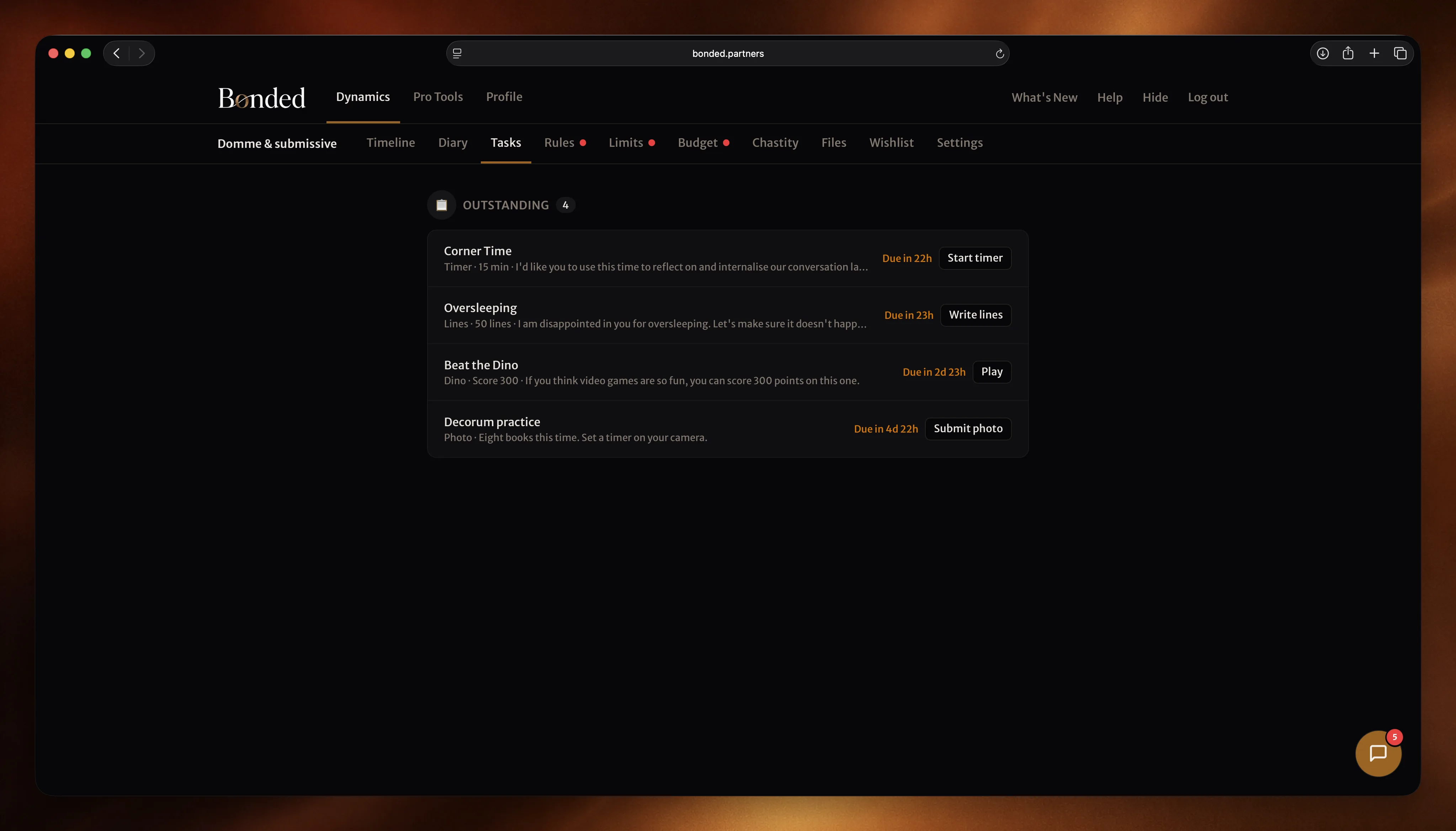
The diary gives submissives a structured space for daily reflections — processing the emotional experience of the dynamic as it happens, not just after scenes. Dom(me)s review entries and add private notes. Chat keeps the conversation flowing. The timeline captures the history so nothing is lost.
Tools
Aftercare is fundamentally a human practice — no tool replaces the presence, attentiveness, and care of a partner. But tools can support the practice. They can remind you to check in. They can provide a structured space for processing. They can keep a record that helps you recognise patterns in when and how drop occurs.
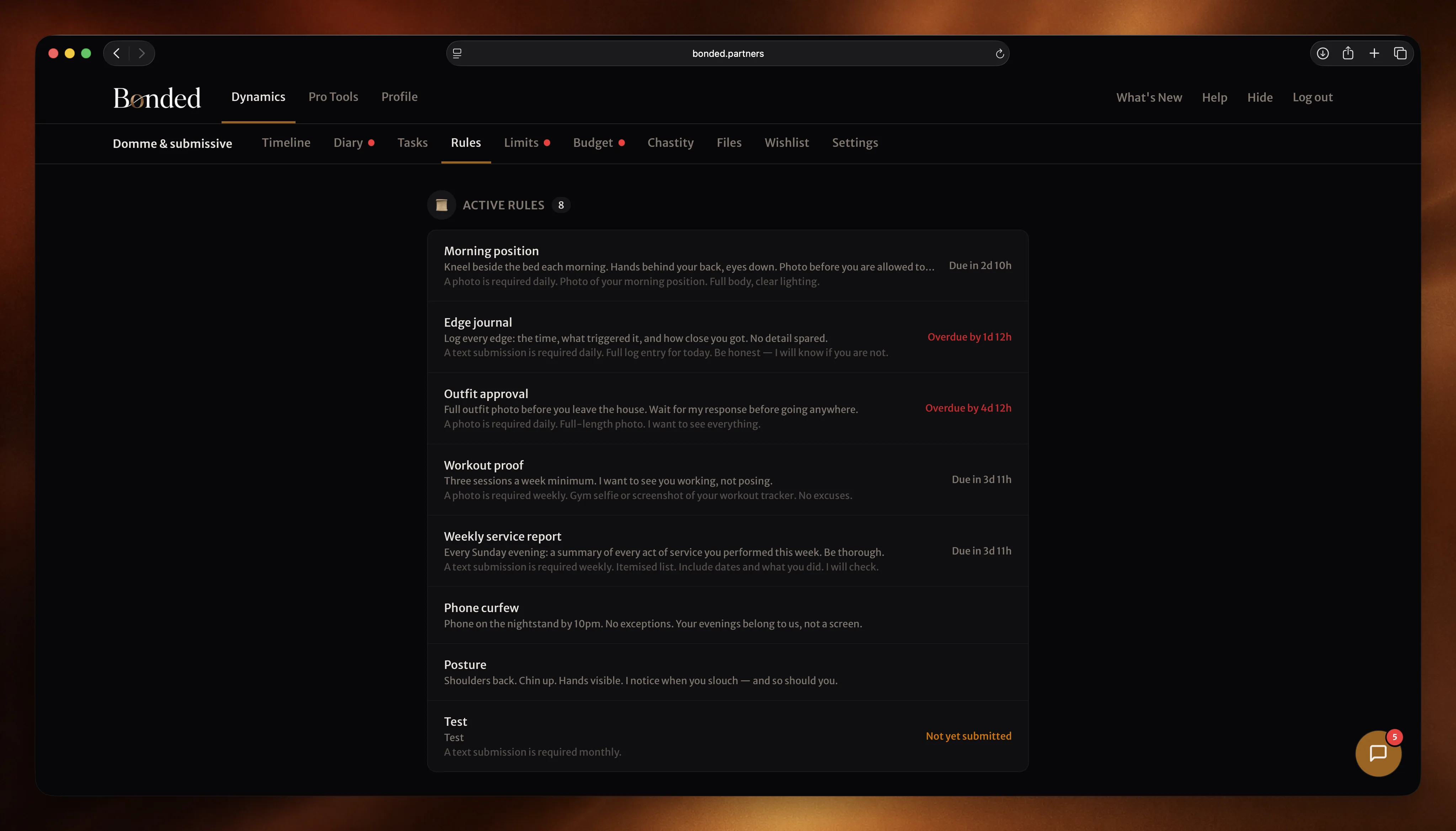
A daily reflection practice — supported by a tool that makes writing easy and private — turns aftercare from something that happens only after dramatic events into something woven into the fabric of the dynamic. A check-in rule with a consistent schedule ensures that neither person forgets to ask how the other is doing. A timeline that captures the history of the dynamic gives both people a way to look back and see the full picture — including patterns they might not notice day to day.
The right tool also helps with distance. When your partner is not in the same room, aftercare happens through communication — and having a private, purpose-built channel for that communication matters. A tool that combines chat, reflections, and the context of the dynamic makes remote aftercare more natural and more effective than scattered messages across multiple platforms.
Built for exactly this
Bonded keeps reflections, chat, rules, and your full timeline in one private space. Build aftercare into your daily rhythm with structured check-ins and a diary that supports ongoing processing — not just post-scene recovery.
See all features→