




What subdrop is
Subdrop is the physical and emotional crash that can follow intense BDSM scenes, sustained submission, or any experience that produces a significant neurochemical high. It is the come-down. The withdrawal. The moment when the body and mind stop producing the chemicals that made the experience feel powerful, and suddenly there is a deficit where the surplus used to be.
During intense scenes, the body floods with endorphins, adrenaline, dopamine, and oxytocin. These chemicals create euphoria, reduce pain perception, heighten emotional bonding, and produce what many submissives describe as "subspace" or a feeling of floating. This is a real physiological state, not a metaphor. The chemicals are measurable. The effects are consistent across people, though the intensity varies.
When the scene ends, those chemicals begin to recede. The body does not return to baseline instantly. It overshoots. Endorphin levels drop below normal before they stabilise. Adrenaline withdrawal produces fatigue and vulnerability. The oxytocin that created a sense of safety and connection fades, and in its absence the world can feel cold and uncertain. This is subdrop.
Subdrop is not exclusive to physical scenes. A submissive who has been in a state of sustained emotional vulnerability, intense focus on service, or prolonged anticipation can experience drop when that state ends. The mechanism is the same: the body produced chemicals to sustain the heightened state, and now it is recalibrating.
It is also not exclusive to new or inexperienced submissives. People who have been practising for years still experience drop. In some cases, experienced submissives report that drop becomes more predictable over time, but not less intense. The depth of the experience correlates with the depth of the drop, and experienced practitioners tend to go deeper, not shallower.
Understanding subdrop as a neurochemical process rather than an emotional failing is the first and most important step. It is not a reaction to bad play. It is not a sign that the submissive is fragile or that the Dom(me) did something wrong. It is the body doing exactly what bodies do after intense experiences. The only question is whether you are prepared for it.
When it happens
One of the things that makes subdrop difficult to manage is its unpredictable timing. It does not always arrive immediately after the scene. It can show up hours later, the next day, or even two to three days after the experience that triggered it. This variability is what catches people off guard.
Immediate drop happens within minutes to an hour of a scene ending. The submissive comes out of subspace and crashes. They may go from euphoric to tearful in minutes. They may feel suddenly cold, shaky, or disoriented. Immediate drop is the most recognised form because it is visible and occurs while both partners are still together. It is also, in some ways, the easiest to address because the Dom(me) is present and can respond directly.
Short-delay drop arrives a few hours after the scene, often that same evening or the next morning. The submissive felt fine during aftercare and seemed to recover well, but wakes up feeling heavy, sad, or anxious without a clear reason. This is the endorphin crash working on a slower timeline. The body maintained enough chemical momentum to feel okay in the immediate aftermath, but the true baseline has not yet been reached.
Delayed drop is the most dangerous because it arrives 24 to 72 hours after the triggering experience. By this time, both partners may have mentally moved on. The scene feels like it was days ago. The submissive may not connect what they are feeling to what happened earlier in the week. They just know they feel terrible and cannot explain why. This is where the real harm happens, because delayed drop is often experienced alone and without understanding.
The timing of drop can vary for the same person depending on the intensity of the scene, their physical state going in, their stress levels, sleep quality, hormonal cycles, and whether they had adequate nutrition and hydration. A scene that produces immediate drop one time might produce delayed drop the next. This is why rigid expectations about timing are unhelpful. The only reliable approach is to stay attentive for several days after any intense experience.
Drop can also be cumulative. If a dynamic involves frequent intense scenes without sufficient recovery time, the submissive may experience a persistent low-grade drop that never fully resolves. This can be mistaken for general depression or relationship dissatisfaction when it is actually a physiological pattern that needs to be addressed through pacing and recovery.
Physical signs
Subdrop manifests physically in ways that are real and measurable. These are not psychosomatic symptoms. They are the direct result of neurochemical withdrawal and the body's recovery process after a state of heightened arousal and stress response.
Fatigue is often the first and most noticeable physical sign. Not ordinary tiredness but a bone-deep exhaustion that sleep does not seem to fix. The submissive may feel like they cannot get out of bed, that their limbs are heavy, that ordinary tasks require enormous effort. This is the body recovering from the adrenaline surge. Adrenaline is expensive for the body to produce, and the recovery period demands rest.
Feeling coldis extremely common and often underestimated. As endorphins recede, the body's pain-and-temperature regulation shifts. The submissive may feel chilled even in a warm room, may want to be wrapped in blankets, may gravitate toward hot drinks and warm baths. This is not being dramatic. The body's thermoregulation is genuinely affected during drop.
Nausea and appetite changes happen because the digestive system is affected by both adrenaline and endorphin fluctuations. Some submissives feel nauseated during drop. Others lose their appetite entirely. Some crave sugar or carbohydrates, which makes sense: the brain is looking for quick energy sources to support its recovery. None of these responses are unusual.
Shaking and trembling can occur during immediate drop as the body processes excess adrenaline. This is the same mechanism that makes people shake after a car accident or other high-stress event. It is the nervous system discharging stored energy. It is not dangerous, but it can be frightening if the submissive does not understand what is happening.
Headaches and muscle aches are common in the day or two following intense scenes. During the scene, endorphins masked pain signals. As they withdraw, the body becomes more sensitive to pain, not less. Any physical tension held during the scene, any sustained positions, any impact, will make itself felt more strongly during drop than it did during the activity itself.
Sleep disruption rounds out the physical picture. Some submissives sleep excessively during drop. Others cannot sleep at all, experiencing restlessness or waking frequently. The nervous system is dysregulated, and sleep architecture is affected. This compounds the fatigue and can extend the duration of drop if not addressed through basic self-care.
Emotional signs
The emotional dimension of subdrop is often more distressing than the physical. Physical symptoms are uncomfortable but comprehensible. Emotional symptoms can feel like the ground has shifted beneath you, and they are harder to attribute to a cause, especially when the drop is delayed.
Sadness without a clear reason is the hallmark emotional symptom. The submissive may feel genuinely sorrowful, may cry without understanding why, may experience a pervading sense of loss or grief that has no identifiable object. This is the dopamine and endorphin deficit in action. The brain's reward system has been overstimulated and is now underproducing. The result feels like sadness, because at a neurochemical level, it is.
Anxiety and worry often accompany the sadness. The submissive may become convinced that the Dom(me) is upset with them, that the scene went badly, that they did something wrong, or that the relationship is in trouble. These fears feel completely real and urgent in the moment. They are being generated by the same neurochemical imbalance that produces the sadness, but that does not make them feel any less real to the person experiencing them.
Feeling worthless or undeserving is particularly common after scenes involving degradation, punishment, or intense power exchange. The submissive may internalise the dynamic in a way they would not when neurochemically stable. The words spoken during a degradation scene, the experience of being punished, the vulnerability of being controlled, these can loop in the mind during drop and take on a weight that was not present during the scene itself.
Irritability and anger are less commonly discussed but equally real. Some submissives do not crash into sadness. They crash into frustration. Everything irritates them. Small problems feel enormous. They may snap at their partner, withdraw from communication, or become uncharacteristically short-tempered. This is still drop. It just presents differently.
Emotional detachment is the version that gets missed most often. Instead of feeling too much, the submissive feels nothing. Flat. Numb. Checked out. They may seem fine on the surface because they are not crying or visibly distressed, but internally they have disconnected from their emotions as a protective response. This form of drop can persist longer because it does not signal its presence as clearly as tears or trembling.
Cryingdeserves its own mention because it is one of the most common immediate responses. Crying during or immediately after a scene is not necessarily a problem. It is often the body's natural way of processing intensity and releasing stored emotion. But crying that arrives hours or days later, unconnected to any obvious trigger, is usually a drop signal and should be treated as such.
How Bonded handles this
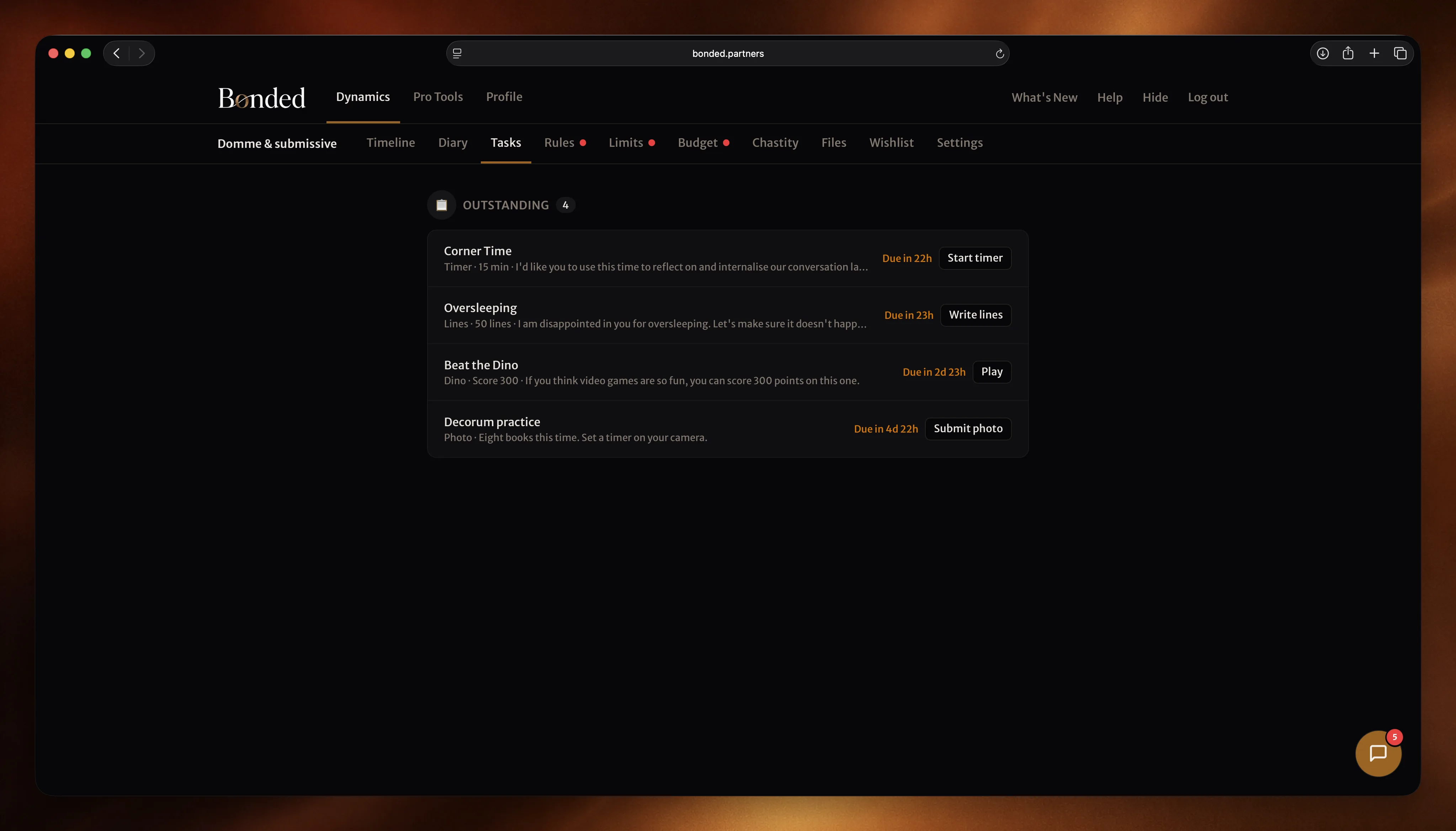
The diary includes a daily mood and wellbeing check-in. Submissives can log how they are feeling each day, creating a pattern over time that makes it easier to spot drop before it deepens. Dom(me)s see these entries and can respond early, rather than waiting until the submissive is already in crisis.
What causes it
The primary cause of subdrop is neurochemical. During intense BDSM activities, the body activates its stress response system and simultaneously floods with reward chemicals. Endorphins act as the body's natural painkillers, producing euphoria and reducing sensitivity. Adrenaline sharpens focus and creates a sense of heightened awareness. Dopamine reinforces the experience as pleasurable. Oxytocin, released through physical contact and emotional intimacy, creates feelings of bonding and safety.
When the experience ends, the production of these chemicals slows or stops. But the receptors that were processing them do not immediately readjust. The result is a period where the brain is underproducing relative to what the receptors expect. This is the same mechanism behind any withdrawal state, from post-exercise blues to the comedown after a major life event. The difference with BDSM is that the cocktail of chemicals involved is broader and the emotional context is more complex.
Emotional vulnerability amplifies the chemical crash. Submission involves opening yourself up. You hand over control. You allow yourself to be seen in states of vulnerability, need, and rawness that you guard carefully in the rest of your life. That level of openness has an emotional cost. When the scene ends and ordinary life resumes, the contrast between that radical openness and everyday self-protection can feel jarring. Drop is partly the emotional system processing that transition.
Identity processing plays a role that is rarely discussed. For many submissives, the desires and experiences within the dynamic touch on deep questions about who they are. Enjoying degradation, craving control, finding peace in surrender: these experiences can conflict with how the submissive sees themselves outside the dynamic. During drop, when defences are low and the critical mind is loud, those conflicts can surface with force. The submissive may question whether their desires are healthy, whether they are "normal," whether something is wrong with them. This is not the time to have that conversation, but it is the time those thoughts tend to arrive.
Adrenaline withdrawal specifically contributes to the physical symptoms. Adrenaline is a powerful hormone that diverts energy to muscles, sharpens cognition, and suppresses non-essential functions like digestion. When it clears the system, the body rebounds. The digestive system reactivates (sometimes aggressively), muscles relax (sometimes to the point of trembling), and the immune system, which was suppressed during the stress response, may overcompensate, producing flu-like aches and malaise.
External factorscan worsen drop significantly. Sleep deprivation, dehydration, poor nutrition, alcohol consumption, existing stress, and hormonal fluctuations all lower the body's resilience. A submissive who is well-rested, well-fed, and emotionally stable going into a scene will generally experience milder drop than one who is already running on empty. This is not always within anyone's control, but it is worth being aware of.
Immediate response
When a submissive is in drop, the Dom(me)'s job is simple: be present, be calm, and tend to the basics. This is not the moment for analysis, feedback on the scene, or conversations about what went well. The submissive's system is in a deficit state. The priority is stabilisation.
Physical warmth comes first. Get a blanket. Body heat is ideal if the submissive wants physical contact. Many submissives describe feeling intensely cold during drop, and warmth is one of the most immediately effective interventions. It signals safety to the nervous system at a level that words cannot reach.
Water and food. Hydration is non-negotiable. The body has been through a stress response and needs fluids. Water first, then something with sugar. Juice, chocolate, a sweet snack. The brain runs on glucose, and during recovery it burns through its reserves quickly. Do not wait for the submissive to ask. Have these things ready and offer them.
Physical presence. Stay close. Hold them if they want to be held. Keep physical contact if they are receptive to it. Some submissives want to be wrapped up tightly. Others want a hand on their back. Some need space. Ask, and then do what they need, not what you assume they need. If they cannot articulate a preference, default to gentle closeness and adjust based on their response.
Quiet reassurance. Speak gently. Keep it simple. "You're safe." "I'm here." "You did so well." "I've got you." The content of the words matters less than the tone and the consistency. A submissive in drop may not be processing language at full capacity. They are processing tone, presence, and physical sensation. Short, warm, repeated phrases work better than long speeches.
No analysis. This cannot be overstated. Do not ask the submissive to evaluate the scene. Do not ask what they liked or did not like. Do not offer your own analysis. Do not bring up anything that requires cognitive processing. All of that can happen later, when they are back at baseline. Right now, the goal is physical and emotional stabilisation. Everything else waits.
Time. Drop does not resolve on a schedule. The Dom(me) should not be watching the clock or signalling impatience. If aftercare takes twenty minutes, it takes twenty minutes. If it takes two hours, it takes two hours. Rushing the recovery process communicates to the submissive that their needs are an inconvenience, and that message will be remembered long after the drop has passed.
Delayed subdrop
Delayed subdrop is the version that causes the most damage, because it arrives when no one is expecting it and often when the submissive is alone. The scene was two days ago. Aftercare went well. Everyone felt fine. And then on Tuesday afternoon the submissive is sitting at their desk and suddenly cannot stop crying, or feels a crushing emptiness, or is gripped by anxiety about the relationship for no reason they can identify.
The delay happens because the body's chemical reserves do not deplete all at once. Some people maintain enough neurochemical momentum to feel stable for a day or more before the deficit becomes noticeable. Others have delayed drop triggered by a secondary event: a stressful day at work, poor sleep, or a minor conflict that would normally be manageable but tips the balance when the body is already in recovery.
The danger of delayed drop is misattribution. The submissive does not connect their feelings to the scene because too much time has passed. Instead, they look for an explanation in their current circumstances. They decide they are unhappy with the relationship. Or that the Dom(me) does not really care about them. Or that something is fundamentally wrong with them. These conclusions feel completely rational in the moment because the emotional state generating them is invisible to introspection.
This is why check-ins matter so much. A message from the Dom(me) on the second day after an intense scene that says "How are you feeling today?" serves two purposes. It gives the submissive an opening to report symptoms they might not have volunteered. And it reminds them that what they are feeling might be connected to the scene, which reframes the experience from "something is wrong with me" to "this is a known and manageable process."
For long-distance dynamics, delayed drop is a particular risk because the partners are not together to observe subtle changes in mood or behaviour. The Dom(me) cannot see that the submissive is quieter than usual, not eating, or withdrawing from their routine. Structured daily check-ins become not just nice-to-have but essential infrastructure for the dynamic's safety.
Delayed drop also responds less well to the standard aftercare toolkit. Blankets and chocolate are effective immediately after a scene when the nervous system is still activated. Two days later, the submissive needs something different: acknowledgement that what they are feeling is real and valid, reassurance about the relationship, permission to rest, and if possible, connection with their Dom(me) through whatever channel is available.
How Bonded handles this
Chat keeps the line open between scenes. When delayed drop arrives, the submissive is not starting a conversation from scratch. They are continuing one that is already happening. The context is there. The connection is warm. Reaching out feels natural rather than like an emergency signal.
Self-care for subdrop
Not every submissive has a Dom(me) available when drop hits. The Dom(me) may be at work, asleep in a different timezone, or otherwise unreachable. In long-distance dynamics, solo drop management is not the exception. It is the norm. Every submissive needs a personal toolkit for handling drop on their own.
Name what is happening. The single most powerful thing you can do for yourself is to recognise the drop for what it is. Say it out loud or write it down: "This is subdrop. This is a chemical process. This will pass." Naming it breaks the loop of misattribution. You are not falling apart. You are not broken. Your relationship is not ending. Your body is recovering from an intense experience. That is all.
Comfort items. Things that provide physical comfort and sensory grounding are your allies during drop. A heavy blanket, a favourite hoodie, a hot water bottle, a warm bath, comfort food, a familiar show or playlist. These are not indulgences. They are interventions. They provide the warmth and sensory input that your nervous system is asking for. Prepare these in advance so you do not have to make decisions about what you need when you are already in a depleted state.
Grounding techniques. When drop produces anxiety or dissociation, grounding brings you back into your body and your present moment. The 5-4-3-2-1 method works: name five things you can see, four you can touch, three you can hear, two you can smell, one you can taste. Deep breathing with extended exhales activates the parasympathetic nervous system and counters the residual stress response. Holding something cold, like an ice cube, provides a strong sensory anchor.
Writing it out. Journaling during drop serves a dual purpose. It gives the emotions somewhere to go other than circling inside your head, and it creates a record that you can look back on later. When you are past the drop, reading what you wrote often provides useful insight: patterns in when drop hits, what triggers it, what makes it worse, what helps. Over time, this record becomes your most personalised resource for managing it.
Do not make decisions. This is the rule that matters most. During drop, your perception of reality is distorted by neurochemistry. You are not seeing the relationship clearly. You are not seeing yourself clearly. Any conclusions you draw about the dynamic, your Dom(me), your desires, or your self-worth are unreliable. Write them down if you need to, but do not act on them. Do not send the message you are composing in your head about how the dynamic is not working. Do not make any changes to your agreements. Wait until you are back at baseline, and then revisit.
Reach out, even imperfectly. If your Dom(me) is available, tell them. It does not have to be eloquent. "I think I'm dropping" is enough. If they are not available, text a trusted friend who understands the dynamic. If no one is available, connect with an online community. The worst thing you can do during drop is isolate completely and let the spiral run unchecked.
Prevention
You cannot eliminate subdrop. As long as you are engaging in experiences that produce significant neurochemical responses, there will be a recovery period. But you can reduce the severity and duration of drop, and you can ensure that when it happens, it is managed well rather than endured in silence.
Gradual comedown. An abrupt end to a scene is the most reliable way to produce severe drop. The Dom(me) should bring the submissive down gradually. Reduce intensity before stopping. Transition from the scene to aftercare with intention, not with a sudden "okay, we're done." The body needs a ramp-down period just as it needed a warm-up. Five to ten minutes of decreasing intensity at the end of a scene can make a significant difference to the severity of the subsequent drop.
Aftercare planning. Know what the submissive needs before the scene begins. Have the supplies ready. Have the time blocked. Aftercare that is scrambled together in the moment is less effective than aftercare that is planned and prepared. Discuss aftercare preferences during negotiation. Revisit them regularly, because needs change over time and with different activities.
Nutrition and hydration. Eat a proper meal before intense scenes. Stay hydrated before, during, and after. The body's ability to manage the chemical recovery is directly affected by its fuel state. A submissive who plays on an empty stomach will drop harder than one who ate well an hour beforehand. This is basic physiology, and it is one of the simplest preventative measures available.
Pacing. Frequent intense scenes without adequate recovery between them lead to cumulative drop. The body needs time to re-establish its baseline. How much time depends on the individual and the intensity of the activities, but as a starting point, consider whether the submissive has fully returned to baseline before the next intense scene. If they have not, you are building on a deficit.
Sleep. Prioritise sleep in the days surrounding intense scenes. Sleep is when the body does most of its neurochemical recalibration. A submissive who is sleep-deprived going into a scene and sleep-deprived after it has fewer resources to manage the drop. If the scene happens late at night, build in time for extra sleep the next day.
Scheduled check-ins. Build them into the dynamic as a rule, not a suggestion. A check-in the morning after and another 48 hours later covers the most common drop windows. Make them specific enough to be useful: not just "you okay?" but "how is your energy? how is your mood? are you feeling connected?" Questions that invite real answers rather than automatic reassurances.
Domdrop
Dom(me)s drop too. It is less discussed, less understood, and often goes completely unacknowledged, but the phenomenon is real and the mechanism is parallel though not identical. Dom(me)s experience their own neurochemical highs during scenes, and those chemicals recede just as they do for submissives.
The emotional texture of domdrop is different. Where submissives often experience sadness and vulnerability, Dom(me)s tend to experience guilt and doubt. After a scene involving pain, degradation, or intense control, the Dom(me) may look back and feel disturbed by what they did. "Did I go too far? Did I hurt them? What kind of person enjoys that?" These questions can arrive with real force during drop, even when the scene was fully consensual and the submissive is glowing with satisfaction.
The weight of responsibility is its own drop trigger. Holding authority over another person is demanding. Making decisions that affect someone else's body and emotions requires sustained vigilance, and when the scene ends and that vigilance relaxes, the Dom(me) may feel the accumulated weight of what they carried. This is not weakness. It is the appropriate response of a person who takes their role seriously.
Domdrop is compounded by the cultural expectation that Dom(me)s are the strong ones who do not need care. Many Dom(me)s do not even have a framework for understanding their post-scene lows. They may interpret their guilt as evidence that they should not be doing this, rather than as a predictable chemical and emotional response to intense experience. Submissives can help by asking their Dom(me) how they are feeling after scenes, by offering reassurance that the experience was wanted and valued, and by creating space for the Dom(me) to be vulnerable.
If you are a Dom(me) reading this: you are allowed to need aftercare. You are allowed to feel shaken after a scene. You are allowed to ask for reassurance. None of this diminishes your authority. It makes you a human being doing something intense, and recognising that is a sign of competence, not weakness.
Communication about drop
The biggest barrier to managing drop well is silence. People do not talk about it because they are ashamed of it, because they do not want to seem needy, because they think it means something went wrong, or because they genuinely do not recognise it for what it is. Breaking that silence is the single most impactful thing a dynamic can do.
Normalise it early. During your initial negotiation, before you ever play together, discuss drop. Explain what it is. Ask about each other's experiences with it. Make it clear that experiencing drop is expected, not exceptional, and that reporting it is not a burden but a responsibility. When drop is normalised from the beginning, the submissive does not have to overcome shame before they can ask for help.
Track patterns. Over time, most people develop recognisable drop patterns. They may always drop 36 hours after impact scenes. They may drop more severely during certain phases of their hormonal cycle. They may be more vulnerable after scenes that involve emotional intensity rather than physical. Tracking these patterns turns drop from an unpredictable ambush into a manageable, anticipated event. A simple log of scenes, their intensity, and subsequent emotional states over the following days is enough to start seeing patterns.
Develop a shorthand. When you are in drop, articulating what you need can feel impossible. Develop a shorthand with your partner in advance. A simple scale of 1 to 5 for current emotional state. A specific word that means "I am dropping and need support." An agreed protocol: when either person says the word, the other drops what they are doing and provides presence. Making it easy to ask for help means help gets asked for sooner.
Debrief outside of drop. The conversation about what the drop felt like, what helped, and what to adjust should happen after recovery, not during. During drop, everything is filtered through the neurochemical deficit. After recovery, the submissive can think clearly about what they experienced and provide useful feedback. The Dom(me) can ask questions without worrying about increasing distress. Use these debriefs to refine your approach to aftercare and prevention.
When drop is a signal. Most drop is neurochemical and resolves on its own with time and support. But persistent or worsening drop can be a sign that something in the dynamic needs attention. If a submissive is dropping more severely over time, if drop is lasting longer, if it is accompanied by a persistent feeling that the dynamic is wrong, these are worth exploring with a clear mind and honest conversation. Not every bad feeling after a scene is just chemistry. Sometimes the bad feeling is information, and it deserves to be examined.
Tools for monitoring and supporting
Managing drop well requires awareness, communication, and consistency. Tools do not replace any of those things, but they make all three easier. The right tool gives you a structured space to track your emotional state, a channel for reaching your partner when you need them, and a history that reveals patterns you would not see otherwise.
A daily diary or check-in practice is the most effective tool for managing drop. It creates a data point every day, not just on the days when something feels wrong. When you can look back and see that your mood reliably dips two days after intense scenes, you stop being blindsided by it. You start planning for it. You block time for rest. Your Dom(me) knows to check in more actively during that window.
Ongoing communication that does not require a crisis to justify itself is equally important. If the only time a submissive reaches out to their Dom(me) about their emotional state is when they are already in drop, that pattern creates an association between emotional honesty and emergency. A communication channel that is active every day, where mood and wellbeing are regular topics, means that reaching out during drop is just a continuation of what was already happening.
A timeline that captures the full history of the dynamic provides the long view. It shows when intense scenes happened, when mood dipped, when recovery took longer than expected, and how patterns shift over months. This information is genuinely useful for calibrating the pacing and intensity of the dynamic. Without it, you are relying on memory, and memory is unreliable, especially about emotional states.
Whatever tools you use, the principle is the same: make the invisible visible. Drop is a process that happens inside one person's body and mind. The better you can externalise it, through writing, tracking, and communication, the more manageable it becomes. Not because the tool fixes anything, but because seeing a pattern clearly is the precondition for responding to it well.
How Bonded handles this
The timeline captures the full arc of your dynamic in one place: scenes, mood entries, diary reflections, and significant moments. Over time, patterns in drop become visible that neither person noticed in the day-to-day. Combined with the diary for daily check-ins and chat for real-time connection, it gives you the complete toolkit for monitoring wellbeing and responding to drop before it deepens.