



What D/s actually means
Dominance and submission — D/s — is a relationship structure built on the consensual exchange of power between two or more people. One person takes authority over defined areas of the relationship. The other consents to follow that authority within boundaries they have negotiated together. Everything beyond that baseline — the rules, the rituals, the protocols, the specific activities — is shaped by the people involved.
D/s is often grouped under the BDSM umbrella, and it overlaps with bondage, discipline, sadism, and masochism for many practitioners. But D/s can exist entirely on its own. A dynamic can involve no physical pain, no restraints, and no sexual activity whatsoever. What makes it D/s is the deliberate, consensual power imbalance — not the specific things people do within it.
This distinction matters because it broadens the understanding of who practises D/s and why. For some, it is primarily sexual. For others, it is a relational framework that provides structure, accountability, and emotional depth to their daily lives. For many, it is both — and the balance shifts depending on the season, the circumstances, and how the dynamic matures.
The single non-negotiable element is consent. Genuine, ongoing, informed consent from everyone involved. A submissive chooses to submit. A Dom(me) accepts authority that is offered, not seized. If consent is absent — or coerced, or withdrawn and ignored — it is not D/s. It is abuse. This principle sits above everything else in this guide and everything else in the practice.
The spectrum of D/s
D/s is not binary. It sits on multiple spectrums, and where any given dynamic falls on those spectrums is a matter of preference, negotiation, and context.
24/7 vs. scene-based
Some dynamics operate around the clock. The power exchange is always active — when they wake up, at work (even if only subtly), during meals, before bed. The submissive is always in role. The Dom(me) is always in authority. This is often called total power exchange (TPE) or 24/7 D/s.
Other dynamics are scene-based. The power exchange activates at specific times — during a scene, on weekends, when a certain phrase is spoken — and deactivates otherwise. Between those times, the relationship operates as an equal partnership.
Most dynamics fall somewhere in between. A couple might maintain a few standing rules around the clock (daily check-ins, an honorific in private) but reserve intense protocol for certain times. The key is that both people agree on where the dial sits — and that it can be adjusted. Starting with less scope and expanding is almost always healthier than starting at 24/7 and trying to dial back.
Sexual vs. non-sexual
D/s is frequently assumed to be inherently sexual. It can be — and for many practitioners, the erotic dimension is central. But non-sexual D/s dynamics are both real and common. Service-oriented dynamics, for instance, may centre on domestic tasks, self-improvement, or personal growth with no sexual component. The power exchange itself — the act of giving and receiving authority — provides the fulfilment.
Asexual practitioners, people whose D/s exists alongside but separate from their sex life, and those who practise D/s with someone who is not a sexual partner all demonstrate that power exchange does not require sex. Treating sexual activity as a prerequisite erases a significant portion of the community and misunderstands what D/s is at its core.
Intensity levels
The intensity of a dynamic — how much of daily life it touches, how strict the protocols, how significant the consequences — varies enormously. A light dynamic might involve a few rules and a weekly check-in. A heavy dynamic might involve detailed protocols for nearly every aspect of life, strict accountability, and daily evidence requirements.
Neither is more valid than the other. A dynamic with three meaningful rules that both people engage with deeply serves its participants better than one with fifty rules that have become background noise. Intensity should follow the needs of the people involved, not an external idea of what a "real" dynamic looks like.
Free course
Want a structured introduction to roles, power exchange, and dynamic types? BDSM 101 covers this in Chapter 3.
Start the course →Power exchange as a framework
At its heart, D/s is about power — who holds it, how it flows, and what both people gain from the arrangement. Understanding power exchange as a framework rather than a fixed state helps explain why D/s works for so many different kinds of people.
The Dom(me) holds authority, but that authority is delegated by the submissive. This is not a semantic trick. It is the structural reality that makes D/s ethical and sustainable. The submissive's consent is the foundation. Their limits are the walls. The Dom(me) operates within those boundaries — and the act of doing so responsibly is what earns continued trust.
For submissives, power exchange often provides freedom through structure. Knowing what is expected — having clear rules, defined roles, and consistent accountability — can be deeply relieving. The paradox of submission is that handing over control in specific areas often creates a sense of safety and clarity that feels more freeing than autonomy in those same areas.
For Dom(me)s, the exchange provides purpose, creative expression, and the satisfaction of building something together. Holding authority well requires attentiveness, planning, emotional intelligence, and consistency. It is work — and the people who do it well tend to find it deeply fulfilling.
Power exchange is not static. It fluctuates with mood, life circumstances, and the natural rhythm of a relationship. A good dynamic has mechanisms for adjusting the intensity — for the Dom(me) to ease off when life is hard, and for the submissive to signal when they need more or less structure. These mechanisms should be built into the dynamic from the start, not invented in a crisis.
Communication and trust
Every practitioner says communication is important. Fewer describe what that actually looks like in practice. Communication in a D/s dynamic is not a single conversation at the start. It is a system — ongoing, structured, and deliberately maintained.
Negotiation
Negotiation is the formal process of establishing what the dynamic includes and excludes. It covers limits, safewords, scope, expectations, and consequences. Initial negotiation happens before the dynamic starts, but renegotiation should happen regularly — quarterly at minimum, and any time something significant changes.
Good negotiation is honest, specific, and mutual. Both people bring their needs, fears, and curiosities to the table. The Dom(me) does not dictate terms; the submissive does not simply agree to everything. It is a genuine exchange between equals, even in dynamics where equality is deliberately set aside during day-to-day interaction.
Check-ins
Regular check-ins — where both people step out of role and talk as equals — are the maintenance that keeps a dynamic healthy. They provide a safe context for raising concerns, sharing feedback, and discussing adjustments. Without them, small issues become large ones, and resentment builds in silence.
The cadence depends on the dynamic. New dynamics benefit from daily or every-other-day check-ins. Established dynamics might do weekly or biweekly. The format can be a conversation, a shared document, or written reflections. What matters is consistency and the genuine freedom for both people to speak honestly without in-role consequences.
Building trust
Trust in a D/s dynamic is not a feeling. It is a track record. It accumulates through consistent behaviour: the Dom(me) respects limits every time. The submissive communicates honestly, even when it is difficult. Rules are followed. Consequences are fair. Check-ins happen on schedule. Safewords are honoured instantly and without resentment.
Trust also requires vulnerability from both sides. The submissive is vulnerable by design — they have consented to give up control. But the Dom(me) is vulnerable too: they have accepted the responsibility of holding someone's trust and the expectation of getting it right. Acknowledging this mutual vulnerability tends to deepen dynamics in ways that power alone cannot.
How Bonded handles this
The diary feature gives submissives a structured space for daily reflections and emotional processing. Real-time chat keeps ongoing conversation in the same private space as the rest of the dynamic. Timeline captures the full history of what's happened — useful for check-ins and quarterly reviews.
Explore the diary→Structure in D/s: why it matters
Power exchange without structure is just a vibe. Structure is what turns the concept of D/s into something practised — something both people experience and engage with daily. Structure takes the form of rules, protocols, rituals, schedules, and systems of accountability.
Rules define expectations. Protocols define behaviour. Rituals create meaning. Schedules create rhythm. Accountability creates trust. Together, they form the architecture of a dynamic — the infrastructure that supports the emotional weight the relationship carries.
Without structure, dynamics tend to drift. The Dom(me) forgets to check evidence. The submissive skips a rule because nobody is tracking it. The power exchange becomes theoretical rather than practical. Over time, both people feel the difference. The submissive feels unseen. The Dom(me) feels ineffective. What started with intention fades into something uncertain.
The amount of structure varies. Some dynamics run on three rules and a daily check-in. Others have detailed protocols for dozens of situations. The right amount is whatever creates the felt sense of power exchange without becoming administrative burden. If maintaining the structure takes more energy than the dynamic itself provides, there is too much. If the dynamic feels formless, there is too little.
The best structure is the kind you do not have to think about maintaining — where the systems handle the tracking and reminders, freeing both people to focus on the relationship itself rather than the logistics of managing it.
How Bonded handles this
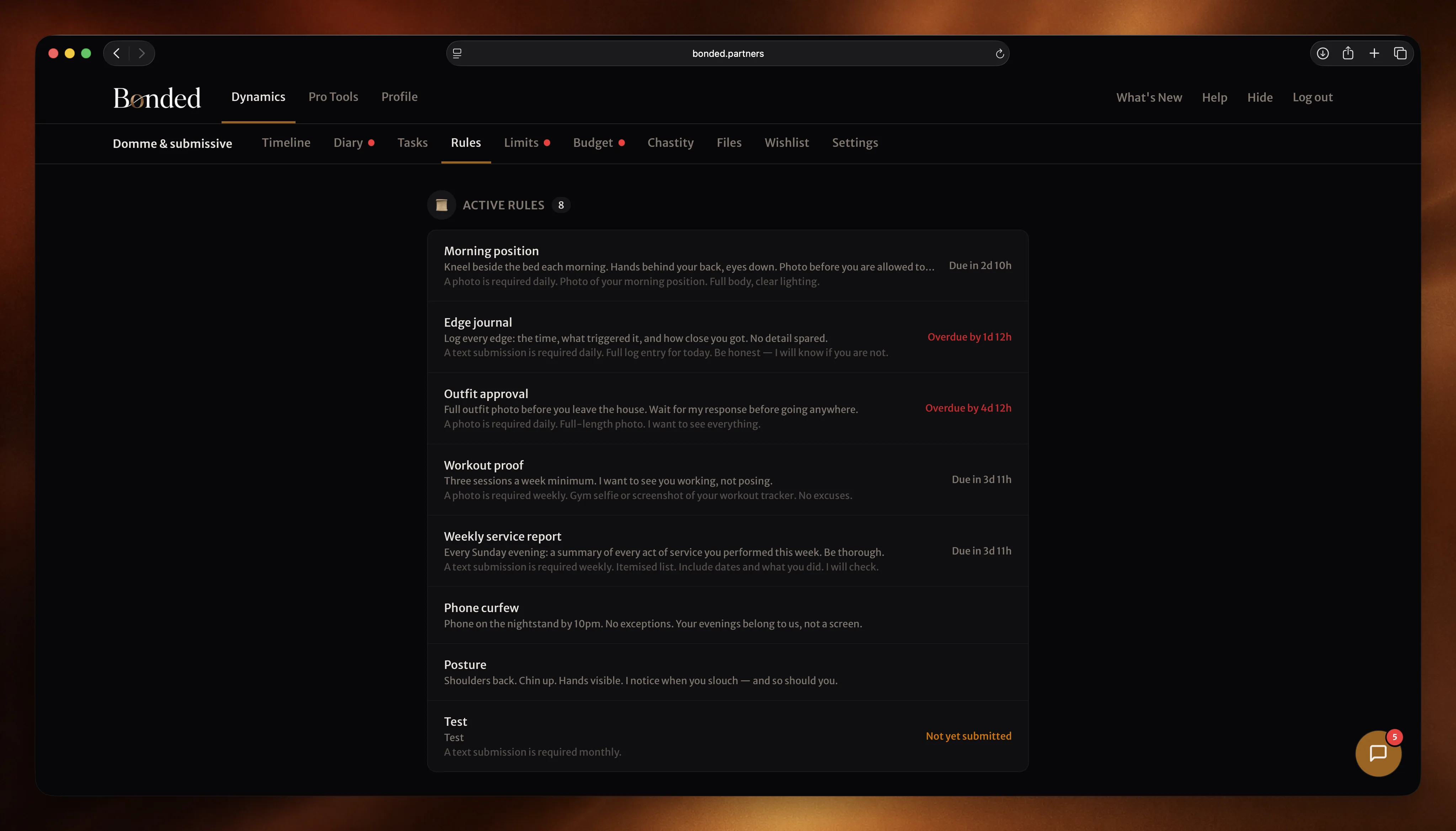
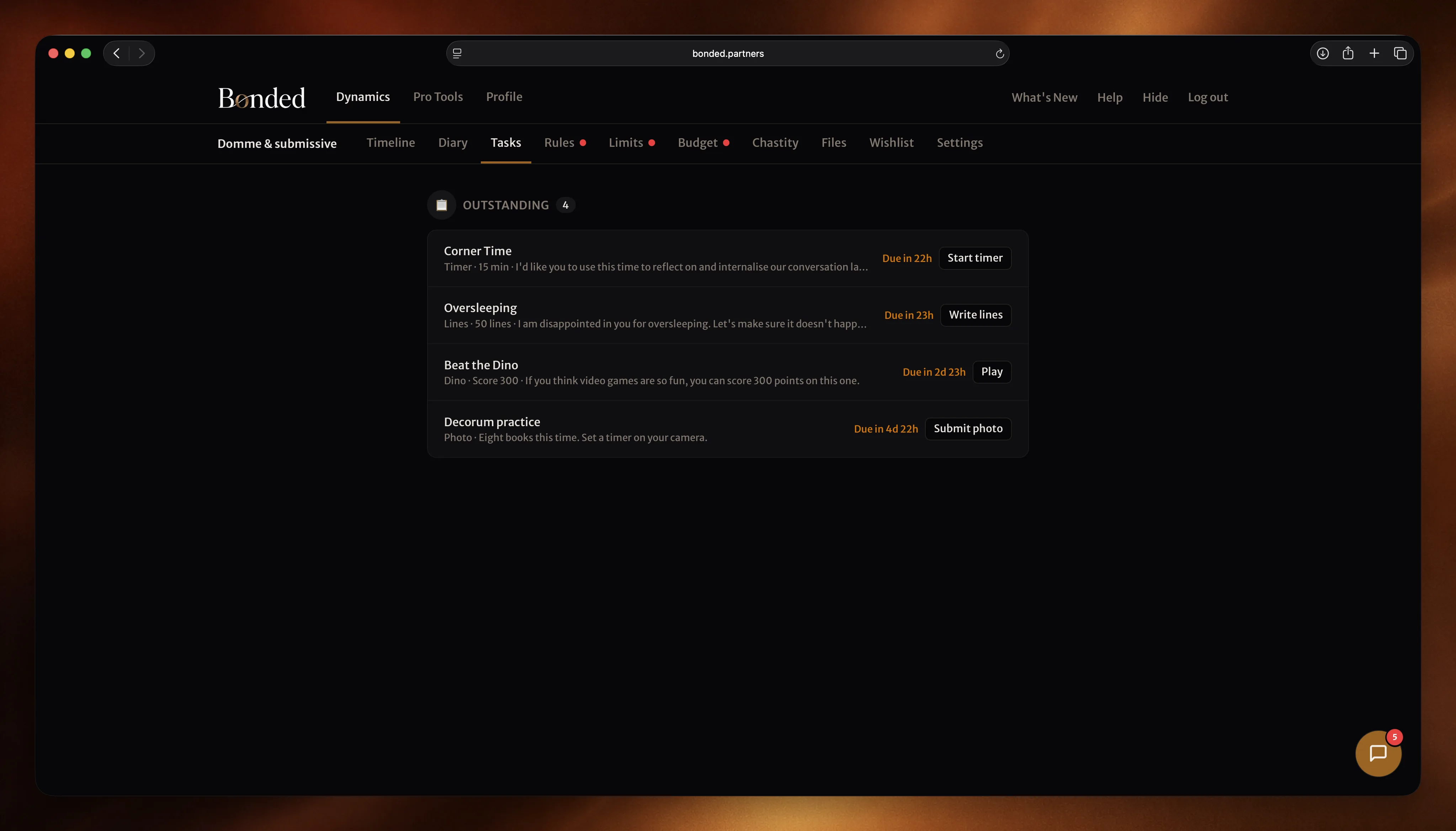
Rules with schedules and evidence requirements. Tasks with deadlines and completion tracking. Limits that only you can edit. A timeline that captures everything. Structure that runs itself so you can focus on each other.
See how rules work→Common dynamic types
D/s is a broad category. Within it, practitioners have developed distinct dynamic types — each with its own culture, expectations, and vocabulary. Understanding these types helps you identify what resonates with your relationship, though many dynamics borrow elements from multiple types.
D/s (Dominant/submissive)
The broadest category. A Dom(me) holds authority; a submissive follows within agreed boundaries. The intensity, scope, and focus are entirely negotiable. Most people who practise power exchange identify with this label, even if their dynamic includes elements from the types below.
M/s (Master/slave)
Master/slave dynamics typically involve a deeper level of power exchange than standard D/s. The slave often cedes authority over a broader range of decisions — sometimes approaching total power exchange. The relationship is often more formal, with stricter protocols and higher expectations of obedience.
M/s dynamics require a high level of trust, experience, and self-awareness from both parties. They are not "more advanced" than D/s — they are a different configuration that suits different people. Many practitioners move between D/s and M/s as their relationship and understanding deepen.
DD/lg and nurturing dynamics
Daddy Dom/little girl (DD/lg) dynamics — and their gender-neutral and gender-varied counterparts (MD/lb, DD/lb, MD/lg, and others) — centre on a caregiving power exchange. The Dominant partner takes a nurturing, protective role. The submissive partner engages with a younger, more vulnerable headspace. This can involve age regression, or it can simply manifest as a caregiving/care-receiving relationship dynamic without any age component.
These dynamics often emphasise emotional safety, comfort, and guidance over strict obedience. Rules in nurturing dynamics frequently focus on self-care, daily routines, and the submissive's wellbeing. The power exchange is real, but the framing is protective rather than authoritative.
Pet play
In pet play dynamics, the submissive takes on the role of an animal — often a kitten, puppy, pony, or bunny. The Dominant partner acts as owner, trainer, or handler. Pet play can be deeply immersive (headspace, gear, training protocols) or relatively light (a collar and a pet name).
The appeal often lies in the simplification of the dynamic: the pet's role is clear, the expectations are straightforward, and the headspace provides a break from the complexity of human social interaction. Pet play can be sexual, non-sexual, or somewhere in between.
Service-oriented dynamics
Service dynamics centre on the submissive providing practical service to the Dominant: domestic tasks, personal assistance, organisation, or other forms of tangible contribution. The submissive's fulfilment comes from serving well and having that service recognised and valued. The Dom(me)'s authority is expressed through directing and evaluating the service.
These dynamics often work well for people who experience power exchange through acts of devotion rather than through protocol or discipline. Service dynamics can stand alone or be layered with other elements — rules, protocols, or scene-based activities.
Finding your type
Most real-world dynamics do not fit neatly into a single category. A dynamic might combine D/s structure with nurturing elements and service expectations. Labels are useful for communication — they help you explain what you are looking for — but they are descriptive, not prescriptive. Your dynamic does not have to match a template. It has to work for the people in it.
Starting vs. maintaining
Starting a dynamic gets most of the attention. The first conversations, the first rules, the excitement of a new power exchange. But the real work — and the real reward — is in maintaining one. Most dynamics that fail do so not because they started wrong but because they stopped being actively tended.
The new relationship energy problem
The early phase of a D/s dynamic often runs on enthusiasm. Everything is fresh. Every rule is exciting. Every task is engaging. The Dom(me) checks evidence promptly. The submissive completes everything with eagerness. This energy is genuine but not sustainable. Eventually, the dynamic becomes routine — and routine is where many dynamics stall.
The transition from excitement to routine is not failure. It is maturity. But it requires a different set of skills. Instead of the energy of novelty, maintained dynamics run on systems, consistency, and deliberate renewal. The Dom(me) who checks evidence reliably — not just when they feel inspired — builds more trust than the one who is enthusiastic but inconsistent.
What maintenance looks like
Maintaining a dynamic means showing up even when it is not exciting. It means enforcing rules consistently, tracking evidence, reading reflections, giving feedback, and adjusting the dynamic when something stops working. For submissives, it means following rules on the hard days — not just the inspired ones — and communicating honestly about struggles rather than silently dropping off.
Practical maintenance also involves protecting time for the dynamic. Life crowds in. Jobs, families, friends, health — everything competes for bandwidth. Dynamics that survive this competition are the ones where both people treat the dynamic as a priority worth scheduling, not a bonus activity that gets done if nothing else is happening.
How Bonded handles this
Automated schedules and push notifications reduce the maintenance overhead. Evidence tracking with unseen indicators keeps the Dom(me) engaged. Timeline makes it easy to review the history and spot gaps. The infrastructure handles the logistics so you can focus on the relationship.
Explore the timeline→When dynamics evolve
Dynamics change. They should. The dynamic that serves you at three months should look different from the one at three years. People grow, circumstances shift, and what once felt perfect may no longer fit. The question is whether you evolve together — deliberately, through conversation — or whether the dynamic drifts until one or both people feel lost in it.
Deepening
Many dynamics deepen over time — the power exchange becomes more central to daily life, the protocols become more detailed, the trust allows for activities that were once limits. This is natural and often deeply rewarding. But deepening should follow trust, not lead it. Expanding the scope of the dynamic before both people are ready can damage the trust that makes expansion possible.
Shifting
Sometimes a dynamic does not deepen so much as change direction. A sexually focused dynamic might become more service-oriented. A strict protocol dynamic might soften into something more nurturing. A person who identified as a submissive might discover Dominant tendencies. These shifts require honest conversation and a willingness to release the dynamic you had in order to build the one you need.
Pausing
Life sometimes makes a dynamic unsustainable — illness, grief, career crises, or simple burnout. Pausing the dynamic (reducing or suspending rules and protocols) is not failure. It is responsible stewardship. A dynamic that cannot flex around real life is too rigid to last. Agreeing on what a pause looks like before you need one makes activating it less stressful.
Renegotiation
All of these changes require renegotiation — returning to the table as equals and rebuilding the agreements that underpin the dynamic. Renegotiation is not a sign that something went wrong. It is a sign that the people in the dynamic are paying attention. The most resilient dynamics are the ones that renegotiate before a crisis forces them to.
How Bonded handles this
Limits can be updated any time — each person controls their own, and changes are flagged instantly. Rules can be edited, paused, or archived. The dynamic's structure adapts because the tool adapts.
See how limits work→When dynamics end
Not every dynamic is meant to last forever. Some run their natural course. Some end because people change. Some end because of incompatibility that only becomes clear with experience. Ending a dynamic — cleanly, respectfully, and with care for both people — is as much a part of healthy practice as starting one.
The power imbalance in D/s makes endings more complex than in vanilla relationships. A submissive who has surrendered authority may struggle to reclaim it. A Dom(me) may experience a loss of purpose and identity. The emotional intensity of D/s means the grief of ending one can be significant, regardless of whether the dynamic was romantic.
How to end well
Step out of role first. Ending a dynamic should happen between equals, not within the power exchange. Use a check-in context, not an in-role one. Be honest about why. Listen without defending. Acknowledge what the dynamic provided, even if it is ending.
Allow for transition. If the dynamic was intense, ending it abruptly can cause significant drop for both partners. Gradually reducing the structure — fewer rules, lighter protocols, more time out of role — gives both people time to adjust. Not every ending allows for this, but when it is possible, it is kinder.
Aftercare applies to endings too. The emotional processing after a dynamic ends is aftercare on a larger scale. Both people may need support — from each other if the ending is amicable, or from friends, community, or professionals if it is not. D/s grief is real, and it deserves the same respect as any other form of loss.
Tools and infrastructure
A D/s dynamic can run on conversation alone — and many have, for a long time. But as a dynamic grows in complexity, the administrative overhead grows with it. Rules need tracking. Evidence needs reviewing. Limits need documenting. Tasks need assigning and following up. Chastity sessions need managing. Reflections need a home. Communication needs a private channel.
Spreadsheets work until they don't. Messaging apps are fine for chat but terrible for structure. Habit trackers handle rules but miss everything that makes D/s different from a morning routine. The gap between what a D/s dynamic needs and what general tools provide is where purpose-built infrastructure comes in.
The right tool should reduce overhead, not add to it. It should handle schedules, reminders, and tracking so that both people can focus on the dynamic itself. It should be private — what happens in your dynamic should stay in your dynamic. And it should understand the specific needs of power exchange: that limits belong to individuals, that evidence is part of accountability, that a rule is different from a habit, and that the relational context matters as much as the task itself.