




Long-distance D/s is real D/s
Let's address this immediately, because the dismissal comes up often enough to warrant it: a long-distance D/s dynamic is not a lesser version of an in-person one. It is a different configuration with different strengths and different challenges. The power exchange is real. The structure is real. The emotional investment is real. The growth is real.
People have been practising D/s across distance for as long as distance communication has existed — through letters, then phone calls, then the internet, now dedicated tools. What has changed is not the validity of the practice but the quality of the infrastructure available to support it.
Distance dynamics are common for many reasons. Partners who met online and have not yet closed the gap. Partners who live together but have periods of separation — work travel, military deployment, family obligations. People who prefer distance dynamics because they value autonomy in their daily lives while wanting structured power exchange with a partner who is not physically present.
If you are in a long-distance dynamic and someone tells you it is not real D/s, they are wrong. If you are considering a long-distance dynamic and wondering whether it can work, it can — with intention, structure, and the willingness to do things differently from the in-person default.
What works at a distance
A surprising amount of D/s translates directly to distance. The elements that require physical proximity are a subset of what makes a dynamic work — and often a smaller subset than people assume.
Rules
Rules work identically at distance. A morning check-in rule, a self-care rule, a protocol for how the submissive addresses the Dom(me) — none of these require being in the same room. In fact, rules may matter more at distance because they are the primary mechanism through which the dynamic is experienced day to day. Without the passive awareness of a partner's physical presence, rules create the active awareness that the dynamic is alive.
Evidence
Evidence submission is arguably more powerful at distance than in person. When the Dom(me) is not physically present to observe compliance, evidence becomes the bridge. A photo of the submissive's morning routine. A video of them completing a task. A written reflection on their day. Each piece of evidence is a communication — "I did this for you, even though you are not here to see it" — and that communication is what makes distance feel like presence.
Diary and reflections
Written reflections are one of the most effective tools for long-distance dynamics. They provide a depth of emotional communication that phone calls and text messages often miss. The submissive processes their experience of the dynamic in writing; the Dom(me) reads, reflects, and responds. Over time, the diary becomes a running conversation about the internal life of the dynamic — something many in-person dynamics never achieve because the proximity creates an illusion of knowing without asking.
Chat
Ongoing messaging — whether real-time or asynchronous — maintains the conversational fabric of the dynamic. In-role communication (using honorifics, following protocol) can happen in text as naturally as in person. Out-of-role check-ins can happen on a schedule that works for both time zones.
Chastity
Chastity is uniquely suited to distance dynamics. The physical device is present even when the keyholder is not. The submissive experiences the Dom(me)'s authority continuously through the tangible reminder on their body. Remote keyholding — where the Dom(me) controls access from a distance — is one of the most common long-distance D/s activities for good reason: it works.
Tasks
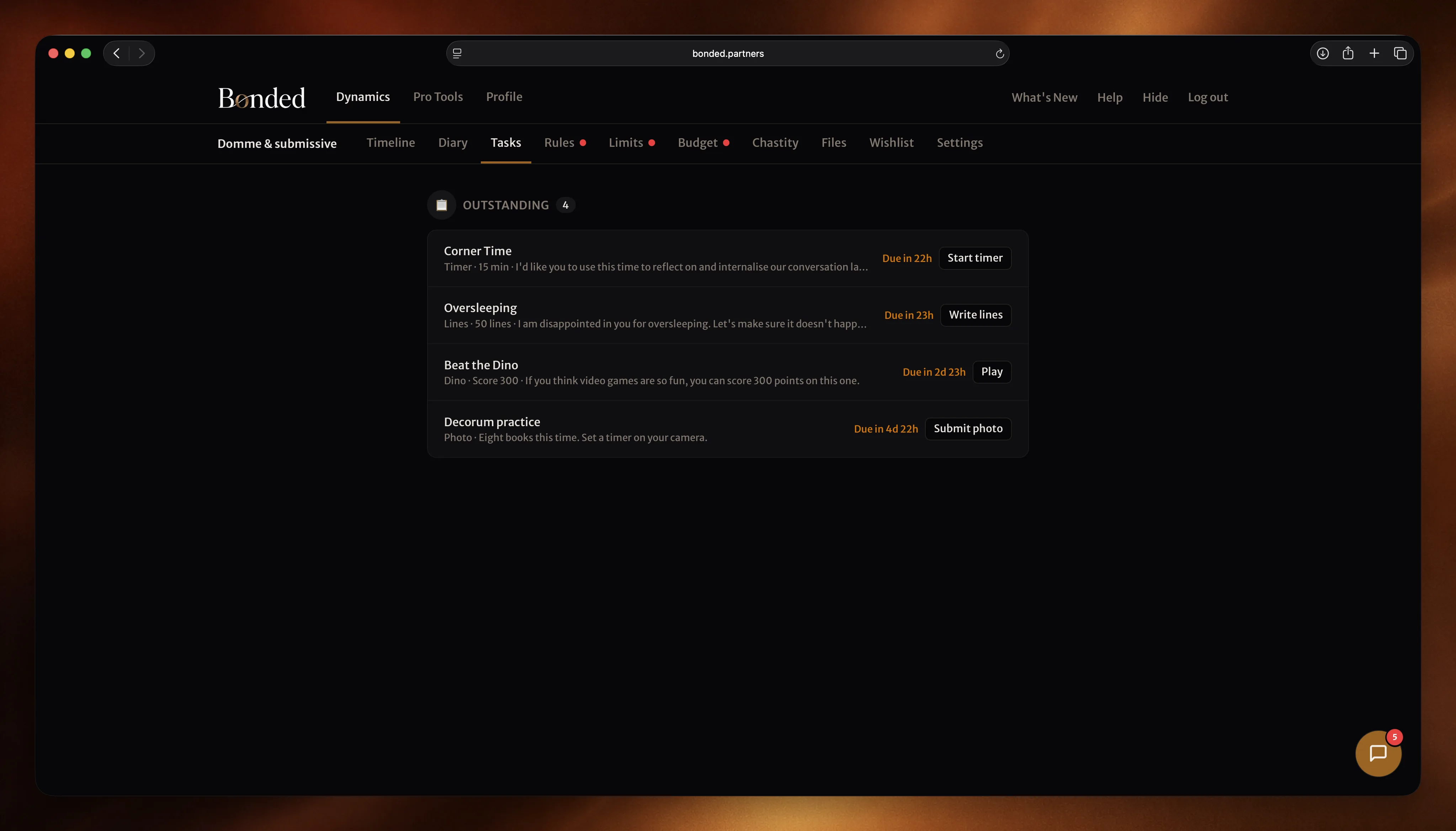
One-off tasks add variety to the distance dynamic the same way they do in person. Writing assignments, creative challenges, endurance tasks, lines — all work independently of physical location. Tasks that require evidence give the Dom(me) something tangible to review and respond to, creating a cycle of assignment, completion, and acknowledgement that sustains the power exchange.
What's harder
Honesty about what distance makes harder is not defeatism — it is preparation. Knowing the challenges lets you address them deliberately rather than being surprised by them.
Physical play
Impact, bondage, service that requires physical presence — these cannot happen at distance. This is the most obvious limitation and the one most people think of first. For dynamics where physical play is central, distance periods require either accepting the gap or finding alternative expressions that provide similar emotional weight.
Immediate presence
The feeling of being in the same space as your partner — the passive awareness, the ability to read body language, the comfort of proximity — cannot be replicated. Video calls approximate it but do not replace it. This is the loss that many distance dynamics grieve most, and it is worth acknowledging rather than minimising.
Spontaneity
In-person dynamics allow for spontaneous power exchange — an unexpected command, a look across the room, a moment of physical control. Distance dynamics tend to be more scheduled and deliberate. This is not necessarily a weakness — deliberate structure has its own power — but it is a different quality of experience. Some practitioners miss the unpredictability. Others find they prefer the intentionality.
Aftercare
Aftercare at distance requires more effort and creativity than in person. You cannot wrap a blanket around someone through a screen. Physical aftercare — holding, touch, presence — is limited to what the person can provide for themselves. Emotional aftercare works through voice, text, and video — which is effective but different. Distance dynamics benefit from explicit aftercare protocols that work within the constraints of separation.
Misreading tone
Text-based communication strips away tone, expression, and context. A message that was playful can read as harsh. A brief response that reflects a busy day can feel like dismissal. In a dynamic where power exchange adds emotional weight to every interaction, miscommunication can escalate quickly. Building in mechanisms for clarification — asking before assuming, using emoji or tone indicators when helpful, defaulting to generosity of interpretation — mitigates this but never entirely eliminates it.
Communication at a distance
In-person dynamics can coast on proximity. Distance dynamics cannot. Every moment of connection has to be intentional because none of it happens passively. This is both the challenge and the hidden advantage of long-distance D/s: the communication tends to be more deliberate, more thorough, and more honest than in dynamics where people assume proximity equals understanding.
Layered communication
Effective distance communication uses multiple channels, each serving a different purpose. Real-time chat for ongoing connection and in-role interaction. Voice or video calls for deeper conversations and check-ins. Written reflections for emotional processing. Evidence submissions for accountability and visual connection. Using a single channel for everything flattens the communication — important conversations get buried in casual chat, and the different registers of D/s communication blend together.
Asynchronous vs. synchronous
Not all communication needs to happen in real time. In fact, some of the most valuable communication in a distance dynamic is asynchronous. A reflection written in the morning and read in the evening. An evidence submission sent at noon and reviewed that night. A voice message left during a break and listened to before bed. Asynchronous communication reduces the pressure of being available simultaneously — which is particularly important when time zones are involved — while maintaining the thread of connection.
Synchronous communication — live conversation — is important too, but it does not have to carry the entire weight of the dynamic. Reserve real-time conversations for check-ins, negotiations, and the moments that genuinely benefit from immediate back-and-forth. Let the asynchronous channels handle the rest.
Over-communication
In distance dynamics, it is better to communicate too much than too little. Stating the obvious, explaining your tone, checking in when you are not sure — these feel redundant but prevent the kind of misunderstandings that fester across distance. "I am going quiet for a few hours because of work, not because anything is wrong" takes ten seconds to type and prevents hours of anxiety.
How Bonded handles this
Chat, diary, evidence, and timeline in one space. Different channels for different purposes — without scattering your dynamic across multiple apps. Everything is private, and nothing gets lost in a general messaging feed.
See how chat works→Structure as substitute for proximity
In an in-person dynamic, proximity itself creates the background sense of the power exchange. The submissive is aware of the Dom(me)'s physical presence. The Dom(me) can observe compliance directly. This passive awareness does not exist at distance. Structure replaces it.
Rules with specific schedules create touchpoints throughout the day when the dynamic is actively engaged. A morning check-in rule means the submissive thinks about the Dom(me) first thing. An evening reflection means the dynamic is the last thing processed before sleep. Evidence requirements mean the submissive is actively presenting their compliance — not just following rules in isolation but demonstrating it for their Dom(me).
The structure does not need to be overwhelming. Even two or three well-designed rules with evidence requirements create a rhythm that makes the dynamic feel present throughout the day. The key is consistency: the rules fire on schedule, the submissive completes them, the Dom(me) reviews evidence, and the cycle continues. That reliability is what creates the felt sense of the power exchange — not the number of rules, but the consistency of engagement.
For distance dynamics specifically, consider rules that create visual or auditory connection: a photo-evidence rule so the Dom(me) sees the submissive daily, a voice-message rule so they hear each other, a video check-in at least weekly. These sensory elements compensate partially for the absence of physical presence and keep the people behind the dynamic vivid to each other.
Evidence and accountability
Evidence is the backbone of a long-distance dynamic. Without physical observation, the Dom(me) has two options for knowing what the submissive is doing: trust, and evidence. Both have a role — but evidence provides something trust alone cannot: a tangible, shared record of the dynamic in action.
For the submissive, submitting evidence at distance is an act of showing up. There is nobody watching over their shoulder. Nobody physically present to hold them accountable. The submissive chooses to complete the rule and submit proof because the dynamic matters to them. That choice, made daily, is what sustains the power exchange across distance.
For the Dom(me), reviewing evidence at distance is an act of attention. It says: I see what you are doing, even from here. The consistency of that review matters enormously. Acknowledging evidence promptly — even if only briefly — signals that the submissive's effort is valued. Delayed or inconsistent review, over time, signals the opposite.
The type of evidence matters more at distance. Photo and video evidence creates visual connection — the Dom(me) sees the submissive, their environment, their expression. This is valuable beyond accountability. It is intimacy. Text evidence works for simpler confirmations, but for the rules that anchor the dynamic, visual evidence provides a dimension that text cannot.
How Bonded handles this
Photo, video, and text evidence on every rule. Unseen indicators so the Dom(me) knows exactly what needs review. Timestamped submissions. Everything lives alongside the rule — no scrolling through chat to find it.
See how rules work→Chastity in long-distance dynamics
Chastity is one of the most popular activities in long-distance D/s — and for good reason. A chastity device creates a constant, physical reminder of the Dom(me)'s authority. When the keyholder is hundreds or thousands of miles away, the submissive still feels the dynamic against their body. That tangibility is rare and valuable at distance.
Remote keyholding works by separating the device from the key. The submissive wears the device. The Dom(me) controls when it comes off — through conversation, through scheduling, through whatever system the dynamic uses. This creates an ongoing power exchange that does not depend on proximity and does not require constant active communication to maintain. The device itself does the work of keeping the dynamic present.
Safety considerations for remote chastity are important. Because the Dom(me) cannot physically observe the submissive's condition, clear protocols for hygiene breaks, emergency removal, and regular check-ins about physical comfort are essential. The submissive must have the ability to remove the device independently if a genuine safety issue arises — and that ability should be framed as a safety feature, not a loophole. The honour system around emergency removal is part of the trust that makes remote chastity work.
Tracking chastity sessions at distance adds accountability. When both people can see the session history — when it started, how long it has been, when breaks occurred — the activity becomes shared rather than isolated. The submissive knows the Dom(me) is aware. The Dom(me) knows the submissive is committed. The shared visibility bridges the distance.
How Bonded handles this
Chastity sessions with lock and unlock controls, session history, and real-time visibility for both partners. The Dom(me) controls the session. The submissive sees the timer. Both see the history.
See how chastity works→Maintaining emotional connection
The biggest risk in a long-distance dynamic is not logistical — it is emotional. Over time, distance can create a sense of abstraction. The partner becomes a voice, a profile, a series of messages rather than a full person. The dynamic becomes a system to maintain rather than a relationship to inhabit. Guarding against this requires deliberate effort from both people.
Be more than the dynamic. If every conversation is about rules, tasks, and protocol, the relationship beneath the dynamic atrophies. Talk about your day. Share things that have nothing to do with D/s. Be a person with your partner, not just a role. The dynamic should sit within a relationship — not replace one.
Vulnerability. Distance makes it easier to perform a role and harder to be genuinely vulnerable. Push against that tendency. Share the hard things — the doubt, the loneliness, the frustration. A dynamic that only shares the polished version of itself across distance is building on something hollow. The messy, honest stuff is what creates real connection.
Sensory connection. Seek out forms of communication that engage the senses. Voice messages so you hear each other's tone. Video calls so you see each other's expressions. Photo evidence that shows their world, not just their compliance. A care package sent through the post. These sensory inputs counter the abstraction that pure text communication creates.
Shared experiences. Find things to do together even at distance. Watch the same show and discuss it. Read the same book. Do a task simultaneously and compare results. Shared experiences create shared reference points — the inside jokes, the common ground, the "remember when" that keeps the relationship vivid.
Anticipation. If you have visits planned, build anticipation deliberately. Discuss what you will do when you are together. Assign tasks that lead up to the visit. Let the upcoming proximity be a shared event that both people are working toward. Anticipation is its own form of connection.
Time zones and scheduling
Time zones add a layer of logistical complexity that can either be a source of ongoing friction or a solved problem — depending on how you approach it.
Design rules around both time zones. A rule that says "send a morning check-in before 9am" needs to specify whose 9am. In a dynamic spanning multiple time zones, rules should reference the submissive's local time for completion and the Dom(me) should expect to review evidence on a schedule that works for their own time zone. Mismatched expectations about timing are one of the most common sources of avoidable conflict in distance dynamics.
Embrace asynchronous rhythms. When time zones make synchronous communication difficult, lean into asynchronous patterns. The submissive's morning reflection arrives during the Dom(me)'s evening — and that can become part of the Dom(me)'s wind-down ritual. The Dom(me)'s review and response arrives during the submissive's morning — and that starts their day with connection. The time gap becomes a feature, not a bug.
Protect synchronous time. Even in dynamics that run primarily asynchronously, some synchronous time matters. Schedule it. Protect it. A weekly video check-in at a time that works for both — even if it is early morning for one and late evening for the other — maintains the real-time connection that asynchronous communication cannot fully replace.
Be forgiving about timing. Time zone dynamics require grace. A message that arrives at 3am in the Dom(me)'s time zone will not be answered until morning. A rule completion that comes in during the submissive's evening might not be reviewed until the Dom(me)'s morning. Both people need to understand and accept the delays that time zones create — and not interpret them as neglect.
When you're together again
Visits — when distance partners are physically together — are both exciting and complicated. The dynamic that has been running through screens and text suddenly exists in the same room. This transition is not always seamless.
Expect an adjustment period. The dynamic you have at distance may feel different in person. Rules that worked over text might feel different when the Dom(me) is sitting across the table. Protocol that was comfortable in writing might feel awkward when spoken aloud. Give each other time to find the in-person version of the dynamic you have been building remotely.
Do not try to do everything. The temptation during visits is to pack in every activity that distance prevented. This leads to exhaustion, overwhelm, and insufficient time for the things that matter most. Prioritise. Choose a few things that are important to both of you. Leave room for rest, for spontaneity, and for simply being together without an agenda.
Plan for the return to distance. The end of a visit is often the hardest part. The return to screens and text after physical closeness can trigger significant drop for both people. Plan for this in advance. Acknowledge that it will be hard. Have a reconnection ritual for after you have separated — a message, a call, a task — that bridges the transition back to the distance dynamic. Aftercare applies to the end of visits just as it applies to the end of scenes.
Use visits to recalibrate. In-person time is valuable for the conversations that are harder to have at distance: renegotiation, limit reviews, deep check-ins about how the dynamic is going. Use some of the visit for this work. It is not romantic, but it is investment in the long-distance dynamic you are returning to.
Tools
Long-distance dynamics depend on tools more than in-person dynamics do. When physical presence is not available, the tools you use to communicate, track, and manage the dynamic become the infrastructure the relationship runs on. The quality of that infrastructure matters.
Scattered tools create scattered dynamics. When rules are tracked in one app, reflections happen in another, evidence is submitted over a third, and chat happens on a fourth, the dynamic exists in fragments. No single space holds the full picture. Reviewing how the dynamic is going requires cross-referencing multiple platforms. Things get lost.
Consolidated tools create consolidated dynamics. When rules, evidence, reflections, chat, chastity tracking, and the timeline all live in one place, the dynamic has a home. Both people can see the full picture. The Dom(me) can review evidence, read a reflection, and send a message without switching apps. The submissive can complete a rule, write a diary entry, and check the chastity timer in the same space.
Privacy matters even more at distance. When the dynamic runs through general messaging apps, it coexists with work messages, family group chats, and everything else. A notification from the dynamic appears alongside a notification from a colleague. The contexts bleed together. A purpose-built private space keeps the dynamic contained — visible when you enter it, invisible when you leave.