



Task Design for Dom(me)s: How to Assign Work That Matters
A Dom(me)'s guide to designing D/s tasks with purpose. 15+ task ideas, matching task to intent, and how to read completion reports.

There's a difference between giving a submissive something to do and giving them something that means something. Both are valid. But if your task list could have been pulled from a random internet generator, you're leaving the most powerful tool in your dynamic underused.
Tasks are where dominance becomes tangible. A rule is a standing expectation. A task is a direct instruction, a specific demand, a moment where one person says "do this" and the other person does it. That exchange -- the assignment, the effort, the completion, the review -- is power exchange distilled.
This post is for Dom(me)s who want to move beyond generic task lists and into intentional task design. Why you assign something matters as much as what you assign.
The Three Purposes of Tasks
Every task should serve at least one of these purposes. Ideally, you know which one before you assign it.
Corrective
The submissive needs to redirect their attention. Something went wrong -- a rule was broken, a behaviour was off, an attitude slipped -- and the task is designed to address it specifically.
Corrective tasks work best when they're directly related to the infraction. A submissive who forgot their morning check-in three days running might be assigned to write an essay about what the check-in means to the dynamic. A submissive who was disrespectful in a conversation might be assigned lines reinforcing proper address.
The connection between infraction and task matters. Random punitive tasks ("you forgot your check-in, so go scrub the bathroom") feel arbitrary. Connected tasks ("you forgot your check-in, so write fifty lines about why your morning communication matters to me") feel purposeful.
Bonding
The task is designed to strengthen the connection between Dom(me) and submissive. It's not about correction or skill-building -- it's about creating a shared moment, even asynchronously.
Bonding tasks often involve vulnerability. "Write about your favourite moment in our dynamic and why." "Take a photo of something that reminded you of me today." "Record yourself reading this passage aloud -- I want to hear your voice."
These tasks work because they direct the submissive's creative and emotional energy toward the Dom(me) and the dynamic. The submission isn't in doing something hard; it's in being open.
Training
The task is building toward something. A skill, a habit, a capability, a threshold. Training tasks are progressive -- each one builds on the last, and there's a clear trajectory.
Position practice is a classic training task. Five minutes of kneeling in week one. Eight minutes in week two. Adding a posture check in week three. Adding a held position in week four. The submissive can feel themselves improving, and that improvement is itself motivating.
Training tasks can also be intellectual: reading assignments, research tasks, learning a new skill that serves the dynamic. Or physical: exercise programs, flexibility work, endurance building.
Matching Task to Intent
Dom(me)s who assign tasks impulsively -- grabbing an idea that sounds fun in the moment -- often find that their submissive completes the task but neither of them feels particularly satisfied by it. The task happened. So what?
Before assigning, ask yourself three questions:
What am I trying to achieve? Correction, bonding, or training. Be honest. If the answer is "I just want to see them do something," that's fine -- but name it. Dominance for its own sake is valid, and a task assigned purely to express authority doesn't need to pretend to be corrective or educational.
Why this task specifically? What about this particular task serves the intent? If it's corrective, how does it address the specific issue? If it's bonding, how does it create connection? If it's training, what does it build toward?
Can my submissive do this? A task should stretch, not break. If the submissive genuinely can't complete it -- due to time, skill, physical limitation, or emotional state -- you haven't assigned a task. You've set them up to fail. Good task design accounts for the submissive's current capacity.
Avoiding Busywork
The fastest way to kill a submissive's engagement with tasks is to make them pointless. Busywork is the enemy of meaningful submission.
Signs a task is busywork:
- You don't care about the result and won't review it
- The submissive has done this exact task several times with no variation or escalation
- The task has no connection to anything else in the dynamic
- You assigned it because you felt like you should assign something, not because something needed doing
If you find yourself reaching for a task just to maintain the rhythm of assigning tasks, stop. A day without a task is better than a day with a meaningless one. Your submissive knows the difference, even if they don't say so.
The inverse is also true: a task that seems mundane can be deeply meaningful if the intent behind it is clear. "Fold the laundry" is a chore. "Fold the laundry while thinking about the three things I told you this morning, and write me a paragraph about each one when you're done" is a service task layered with reflection. Same laundry. Different experience.
Reading Task Reports
Assigning tasks is half the job. Reviewing completions is the other half, and it's where many Dom(me)s underinvest.
When a submissive completes a task and submits evidence, the evidence tells you more than whether the task was done. It tells you how it was done, which tells you how the submissive is doing.
What to look for in Lines completions
Lines tasks generate specific data: total time, error count, and words per minute.
- Time: How long did it take? Lines written quickly with few errors suggest focus and familiarity. Lines that took significantly longer than expected might indicate the submissive struggled to focus, or they might indicate they were being extremely careful. Both are interesting.
- Errors: High error count with fast WPM means the submissive was rushing and not paying attention to the content. Low error count with slow WPM means they were deliberate. Zero errors means either the content was short and easy or the submissive took it very seriously.
- WPM trend: If you assign lines regularly, track whether WPM changes over time. Increasing WPM might mean the submissive is getting comfortable with the format. Decreasing WPM might mean they're losing patience.
A Dom(me) who reads these stats and mentions them -- "I noticed you completed your lines in twelve minutes with no errors. That focus is exactly what I wanted to see" -- transforms a completed task into a connection point.
What to look for in Timer completions
Timer tasks record duration and interruptions.
- Interruptions: A timer completed with zero interruptions means the submissive maintained focus for the entire duration. Tabs weren't switched, the app wasn't backgrounded. That's genuine discipline, especially for longer timers.
- Multiple interruptions: This doesn't necessarily mean failure. It might mean the submissive's environment wasn't conducive to focus. But it's worth discussing: "I noticed three interruptions during your fifteen-minute timer. What was going on?"
- Duration vs. assigned time: Did the timer run exactly as long as you specified, or did the submissive have to restart?
Timer tasks are particularly revealing because they measure attention, not just action. A submissive who can hold focus for ten minutes without an interruption has demonstrated something real about their commitment in that moment.
What to look for in Evidence submissions
Photo, video, and text evidence each tell different stories.
- Photo quality and care: A well-composed, well-lit photo of a completed task shows pride in the work. A blurry, dark, hastily snapped photo shows compliance without engagement.
- Text depth: A text submission that hits the minimum word count and stops is different from one that exceeds it. Neither is wrong, but they indicate different levels of engagement.
- Video effort: Did the submissive just point a camera and film, or did they set up the shot, consider the angle, narrate what they were doing?
All of this is data. Not for judgment, but for understanding. A dip in evidence quality might signal fatigue, stress, or waning engagement with the task type. An increase might signal renewed investment or the desire to impress.
15+ Task Ideas by Category
These aren't prescriptions. They're starting points. Adapt them to your dynamic, your submissive's strengths and growth areas, and the specific intent you're pursuing.
Corrective Tasks
1. Lines with specific content
"I will ask before assuming [Dom(me)'s Title] does not care about my check-in." Fifty repetitions. The content should directly address the infraction without being humiliating -- corrective, not degrading (unless degradation is a consensual part of your dynamic).
2. Apology essay
Write a 300-word essay explaining what happened, why it matters, and what will be different going forward. This works because it requires genuine reflection, not just parroting.
3. Rule recitation
Write out all active rules from memory, including evidence requirements and consequences. This is effective when the submissive has been non-compliant with multiple rules -- it forces re-engagement with the entire structure.
4. Replacement service
The submissive's failure created a gap. The corrective task fills a different gap. They forgot to submit their morning check-in, so they complete an extra household task that evening. The energy they didn't spend on the rule gets redirected.
Bonding Tasks
5. Memory capture
"Take a photo of something today that reminds you of us. Write a paragraph about why." Simple, low-effort, but it directs attention to the dynamic during an otherwise vanilla day.
6. Letter writing
Write a letter to your Dom(me). No prompt, no minimum length. Just whatever you want to say. Letters create a different quality of communication than texts or check-ins -- they feel deliberate.
7. Playlist creation
Build a playlist of songs that represent your experience of submission. Explain each choice in a sentence or two. Music is emotional and personal, and this task surfaces feelings that might not come up in conversation.
8. Gratitude list with specificity
List ten things you're grateful for about your Dom(me), but each must reference a specific moment. Not "I'm grateful for your patience" but "I'm grateful you were patient last Tuesday when I couldn't decide what to wear and you didn't rush me." Specificity demands memory, which demands attention.
9. Fantasy description
Write about a scene or experience you'd like to have. No judgment, no commitment. Just the description. This is bonding through vulnerability and also gives the Dom(me) information for future planning.
Training Tasks
10. Position practice with video evidence
Practice the three named positions for three minutes each. Film it. The Dom(me) reviews form and provides feedback. Next week, increase the duration or add a fourth position.
11. Research assignment
Read a specific article, chapter, or resource. Write a summary and three takeaways. This works for dynamics that value intellectual engagement and is particularly useful for new submissives building their understanding of power exchange.
12. Skill building
Learn a specific skill that serves the dynamic. Tie a specific knot. Cook a specific dish. Learn a massage technique. Submit evidence of the attempt and the result. Training tasks that produce usable skills feel meaningful rather than arbitrary.
13. Endurance timer
Hold a specific position for a set duration. Start at a manageable time and increase weekly. The submissive tracks their progress, and the sense of measurable improvement is motivating.
14. Vocabulary practice
If your dynamic uses specific language -- titles, formal terms, specific phrasing for requests -- assign the submissive to write those phrases in context. "Write ten sentences that correctly use my title in a request format."
Service Tasks
15. Detailed planning
Plan the next date night, scene, or outing. Research options, present three proposals with pros and cons. This is service that also develops the submissive's understanding of their Dom(me)'s preferences.
16. Wardrobe preparation
Lay out the Dom(me)'s clothes for the next day. Iron if needed. Include accessories. Submit a photo. This is intimate, tangible service.
17. Space preparation
Prepare a specific space according to detailed instructions. "Set up the bedroom for tonight: candles on the nightstand, soft music queued, bed made with the grey sheets, water on both sides." Submit a photo when complete.
18. Anticipatory service
No specific instructions. The submissive identifies something the Dom(me) needs before being asked and does it. Submit evidence and explanation. This is an advanced task that develops the submissive's attentiveness.
Timing and Frequency
How often you assign tasks matters. Too many tasks create overwhelm. Too few create disconnect. The right frequency depends on your protocol level and both parties' capacity.
Daily taskers: Some Dom(me)s assign a task every morning. This works best in mid-to-high protocol dynamics where the submissive expects daily direction. Keep daily tasks manageable -- fifteen to thirty minutes of effort. Save intensive tasks for weekends or specific occasions.
Weekly rhythm: Assign two or three tasks per week. This gives the submissive time to complete each one thoughtfully rather than rushing through a queue. Vary the types -- one bonding, one training, one service -- to keep engagement diverse.
Occasional and purposeful: Some Dom(me)s assign tasks only when there's a specific reason. This can work well, but be careful about going too long without assigning anything. The submissive may interpret silence as disengagement.
Due dates: Every task should have one. "When you get around to it" is not a due date. Bonded defaults task due dates to twenty-four hours from creation, which is a good baseline. Adjust up for complex tasks, down for simple ones.
The Art of the Instruction
How you describe a task affects how it's received and completed.
Be specific. "Write about your feelings" produces anxiety. "Write 200 words about how you felt when I corrected you last night" produces a focused submission.
Include the why. "Write fifty lines" is an order. "Write fifty lines of 'I will submit my evidence on time because my Dom(me)'s attention to my submissions is a gift I honour' -- I want you to sit with what evidence review means to both of us" is an order with purpose.
Set clear parameters. Word counts, time limits, format requirements, submission method, due date. The more clearly defined the task, the less the submissive has to guess and the more they can focus on doing.
Consider tone. The same task delivered firmly, warmly, playfully, or coldly creates four different experiences. Match the tone to the intent. A corrective task should feel firm. A bonding task should feel warm. A training task should feel encouraging. Vary your tone deliberately.
When Tasks Are Completed -- Then What?
The moment after completion is the moment that determines whether the task mattered.
Acknowledge promptly. Not "when I get around to it." Within twenty-four hours at maximum. The submissive completed the task for you. The least you owe them is attention to the result.
Be specific in your feedback. "Good job" is a C-minus response. "Your lines were completed in fourteen minutes with two errors. That's an improvement from last time. I can see you're taking the content seriously, not just rushing through" -- that's engagement.
Note what surprised you. If something in the evidence was unexpected -- more effort than required, an insight in a text submission, a creative interpretation of the instructions -- say so. Submissives who feel seen will outperform submissives who feel processed.
Use completions to inform future tasks. Did the submissive struggle with the lines? Maybe the sentence was too long. Did they breeze through the timer with zero interruptions? Next time, make it longer. Did their reflective essay reveal something you want to explore? Assign a follow-up task that goes deeper.
Close the loop. A task that's completed, reviewed, and discussed is finished. A task that's completed and never mentioned again is an offering that went unacknowledged. Over time, unacknowledged offerings will stop coming.
Building a Task Practice in Bonded
Bonded's task system is designed around the three task types that matter most.
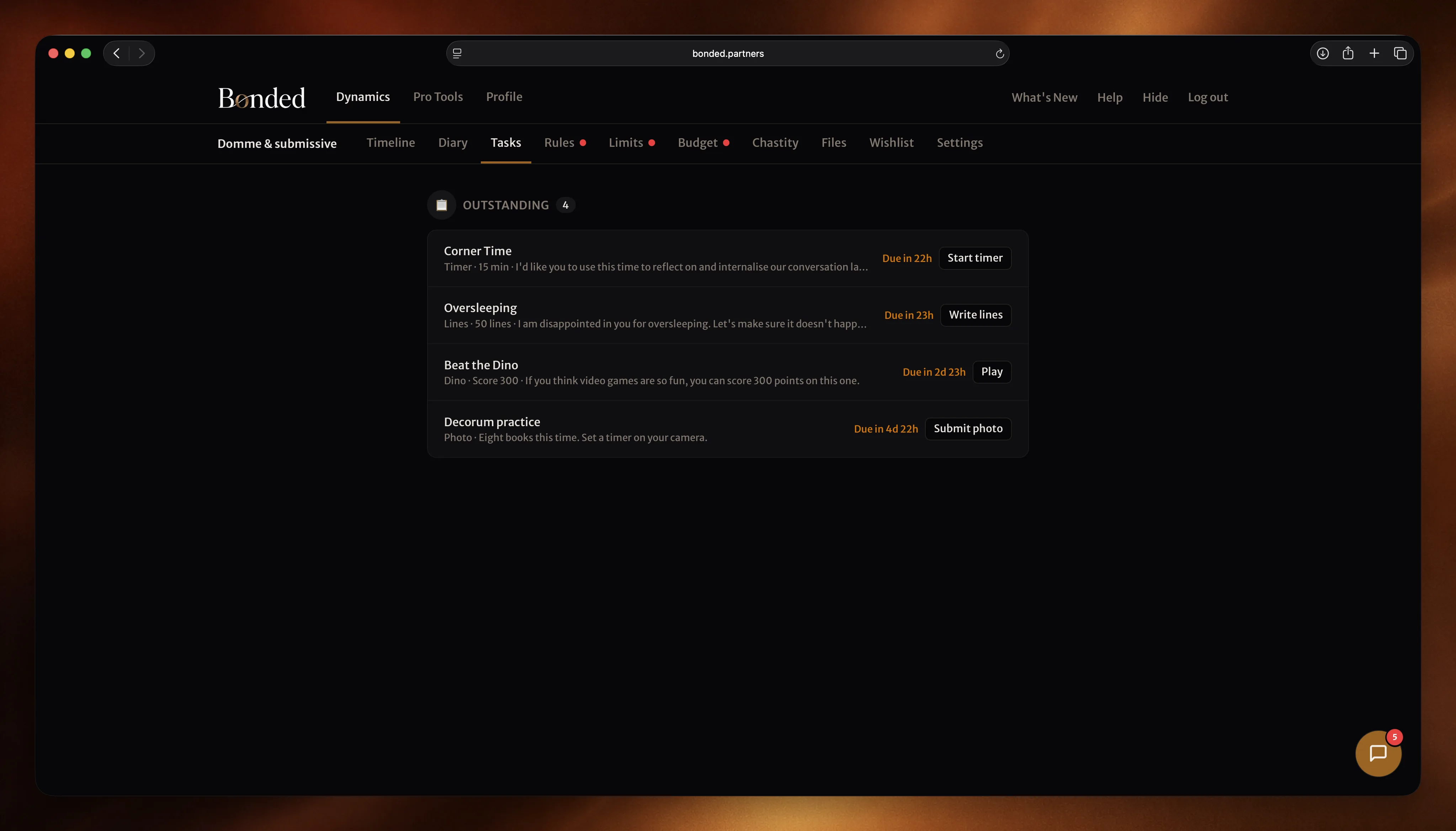
Evidence tasks let you assign work that requires photo, video, or text proof. The submissive sees the task in their Diary, submits evidence through the same interface they use for rules, and the task auto-completes when evidence is received. You set the evidence type when you create the task, so the submissive knows exactly what's expected.
Lines tasks go beyond simple repetition. The submissive types each line character by character. Errors reset the current line -- there's no skipping past mistakes. On completion, you see the stats: total time, error count, and words per minute. These numbers tell a story about focus, patience, and engagement that simple completion can't.
Timer tasks measure focus directly. The submissive starts the timer and must stay present for the assigned duration. Switching tabs or backgrounding the app registers as an interruption, and the interruption count is visible in the completion report. You know not just that they did it, but how they did it.
Each task type has a due date, and the Diary organises duties by urgency so nothing falls through the cracks. The Timeline records every assignment and completion, building a history of directed work that you can reference in check-ins, audits, and planning.
The point isn't the system. The point is what the system enables: tasks that are assigned with purpose, completed with effort, and reviewed with care. That cycle -- purpose, effort, care -- is what turns a task list into a practice.
Go deeper
Read the full guide→