



How to Write D/s Rules That Actually Work
Learn how to write D/s rules that stick. 10+ examples across protocol levels, plus a framework for specificity, evidence, and consequences.

Most D/s rules fail. Not dramatically -- they just quietly stop mattering. The submissive forgets, the Dom(me) stops checking, and what was supposed to be a cornerstone of your dynamic becomes background noise. Three months later someone brings it up during a check-in and both of you realise the rule hasn't been followed in weeks.
The problem is rarely desire. Both parties wanted the structure. The problem is construction. A rule that sounds compelling during a negotiation can be functionally unenforceable within days if it lacks the right bones.
This is a guide to building rules that hold weight -- rules your submissive can actually follow, rules you as a Dom(me) can actually track, and rules that deepen your dynamic instead of cluttering it.
The Anatomy of a Good Rule
Every functional rule answers five questions. If you can't answer all five, the rule isn't ready.
1. What exactly does compliance look like?
"Be respectful" is a value. "Address me as Sir/Ma'am in all text messages" is a rule. The difference matters enormously.
Specificity removes ambiguity. Ambiguity creates anxiety for submissives who want to obey and resentment for Dom(me)s who feel like they're constantly having to interpret. A submissive should be able to read the rule and know, without asking, whether they followed it today.
Bad: "Take care of yourself."
Better: "Eat three meals a day and drink at least two litres of water."
Best: "Log your three meals and water intake in your diary before 9pm."
Each version adds clarity. The final version also adds a deadline and a method of reporting, which brings us to the next question.
2. How do you measure it?
A rule without measurement is a suggestion. That's fine for values you want to cultivate, but it's not structure. Structure requires that both parties can point to something and say "yes, that happened" or "no, it didn't."
Measurement doesn't have to mean surveillance. It can be self-reporting in a diary, a photo sent at a specific time, a text confirmation, or simply a conversation. But the mechanism needs to exist and both people need to know what it is.
3. How often does it apply?
Daily rules create rhythm. Weekly rules create anticipation. Monthly rules create milestones. Rules without frequency create confusion.
"Keep the bedroom tidy" sounds permanent, but what does that mean? Checked daily? Only when the Dom(me) visits? Before every scene? Frequency isn't just about repetition -- it's about when the submissive's attention needs to be on this particular expectation.
4. What evidence is required?
This deserves its own section (and its own post -- see Evidence-Based Obedience), but the short version: requiring evidence transforms a rule from something the submissive does alone into something shared.
Evidence isn't about distrust. It's about attention. When a Dom(me) reviews evidence, that's an act of care. When a submissive creates evidence, that's an act of offering. The evidence cycle turns a solitary behaviour into a point of connection.
Types of evidence to consider:
- Photo: Completed chore, outfit check, meal prep
- Video: Exercise routine, posture practice, recitation
- Text: Reflection on the day, gratitude list, rule acknowledgement
5. What happens when the rule is broken?
Consequences are where many Dom(me)s stall. Either they set consequences that are too harsh (creating fear rather than accountability) or they set none at all (creating a rule that has no teeth).
Consequences should be proportional, relevant, and something the Dom(me) will actually enforce. That last part is critical. A consequence you won't follow through on is worse than no consequence, because it teaches the submissive that rules are negotiable through inaction.
Good consequences create a moment of reconnection. Lines to write. A temporary privilege removal. An essay about what went wrong. A required apology in a specific format. The consequence should bring the submissive's attention back to the rule, not make them dread the dynamic.
Common Mistakes (And How to Avoid Them)
Too many rules too soon
New dynamics are intoxicating. You've found someone who wants this, and suddenly every protocol you've ever imagined feels within reach. So you draft fifteen rules in the first week.
By week three, both of you are drowning. The submissive can't remember them all, the Dom(me) can't track them all, and resentment builds on both sides.
Start with two or three rules. Let them become habit. Then add. A dynamic with three rules that are followed perfectly has more structure than one with twenty rules that are followed sporadically.
Rules without buy-in
A rule imposed without discussion is an order. Orders have their place, but standing rules work better when the submissive understands the purpose behind them.
This doesn't mean rules require negotiation in the traditional sense. But a submissive who knows why a rule exists will follow it with more intention than one who's simply been told to comply. "Send me a good morning text because I want to be the first thing you think about" lands differently than "Send me a good morning text."
Vague consequences
"There will be consequences" is not a consequence. It's a threat, and threats create anxiety rather than accountability. Specify the consequence when you create the rule. If you're not sure what the consequence should be, that's a signal that the rule might need more thought.
Rules that serve no one
Every rule should serve the dynamic. Some serve the Dom(me) directly (service tasks, protocols). Some serve the submissive (self-care rules, structure for anxiety). Some serve the connection itself (daily check-ins, gratitude practices). But if a rule exists purely because it sounds like something a D/s dynamic "should" have, it's dead weight.
Ask yourself: if this rule were followed perfectly for a year, what would be different? If the answer is "nothing meaningful," drop it.
Forgetting to maintain
Rules are not set-and-forget. They need attention from the Dom(me) to stay alive. If you stop reviewing evidence, stop acknowledging compliance, stop enforcing consequences, you've effectively retired the rule whether you meant to or not.
Scheduled reviews -- monthly or quarterly -- keep your rule set alive. More on this in When Rules Stop Working.
10+ Example Rules Across Protocol Levels
These examples range from light structure to high protocol. Adapt them to your dynamic -- the specific wording matters less than the underlying framework.
Light Structure
Morning check-in
Title: Good morning text
Description: Send a good morning message before 9am with one thing you're looking forward to today.
Frequency: Daily
Evidence: Text
Consequence: Write a one-page reflection on what the morning routine means to your dynamic.
Hydration tracking
Title: Water intake
Description: Drink at least 2 litres of water daily. Log your intake in your diary before bed.
Frequency: Daily
Evidence: Text
Consequence: Add an extra 500ml the following day and submit photo evidence of every glass.
Weekly reflection
Title: Sunday reflection
Description: Write a 200+ word diary entry reflecting on the week -- what went well, what was hard, what you want next week.
Frequency: Weekly
Evidence: Text
Consequence: Write two reflections the following week.
Moderate Protocol
Outfit approval
Title: Outfit check
Description: Photograph your outfit before leaving the house and send for approval. Wait for acknowledgement before leaving. If no response within 20 minutes, proceed.
Frequency: Daily
Evidence: Photo
Consequence: Dom(me) selects the next day's outfit.
Exercise compliance
Title: Workout log
Description: Complete your assigned workout and submit a post-workout selfie as evidence. Log duration and exercises in the description.
Frequency: 3x weekly (Monday/Wednesday/Friday)
Evidence: Photo
Consequence: Additional workout session assigned over the weekend.
Bedtime protocol
Title: Lights out
Description: Be in bed by 11pm. Send a goodnight message confirming you're in bed. Phone goes on do-not-disturb after the message.
Frequency: Daily (weeknights)
Evidence: Text
Consequence: Bedtime moves 30 minutes earlier for the following week.
Gratitude practice
Title: Three gratitudes
Description: Before dinner, write three specific things you're grateful for today. At least one must relate to the dynamic.
Frequency: Daily
Evidence: Text
Consequence: Corner time (15 minutes, kneeling, reflecting on the purpose of gratitude).
High Protocol
Address protocol
Title: Formal address
Description: Use my title in all private communications. "Yes, [Title]" / "No, [Title]" for direct questions. Full sentences only -- no one-word answers.
Frequency: Ongoing
Evidence: None (observed)
Consequence: Lines -- write "I will address [Title] with the respect they deserve" 50 times.
Position practice
Title: Daily positions
Description: Practice each of the three assigned positions (kneel, present, rest) for two minutes each. Film a time-lapse and submit.
Frequency: Daily
Evidence: Video
Consequence: Double the duration for the following day.
Journaling protocol
Title: Evening journal
Description: Write a minimum 500-word journal entry covering: tasks completed, rules followed/broken, emotional state, and one question or request for your Dom(me). Submit before midnight.
Frequency: Daily
Evidence: Text
Consequence: Journal must be handwritten and photographed for the following week.
Permission protocol
Title: Spending permission
Description: Request approval for any non-essential purchase over $25. Provide: item, price, reason. Wait for explicit approval before purchasing.
Frequency: Ongoing
Evidence: Text (screenshot of request and approval)
Consequence: Non-essential spending suspended for one week.
Maintenance task
Title: Weekly deep clean
Description: Complete the assigned cleaning zone (rotates weekly). Submit before/after photos. The space must meet inspection standards.
Frequency: Weekly
Evidence: Photo
Consequence: Re-clean plus an additional zone.
How Rules Should Evolve
A rule that worked perfectly six months ago might be wrong for your dynamic today. This isn't failure -- it's growth.
Rules evolve in several ways:
Graduation. The behaviour has become habit. The submissive does it automatically. You can retire the rule with acknowledgement -- celebrate that it worked -- and redirect that attention to a new area of growth.
Escalation. The rule is easy now. Increase specificity, frequency, or evidence requirements. A daily text check-in might evolve into a structured morning report. A weekly reflection might become a daily journal.
Retirement. The rule no longer serves its purpose. Maybe circumstances changed -- a new job, a health issue, a shift in the dynamic. Retiring a rule isn't weakness. Keeping a rule that no longer fits is.
Revision. The intent was right but the implementation was wrong. Keep the spirit, change the details. Maybe the frequency was too aggressive, or the evidence type didn't work. Adjust and re-establish.
Building Your Rule Set in Practice
If you're starting from zero, here's a framework:
Week 1-2: One rule. Something simple with daily frequency and text evidence. A morning check-in or a gratitude practice. Focus on establishing the rhythm of compliance, review, and acknowledgement.
Week 3-4: Add a second rule. Something with a different frequency -- weekly works well. Maybe a reflection or a service task. Now the submissive is managing two rhythms simultaneously.
Month 2: Consider adding a rule with photo or video evidence. This requires more effort from the submissive and more attention from the Dom(me). Only add it if you're both keeping up with the first two.
Month 3 and beyond: Audit what's working. Retire or revise what isn't. Add rules deliberately, not impulsively. A well-maintained set of five to seven rules provides profound structure without overwhelming either party.
Where Bonded Fits
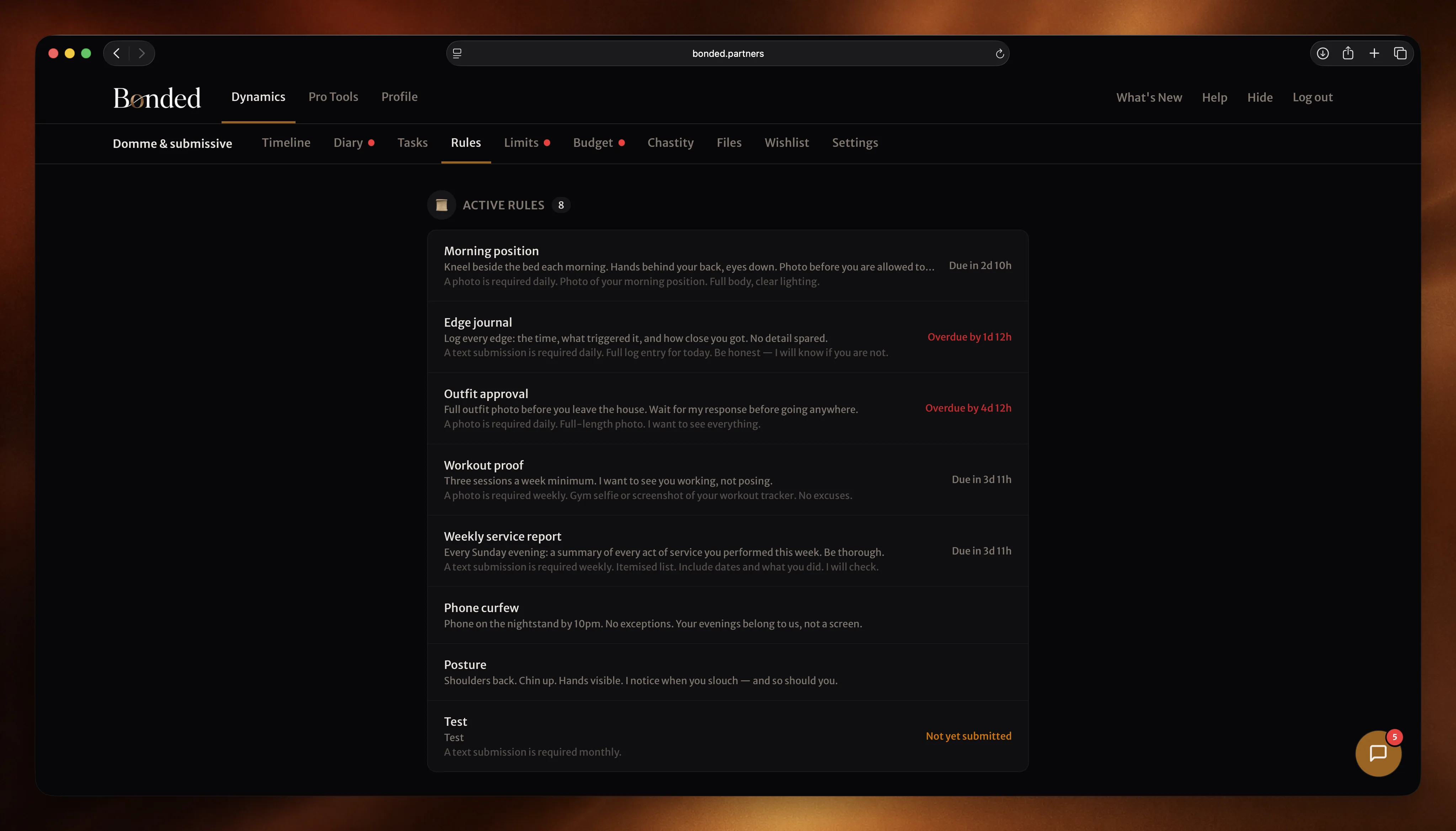
Bonded was built for exactly this kind of structured power exchange. Each rule you create includes a title, description, evidence type (photo, video, or text), frequency (daily, weekly, or monthly), and a detailed evidence description so your submissive knows precisely what to submit.
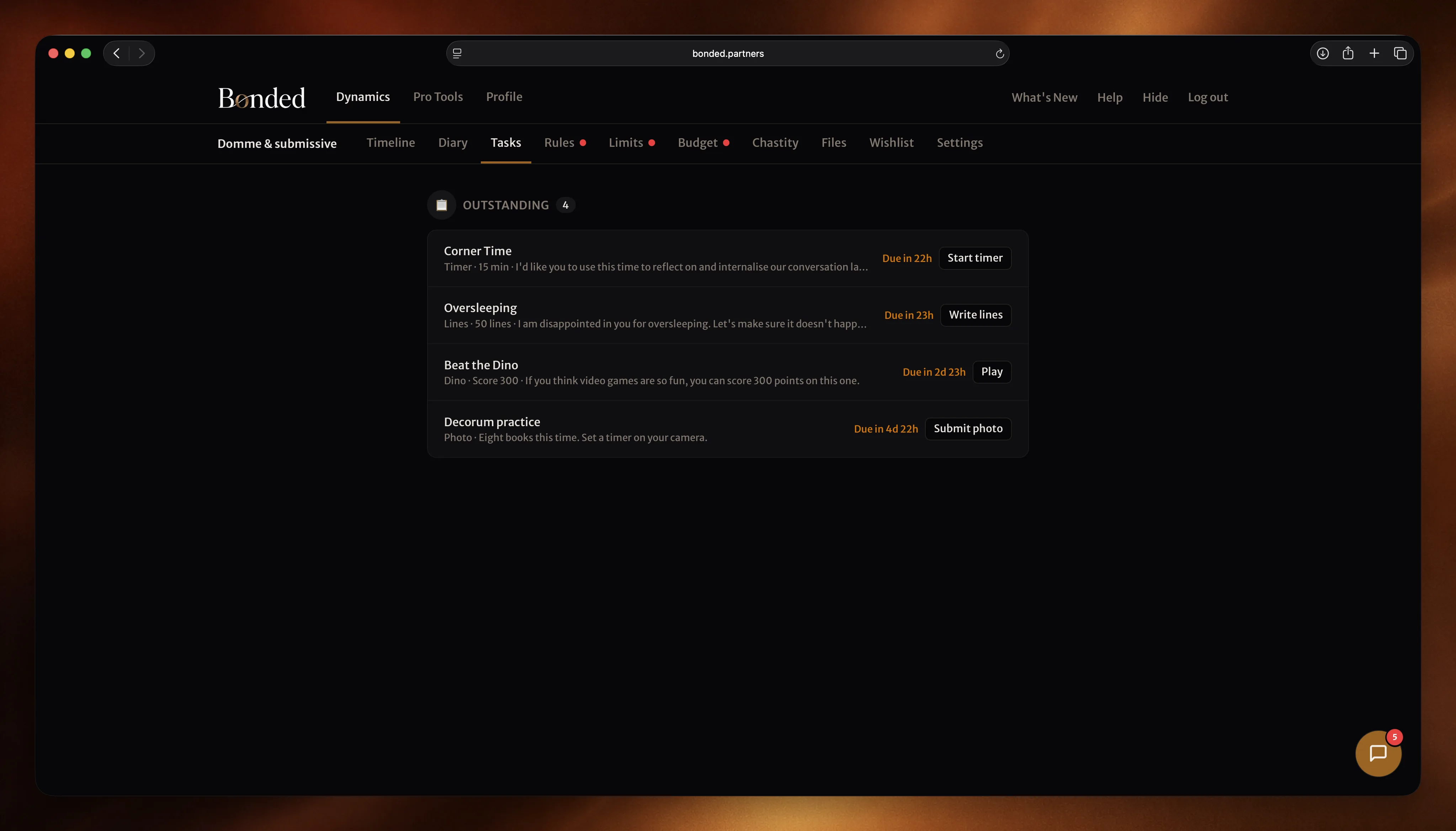
Evidence flows into the Diary, where submissives see their duties organised by status -- overdue, due today, coming up. Dom(me)s review submissions with the ability to acknowledge, comment, or request resubmission. Everything is tracked on the Timeline, creating a living history of your dynamic's structure.
The system handles the logistics -- due dates, submission tracking, status updates -- so you can focus on what matters: the relationship between the rule-maker and the rule-follower.
Go deeper
Read the full guide→