



When Rules Stop Working: How to Renegotiate Without Losing Structure
D/s rules not working? Learn how to audit, renegotiate, and evolve your rules without losing the structure your dynamic depends on.

There's a rule in your dynamic that both of you quietly know isn't being followed anymore. The submissive hasn't submitted evidence in two weeks. The Dom(me) hasn't mentioned it. Nobody's pretending it doesn't exist exactly, but nobody's addressing it either. It's just... there, taking up space, generating a low hum of guilt on one side and frustration on the other.
This is rule decay, and every dynamic that lasts long enough encounters it. The question isn't whether your rules will stop working. The question is what you do when they do.
Why Rules Go Stale
Rules don't usually fail dramatically. They erode. Understanding why gives you a chance to catch it early.
The novelty wore off
New rules carry energy. The first week of a daily check-in feels charged -- the submissive is thinking about it, the Dom(me) is reading every word. By month three, it's routine. Routine isn't bad -- it's literally the goal of a rule -- but routine without engagement is hollow. If the Dom(me) stopped reading the check-ins but the submissive is still sending them, the rule is technically being followed but functionally dead.
Life changed
You wrote the rule when one of you worked from home. Now they're in an office five days a week. The evidence photo that was easy to take at 7am is now impossible. The evening journal that was meditative is now one more task in an exhausted day.
Rules are written for specific circumstances. When circumstances change and the rule doesn't, friction follows.
The submissive outgrew it
Some rules are training wheels. A rule requiring three meals a day makes sense when a submissive is struggling with self-care. Six months later, eating regularly is just what they do. The rule hasn't failed -- it succeeded. But keeping it active past its purpose creates resentment: "I've proven I can do this. Why don't they trust me?"
The Dom(me) stopped enforcing
This is the most common cause and the hardest to admit. Enforcement takes energy. Reviewing evidence, acknowledging submissions, tracking compliance, issuing consequences -- it's work. When life gets busy, enforcement is often the first thing that slides.
A submissive who breaks a rule and receives no response learns that rules are optional. Two or three unenforced breaks and the rule's authority is gone. Rebuilding it requires more than just saying "I'm serious about this again."
It was never right to begin with
Sometimes a rule was exciting in theory and awkward in practice. The outfit approval rule sounded hot during negotiation but in reality, the Dom(me) is in meetings all morning and can't respond in time, and the submissive is standing in the hallway getting anxious. The rule wasn't tested against real conditions.
Signs of Rule Fatigue
Watch for these. They rarely appear as open complaints.
Consistent lateness. Submissions that were once punctual start arriving later and later. Not flagrantly late -- just edging. An evening journal due by midnight consistently arriving at 11:47, then 11:53, then 11:58.
Decreased quality. A reflection that used to be three paragraphs is now three sentences. Photo evidence that was once thoughtful is now a blurry afterthought.
Avoidance of discussion. During check-ins, the subject of rules gets skipped or glossed over. Both parties are complicit in this -- neither wants to say what both feel.
Increased bratting around the rule. Bratting is its own thing and can be healthy. But a submissive who's never bratted about their morning text and suddenly starts "forgetting" is communicating something.
The Dom(me) stops checking. If you realise you haven't reviewed evidence in a week and it didn't occur to you, the rule has already lost its hold on your attention.
Guilt spirals. The submissive misses the rule, feels guilty, avoids their Dom(me) because of the guilt, misses the rule again because they're avoiding, feels more guilty. This is rule decay turning toxic.
The Renegotiation Framework
When you've identified that a rule isn't working, resist two temptations: pretending it's fine and burning the whole structure down. Neither helps. Instead, use this four-stage process.
Stage 1: Audit
Before you discuss anything, gather information. Review the evidence trail. When did submissions become inconsistent? Was there a trigger -- a life event, a shift in the dynamic, a pattern of enforcement gaps?
If you're using Bonded, your Timeline and Diary history give you this data without relying on memory. You can see exactly when compliance shifted, whether evidence quality changed, and how the Dom(me)'s engagement (acknowledgements, comments) tracked against it.
Write down what you observe. Facts, not judgments. "Evidence submissions went from daily to every three days starting around mid-January" is useful. "You stopped caring about the rule" is an accusation.
Stage 2: Discuss
This is a conversation, not an interrogation. The goal is to understand what happened and whether the rule still serves the dynamic.
Questions that open the conversation:
- "I've noticed [specific observation]. What's been going on for you with this rule?"
- "How does this rule feel compared to when we started it?"
- "Is this rule still doing what we wanted it to do?"
- "What would need to change for this rule to work again? Or should we let it go?"
Listen for what's underneath the answer. "It's fine, I'll do better" is a submissive trying to please, not a submissive being honest. Push gently: "I'm not looking for compliance right now. I'm looking for truth. If this rule doesn't fit anymore, that's okay to say."
Dom(me)s need to be honest too. If enforcement slipped, own it. "I stopped checking your evidence, and that's my failure as much as yours. I let the structure down."
Stage 3: Decide -- Retire, Revise, or Replace
Based on the conversation, the rule goes one of three directions.
Retire. The rule served its purpose and is done. The behaviour is ingrained, or circumstances made it irrelevant. Retirement isn't failure. Celebrate what it accomplished: "This rule helped you build a morning routine that you now do naturally. We don't need it anymore."
Toggle the rule to inactive. It stays in your history -- visible in the Timeline, part of your dynamic's record -- but it no longer generates duties or expectations.
Revise. The intent is right but the execution needs adjustment. Common revisions:
- Change frequency (daily was too much; make it three times a week)
- Change evidence type (photos are inconvenient; switch to text)
- Change timing (morning submissions don't work with the new schedule; move to evening)
- Simplify the requirement (500 words was aspirational; 200 words gets done)
- Clarify the consequence (the original consequence was never enforced; set one that will be)
Revision should feel like an upgrade, not a downgrade. Frame it as making the rule fit better, not making it easier.
Replace. The rule's intent is still valid but the specific rule is wrong. Replace it with something that achieves the same goal through different means. If the morning check-in text was about connection but the text format isn't working, maybe it becomes a voice message. Or a photo of something that caught the submissive's eye. Same intent, different vehicle.
Stage 4: Re-establish
However the rule lands, it needs a fresh start. A revised or replaced rule should be re-communicated clearly, with updated expectations, evidence requirements, and consequences. The submissive should acknowledge the new terms. The Dom(me) should commit to enforcement.
If you retired the rule and replaced it with nothing, that's a valid outcome. But address the gap explicitly: "We're going from seven rules to six. That's intentional. I'd rather have six rules that hold than seven where one is hollow."
If you revised the rule, set a check-in date. "Let's try this version for three weeks and then talk about how it's going." This prevents the revised rule from silently decaying the way the original did.
When the Problem Isn't the Rule
Sometimes rule fatigue is a symptom of something larger.
Dynamic fatigue. Both parties are tired. Not of each other, but of the ongoing effort of maintaining a power exchange. This is normal. It happens in waves. The solution usually isn't rule changes -- it's rest. A temporary protocol reduction, a "vanilla weekend," or simply an honest conversation about energy levels.
Unspoken resentment. A submissive breaking rules consistently might be expressing anger they don't feel safe voicing directly. A Dom(me) who stops enforcing might be withdrawing emotionally. Rule renegotiation won't fix relationship issues. If the audit reveals something deeper, go deeper.
External stress. Job loss, family crisis, health issues, mental health episodes -- these affect everything, including D/s dynamics. Rules might need to be paused entirely, not renegotiated. There's no shame in saying "We're putting structure on hold while we deal with this."
Role uncertainty. Sometimes a submissive breaking rules is questioning whether they want to be submissive. Sometimes a Dom(me) who stops enforcing is questioning whether they want to lead. These are important realisations, and rule mechanics can't address them.
Normalising Rule Evolution
The D/s community sometimes treats rule changes as instability. If you set a rule, you should keep it. If you change your rules, your dynamic must be struggling.
That's backwards. Static rules are lazy rules. They indicate a dynamic that isn't growing, adapting, or deepening. The healthiest dynamics have rule sets that look different every six months -- not because they're chaotic, but because both parties are paying attention to what works and what doesn't.
Think of your rule set as a living document. Some rules are permanent cornerstones that rarely change. Others are seasonal -- relevant for a period and then retired. Still others are experimental -- tried for a set period and evaluated.
Framing rules this way from the beginning reduces the shame around renegotiation. "This rule is an experiment. We'll try it for a month and then decide" feels different from "This is your new rule" followed by a quiet failure six weeks later.
Practical Tips for Ongoing Rule Health
Schedule regular audits. Monthly or quarterly, review every active rule. Is it being followed? Is the Dom(me) engaging with evidence? Is it still serving the dynamic? Don't wait for decay to trigger the conversation.
Use your data. If you track rules digitally, you have a compliance record. Use it. Patterns in evidence timing, quality, and consistency tell you things that feelings and impressions can't.
Keep a rule diary. Encourage the submissive to write about their experience with rules in their diary entries -- not just evidence, but reflections. "This rule felt easy today" and "I almost didn't do this one" are equally valuable data points.
Acknowledge compliance, not just non-compliance. If you only engage with rules when they're broken, you've built a system where the submissive's best outcome is silence. Acknowledge when rules are followed well: read the evidence, comment on it, mention it in conversation. Attention is the fuel that keeps rules alive.
Be willing to simplify. A dynamic with three well-maintained rules is stronger than one with ten neglected ones. If your rule set has grown unwieldy, cut it back to the essentials and rebuild from there.
Distinguish between compliance and engagement. A submissive who submits evidence exactly on time but with no heart in it is complying, not engaging. If you see this pattern, the rule might need revision or the dynamic might need a conversation that goes beyond mechanics.
What Renegotiation Looks Like in Bonded
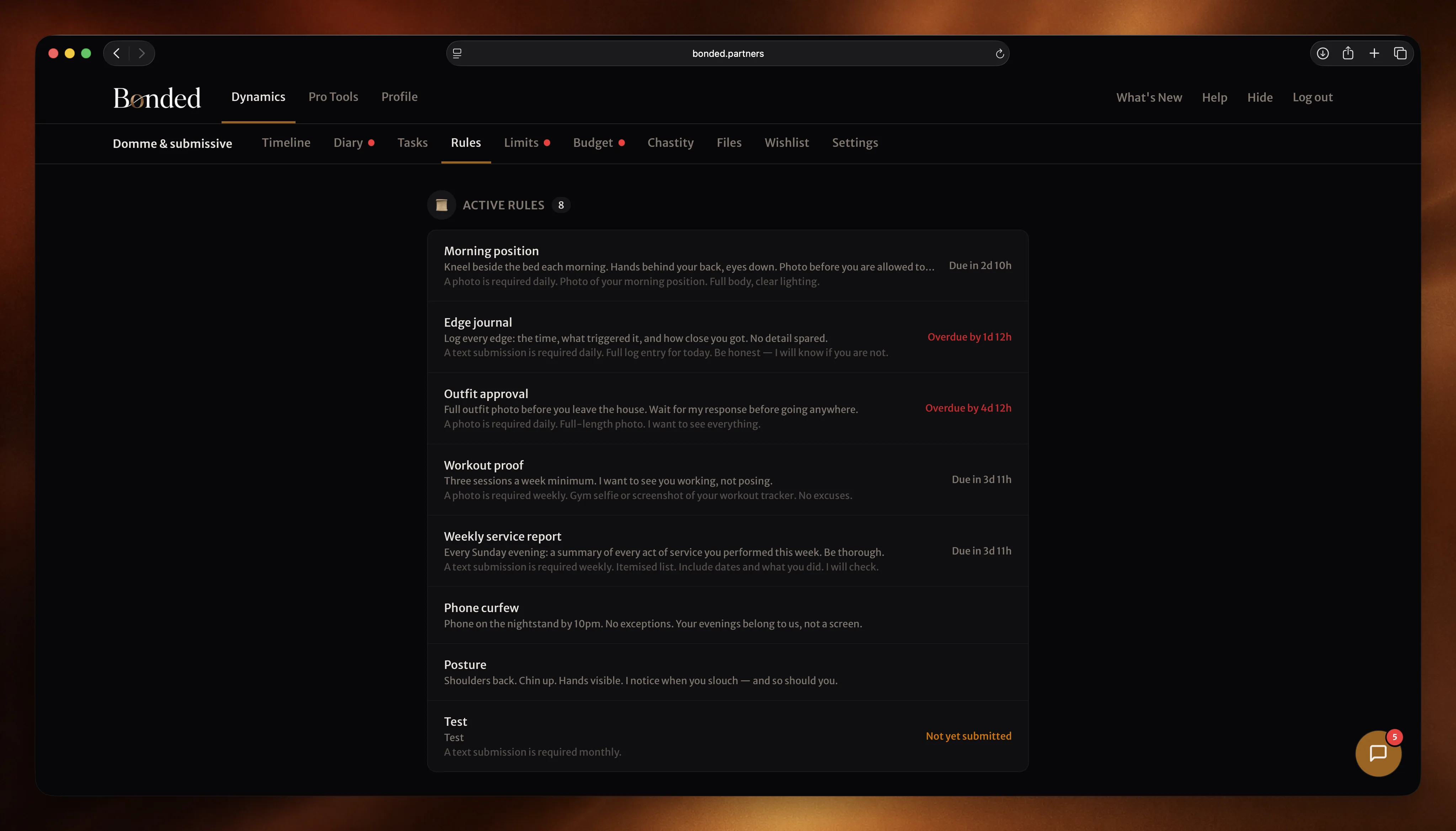
Bonded's rule system was designed with evolution in mind. Rules can be toggled between active and inactive states, preserving their history without cluttering the submissive's current duties. The Timeline records when rules were created, modified, and evidence submitted, giving you a clear audit trail for your renegotiation conversations.
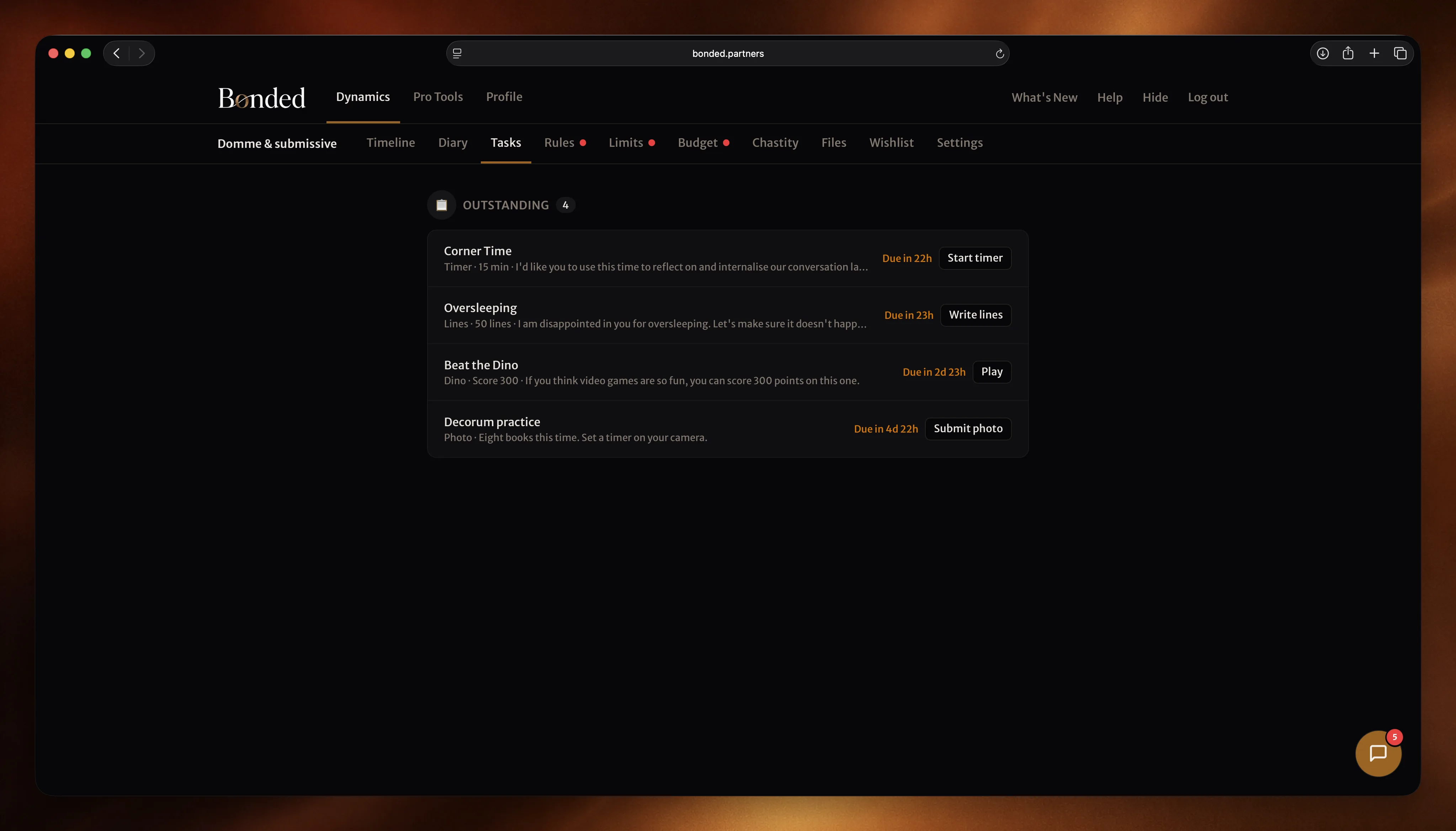
The Diary's reflection feature gives submissives a natural place to write about rule experiences, and Dom(me)s can respond with comments or use the resubmission request to signal that more reflection is needed.
When you revise a rule, you update the title, description, evidence type, or frequency directly. The submissive sees the updated version in their Diary. When you retire a rule, toggling it inactive removes it from the duty flow while keeping every submission, acknowledgement, and comment in the Timeline.
This matters because rule history is dynamic history. Even rules that didn't work are part of your story. Being able to look back and say "We tried this, it didn't fit, so we changed it" is a record of growth.
Go deeper
Read the full guide→