




Evidence-Based Obedience: Why Proof Deepens Accountability
Why requiring evidence in D/s deepens accountability and connection. Types of proof, the psychology behind it, and how to implement it.
There's a meaningful difference between doing something and showing that you did it. Both require effort, but only one creates a shared experience. When a submissive drinks their required water for the day, that's compliance. When they photograph each glass and submit the images with a note about how they're feeling, that's connection.
Evidence in D/s is one of those topics that can sound clinical or distrustful if you approach it wrong. "Prove that you followed the rule" sounds like a boss checking timesheets. But that reading misses what's actually happening. Evidence isn't verification. It's a gift -- from the submissive who creates it, and from the Dom(me) who receives and reviews it.
This post is about why evidence works, what kinds of evidence suit different rules, and how to build an evidence practice that deepens your dynamic rather than creating busywork.
The Psychology of Creating Evidence
When a submissive follows a rule without evidence requirements, the experience is internal. They know they did it. That knowledge might bring satisfaction, a sense of structure, maybe a small rush of obedience. Then the moment passes. By the next day, it's indistinguishable from any other completed task.
When a submissive creates evidence, the experience becomes external. It has to be articulated, captured, shaped into something communicable. This process fundamentally changes the act of compliance.
It demands presence
Taking a photo of your completed chore requires you to stop, assess the result, and consciously mark the moment. Writing a text reflection about your bedtime routine requires you to think about it rather than just doing it. Evidence creation is a mindfulness practice disguised as a D/s requirement.
It creates a record
Humans are terrible at remembering their own consistency. A submissive who's been following a rule for three months might feel like they've been inconsistent because they remember the misses more than the hits. Evidence creates an objective record. Scrolling through weeks of submitted photos or reflections provides a tangible reminder that compliance has been consistent, which is enormously motivating.
It extends the act of obedience
Following a rule takes whatever time the rule requires. Creating evidence adds another step -- another few minutes where the submissive is actively engaged with the rule, thinking about their Dom(me), producing something for their Dom(me)'s attention. The obedience isn't a moment; it's a process.
It creates vulnerability
Especially with photo and video evidence. Sending an image of yourself, your space, your work -- it's an offering. It says "Here. Look at me. See what I did for you." That vulnerability is itself a form of submission, layered on top of the rule compliance.
The Psychology of Receiving Evidence
The other half of the equation matters just as much.
Review is an act of care
When a Dom(me) opens a submission, looks at the photo, reads the reflection, and responds -- that's attention. In a world where attention is the scarcest resource, choosing to spend it on your submissive's evidence is profound.
This is why review can't be perfunctory. A thumbs-up emoji is better than nothing, but a sentence about what you noticed is better than a thumbs-up. "I can see you reorganised the bookshelf by colour -- that must have taken time" tells the submissive their effort was actually seen, not just acknowledged.
It gives the Dom(me) data
Evidence over time reveals patterns that conversation might not. A submissive whose text reflections become shorter and more perfunctory might be experiencing burnout. A submissive whose photos become more creative and detailed is deepening their investment. A submissive who always submits at the last possible minute might be struggling with the rule's timing.
Without evidence, the Dom(me) only knows what the submissive tells them. With evidence, the Dom(me) can observe directly. This isn't surveillance -- it's attentiveness. The same way a good partner notices when the other seems tired or distracted, a good Dom(me) reads evidence for what it reveals about their submissive's state.
It creates a feedback loop
Evidence flows from submissive to Dom(me). Acknowledgement flows back. That exchange is a micro-interaction that reinforces the dynamic multiple times a day, even when both parties are physically apart. For long-distance dynamics especially, the evidence cycle is often the primary way structure is felt day to day.
Not Distrust -- Attention
This point deserves its own section because the misconception is so persistent.
"If you trust me, you wouldn't need proof."
This framing misunderstands the purpose entirely. Evidence isn't about distrust. Consider: a Dom(me) who doesn't require evidence and simply trusts that rules are being followed is -- intentionally or not -- disengaging from the rule. They set it and forgot it. The submissive is doing the work alone.
A Dom(me) who requires and reviews evidence is actively participating in every rule, every day. The submissive is not performing obedience into a void. They are performing it for an audience of one who is paying attention.
Trust and evidence aren't opposites. If anything, evidence builds trust. Consistent evidence over weeks and months creates a factual foundation of reliability that both parties can point to. "I've submitted every day for three months" is a different kind of trust than "I promise I'm following the rules."
Some dynamics work perfectly without evidence requirements. If verbal check-ins and the honour system provide enough structure, that's valid. But if either party feels like rules lack weight, evidence is often the missing ingredient.
Types of Evidence for Different Rules
Matching evidence type to rule type matters. The wrong format creates friction that undermines the rule itself.
Photo Evidence
Best for:
- Physical tasks (chores, organisation, meal prep)
- Appearance rules (outfits, grooming, posture)
- Self-care (meals, workouts, hydration)
- Completed creative work
Tips:
- Specify what the photo should show. "Photo of the completed task" is vague. "Photo of the kitchen counter and stovetop after cleaning" is actionable.
- Consider lighting and quality expectations. Some Dom(me)s want functional documentation. Others want the photo itself to be an act of care -- well-lit, framed thoughtfully.
- Multiple photos can tell a before-and-after story.
Watch out for: Photo evidence becomes rote fast. The submissive snaps a quick picture without thought. If the photos start looking identical and lifeless, it's time to add specificity: "Include something in the photo that's different about today."
Video Evidence
Best for:
- Physical practices (exercise, positions, yoga, stretching)
- Recitation or verbal assignments
- Process documentation (showing how a task was done, not just the result)
- Tasks where duration matters (hold this position for two minutes -- prove it)
Tips:
- Set length expectations. "Under 60 seconds" prevents anxiety about production quality. "At least three minutes" ensures genuine documentation.
- Specify whether the submissive should narrate or be silent.
- Consider privacy. Video evidence is more intimate than photos. Discuss comfort levels and storage expectations.
Watch out for: Video is high-effort. If every rule requires video evidence, evidence fatigue will set in quickly. Reserve video for rules where the process matters, not just the outcome.
Text Evidence
Best for:
- Reflective rules (journaling, gratitude, self-assessment)
- Communication rules (how they felt about something, what they learned)
- Planning tasks (meal plans, schedules, goal-setting)
- Emotional check-ins
Tips:
- Set word minimums when appropriate. "Write about your day" will produce three words from a busy submissive and three pages from a verbose one. "Write at least 150 words about your day" creates a useful floor.
- Prompt specifically when the rule requires depth. "Reflect on your dynamic" is huge and paralysing. "Write about one moment today where you felt your submission" is focused and answerable.
- Encourage honesty over performance. The submissive should be writing for reflection, not for a grade.
Watch out for: Text evidence can become performative. The submissive writes what they think the Dom(me) wants to read rather than what's actually true. Combat this by responding authentically to honest submissions and gently pushing back on ones that feel like they're performing.
Implementing Evidence Without Overwhelm
Not every rule needs evidence
Some rules work fine on the honour system. Address protocol, for example -- you'll hear whether they're using your title. Bedtime rules can be self-reported with a simple text message. Evidence requirements should be reserved for rules where the evidence adds value, either through the creation process (mindfulness, vulnerability, reflection) or through the review process (verification, data, connection).
Start with one evidence rule
If evidence is new to your dynamic, don't convert every rule at once. Pick the rule that would benefit most from an evidence component. Get the rhythm established -- submit, review, acknowledge -- before adding more.
Set realistic review expectations
If you require daily photo evidence for three rules, you need to review three photos every day. Can you commit to that? If not, either reduce the evidence frequency or accept that some evidence will be reviewed in batches. Batched review is fine -- just be transparent about it. "I review evidence every evening" is a manageable commitment.
Make evidence submission easy
The harder it is to create and submit evidence, the more likely it is to be skipped. If your submissive has to take a photo, transfer it to a computer, upload it to a shared drive, and send you a link -- that's four steps too many. A system where they can take the photo and submit it in the same flow removes friction.
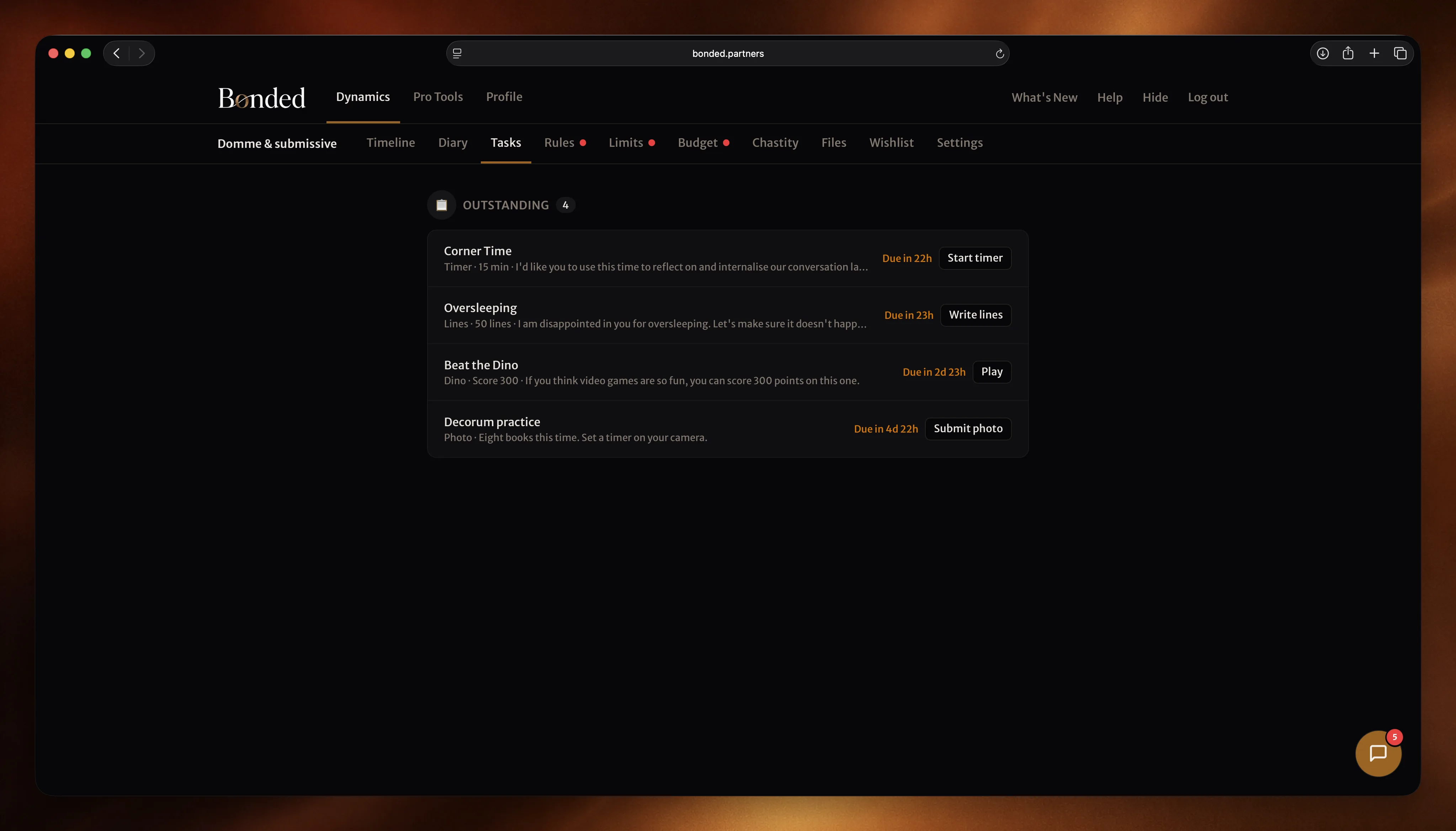
Bonded handles this directly. Evidence for rules flows through the Diary, where submissives see their duties laid out by status. A photo rule shows a camera/upload interface. A text rule shows a text editor. Tap, submit, done. The Dom(me) sees the submission, can acknowledge it, comment on it, or request resubmission -- all in the same place.
Vary evidence expectations over time
A daily photo of the same completed chore will become tedious for both parties. Consider rotating evidence types: photo on Monday and Thursday, text reflection on Wednesday, no evidence on weekends. Or change the evidence prompt monthly: "This month, include a note about how this task makes you feel."
Evidence and Long-Distance Dynamics
For dynamics where partners aren't physically together -- whether that's long-distance, or simply two people with different schedules and separate homes -- evidence is often the backbone of the entire structure.
Without evidence, a long-distance Dom(me) has to take their submissive's word for everything. That's not because the submissive is dishonest -- it's because there's no natural way to observe. In-person dynamics have ambient information: you can see the tidy kitchen, notice the outfit, observe the morning routine. Long-distance dynamics have evidence, or they have nothing.
Many long-distance Dom(me)s report that evidence review is the single most important daily ritual in their dynamic. It's the time when they feel most connected to their submissive, most engaged with the structure, most present in their role.
For the submissive, the creation of evidence for a distant Dom(me) is one of the most tangible expressions of submission available. You can't kneel at someone's feet over a phone call. But you can photograph your completed tasks, write your reflections, film your position practice, and send it all as an offering that says "Even though you can't see me, I want you to."
Evidence as Dynamic History
Over months, evidence submissions accumulate into something greater than their individual parts. They become a record.
That record serves multiple purposes. During rule audits, it provides objective data about compliance patterns. During disagreements, it offers facts instead of competing memories. During low moments, it's a reminder of sustained effort and genuine commitment.
Some couples review old evidence together as a bonding activity. Looking at the first evidence submission alongside the most recent one -- seeing how the submissive's writing deepened, how their photos became more intentional, how the quality of their work improved -- that's growth you can see.
This is why evidence storage matters. A submission reviewed and then lost is a missed opportunity. When evidence lives in a Timeline alongside every other significant event in the dynamic, it becomes part of a story. The rule was created (there it is in the Timeline). The first evidence was submitted (there it is). The Dom(me) commented on it (there). A month later, the rule was revised (there). The evidence changed accordingly (there). Six months later, the rule was retired because the behaviour was ingrained (there).
That's not just a record of compliance. That's a record of growth, attention, and care.
Common Questions
"What if the submissive feels micromanaged?"
They might, at first. Especially if evidence is new. The key is framing: evidence isn't checking up on you, it's connecting with you. If the feeling persists after an adjustment period, reduce the evidence requirements. More evidence isn't always better.
"What if the Dom(me) can't keep up with reviews?"
Then you've overcommitted on evidence requirements. Scale back until the review load is sustainable. Unreviewied evidence is worse than no evidence, because it tells the submissive their offerings aren't worth your time.
"What about privacy? These submissions are intimate."
Absolutely. Discuss and agree on storage, access, and retention. Who can see the evidence? Where does it live? What happens to it if the dynamic ends? These conversations should happen before evidence requirements are established. Bonded stores evidence in private dynamic-scoped storage, and evidence submissions are only visible to members of the dynamic.
"Do both parties need to submit evidence, or just the submissive?"
In most D/s structures, evidence flows from submissive to Dom(me). But there's nothing preventing a Dom(me) from offering evidence of their own commitments -- particularly in dynamics that value mutual accountability. A Dom(me) who commits to reviewing evidence within 24 hours could track that commitment themselves.
Building Your Evidence Practice
If you're starting from scratch:
Week 1: Add an evidence requirement to one existing rule. Choose text evidence -- it's the lowest friction. Something like a daily check-in with a three-sentence minimum.
Week 2: Begin reviewing evidence within 24 hours. Respond with specific observations, not just acknowledgements.
Week 3: Add a second evidence rule, this time with photo or video. Notice how the creation process changes the submissive's engagement with the rule.
Week 4: Check in. How does the evidence cycle feel? Too much? Not enough? Adjust accordingly.
Month 2 and beyond: Consider which other rules would benefit from evidence. Which ones are fine without it. Settle into a sustainable rhythm.
The goal isn't maximum evidence. It's the right amount of evidence -- enough to create connection, accountability, and presence, without so much that it becomes a chore for either party.
Go deeper
Read the full guide→