



Creative Punishments and Rewards That Aren't What You Think
Move beyond the obvious with creative D/s punishments and rewards. Lines, corner time, privilege removal, journaling, and more.

The internet will tell you that punishments in D/s mean spanking and rewards mean orgasms. There's nothing wrong with either of those things. But if your entire consequence system runs on a single axis of physical sensation, you're missing the point -- and probably burning out.
Real consequences and rewards do something more fundamental than create pleasure or pain. They redirect attention. They mark moments. They give weight to the structure you've built together. The best ones are often quiet, deeply personal, and nothing like what people outside the community would expect.
Why Consequences Matter at All
Before the how, the why. Because this question comes up constantly: "Do we even need punishments? We're adults."
You are adults. And adults who have consensually agreed to a power exchange have also agreed that actions have weight. Without consequences, rules become requests. Requests can be ignored without friction. Structure without friction is decoration.
That doesn't mean consequences have to be unpleasant. Some should be. Others should simply be notable -- different enough from the daily routine that they create a marker. "Something happened here. We addressed it. We move forward."
Rewards work the same way. A submissive who follows every rule perfectly for a month and receives no acknowledgement will eventually wonder why they're bothering. Rewards aren't bribes. They're recognition that effort was seen.
Funishment vs. Genuine Consequences
This distinction matters and gets muddled constantly.
Funishment is "punishment" that both parties enjoy. It often involves impact play, predicament bondage, or other forms of erotic play framed as correction. There's nothing wrong with funishment. It's a valid form of play and it can be fantastic.
But funishment is not a consequence system. If your submissive enjoys being spanked and you spank them when they break a rule, you've created a reward loop for non-compliance. Some submissives will absolutely start breaking rules on purpose to trigger the "punishment." This is bratting, and if that's your dynamic, great. But if you wanted genuine accountability, you've built the opposite.
Genuine consequences should be things the submissive doesn't seek out but will accept because they understand the purpose. That's a narrow window, and it's different for every person. Corner time might be genuinely corrective for one submissive and deeply triggering for another. You have to know your person.
The safest test: if breaking a rule leads to something the submissive would actively try to cause, it's funishment. If it leads to something they'd rather avoid but accept as fair, it's a consequence.
Punishments That Actually Work
Lines
Writing lines is one of the oldest disciplinary tools in the world, and it works in D/s for the same reason it worked in schools: repetition forces focus.
"I will complete my morning check-in on time." Written fifty times. Or a hundred. Or two hundred, depending on the severity.
The psychology is interesting. The first few lines feel annoying. Somewhere around line twenty, the mind starts to wander. Around line forty, the repetitive physical act creates a meditative state, and the content of the line starts to actually land. By the end, the submissive has spent real time and real effort engaging with the rule they broke.
Lines work best when:
- The text directly relates to the infraction
- There's a clear count
- There must be completed accurately (errors require starting over or repeating the line)
- There's a time component -- how long it took matters
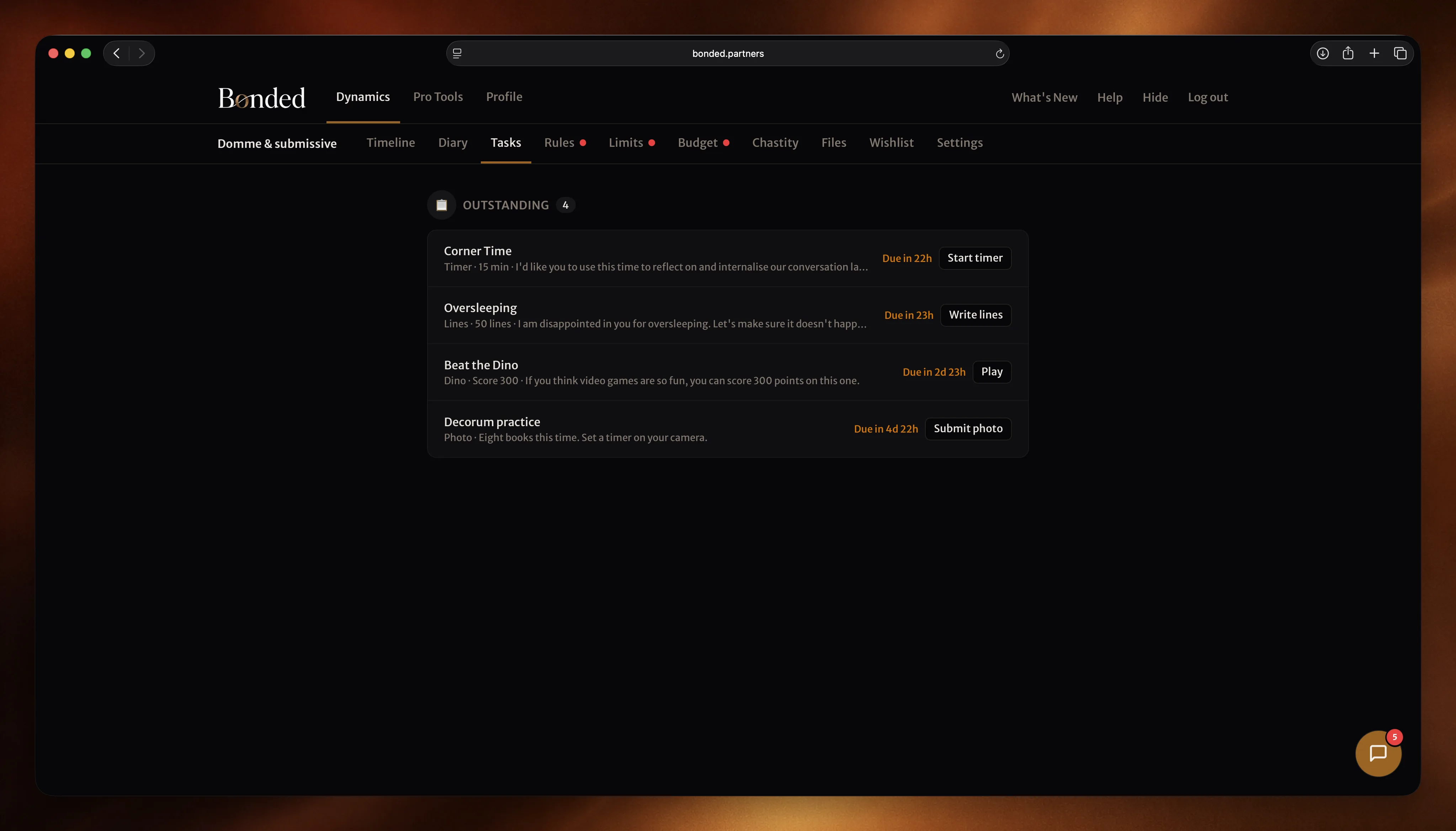
Bonded's Lines tasks track this in detail. The submissive types each line character by character. Errors reset the current line. The system records completion time, error count, and words per minute. The Dom(me) sees everything -- not just whether the lines were done, but how they were done. A completion with zero errors in thirty minutes tells a different story than one with forty errors over two hours.
Corner Time
Simple. Powerful. Underutilised.
The submissive kneels or stands in a designated spot for a set period. No phone. No music. No distraction. Just them, the wall, and whatever thoughts arise.
Corner time works because modern humans are almost never alone with their thoughts. We fill every gap with a screen. Removing that option, even for fifteen minutes, creates space for genuine reflection. Many submissives report that corner time is harder than impact play, not because it hurts but because it requires presence.
Variations:
- Timed corner time: 10, 15, 30 minutes depending on severity
- Reflective corner time: Submissive must write about what they thought during the time afterward
- Position corner time: A specific posture must be maintained -- kneeling, hands behind back, forehead against wall
You can verify corner time with a Timer task. The submissive starts the timer and must maintain focus for the assigned duration. Tab-switching or app backgrounding registers as an interruption, so the Dom(me) can see if the submissive actually stayed put or got distracted.
Privilege Removal
Every dynamic has unspoken privileges -- things the submissive enjoys that aren't formally rules but are part of the dynamic's texture. Removing one temporarily is a potent consequence.
Examples:
- Permission to sit on the furniture (they kneel or sit on the floor for an evening)
- Permission to choose their own meal (Dom(me) chooses for them)
- Permission to initiate conversation (they wait to be addressed for a set period)
- Access to a specific comfort item (a favourite blanket, a pillow)
- Permission to use their first name for the Dom(me) (must use title only)
The key to privilege removal is specificity and duration. "You lose furniture privileges until tomorrow evening" is enforceable. "You lose privileges until I say so" is vague and creates anxiety.
Service Tasks
Corrective service tasks redirect the submissive's energy into something productive. The task should be somewhat tedious but clearly useful.
Ideas:
- Hand-wash delicates (no machine)
- Organise a specific drawer or closet by category and colour
- Prepare a detailed meal plan for the week with recipes and shopping list
- Polish shoes (every pair, not just the ones in rotation)
- Write a handwritten letter of appreciation (minimum one page)
Service tasks work as consequences because they require effort, attention, and time -- the same resources the submissive failed to apply to the rule they broke. They also produce something tangible, which creates a moment of completion and reconnection.
Journaling and Essays
Writing as a consequence goes deeper than lines. Where lines are repetitive and meditative, essays require actual thought.
Prompts for corrective writing:
- "Write about why this rule exists and what your dynamic loses when you don't follow it."
- "Describe the last time you followed this rule perfectly. What was different about that day?"
- "Write a letter to your Dom(me) explaining what happened and what you'll do differently."
- "Reflect on whether this rule still fits or whether we need to discuss changing it."
That last one is important. Sometimes a broken rule reveals a broken rule. Corrective writing that surfaces this is doing exactly what it should.
Submit these as text evidence through the Diary. The Dom(me) reads, acknowledges, and either closes the matter or follows up with a conversation. The submission itself becomes part of the Timeline -- a record that something was addressed.
Early Bedtime
Deceptively simple. Remarkably effective.
Moving bedtime up by thirty minutes to an hour removes evening leisure time and imposes a consequence that also happens to be good for the submissive. It's hard to resent a punishment that results in more sleep.
Loss of Choice
For a set period, the submissive's choices in a specific domain are made by the Dom(me). What to wear. What to eat for dinner. What to watch. Which route to take to work.
This is high-protocol territory, and it works as a consequence because it removes the mental effort of decision-making while simultaneously reinforcing the power dynamic. It says: "You showed you aren't managing this area well, so I'm managing it for you."
Duration matters. A day is corrective. A week is intensive. Open-ended is a protocol shift, not a punishment.
Delayed Gratification
Whatever the submissive is anticipating -- a scene, a date night, a specific activity -- gets pushed back. Not cancelled. Delayed. This works because it's proportional (it doesn't remove something permanently) and it creates time to reflect.
Rewards That Build Motivation
Rewards deserve the same thought as punishments. Here's what works beyond the obvious.
Verbal Recognition (Done Well)
"Good job" is not a reward. It's a reflex.
Specific recognition is a reward: "I noticed you submitted your evidence ten minutes early every day this week. That tells me this rule has become part of how you think about your mornings, not just something on a checklist. I'm proud of that."
The specificity signals attention. The submissive knows you're not just glancing at submissions -- you're reading them, noticing patterns, tracking effort. That attention is itself the reward.
Choice
In a dynamic built on structure, the gift of choice is significant. Let the submissive choose the next scene. Pick the restaurant. Select a new rule they'd like to try. Decide the weekend plans.
This works because it's a temporary inversion that acknowledges the submissive's consistent effort within the structure. It doesn't undermine the dynamic -- it celebrates it.
Extended Intimacy
Not sex (though it can be). Extended intimacy means dedicated time for closeness without agenda. A long bath together. An evening where the Dom(me) reads aloud while the submissive rests. Massage without it leading anywhere. Hair brushing. Simply holding each other for an uninterrupted hour.
Many submissives identify this as the single most meaningful reward their Dom(me) can offer. It signals: "You have earned my full, undivided attention."
Reduced Protocol
For high-protocol dynamics, a "free" evening where protocol is relaxed can be deeply rewarding. The submissive can use the Dom(me)'s first name, sit where they like, speak freely. It's a holiday -- temporary, clearly bounded, and valuable because of the structure it temporarily lifts.
Physical Tokens
A specific piece of jewellery worn for a day. A handwritten note left somewhere they'll find it. A flower. A mark (if consensual) -- lipstick, a bite, a temporary tattoo of a symbol meaningful to the dynamic.
Physical tokens work because they persist. A compliment fades. A note in a pocket is there all day.
Public Acknowledgement (Within Limits)
If your dynamic includes others who know about it -- a community, a polycule, friends in the scene -- public recognition of a submissive's effort can be enormously meaningful. "They completed every rule for thirty straight days" said to an audience that understands the weight of that is a powerful reward.
Obviously this only works where disclosure is appropriate and consensual.
Earned Privileges
New privileges as rewards for sustained compliance create a progression system. After a month of perfect rule adherence, the submissive earns permission to do something they've wanted. After three months, another. This creates long-term motivation and a sense of advancement within the dynamic.
The Emotional Weight
What gets lost in lists of ideas is the emotional reality of both sides.
For submissives, receiving a genuine consequence is often accompanied by a complex mix of guilt, relief, and gratitude. Guilt that the rule was broken. Relief that the Dom(me) cared enough to address it. Gratitude that the dynamic's structure held. Many submissives describe appropriate consequences as "resetting" -- they can let go of the guilt because it was addressed.
For Dom(me)s, enforcing consequences is often harder than it looks. You care about this person. Making them write two hundred lines or kneel in a corner for twenty minutes when you'd rather be on the couch watching a film together requires its own kind of discipline. It requires believing that the structure you've built matters more than the comfort of the moment.
That difficulty is part of the point. A Dom(me) who enforces consequences even when it's inconvenient demonstrates a commitment to the dynamic that submissives feel deeply.
Rewards carry weight too. A Dom(me) who notices good behaviour and names it specifically creates a submissive who wants to be noticed again. That cycle -- effort, attention, acknowledgement, renewed effort -- is the engine of a healthy power exchange.
Matching Consequence to Infraction
Not all rule-breaking is equal, and your consequences should reflect that.
Forgetting is different from choosing not to. A submissive who genuinely forgot their evening journal needs a nudge and maybe a minor consequence. A submissive who decided it wasn't worth the effort needs something weightier.
Circumstances matter. The rule was broken because of a work emergency, a health issue, or a genuinely chaotic day? That's not the same as a lazy Sunday where everything was fine and the rule still didn't happen.
Pattern matters more than incident. One missed check-in is a blip. Four missed check-ins in a week is a conversation about whether the rule works or whether something else is going on.
A tiered approach works well:
- First occurrence: Gentle reminder plus brief written reflection
- Second occurrence: Lines or a service task
- Third occurrence: A longer consequence plus a conversation about the rule itself
- Ongoing pattern: Full rule audit -- something isn't working and it needs to be identified
Tracking What Works
Document your consequences and their effects. Did lines actually lead to improved compliance? Did privilege removal create resentment or reflection? Did a specific reward visibly increase motivation?
Bonded's Timeline records task completions, evidence submissions, and rule activity, giving you a data trail of your dynamic's patterns. When a submissive completes their Lines task, you see the stats -- time taken, error count, words per minute. When they submit corrective writing through the Diary, you can read it, respond, and the exchange becomes part of your shared history.
Over time, this record tells you what works for your specific dynamic. That's more valuable than any list of ideas.
Go deeper
Read the full guide→