



High, Mid, and Low Protocol: Finding Your Level
Understand BDSM protocol levels with concrete examples. Learn how to find your natural D/s protocol level and navigate common friction points.

Protocol is the framework that makes power exchange visible. It's the difference between a dynamic that exists in theory -- "we're D/s" -- and one that's felt moment to moment in how you speak, move, and interact. But protocol isn't one-size-fits-all, and getting the level wrong creates more friction than having no protocol at all.
The community broadly recognises three tiers: low, mid, and high protocol. These aren't official designations. There's no governing body issuing protocol certifications. They're useful categories for talking about the degree of formality and structure in a dynamic. Most people fall somewhere on the spectrum rather than neatly into one tier.
Understanding where you naturally sit -- and where your partner naturally sits -- is one of the most important calibrations in power exchange.
What Protocol Actually Is
Protocol is a set of behaviours that reinforce the power dynamic. It's not rules exactly, though rules can encode protocol. It's more like the ambient temperature of your dynamic -- the thousands of small choices about how submission and dominance are expressed in daily life.
Some protocols are behavioural: how the submissive sits, speaks, enters a room. Some are communicative: how they address their Dom(me), how they make requests, how they express disagreement. Some are ritualistic: morning routines, greeting sequences, scene protocols.
Protocol makes the dynamic tangible. Without it, power exchange is an agreement. With it, power exchange is a practice.
Low Protocol
Low protocol means the power exchange exists but doesn't heavily dictate daily behaviour. The dynamic is primarily felt during scenes, designated D/s time, or specific moments rather than as a constant overlay on every interaction.
What it looks like
- Partners use first names most of the time
- The submissive makes their own daily decisions without checking in
- Conversation is casual and equal in tone
- D/s energy is "switched on" for scenes or specific activities
- Few standing rules, and those that exist are broadly defined
- The submissive may initiate sex, activities, or conversations freely
- Disagreements happen in normal conversational mode
- Friends and family would not notice anything unusual
Example daily flow
Morning: Normal routine. Maybe a kiss goodbye. The submissive goes about their day independently. Evening: They have dinner together, chat about work. Later, the Dom(me) initiates a scene. During the scene, the submissive uses their Dom(me)'s title, follows position commands, submits fully. After the scene, they're back to casual interaction. Aftercare is natural and unprompted.
Who it suits
People new to D/s who want to explore gradually. Couples who integrated D/s into an existing relationship and don't want it to overwrite their established dynamic. People who find constant formality exhausting but deeply enjoy the intensity of focused D/s time. Parents or caregivers who need to context-switch rapidly between their D/s identity and other roles.
Common rules at this level
- Safe words always available and respected
- Scene-specific protocols (positions, verbal responses)
- One or two standing rules -- often related to self-care or a daily touchpoint
- Check-in schedule (weekly or biweekly)
Mid Protocol
Mid protocol is where many established dynamics eventually settle. The power exchange is felt daily through a consistent set of behaviours and expectations, but there's room for relaxation. It's structured without being rigid.
What it looks like
- The submissive uses a title in private (Sir, Ma'am, Daddy, Mistress, etc.) but not necessarily in public
- Daily rules exist and are tracked -- morning texts, evidence submissions, specific behaviours
- The submissive defers to the Dom(me) on agreed-upon decisions (what to eat, what to wear, spending over a certain threshold)
- Conversation can be casual but shifts to formal when needed
- The submissive asks permission for specific things (going out, large purchases, scheduling commitments)
- The dynamic is "on" most of the time at home but can be paused for vanilla contexts
- Some friends may know; most don't
- Consequences for rule-breaking are established and enforced
Example daily flow
Morning: The submissive wakes, follows their morning protocol (hydration, exercise, whatever the rule requires), sends their morning check-in with text evidence. The Dom(me) reviews and acknowledges. The submissive texts "May I wear the blue dress today?" and receives approval. During the day, the submissive follows their standing rules and submits evidence as required. Evening: The submissive kneels briefly when the Dom(me) comes home. They prepare dinner together, the submissive asking guidance on choices. Conversation is warm, familiar, with an undercurrent of deference. The submissive writes their evening reflection and submits it before bed. The Dom(me) reads it and sends a response.
Who it suits
People who want D/s to be a daily practice, not just a bedroom activity. Submissives who find structure calming and grounding. Dom(me)s who enjoy active engagement with their submissive's daily life. Long-distance dynamics that need tangible touchpoints throughout the day.
Common rules at this level
- Daily check-ins (morning and/or evening) with evidence
- Title usage in private
- Permission protocols for specific categories (spending, scheduling, appearance)
- Self-care rules with evidence tracking
- Weekly reflections or journal entries
- Defined consequences for common infractions
- Regular check-in/negotiation schedule (weekly or monthly)
High Protocol
High protocol is a full-time practice. The power exchange informs virtually every interaction, every decision, every moment. It's demanding, intense, and deeply fulfilling for those who want it.
What it looks like
- The submissive uses their Dom(me)'s title at all times in private, possibly in public in subtle ways
- Formal speech patterns: "Yes, Sir," full sentences, no slang, requesting permission to speak in certain contexts
- Specific physical protocols: kneeling positions, how to enter a room, where to sit, how to stand, how to serve food or drink
- The submissive's schedule, appearance, diet, exercise, and social life are subject to Dom(me) approval
- Evidence is required for most or all rules
- The submissive reports on their activities, thoughts, and feelings in detail
- Rituals mark transitions: waking, leaving for work, returning home, beginning a scene, going to bed
- Infractions are addressed promptly with established consequences
- The dynamic is visible to anyone who knows what they're looking at
Example daily flow
Morning: The submissive wakes, kneels beside the bed, and recites a morning affirmation. They follow a prescribed hygiene routine. They photograph their outfit and submit for approval, waiting in a specific position until approval comes. They text their morning report: sleep quality, physical state, emotional state, schedule for the day, any requests. The Dom(me) reviews and provides instructions for the day. Throughout the day: The submissive follows a detailed schedule. They submit evidence for each completed rule. They ask permission before deviating from the plan. If they need something, they make a formal request through an agreed-upon channel. Evening: The submissive greets the Dom(me) in the designated position. They prepare and serve dinner according to protocol. The evening includes a formal check-in where the Dom(me) reviews the day's evidence, addresses any infractions, and provides instructions for the following day. The submissive writes a detailed journal entry (minimum word count, specific prompts) and submits before bed. Bedtime follows a specific protocol: asking permission, a closing ritual, a final "good night, [Title]."
Who it suits
Experienced D/s practitioners who have built up to this level gradually. People for whom power exchange is a core identity, not an activity. Submissives who thrive under comprehensive structure. Dom(me)s who want and can sustain high levels of engagement. Often found in 24/7 or live-in dynamics, though long-distance high protocol absolutely exists.
Common rules at this level
Everything in mid protocol, plus:
- Detailed daily schedule or routine
- Position protocols (multiple named positions for different contexts)
- Speech protocols (formal address, full sentences, permission to speak)
- Appearance protocols (hair, clothing, grooming standards)
- Food and exercise protocols with evidence
- Detailed daily journaling (500+ words)
- Service protocols (how to serve food, open doors, walk together)
- Ritual protocols (morning, evening, greeting, departure)
- Permission protocols for most discretionary decisions
Finding Your Natural Level
Most people have an instinctive sense of where they sit, but it often gets muddied by aspiration and expectation. A submissive might want to be high protocol because it seems more "real" or committed, even though they're exhausted by the time they finish their morning protocols. A Dom(me) might think they should maintain high protocol because they've seen it in media, even though they don't actually enjoy reviewing twelve evidence submissions every day.
Questions to identify your level
For submissives:
- When you imagine your ideal Tuesday, how much of it is governed by your dynamic?
- Does the idea of asking permission for daily choices feel calming or stifling?
- How much time can you realistically dedicate to protocol daily?
- Do you want your submission to be something you step into or something you live in?
- When you forget a protocol, do you feel a pang of "I wanted to do that" or relief?
For Dom(me)s:
- How many hours per day do you want to spend actively managing your dynamic?
- Does reviewing daily evidence feel like connection or obligation?
- Can you consistently enforce consequences, or does it feel like too much effort?
- Do you enjoy making decisions for someone else about mundane things (meals, outfits)?
- When your submissive asks permission for something trivial, do you feel valued or burdened?
Honest answers to these questions usually reveal your natural level. If the Dom(me) finds daily evidence review burdensome and the submissive finds permission protocols stifling, you're not high protocol. And that's fine.
Common Friction Points
Mismatched levels
The most common issue. One partner wants high protocol and the other wants low. This isn't necessarily a compatibility problem, but it requires honest conversation.
The submissive who wants high protocol paired with a Dom(me) who can't sustain that level of engagement will feel neglected. The Dom(me) who wants high protocol paired with a submissive who finds it exhausting will feel like they're dragging someone along.
The solution isn't splitting the difference -- mid protocol that satisfies nobody. The solution is identifying which specific protocols matter most to each party and building a hybrid that serves both. Maybe the submissive needs daily structure through rules and evidence (easily maintained), but the Dom(me) doesn't want to manage appearance choices (dropped). Maybe the Dom(me) values formal address (kept) but doesn't care about position protocols (dropped).
Public vs. private
What happens when you leave the house? High protocol in private might include kneeling, formal address, and position protocols. In public, these are complicated at best and unsafe at worst.
Most dynamics develop a "public protocol" -- a lighter version of their private structure. Maybe the submissive still defers to the Dom(me) for restaurant choices. Maybe there's a subtle signal system (a hand on the back of the neck, a specific word) that carries D/s meaning without being visible to outsiders. Maybe the submissive wears a specific piece of jewellery that both parties know represents their dynamic.
The key is deciding this deliberately rather than letting it happen by default. Ambiguity about public behaviour creates anxiety.
Protocol fatigue
Even the right protocol level can become exhausting during high-stress periods. Work deadlines, illness, family emergencies, depression -- all of these reduce the energy available for protocol.
Healthy dynamics build in pressure valves. Some call them "green/yellow/red" days, where the submissive signals their capacity. Green means full protocol. Yellow means reduced protocol -- core rules only. Red means protocol is paused. The Dom(me) adjusts expectations accordingly.
This isn't weakness. It's sustainability. A dynamic that can't flex under pressure will snap under pressure.
Escalation creep
Some dynamics gradually escalate their protocol level without ever explicitly deciding to. One new rule leads to another, a new ritual gets added, expectations slowly increase. This is fine when it's intentional. When it's unexamined, it can lead to a dynamic that's higher protocol than either person actually wants.
Regular audits prevent this. "Let's look at our current structure and make sure it's still what we both want" should be a recurring calendar event.
The "not real enough" trap
The community can be competitive about protocol levels. "We're 24/7 high protocol" carries a certain status, and both Dom(me)s and submissives can feel inadequate if their dynamic is lower-key.
Reject this entirely. Protocol level is a fit question, not a rank question. A low-protocol dynamic between two people who are perfectly matched at that level is healthier and more sustainable than a high-protocol dynamic between two people pretending they can maintain it.
Scaling Your Rules to Your Protocol Level
Rules should match your protocol level. A high-protocol dynamic with two rules feels inconsistent. A low-protocol dynamic with fifteen rules feels overwhelming.
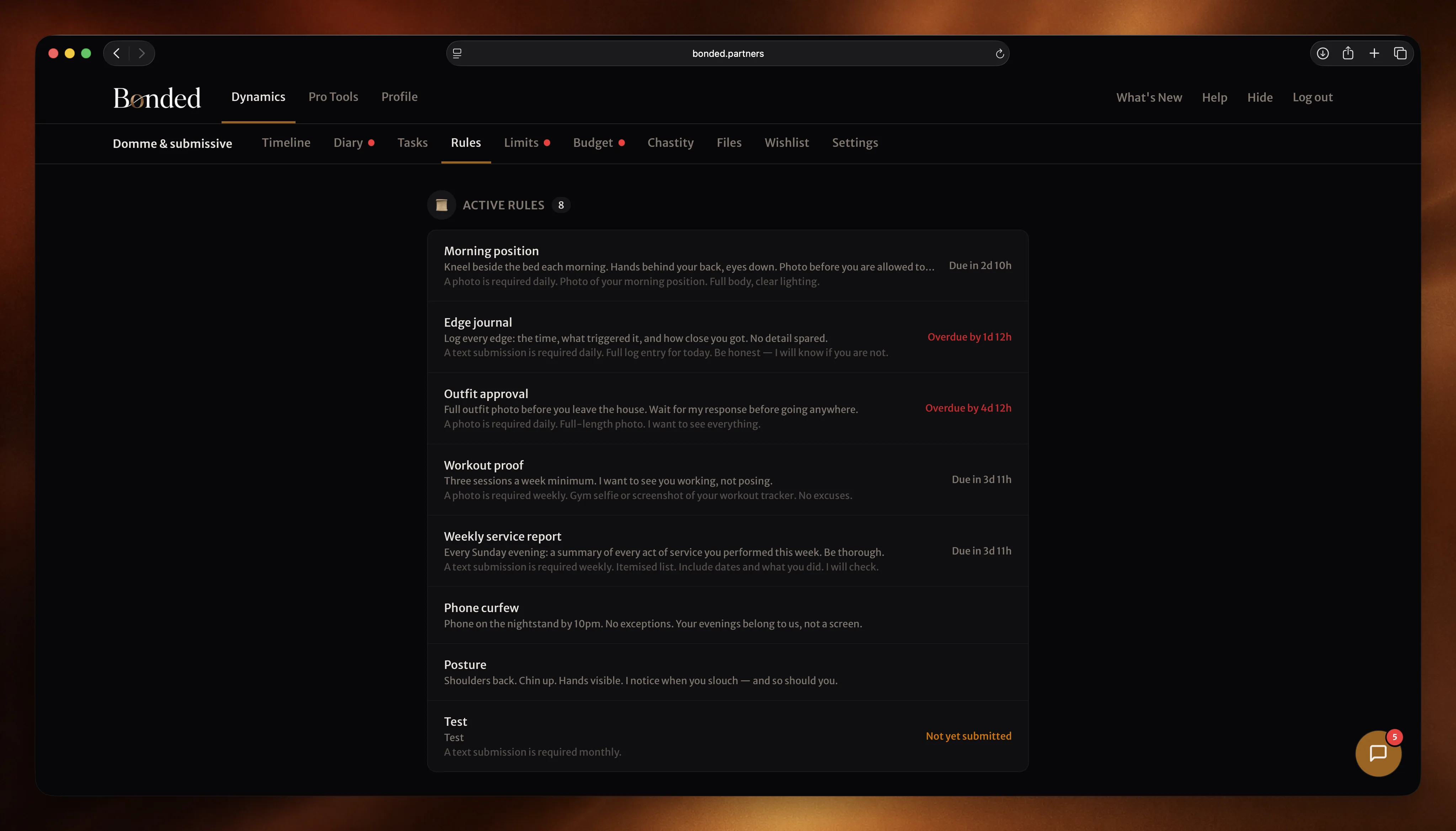
Low protocol: 1-3 rules. Broadly defined. Infrequent evidence requirements. Focus on connection points rather than behavioural control. A weekly reflection, a daily text, a self-care commitment.
Mid protocol: 5-8 rules. Mix of daily and weekly frequencies. Evidence required for most. Clear consequences. Cover several life domains: communication, self-care, service, reflection. This is the range where rules feel like structure without feeling like a second job.
High protocol: 8-15+ rules. Daily frequencies dominate. Detailed evidence expectations. Specific, prescriptive requirements. Cover most aspects of daily life. The submissive's day is largely defined by their rule set.
These aren't limits -- they're guidelines. Your dynamic might have twenty rules at mid protocol because they're all lightweight. Or it might have five at high protocol because each one is comprehensive and demanding.
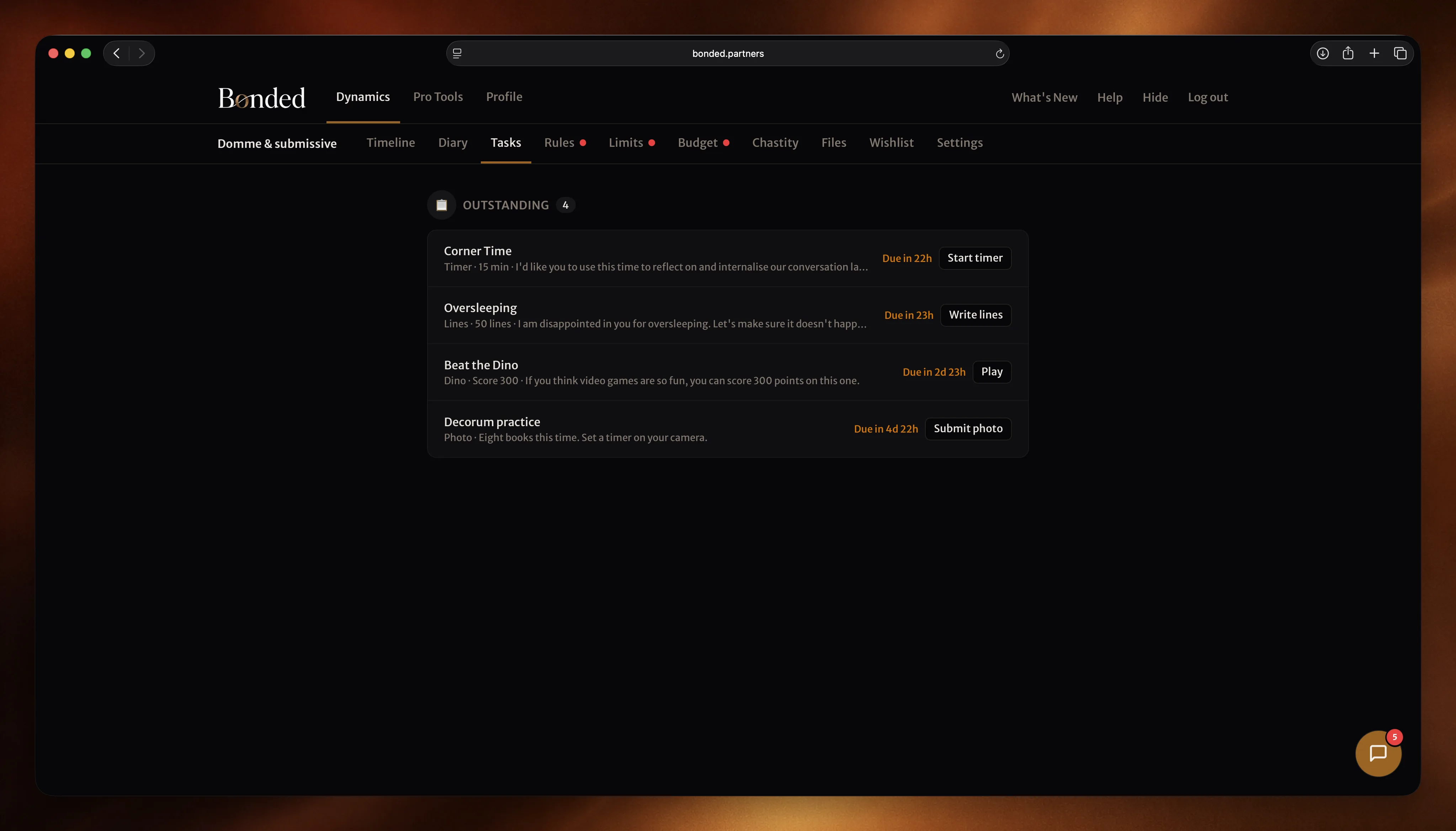
In Bonded, you can scale your rule set to any protocol level. Rules support daily, weekly, and monthly frequencies, three types of evidence, and detailed descriptions that let you be as specific as your protocol demands. Toggling rules between active and inactive states lets you adjust your active rule set without losing your history -- useful for protocol adjustments, protocol holidays, and gradual escalation.
Moving Between Levels
Protocol levels aren't fixed. Many dynamics shift over time -- sometimes gradually, sometimes deliberately.
Escalating: Moving from low to mid or mid to high should be gradual. Add one protocol element at a time. Let it settle. Then add another. Jumping from low to high in a weekend is a recipe for burnout.
De-escalating: Reducing protocol is harder emotionally, even when it's the right call. The submissive might feel rejected or abandoned. The Dom(me) might feel guilty. Frame it honestly: "This level isn't sustainable right now, and I'd rather have a dynamic at a level we can maintain than one that's burning us out."
Oscillating: Some dynamics naturally move between levels. Higher protocol on weekends, lower during the work week. Higher during holidays, lower during crunch periods. This is normal and healthy, as long as both parties are aligned on the rhythm.
Temporary elevation: Using high protocol for a specific period -- a weekend, a retreat, a training period -- can be an effective way to deepen the dynamic without committing to that level permanently.
Building Your Protocol Identity
Protocol is ultimately about identity. How do you want power exchange to feel in your life? Do you want it to be a constant current, a rhythmic pulse, or a vivid but bounded experience?
There's no wrong answer. There's only the answer that fits you, your partner, and the life you actually live. Find that answer honestly, build the structure to support it, and let it evolve as you do.
Go deeper
Read the full guide→