



Sub Frenzy: Why New Dynamics Feel Intoxicating (And What to Watch For)
Sub frenzy is the intense rush of a new D/s dynamic. Learn why it happens, why it is dangerous, and practical strategies for both submissives and Dom(me)s.

Something happened when the dynamic started. Something beyond excitement, beyond butterflies, beyond the normal rush of a new relationship. It is bigger. More consuming. You cannot stop thinking about it. You want more, faster, deeper, now. Every rule feels like a gift. Every task feels electric. Every interaction with your Dom(me) sends a charge through your body that rewires the rest of your day around it.
You are reading everything you can find. You are filling your head with fantasies. You are counting hours until the next scene, the next message, the next moment of contact. The rest of your life, your job, your friends, your hobbies, feels grey by comparison. The dynamic is in colour. Everything else is not.
This is sub frenzy. It feels incredible. It is also one of the most dangerous periods in a new submissive's journey.
What Sub Frenzy Is
Sub frenzy is the intense, often overwhelming rush of energy, desire, and emotional investment that frequently accompanies a new submissive's early experiences with power exchange. It is not a clinical term. It is community language for a recognisable pattern: a state of heightened arousal, obsessive focus, and impaired judgment that can last weeks or months.
It is not exclusive to submissives. Dom(me)s experience their own version, sometimes called "Dom frenzy" or simply new relationship energy (NRE) with a D/s amplifier. But it presents differently in submissives because of the specific vulnerabilities involved in yielding power, which is why the community gave it its own name.
Sub frenzy is not pathological. It is a natural response to a powerful new experience. But natural does not mean safe. A forest fire is natural. Understanding what is happening in your brain and your body gives you the ability to ride the wave without drowning in it.
The Neuroscience: What Your Brain Is Doing
Your brain on sub frenzy is your brain on a cocktail of neurochemicals that evolved to bond you to novel, rewarding experiences.
Dopamine
Dopamine is the anticipation chemical. It does not reward you for getting what you want. It rewards you for wanting. Every moment of anticipation, the wait for a message, the build toward a scene, the wondering what your Dom(me) will do next, triggers dopamine release. And D/s dynamics are structurally designed to create anticipation: rules create ongoing anticipation of compliance and response, power differentials create anticipation of what will happen next, uncertainty within a framework of safety is dopamine's ideal environment.
New experiences produce more dopamine than familiar ones. A new dynamic is, by definition, a cascade of new experiences. Your brain is flooded.
Norepinephrine
The alertness chemical. Elevated during states of arousal, excitement, and novel stress. It sharpens focus, increases energy, and reduces appetite and need for sleep. This is why new dynamics can feel like you are running on rocket fuel. You are not sleeping well, you are barely hungry, and you feel more alive than you have in years. That is norepinephrine, and it is not sustainable.
Oxytocin
The bonding chemical. Released during physical touch, emotional intimacy, eye contact, and acts of trust. D/s dynamics are trust machines. Every act of submission is an act of trust. Every act of dominance that honours that trust releases oxytocin in both parties. The result is an accelerated bonding process that can create attachment at a speed and intensity that outpaces the actual relationship's foundation.
Endorphins
If your dynamic includes pain play, add endorphins to the mix. The body's natural painkillers, chemically similar to opioids, released in response to physical stress. Subspace, the altered state of consciousness that some submissives experience during intense scenes, is partly an endorphin response. It is literally a natural high.
The Cocktail Effect
None of these chemicals operates in isolation. Together, they create a state that is neurochemically similar to falling in love, combined with the intensity of a peak physical experience, combined with the altered states of consciousness that some meditation or spiritual practices produce. It is, frankly, one of the most intense experiences a human brain can generate through consensual interpersonal interaction.
No wonder it feels intoxicating. It is intoxication, mediated by your own neurochemistry rather than an external substance. And like any intoxication, it impairs judgment.
Why It Is Dangerous
Here is where the warmth of this post turns cool, because this matters.
Ignoring Your Own Limits
In the grip of sub frenzy, limits feel like obstacles between you and more of this feeling. A hard limit that felt firm last month suddenly feels negotiable. A soft limit feels like something you should just push past because the desire is so strong. Your brain is telling you: say yes. Say yes to everything. More will feel better.
This is the dopamine talking. More novelty, more intensity, more reward. Your rational assessment of risk has been chemically suppressed by the same system that is generating the desire. You are making decisions about activities that carry real physical and psychological risk while your judgment is impaired by the experience itself.
Submissives in frenzy have agreed to activities they later regretted. Have accelerated dynamics past the point of safety. Have ignored red flags in partners because the frenzy made everything feel like a green flag. Have bypassed their own safeguards because the craving was louder than the caution.
Rushing Trust
Trust is built through repeated, consistent, observable behaviour over time. There is no shortcut. But sub frenzy creates a felt sense of trust that can dramatically outpace the actual evidence.
You feel trusting. The oxytocin and the emotional intensity create a felt experience of deep connection and safety. But felt trust is not the same as earned trust. Felt trust is a neurochemical state. Earned trust is a pattern of behaviour observed over weeks and months.
The danger: you make decisions appropriate to earned trust (deep vulnerability, intense scenes, expanded power exchange) based on felt trust (a few weeks of neurochemical flooding). The foundation is not there yet, and when the frenzy subsides, you may find yourself in a dynamic that went further than the actual relationship can support.
Neglecting the Rest of Your Life
Sub frenzy has a way of consuming bandwidth. Work performance drops. Friendships get neglected. Self-care goes out the window. The dynamic becomes the centre of gravity and everything else orbits around it at increasing distance.
This is unsustainable and it creates fragility. A dynamic that has consumed your entire life has no buffer when it hits a rough patch. If you have neglected your friendships, you have no support network. If you have neglected your work, you have financial stress adding to emotional stress. If you have neglected your health, you have fewer resources to process difficult emotions.
Making Permanent Decisions in a Temporary State
Collaring ceremonies. Tattoos. Moving in together. Quitting a job to serve full-time. These are decisions that people in sub frenzy have made in the first weeks of a dynamic. Each one is a permanent or semi-permanent action taken during a temporary neurochemical state.
The rule of thumb: make no irreversible decisions during frenzy. If it will still feel right in six months, it will still feel right in six months. If it will not, you will be glad you waited.
How to Manage Sub Frenzy (For Submissives)
You cannot prevent sub frenzy. You can manage it. The goal is not to suppress the intensity but to prevent it from driving decisions you will regret.
Name It
The single most powerful intervention. When you recognise what is happening, you create a gap between the feeling and the action. "This is sub frenzy. My neurochemistry is doing a thing. The desire I feel right now is real, but my judgment about acting on it is impaired."
Naming it does not make it go away. But it reintroduces your rational brain into a process that your emotional brain has been running solo.
Keep Your Limits List
The limits list you filled out before the frenzy started is more reliable than the limits list you would fill out during it. When frenzy makes a hard limit feel soft, trust the pre-frenzy version. You were thinking more clearly then.
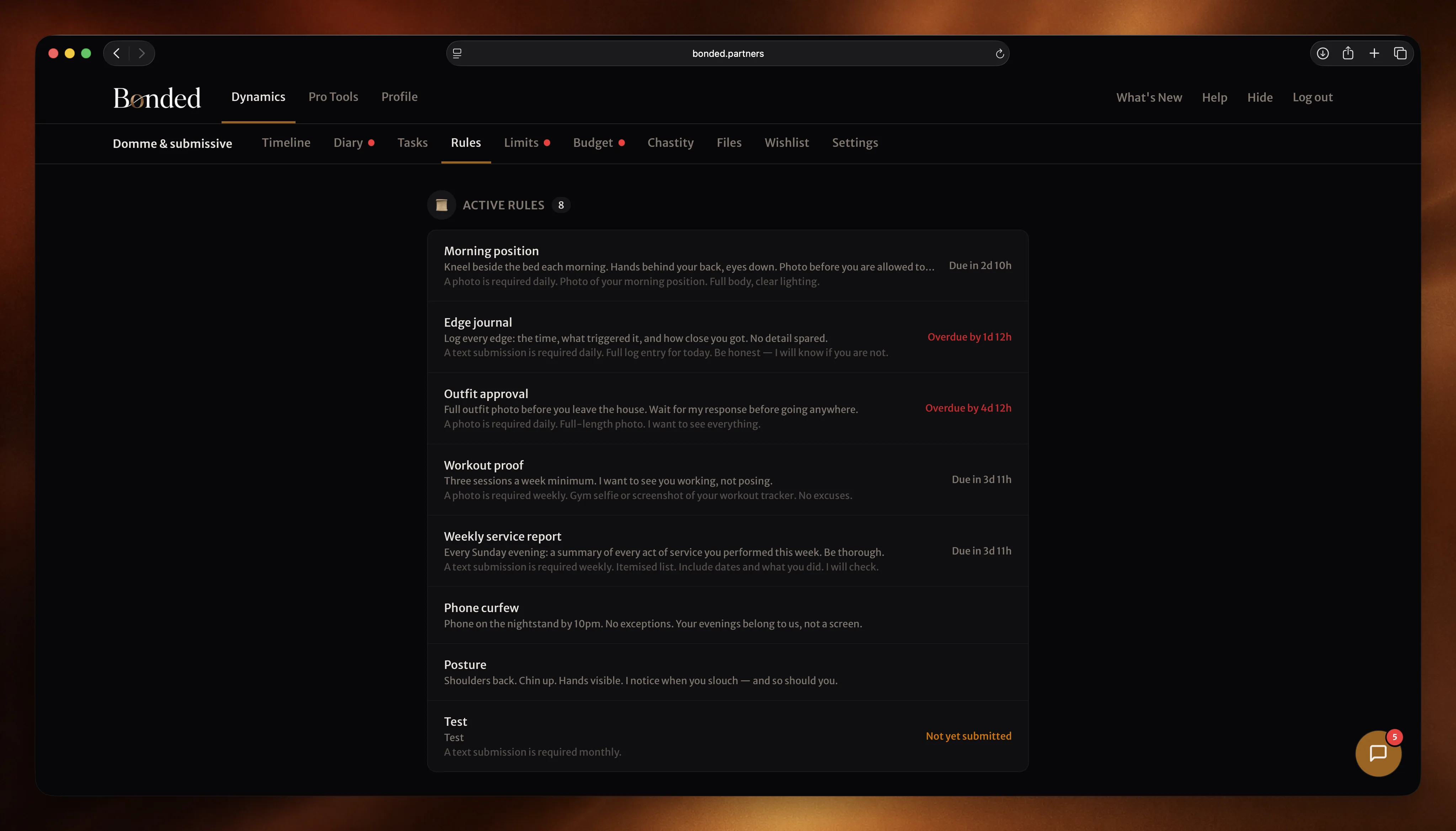
Bonded's Limits feature creates a persistent record of your classifications. When frenzy hits, the record is there, unchanged by your current neurochemical state. It is an anchor to your calibrated self.
Slow Down
The frenzy wants speed. Give it patience instead. Deliberately slow the pace of the dynamic. If you want to try something new, wait a week. If you want to expand the power exchange, wait a month. If you want to make a permanent decision, wait three months.
This is not suppression. It is pacing. You are not saying no to yourself. You are saying not yet. The distinction matters because it does not fight the desire, it just puts space around it.
Maintain Your Life
Force yourself to maintain the non-dynamic parts of your life. See your friends. Do your work. Exercise. Sleep. Eat properly. These are not obstacles to the dynamic. They are the foundation that allows the dynamic to be healthy.
If you notice that your entire social calendar has been replaced by dynamic time, that is a flag. Rebalance deliberately.
Journal
Write about what you are feeling. Not to perform for your Dom(me), but for yourself. The act of writing engages your prefrontal cortex, the rational part of your brain, in a process that has been dominated by your limbic system, the emotional and reward-driven part.
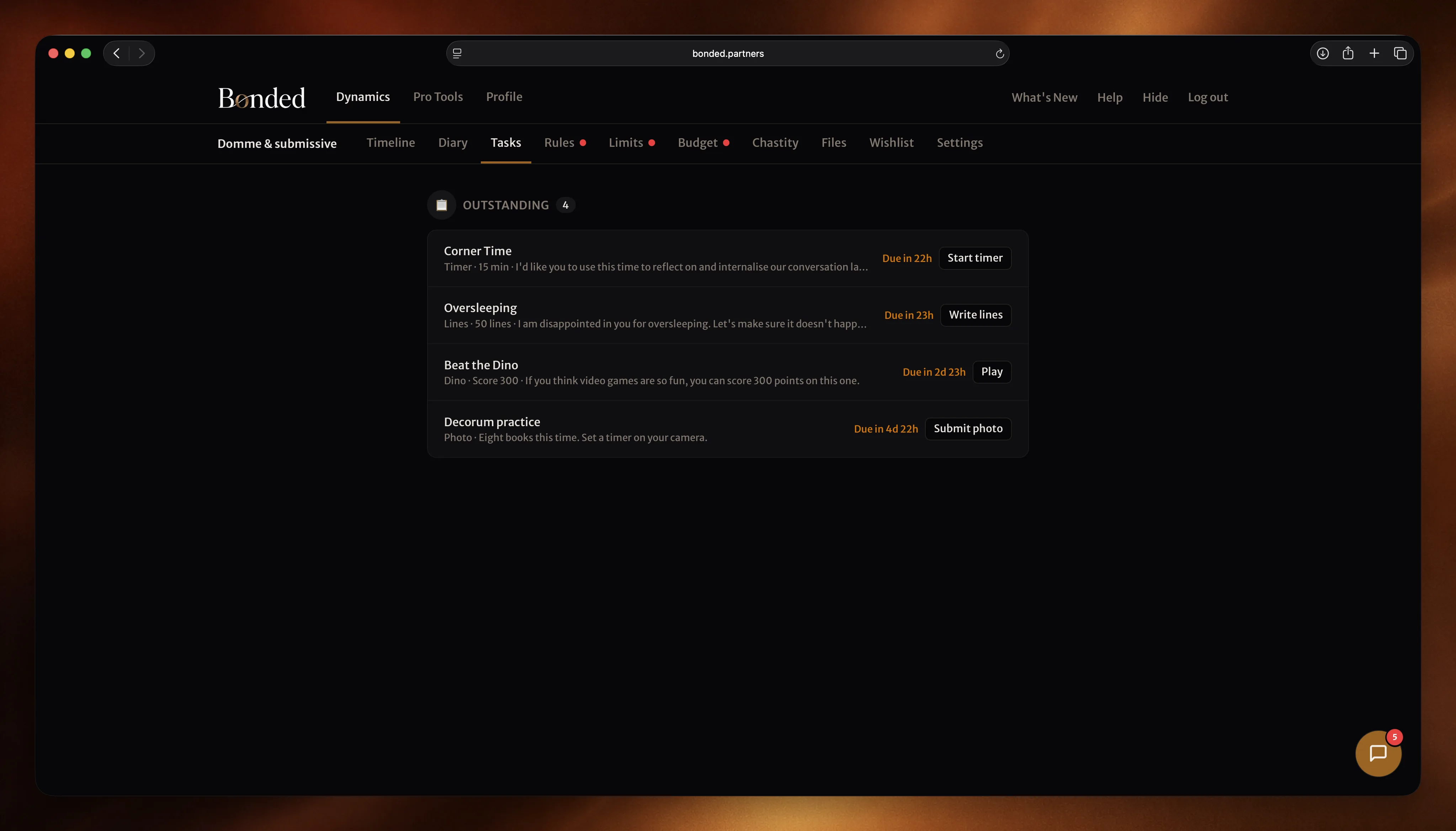
Bonded's Diary feature gives you a private space for this kind of processing. Entries you write during frenzy become a record you can look back on later, seeing the pattern from outside the pattern.
Talk to People Outside the Dynamic
Friends. A therapist. A community mentor. Someone who can see what you cannot see from inside the whirlwind. "I'm in a new dynamic and I'm feeling really intense about it. Can you help me stay grounded?" is a reasonable thing to ask of people who care about you.
If your Dom(me) discourages you from talking to anyone else about the dynamic, that is a serious red flag, frenzy or not.
Set Pre-Commitments
Before frenzy fully takes hold, set rules for yourself. "I will not agree to any new activity without sleeping on it first." "I will not skip my weekly dinner with friends." "I will not reclassify any hard limits for at least three months." Pre-commitments work because they are decisions made with clear judgment that constrain behaviour during impaired judgment.
How to Manage Sub Frenzy (For Dom(me)s)
If your submissive is in frenzy, you have a specific and critical responsibility. The submissive's judgment is impaired. Yours (hopefully) is not. That asymmetry means you need to be the brakes.
Recognise the Signs
A submissive in frenzy often looks like the ideal submissive. Eager, compliant, enthusiastic, insatiable. They want more. They agree to everything. They push for escalation. This can be enormously flattering and enormously dangerous.
Signs of frenzy versus genuine enthusiasm:
- Pace. Frenzy wants everything now. Genuine enthusiasm is happy to build.
- Limits. Frenzy erodes limits. Genuine enthusiasm operates within them.
- Life balance. Frenzy consumes. Genuine enthusiasm coexists with a full life.
- Emotional regulation. Frenzy swings wildly between euphoria and anxiety. Genuine enthusiasm is warm but steady.
Pump the Brakes
When you recognise frenzy, slow down. Even if the submissive is asking for more. Especially if they are asking for more.
"I love your enthusiasm. And I want to build this sustainably. We're not going to rush."
This might frustrate your submissive. That is okay. Part of the responsibility of dominance is making decisions that serve the long-term health of the dynamic, even when the short-term desire is pointing elsewhere. A submissive in frenzy who is frustrated by your pacing will thank you later. A submissive in frenzy whose Dom(me) matches their pace will crash later.
Do Not Exploit the Frenzy
This is the ethical line, and it must be drawn in bold. A submissive in frenzy will say yes to things they would not otherwise agree to. Their consent is technically present but functionally compromised. A Dom(me) who uses the frenzy period to push past limits, to escalate the dynamic beyond what the submissive would agree to with clear judgment, is exploiting impaired consent.
This applies even if the submissive initiated the escalation. "But they asked for it" is not sufficient when you know their asking is driven by a neurochemical state that impairs judgment. You know better. Act accordingly.
Maintain the Framework
Keep the rules consistent. Keep the check-ins happening. Keep the pace steady. The structure of the dynamic is a container that holds the frenzy safely. Without that container, the frenzy spills everywhere.
Enforce limits that the submissive is trying to bypass. Enforce pacing that the submissive is trying to accelerate. This is not being rigid. It is being safe.
The Arc of Sub Frenzy
Sub frenzy does not last forever. The neurochemical flood subsides. The novelty diminishes. The extraordinary becomes the ordinary. This typically happens somewhere between one and six months into a dynamic, though the timeline varies.
When frenzy subsides, one of several things happens:
The dynamic remains satisfying. The underlying connection and compatibility were real. The frenzy amplified something genuine. Now that the amplification has faded, what remains is still good. This is the ideal outcome and it is common.
The dynamic feels flat. The contrast between frenzy-level intensity and normal-level intensity feels like a loss. Some submissives interpret the fading of frenzy as falling out of love with the dynamic or with submission itself. It is not. It is the transition from neurochemical intensity to sustainable intensity. The dynamic may need recalibration to find its sustainable rhythm.
Regret surfaces. Things agreed to during frenzy no longer feel right. Limits that were reclassified need to move back. The pace of the dynamic needs to slow. This is uncomfortable but manageable if both people can have honest conversations about it.
The dynamic was built on frenzy and has no foundation without it. This is the painful outcome. If the connection was primarily neurochemical rather than relational, the fading of frenzy reveals that there is not enough underneath. Better to discover this than to sustain a dynamic on frenzy alone, which is impossible anyway.
Practical Takeaways
Sub frenzy is real, neurochemical, and predictable. Knowing what it is gives you power over how you respond to it.
It impairs judgment about limits, trust, and pace. Decisions made during frenzy should be treated like decisions made while intoxicated: suspect until confirmed by a sober mind.
Name it. Recognition creates distance between feeling and action.
Trust your pre-frenzy limits list. It was written with clearer judgment.
Slow down deliberately. Space between desire and action is your safety margin.
Maintain the rest of your life. Friends, work, health, hobbies. These are not distractions from the dynamic. They are its support structure.
Journal for grounding. Writing engages the rational brain when the emotional brain is running the show. Bonded's Diary gives you a private space for this processing.
Dom(me)s: you are the brakes. Recognise frenzy, maintain pacing, do not exploit impaired judgment.
No irreversible decisions during frenzy. If it is still right in six months, it will still be right in six months.
Frenzy fading is not the dynamic dying. It is the dynamic transitioning from neurochemical intensity to sustainable depth. Ride it out with patience and honest communication.
Bonded's Limits feature serves as a pre-frenzy anchor: a record of your classifications made with clear judgment, always accessible, with real-time notifications if either person changes anything. Combined with the Diary for ongoing self-monitoring, it gives you tools to navigate frenzy without losing yourself in it.
Go deeper
Read the full guide→