



How to Bring Up D/s With Your Partner (Without Making It Weird)
Practical scripts and frameworks for talking to your partner about D/s interest. Covers timing, framing, handling every response, and next steps for both roles.

You know you are interested in D/s. You have done your reading, maybe some self-reflection, possibly even some private exploration. But you are in a relationship with someone who does not know about this interest, and the gap between your inner world and your shared world feels like it is getting wider.
So you need to have the conversation.
This is the post about that conversation. Not the theory of why communication matters (you know that), but the practical how. When to bring it up. How to frame it. What to do with every possible response. And how to handle the fear that sits between knowing you need to say this and actually saying it.
Why This Conversation Feels So Hard
First, name the fear. It is probably some combination of these:
Rejection. Not just of the idea, but of you. If your partner reacts with disgust, you will feel that disgust is directed at a core part of who you are. That fear is rational, even if the outcome rarely matches the catastrophe your brain is projecting.
Judgment. "They'll think I'm a freak." "They'll see me differently." "They'll never look at me the same way." These fears are about identity: the gap between the person your partner thinks you are and the person you are revealing yourself to be.
Loss of the relationship. The worst-case scenario: this is a dealbreaker. They leave. Or they stay but with a new distance that never closes. This fear keeps people silent for years, sometimes for entire relationships.
Shame. Internalised messaging that your desires are wrong, deviant, unhealthy, or evidence of damage. You might intellectually reject that messaging but still feel its weight when you imagine speaking your desires out loud to someone whose opinion matters to you.
All of these fears are real and valid. None of them are reasons not to have the conversation. Because the alternative, carrying a fundamental aspect of yourself in silence, has its own costs. Emotional distance. Resentment. The slow erosion of intimacy that comes from hiding. The conversation is hard. Silence is harder, it just takes longer to show.
Timing and Context
When and where you have this conversation matters as much as what you say.
When to Bring It Up
Not during sex. The moment of highest vulnerability is not the time to introduce a topic that requires clear-headed conversation. What feels brave in the moment can feel ambushing in retrospect.
Not during a fight. Do not weaponise this conversation or use it as evidence that the relationship is lacking. "The reason I'm unhappy is..." turns a vulnerable disclosure into an accusation.
Not while either person is drunk or high. You need genuine, sober presence from both sides.
Not when either person is stressed, exhausted, or distracted. You want their full attention and their best emotional capacity. If they have just had a terrible day at work, wait.
Good timing looks like: a quiet evening with no pressing obligations. A relaxed weekend morning. A moment when you have both been connecting well and the relationship feels solid. You want a foundation of warmth to hold the vulnerability of the conversation.
Setting the Stage
You do not need a formal sit-down with candles and an agenda. But you do need to signal that something important is coming.
"There's something I've been wanting to talk to you about. It's not bad, it's about us and what I'd like to explore together. Can we find some time this week?"
That preamble does a few things: it prevents the panic of "we need to talk," it frames the topic as positive exploration rather than problem-solving, and it gives your partner a chance to be emotionally ready.
Framing: Curiosity, Not Demand
The single most important framing decision: this is an invitation, not a request. You are not asking your partner to do something. You are sharing something about yourself and inviting them to explore it with you. The difference is everything.
Demand framing (avoid this): "I need this in our relationship." "I've discovered that I'm submissive and I need a Dom(me)." "Our sex life would be so much better if..."
Curiosity framing (do this): "I've been exploring some ideas about what I'm into, and I want to share them with you." "I've been reading about power dynamics in relationships and some of it really resonates with me." "There's a part of my sexuality I haven't shared with you, and I'd like to."
Demand framing puts your partner on the defensive. It implies they are currently failing to meet a need. It centres your desire and positions their response as either compliance or refusal.
Curiosity framing invites them into a shared exploration. It leaves room for their response to shape the outcome. It says "I want to discover this with you" rather than "I need you to be this for me."
What to Actually Say
Here are some frameworks. These are not scripts to memorise but structures you can adapt to your voice and your relationship.
If You Think You Are Submissive
"I've been doing some thinking and reading about power dynamics in relationships, and I've realised that the idea of my partner taking more of a leading role, both in and out of the bedroom, really appeals to me. Not in a way that makes me weak or you controlling. More like a deliberate, consensual thing where I yield to you because I trust you and it feels right. I know this might sound unexpected, and I don't need you to respond right now. I just wanted to share it with you and see what you think."
Key elements: normalising language ("power dynamics in relationships"), distinguishing from negative stereotypes ("not weak, not controlling"), expressing trust, low-pressure close.
If You Think You Are Dominant
"I've been reflecting on something about myself that I want to share with you. I've noticed that I'm drawn to the idea of a more structured dynamic between us, where I take on more of a guiding, leading role and you have the choice to follow that lead. Not domineering or demanding. More like, I want to create a framework where both of us feel fulfilled, and I think for me that framework involves more explicit power exchange. I don't want to spring this on you or make you feel pressured. I just want you to know this part of me."
Key elements: self-disclosure framing ("something about myself"), emphasising their choice ("you have the choice"), distinguishing from aggression, no-pressure close.
If You Are Not Sure of Your Role
"I've been curious about D/s dynamics. Not the extreme stereotypes, but the real thing: two people who negotiate a power exchange that works for both of them. I don't know exactly what role I'd want, or what it would look like for us, but I'd love to explore the idea together if you're open to it."
Key elements: intellectual curiosity framing, managing stereotypes, openness about uncertainty, collaborative invitation.
Handling Their Response
If They Are Interested
This is the dream scenario, and it is more common than you might think. A lot of people have some degree of interest in power dynamics and have never had a safe context to express it.
If they are interested, resist the urge to plan the entire dynamic that evening. The excitement is real but can lead to rushing, which leads to mistakes.
Next steps for an interested partner:
- Share some of the resources you have been reading. Let them do their own exploration.
- Give them time and space to figure out what resonates for them.
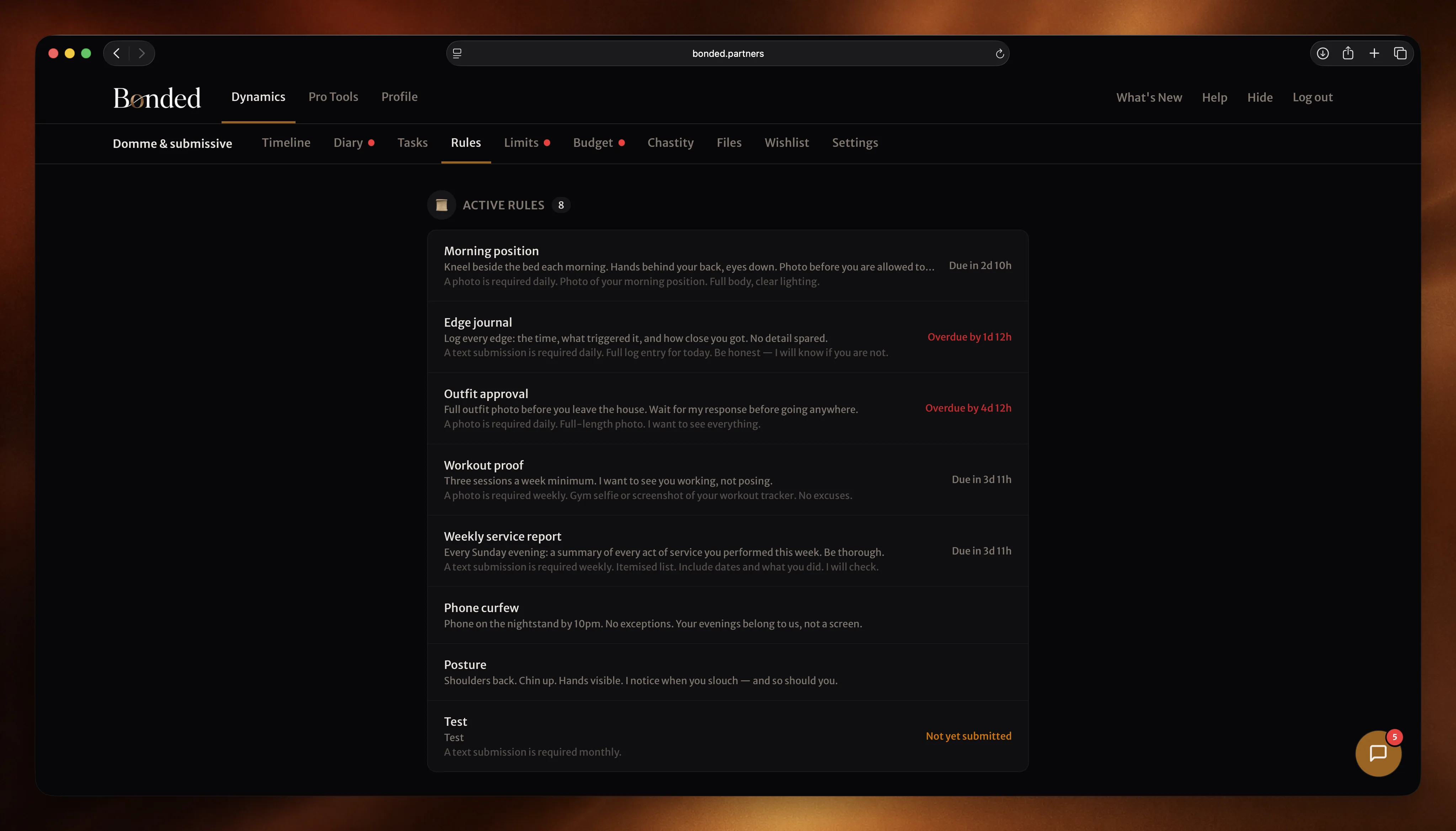
- When you are both ready, sit down with a limits checklist and fill it out independently. This is where a structured tool becomes genuinely useful. A comprehensive list with independent classification removes the pressure of face-to-face confession and lets both people be honest.
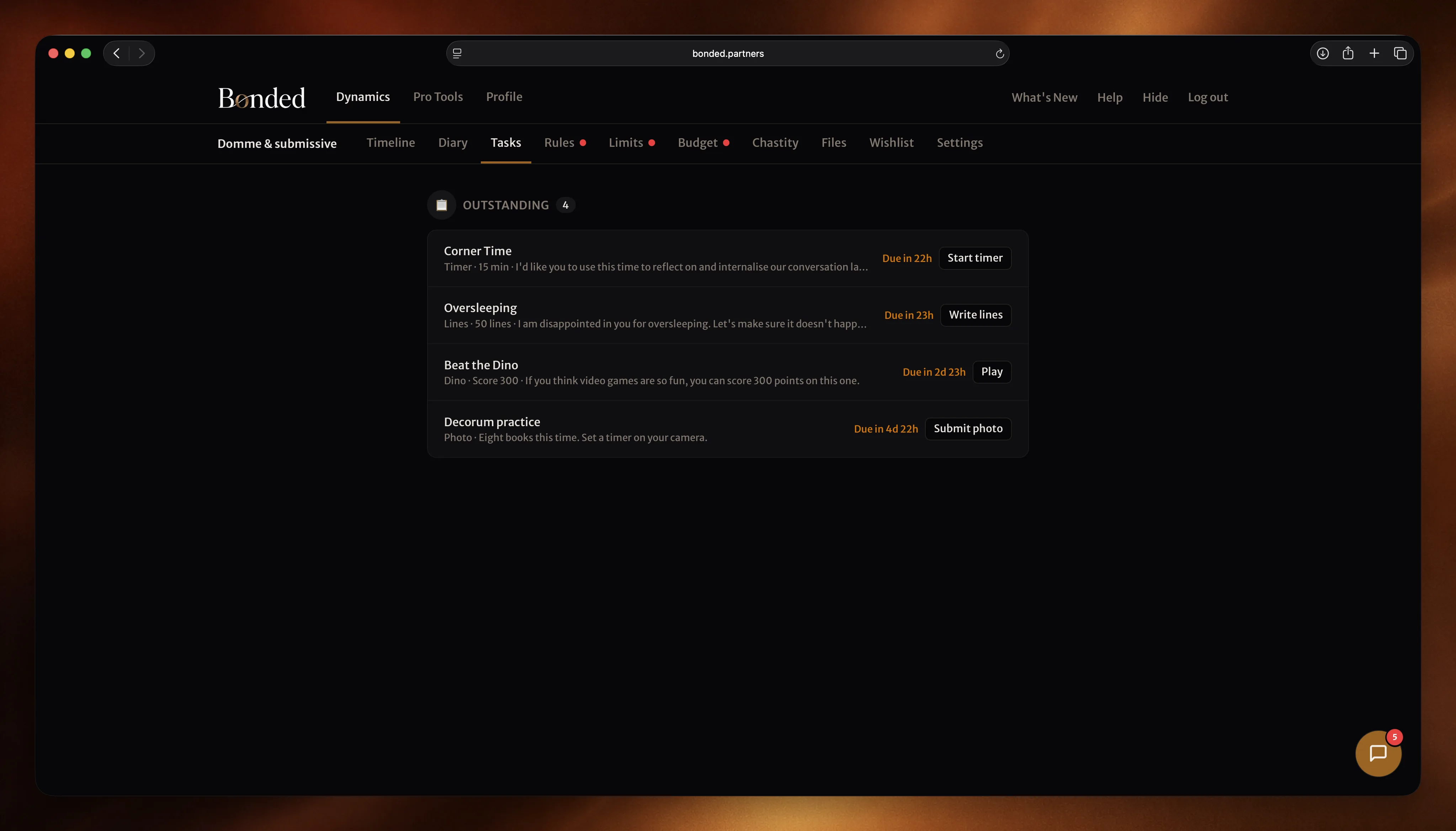
- Start small. One rule. One scene. One experiment. Build from there.
If They Are Not Interested
This hurts. Let yourself feel that. But not-interested is not the same as disgusted, and it is not necessarily permanent.
Some responses within "not interested" and what they might mean:
"That's not really my thing." Neutral. They are not judging you, just not drawn to it themselves. This might be a genuine incompatibility, or it might be a response based on incomplete understanding. Give it time before deciding it is final.
"I don't really understand what you mean." An opening, not a closure. They need more information. Offer to share resources or answer questions. Many people's understanding of D/s is shaped by media stereotypes, and their "not interested" might be based on a version of D/s that bears little resemblance to what you are actually describing.
"I'm worried this means something is wrong with you/us." A fear response. Address it directly. "No, this isn't about something being wrong. It's about something I want to explore. Our relationship is the reason I feel safe enough to bring it up."
"Absolutely not, that's disgusting." This is the hardest response. It may reflect deeply held values, it may reflect ignorance, or it may reflect their own unprocessed shame about desires they are not ready to face. You cannot control their reaction. What you can control is whether you accept a response that shames you for who you are.
In all not-interested scenarios: do not push. You have shared your truth. They have responded. Pushing converts your vulnerability into pressure, and that pressure will breed resentment in both directions. Let the information sit. Come back to it in weeks or months if the relationship allows. Sometimes initial reactions soften with time and processing.
If They Are In Between
The most common and most nuanced response. Some version of: "I'm not sure. Maybe. I need to think about it."
This is not a rejection. It is a processing period. What it requires from you:
Patience. They need to sit with this at their own pace. Do not bring it up every day. Do not interpret silence as rejection.
Availability. Make it clear you are ready to talk whenever they are. "No rush, but I'm here whenever you want to discuss it or ask questions."
No scorekeeping. Do not track how long it has been since you brought it up. Do not drop hints. Do not send them articles every day. Let them come to it.
Managing your own anxiety. The uncertainty is uncomfortable. Sit with it. Journal. Talk to a trusted friend. Do not make your partner responsible for managing your anxiety about their response.
Both Directions
This post has addressed the conversation from the perspective of the person who knows they are interested in D/s. But the conversation can flow in both directions.
When a Submissive Tells Their Partner
The additional fear here is often about masculinity or femininity. A male-identified submissive telling a female-identified partner may fear being seen as less masculine. A female-identified submissive may fear reinforcing gender stereotypes. These are real cultural pressures, and naming them, either to yourself or in the conversation, can defuse some of their power.
"I know this might seem like it contradicts who I am in the rest of our life. It doesn't. Being strong enough to surrender is different from being weak."
When a Dom(me) Tells Their Partner
The additional fear here is about seeming controlling, aggressive, or dangerous. "I want power over you" is a sentence that can sound very different depending on context.
"I want to be clear: this is about something we build together, with your enthusiastic participation. I am not asking to control you. I am asking if you would enjoy a dynamic where I lead and you follow, within boundaries we both agree on."
When Neither Person Is Sure Who Would Be What
This is more common than the D/s community sometimes acknowledges. You both might be curious without knowing your roles. That is fine. Fill out a limits list together (independently, then compare) and see what emerges. Sometimes the negotiation process itself reveals things. One person naturally gravitates toward structuring the conversation. The other naturally gravitates toward responding to prompts. Pay attention to those instincts.
After the Conversation
Regardless of the outcome, the conversation itself changes things. You have been more honest with your partner than you were before. That honesty has value even if the outcome is not what you hoped for.
If you are moving forward together:
- Take it slow. Enthusiasm is not a substitute for preparation.
- Educate yourselves together.
- Use structured tools to guide your early negotiations. A comprehensive limits checklist, filled out independently and compared, is the single best starting point.
- Set a check-in date. "Let's try this for two weeks and then talk about how it's going."
If you are not moving forward:
- Decide what this means for you and the relationship. Is this a nice-to-have or a core need? The answer is different for everyone.
- Do not pretend you never had the conversation. It happened. It matters.
- Consider whether this interest can be explored in other ways: reading, community, self-exploration that does not require your partner's participation.
- If it is truly a core incompatibility, that is painful but important information. Better to know now than to spend years in silent frustration.
Practical Takeaways
Name the fear before the conversation. Understanding what you are afraid of reduces its power.
Choose your timing deliberately. Calm, connected, sober, unrushed.
Frame as curiosity, not demand. "I'd like to explore" not "I need you to be."
Give your partner time and space. Their processing timeline is not yours to control.
Do not push. Share your truth and let it land at its own pace.
An in-between response is not a no. Patience and availability are your best tools.
Both directions carry unique fears. Name the gendered and cultural pressures explicitly if they are relevant.
If you move forward together, start with structure. A limits checklist, filled out independently, is the single best first step. Bonded's Limits feature offers 127 activities across 22 categories with independent classification, designed to make that first negotiation concrete and manageable.
Go deeper
Read the full guide→