



I Think I'm Dominant. Here's What That Actually Means.
Dominance is responsibility, not entitlement. A practical guide for new Dom(me)s covering styles, emotional labour, imposter syndrome, and predator awareness.

You have started to recognise something in yourself. A pull toward leading, directing, shaping. An awareness that when you are in control, things feel right in a way that they do not otherwise. Maybe it showed up in relationships, in the bedroom, in how you naturally organise the people around you. Maybe someone called it out: "You're really dominant." And you thought, yeah. I think I am.
Good. That recognition is the starting point. But what comes next matters enormously, because the gap between recognising dominance in yourself and practising it responsibly in a power exchange dynamic is wide. This is the guide for crossing that gap.
Dominance Is Responsibility
This is the foundational truth, and everything else flows from it: dominance is a responsibility, not an entitlement.
A submissive offers you something precious. Their trust, their vulnerability, their willingness to let you lead. That offering does not make you powerful. It makes you accountable. The power you hold in a dynamic is given, not taken, and it comes with obligations.
You are responsible for their safety. Physical, emotional, psychological. You are responsible for knowing their limits and respecting them absolutely. You are responsible for checking in, for reading signals, for recognising when something is wrong even when they do not say it. You are responsible for the framework: the rules, the structure, the direction of the dynamic. And you are responsible for your own growth, your own emotional health, and your own capacity to hold what is being offered to you.
If that sounds like a lot, it is. Dominance is not easy. It is not just "being bossy" or "telling someone what to do." It is a practice that requires self-knowledge, emotional intelligence, technical skill, and ongoing work. The Dom(me)s who do it well are the ones who take that work seriously.
What Dominance Is Not
Before going further, some clearing of the brush.
Dominance is not aggression. Aggression is reactive, uncontrolled, rooted in emotion rather than intention. Dominance is deliberate, measured, purposeful. A Dom(me) who loses their temper during a scene is not being dominant. They are being unsafe. Controlled intensity is dominance. Loss of control is its opposite.
Dominance is not entitlement. You are not owed obedience, service, sex, or submission from anyone. Not because you are dominant. Not because you are experienced. Not because someone identifies as submissive. Submission is offered within a negotiated framework, and it can be withdrawn at any time. If that withdrawal makes you angry, examine that anger carefully.
Dominance is not about you. Or rather, not only about you. A dynamic serves both people. If your practice of dominance consistently serves your needs at the expense of your submissive's, you are not in a power exchange. You are in an exploitation.
Dominance is not a personality trait that excuses behaviour. "I'm just dominant" is not a justification for being controlling in contexts where control has not been offered to you. D/s is a consensual framework with defined boundaries. Outside those boundaries, you are a person in a relationship with ordinary obligations of respect and reciprocity.
Styles of Dominance
Like submission, dominance takes many forms. These are not rigid categories but starting points for reflection.
The Nurturer
Your dominance expresses itself through care. You lead by creating structure, safety, and growth. You set rules because they help your submissive thrive, and watching them thrive is what drives you. Discipline, when necessary, is corrective rather than punitive. You might think of yourself as a gardener: creating conditions for someone to flourish within a framework you tend.
The Disciplinarian
Structure, rules, consequences. You are drawn to order and protocol. The clarity of expectations, the satisfaction of standards met, the measured response when they are not. Your dominance lives in the framework itself. You build it carefully, maintain it consistently, and derive satisfaction from its operation.
The Sadist
You enjoy administering pain, within consent and limits. This is not cruelty. It is a specific dynamic where your enjoyment of giving pain meets your partner's enjoyment (or endurance, or submission) of receiving it. Ethical sadism requires exceptional attunement to your partner. You need to be able to distinguish between productive pain and harmful pain, between intensity they are processing and intensity that has crossed a line.
The Sensualist
Your dominance centres on pleasure, sensation, and the body. You control your submissive's experience through what they feel: pleasure, denial, teasing, overwhelming sensation. The power exchange lives in the sensory realm. You might be less interested in rules and protocol and more interested in the direct, physical experience of control.
The Mentor
You dominate through development. You see potential in your submissive and your dominance is the vehicle for realising it. Tasks are designed to build skills. Rules are designed to develop habits. The dynamic is explicitly growth-oriented, and your satisfaction comes from watching your submissive become more than they were.
The Primal
Your dominance is instinctive, physical, visceral. Less about structure and more about energy. The chase, the takedown, the raw physical expression of power. Primal dominance often overlaps with other styles but has its own distinct quality of immediacy and physicality.
Most Dom(me)s are a blend. You might lead with nurturing but have a strong disciplinarian streak. Or you might be primarily a sadist who mentors through intensity. The blend evolves over time as you gain experience and self-knowledge. Do not rush to identify with one style. Let your practice reveal your nature.
The Emotional Labour of Dominance
This is the part that nobody tells you about, and it is arguably the most important.
Dominance is emotionally expensive. You are holding space for another person's vulnerability while managing your own. You are making decisions that affect both of you and carrying the weight of those decisions. You are reading signals, adjusting in real time, staying present while simultaneously monitoring safety, pacing, intensity, and your submissive's emotional state.
After a scene, your submissive needs aftercare. Who provides aftercare for you? This is a genuine question that many new Dom(me)s do not think about until the emotional weight becomes unsustainable.
Top drop is real. The post-scene emotional crash that submissives experience (sub drop) has a dominant equivalent. After the intensity of a scene, after holding all that control, you might feel empty, anxious, guilty, or emotionally flat. This is a neurochemical and emotional response, not a sign of weakness. Name it, expect it, and build support structures for it.
Emotional containment is draining. Holding a consistent dominant frame, especially during intense scenes or difficult negotiations, requires that you manage your own emotions while attending to your submissive's. That containment costs energy. If you do not replenish it, you will burn out.
The loneliness of leadership. There are aspects of dominance that you cannot fully process with your submissive because doing so would undermine the dynamic. Doubts about a decision you made. Uncertainty about whether you handled a scene well. The weight of responsibility when something goes wrong. You need peers, mentors, therapists, community connections: people you can be honest with about the hard parts of dominance.
Imposter Syndrome
Almost every new Dom(me) experiences it. The voice that says: who are you to be in charge? What if you are not really dominant? What if you are just pretending?
Here is what that voice misses: dominance is a skill, not an inborn quality. You develop it through practice, education, mentorship, and experience. Feeling uncertain does not mean you are not dominant. It means you are new. Those are not the same thing.
Imposter syndrome tends to spike in specific moments:
After a scene goes wrong. Even experienced Dom(me)s have scenes that miss the mark. A misjudged activity, a miscommunicated signal, an unexpected emotional response. These moments feel like evidence of inadequacy. They are actually evidence of complexity. Learn from them, debrief honestly, adjust, and continue.
When comparing yourself to others. The Dom(me) at the event who seems effortlessly commanding. The community leader who seems to have it all figured out. You are seeing their performance, not their process. They had their awkward early scenes too. They still have moments of doubt. You are comparing your inside to their outside.
When your submissive knows more than you. If your submissive has more experience, the imposter syndrome can be intense. But experience asymmetry does not determine dynamic viability. You bring something to this dynamic that experience alone does not provide. And a submissive who chose you did so knowing your experience level. Trust that choice.
The antidote to imposter syndrome is not confidence. It is competence. Learn continuously. Attend workshops. Read. Find a mentor if you can. Practice deliberately. Competence builds genuine confidence over time. Fake confidence is both transparent and dangerous.
Predators Who Use "Dom" as Cover
This needs to be said directly, even though it is uncomfortable.
Some people who call themselves dominant are predators. They use the language of D/s to gain access to vulnerable people and to frame abusive behaviour as consensual power exchange. As a new Dom(me), you need to be aware of this, both to avoid being victimised by such people yourself and to ensure you are not accidentally replicating their patterns.
Predatory behaviour disguised as dominance:
Demanding submission from people who have not consented to a dynamic with them. Calling someone "pet" or issuing commands to a submissive they have not negotiated with. This is not dominance. It is harassment.
Refusing to negotiate. "Real Dom(me)s don't negotiate" is a predator's manifesto. Every responsible Dom(me) negotiates. Every single one.
Targeting isolated newcomers. Predators look for people who are new, alone, and uncertain. They offer certainty, structure, and belonging, which are things that genuinely dominant people also offer, but without the safeguards of negotiation, community accountability, and gradual trust-building.
Punishing limits. Retaliating, emotionally or physically, when a submissive states a boundary. This is abuse, full stop.
Claiming exemption from community norms. "We do things differently." "Rules don't apply to us." "Community standards are for beginners." These are isolation tactics.
Hold yourself to the highest standard. If your behaviour would look wrong to a room full of experienced practitioners, it is wrong. Community accountability is your friend, not your enemy.
Building Your Skills
Practical steps for developing as a Dom(me):
Learn the technical skills. If you want to use rope, learn rope safety. If you are interested in impact, learn anatomy and targeting. If you are drawn to psychological play, study communication and psychology. Every activity in D/s has a skill component, and "winging it" puts people at risk.
Study negotiation. This is arguably the most important skill you will develop. The ability to have honest, detailed, emotionally intelligent conversations about desires, limits, and expectations is what separates good Dom(me)s from mediocre ones. Use tools like Bonded's Limits feature to structure these conversations, but invest in the interpersonal skills that make the conversations productive.
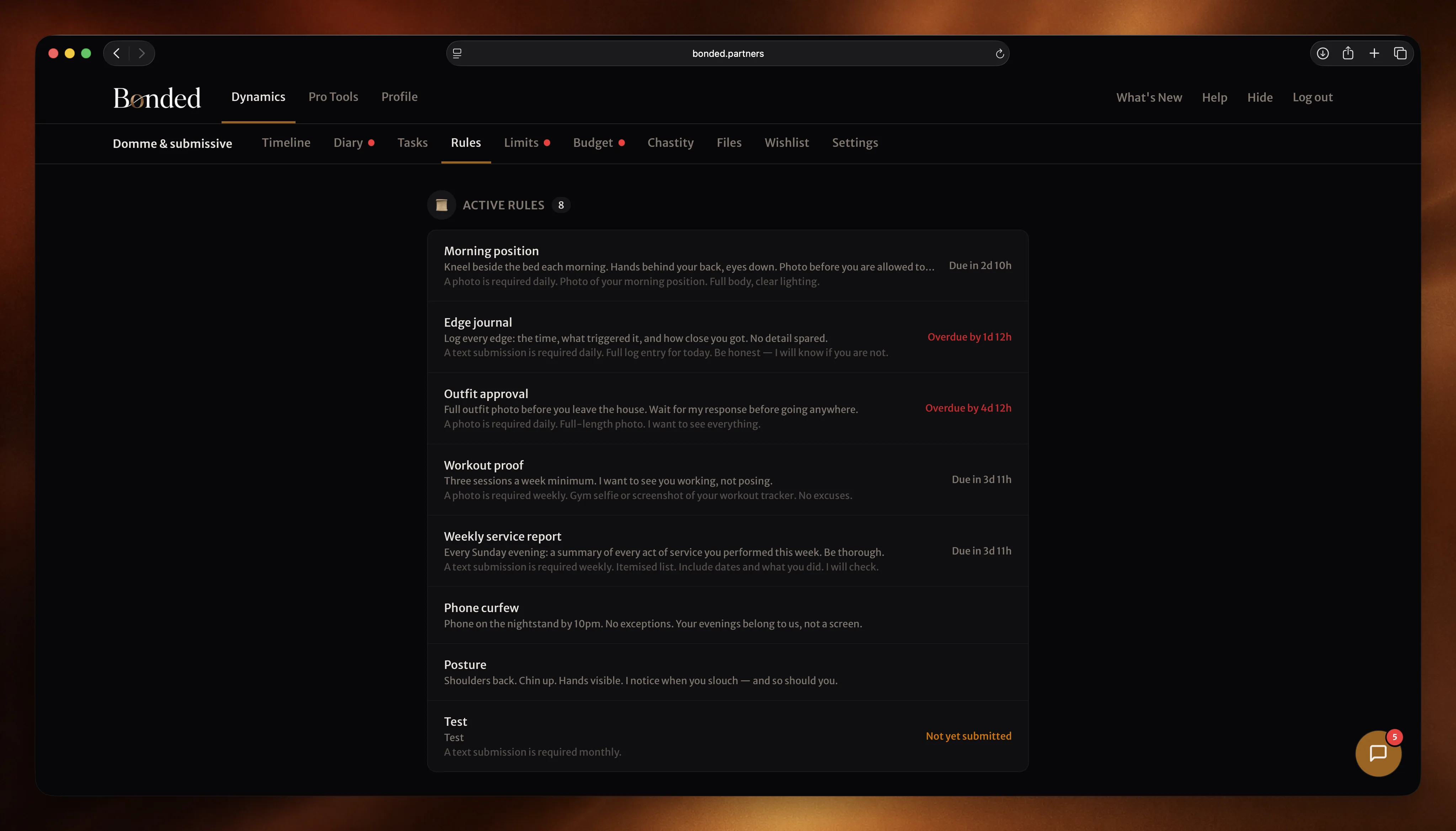
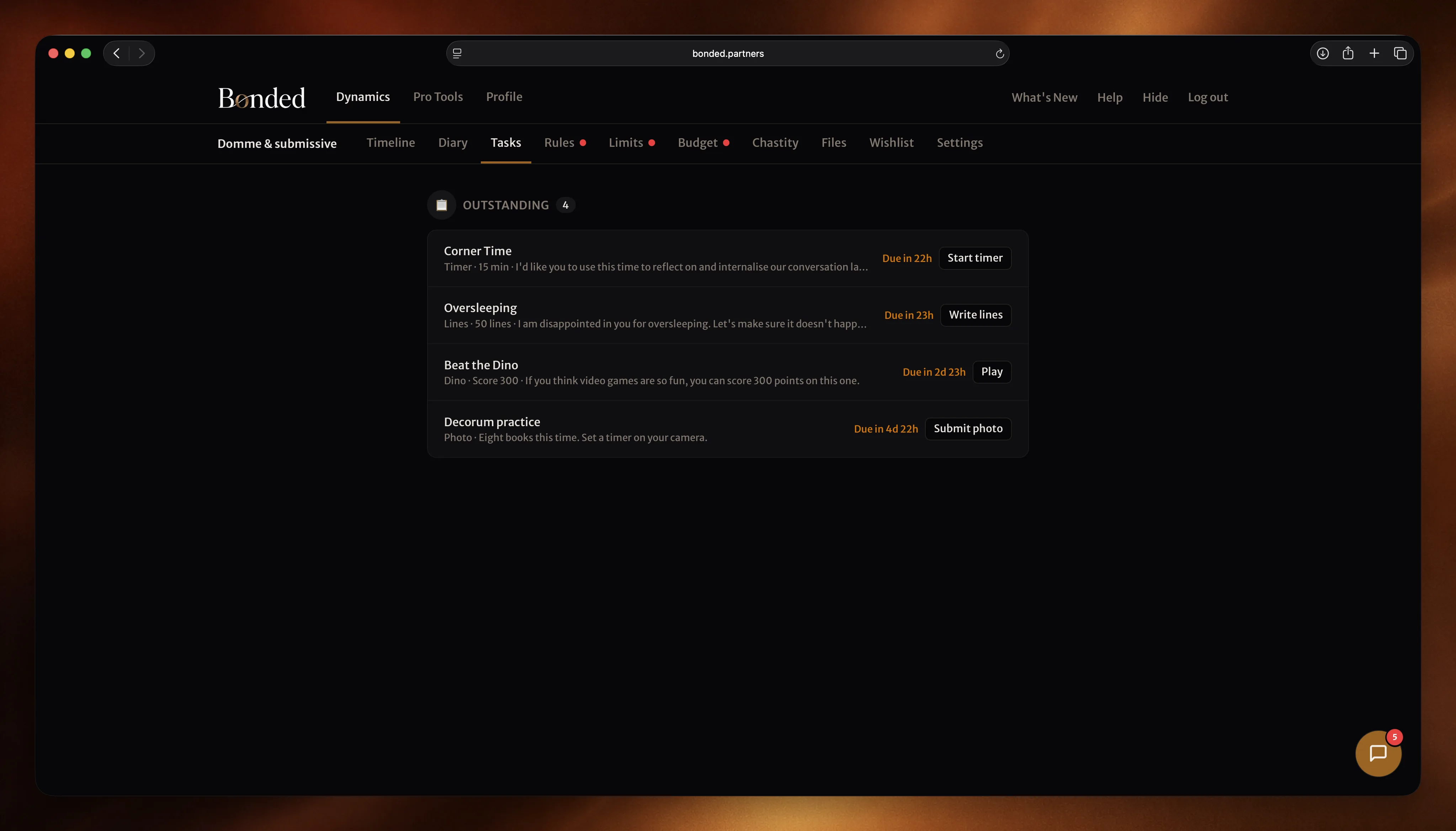
Practice scene planning. Before a scene, think through what you want to do, what might go wrong, what your contingencies are, what your submissive's limits are in this area, and what aftercare will look like. Write it down if that helps. Bonded's Rules and Tasks features can help structure the day-to-day elements of a dynamic, giving you frameworks to plan within.
Develop your self-awareness. Why do you want control? What does it give you? Where are your own edges? What triggers you? What drains you? What replenishes you? A Dom(me) who does not understand their own inner landscape cannot safely navigate someone else's.
Find community. Mentors, peers, workshops, munches, online communities. The learning curve for dominance is steep, and trying to climb it alone is both slower and riskier than climbing it with support.
Get comfortable with vulnerability. This might be the hardest one. Dominance culture sometimes suggests that vulnerability is weakness. It is not. The ability to say "I don't know," "I made a mistake," "I'm struggling," or "I need help" is a strength. It builds the trust that your dynamic depends on.
Practical Takeaways
Dominance is responsibility first. Everything else, the power, the control, the intensity, sits on a foundation of obligation to the person who trusts you.
Learn the difference between dominance and aggression. Control is intentional. Loss of control is dangerous.
Expect emotional labour. Dominance is not just fun and authority. It is containment, attunement, and the loneliness of leadership. Build support structures.
Imposter syndrome is normal. It fades with competence. Invest in learning, not in performing confidence you do not feel.
Hold yourself accountable. Know what predatory behaviour looks like and ensure your practice is nothing like it.
Develop skills deliberately. Technical, interpersonal, and self-awareness skills all matter. None of them come automatically.
Find your style through practice, not theory. You will not know what kind of Dom(me) you are until you have done it for a while. Let experience teach you.
Bonded gives new Dom(me)s a structured starting point: Limits for negotiation, Rules for building framework, Tasks for daily dynamic, and Diary for processing the emotional journey of becoming the Dom(me) your submissive needs.
Go deeper
Read the full guide→