



I Think I'm Submissive. Now What?
Think you might be submissive? Here's what submission actually means, how to explore safely, common archetypes, and red flags to watch for in potential Dom(me)s.

Something clicked. Maybe it was a scene in a book. A dynamic you observed. A moment in a relationship where you realised that yielding felt more natural than leading. Maybe it was a fantasy you have had for years that you are only now putting a name to. Maybe it was a conversation with someone who said the word "submissive" and you felt your chest tighten with recognition.
Whatever brought you here, you are asking a question that thousands of people before you have asked: is this me? And if it is, what do I do about it?
The short answer is yes, this exploration is worth pursuing, and no, you do not need to figure it all out right now. The longer answer is what follows.
What Submission Actually Is
Let's start by clearing away what it is not.
Submission is not weakness. It is not passivity. It is not the absence of will, opinion, or backbone. It is not being a doormat. It is not an inability to make decisions. It is not something that happens to you because you cannot help it.
Submission is a deliberate choice to yield power to someone you trust, within boundaries you set, for reasons that serve you both. Every word in that sentence matters.
Deliberate choice. You choose this. Actively, repeatedly, with full awareness. The submissive who kneels is making a decision to kneel. The submissive who follows a rule is choosing to follow it. The submissive who endures something difficult is choosing endurance. Agency is not surrendered in submission. It is directed.
To someone you trust. Submission without trust is not power exchange. It is exploitation. The trust is earned, not assumed, and it is conditional on ongoing behaviour. You do not owe submission to anyone who asks for it. You offer it to someone who has demonstrated they will handle it with care.
Within boundaries you set. This is where limits come in. The submissive defines the playing field. The Dom(me) operates within it. Your limits are not obstacles to submission. They are the architecture that makes it possible. Without them, there is no consent, and without consent, there is no power exchange. There is just power.
For reasons that serve you both. Submission is not self-sacrifice. It is not martyrdom. If your submission does not serve your needs alongside your Dom(me)'s, something is wrong. The specific needs it serves vary widely: emotional fulfilment, sexual satisfaction, personal growth, stress relief, spiritual practice, connection, play, challenge. But it should serve them.
The Shape of Your Submission
Submission is not one thing. It takes many forms, and the form yours takes is not a measure of its authenticity or depth. Here are some common expressions, offered as a starting point for reflection, not as boxes to sort yourself into:
Service-Oriented Submission
You find satisfaction in doing things for your Dom(me). Anticipating needs. Maintaining standards. Creating comfort and order. The act of service itself is the point, not because you are earning approval (though that might be a bonus) but because the doing feels right. Service-oriented submissives often describe a meditative quality to tasks done well. The focus, the attention to detail, the quiet pride in a perfectly executed protocol.
Sensation-Seeking Submission
You are drawn to the physical experience of submission. Impact, restraint, pain, pleasure, the body under someone else's control. You want to be pushed, tested, taken to edges. The intensity is the point. This does not make you a masochist necessarily, though it might. It means your submission lives in your body as much as in your mind.
Bratty Submission
You submit, but not quietly. You push back, challenge, provoke, test. Not because you do not want to submit, but because the resistance is part of the dance. Being overcome, being brought to heel, the battle of wills followed by surrender: that is what lights you up. Bratty submission is not "bad" submission. It is a style that requires a Dom(me) who enjoys the dynamic of challenge and response.
Devotional Submission
Your submission is rooted in emotional depth and devotion. The connection, the worship, the vulnerability of giving yourself completely to someone. You want to be known, seen, claimed. Your submission is an expression of intimacy at a level that vanilla frameworks do not quite reach. Rules and tasks matter to you because they are expressions of the bond, not just because of the activities themselves.
Protocol-Driven Submission
Structure, ritual, formal address, positions, procedures. You thrive in a framework with clear expectations and defined roles. The clarity of protocol is not restrictive. It is freeing. You know exactly what is expected, and meeting those expectations gives you a sense of order and purpose. Protocol-driven submissives often do well in high-structure dynamics and may find looser arrangements anxiety-inducing.
Pet Play Submission
Your submission expresses itself through a non-human persona: kitten, puppy, pony, bunny. This is not about humiliation (though it can include it). It is often about simplicity, playfulness, and a kind of surrender that bypasses the overthinking brain. The pet space allows you to be cared for, directed, and present in a way that human roles sometimes complicate.
Most submissives are not purely one type. You might be primarily service-oriented with a strong streak of sensation-seeking. Or devotional with a bratty edge. The categories are descriptive, not prescriptive. Use them as starting points for self-exploration, not as identities to adopt wholesale.
Exploring Safely
You do not need a Dom(me) to begin exploring your submission. In fact, starting on your own has significant advantages.
Know Yourself First
Before you involve anyone else, spend time understanding what draws you to submission. What specifically resonates? Is it the physical aspects? The emotional dynamics? The structure? The surrender? The service?
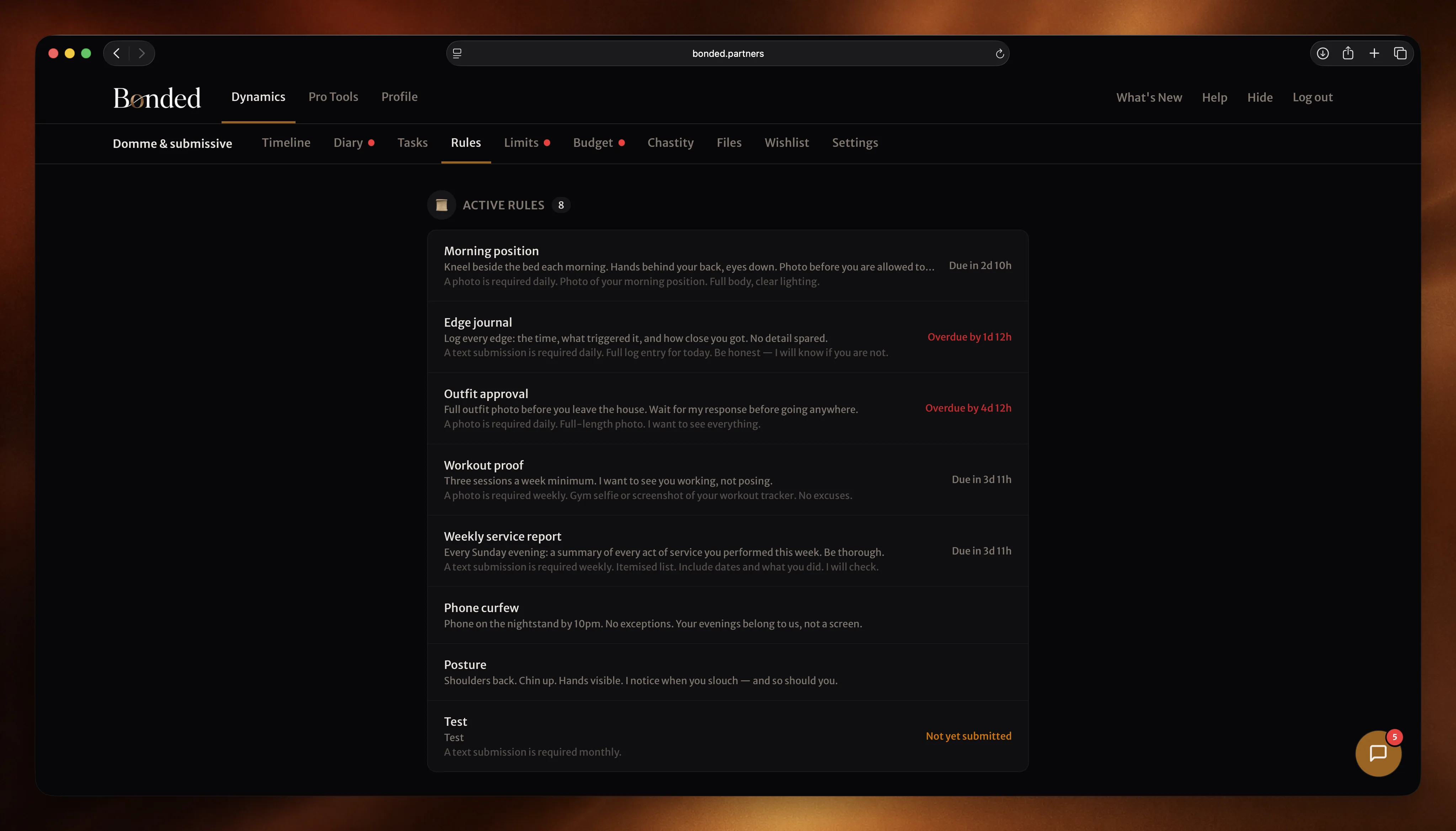
Write about it. Bonded's Diary feature can serve as a private journal for this kind of self-exploration, but any journal works. The act of putting thoughts into words forces a clarity that circling thoughts in your head does not.
Fill out a limits list on your own. Not for a specific partner, but for yourself. Go through a comprehensive list of activities and classify each one: hard limit, soft limit, curious, or neutral. You will learn an enormous amount about yourself from this exercise alone. Which categories excite you? Which frighten you? Which leave you indifferent? The patterns that emerge are a map of your submission's shape.
Educate Yourself
Read. Not just erotica (though erotica has its place), but educational resources about power exchange. Understand the mechanics of consent, negotiation, safewords, and aftercare before you are in a position where you need them. Learn the difference between healthy D/s and abuse. These are not always obvious from the inside, especially when you are new and unsure of the norms.
Good places to start: community workshops (many are available online), books by practitioners with established reputations, forums where experienced people share knowledge and answer questions. Be selective. Not everything published about D/s is accurate or healthy.
Observe Before Participating
If you have access to community events, munches, or workshops, attend as an observer before jumping in as a participant. Watch how experienced dynamics operate. Notice what feels appealing and what does not. Talk to people who have been doing this for a while. Ask questions.
Online communities can serve a similar purpose, though with the caveat that online spaces have their own biases and blind spots. Cross-reference what you read across multiple sources. If something sounds off, it probably is.
Start Small
When you do begin exploring with a partner, start with activities that are low-risk and easily reversible. A single rule. A defined scene with a clear beginning and end. A power exchange that lasts an evening, not a lifetime. You do not need to go from zero to 24/7 total power exchange. Very few people do, and those who try usually crash.
Small experiments give you data. Each one teaches you something about what works for you, what does not, and what you want to try next. Build incrementally.
Red Flags in Potential Dom(me)s
This matters enormously, so read it carefully.
Not everyone who claims to be dominant is safe. The D/s community has predators who use the language of dominance to disguise controlling, abusive, or exploitative behaviour. As a new submissive, you are particularly vulnerable to this because you may not yet know what healthy power exchange looks like.
Watch for:
"A real submissive would..." Any sentence that starts this way is a manipulation. There is no universal standard of "real" submission. Anyone who tries to define your submission for you, especially in ways that conveniently align with what they want, is not someone you should trust with power.
Resistance to negotiation. A safe Dom(me) wants to negotiate. They want to know your limits, your desires, your fears, your communication style. They want to build a framework that works for both of you. A person who dismisses negotiation as unnecessary, unsubmissive, or boring is telling you they do not intend to be constrained by your boundaries.
Isolation. A predator will try to separate you from friends, family, community, and other sources of information and support. A healthy Dom(me) encourages your connections and independence outside the dynamic. If someone tells you not to discuss your dynamic with anyone else, that is a red flag.
Moving too fast. Healthy dynamics build gradually. Someone who wants to collar you on the second date, who wants full control before you have established trust, who pushes for intensity before you are ready, is prioritising their desires over your safety.
No references or community presence. You cannot always verify a person's reputation, but a Dom(me) who has no connections in the community, no one who can vouch for them, and no interest in being part of a broader scene is harder to hold accountable. Community accountability is not foolproof, but isolation from it is a warning sign.
Punishing you for limits. If stating a limit leads to anger, withdrawal, guilt-tripping, or any form of punishment, leave. Immediately. A limit is a boundary, and a person who retaliates against your boundaries is not safe.
Refusing to use safewords. Non-negotiable. If someone tells you safewords are not necessary, are a sign of weakness, or "ruin the mood," they are telling you they do not want you to be able to stop what they are doing. That is the definition of danger.
Trust your instincts. If something feels wrong, it probably is. Being new does not mean being naive. You have a lifetime of experience reading people. Those skills apply here too.
You Do Not Have to Be Sure
Here is something that gets lost in the identity-focused conversations around D/s: you do not have to be certain. You do not need to declare yourself submissive with absolute confidence before you are allowed to explore. "I think I might be" is more than enough to start.
Some people explore and discover they are deeply, fundamentally submissive. Some discover it is a part of their sexuality but not the whole of it. Some discover it was curiosity rather than identity. Some discover they are actually switches, or dominant, or something that does not map neatly onto any label. All of these are valid outcomes.
Exploration is not a commitment. Trying things is not a binding agreement to be this way forever. The question "am I submissive?" does not need a permanent answer right now. It needs an honest engagement with the question itself.
Practical Takeaways
Submission is active, not passive. You choose, you set boundaries, you negotiate, you consent. Your agency is the foundation, not the obstacle.
There is no right way to be submissive. Service, sensation, devotion, protocol, play: these are all valid expressions. Your combination is unique.
Start with self-knowledge. Journal, fill out a limits list, educate yourself. Know your own landscape before inviting someone else onto it.
Learn to recognise red flags. Resistance to negotiation, isolation, pressure to move fast, punishment for limits: these are danger signs, not dominance.
Start small and build. Incremental exploration teaches you more than dramatic leaps. You have time.
You do not need certainty. Exploration is its own valid stage. You are allowed to not know yet.
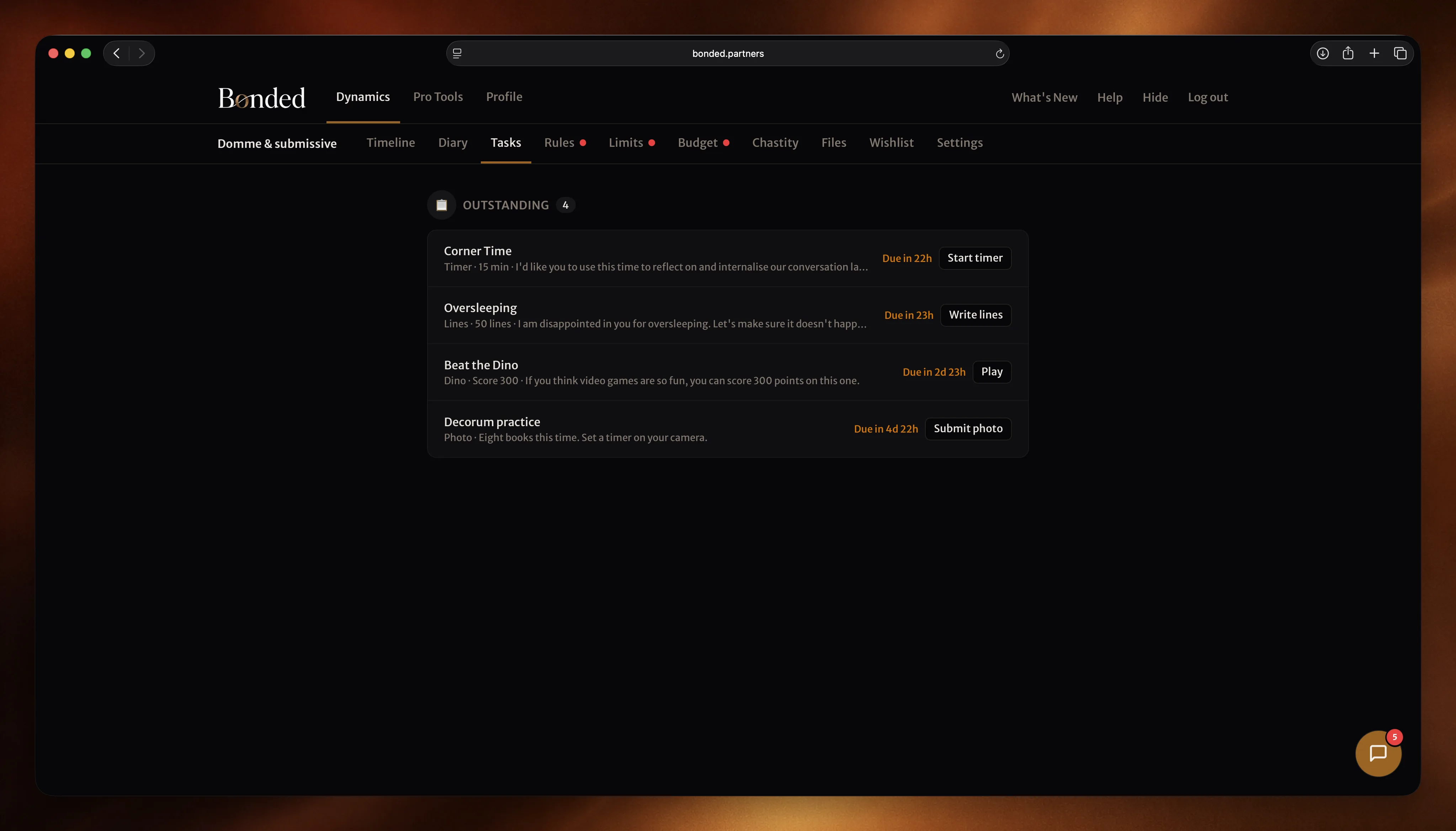
If you are ready to start mapping your submission, Bonded's Limits feature lets you classify 127 activities independently, even before you are in a dynamic. Use it as a self-discovery tool. Combined with the Diary for private reflection, it gives you a structured way to understand yourself before you negotiate with anyone else.
Go deeper
Read the full guide→