



The First 30 Days of a D/s Dynamic: A Practical Roadmap
A week-by-week guide to the first month of a D/s dynamic. Covers rules, limits, communication, tasks, check-ins, and common pitfalls for new dynamics.

You have had the conversation. You have both said yes. Maybe tentatively, maybe enthusiastically, but the decision is made: you are going to try this. A deliberate power exchange between two people who care about each other.
And now you are staring at a blank canvas with no idea where to start.
That is normal. The gap between "we want to do this" and "this is what we are actually doing" is where most new dynamics stall. Not because of incompatibility or lack of desire, but because of lack of structure. You need a starting point, a pace, and a framework for learning as you go.
This is a week-by-week roadmap for the first thirty days. Not a rigid prescription, because your dynamic is yours and will find its own shape, but a practical structure that gives you enough to work with while leaving room for discovery.
Before You Start: Foundations
Before day one, get three things in place.
1. Complete a Limits List
This is not optional. Before any power exchange begins, both of you need to know what is on and off the table. Fill out a comprehensive limits list independently, then compare results and discuss the differences.
Use the four-tier classification: hard limit, soft limit, curious, neutral. Do not shortcut this with a verbal conversation. The structure of a written list catches things that conversation misses.
Bonded's Limits feature gives you 127 activities across 22 categories with independent classification and a side-by-side comparison view. If you use a different tool or build your own list, make sure it is comprehensive enough that you are not surprised in week two by an activity neither of you thought to discuss.
2. Agree on Communication Protocols
How will you talk about the dynamic? When will you check in? What are your safewords?
At minimum:
- Safewords. Red/yellow/green is the standard system. Red means stop everything immediately. Yellow means slow down, check in, something is not right. Green means all good, keep going. Establish these before any scene. Both people should be comfortable using them and confident they will be respected.
- Check-in schedule. Weekly for the first month. No exceptions. Put it on the calendar.
- Meta-communication channel. A way to talk about the dynamic itself that is clearly separate from operating within the dynamic. "I want to talk about how things are going" should always be available to both people, regardless of role.
3. Define the Scope
Is this dynamic 24/7? Bedroom only? Certain hours? Certain days? Certain contexts?
For a new dynamic, smaller scope is better. A dynamic that operates from 7pm to bedtime, or only on weekends, or only during designated scenes, gives both of you clear on/off boundaries. You can expand the scope later as you gain confidence and experience. Starting with an expansive scope and contracting it feels like failure. Starting small and expanding feels like growth.
Week 1: Laying the Foundation
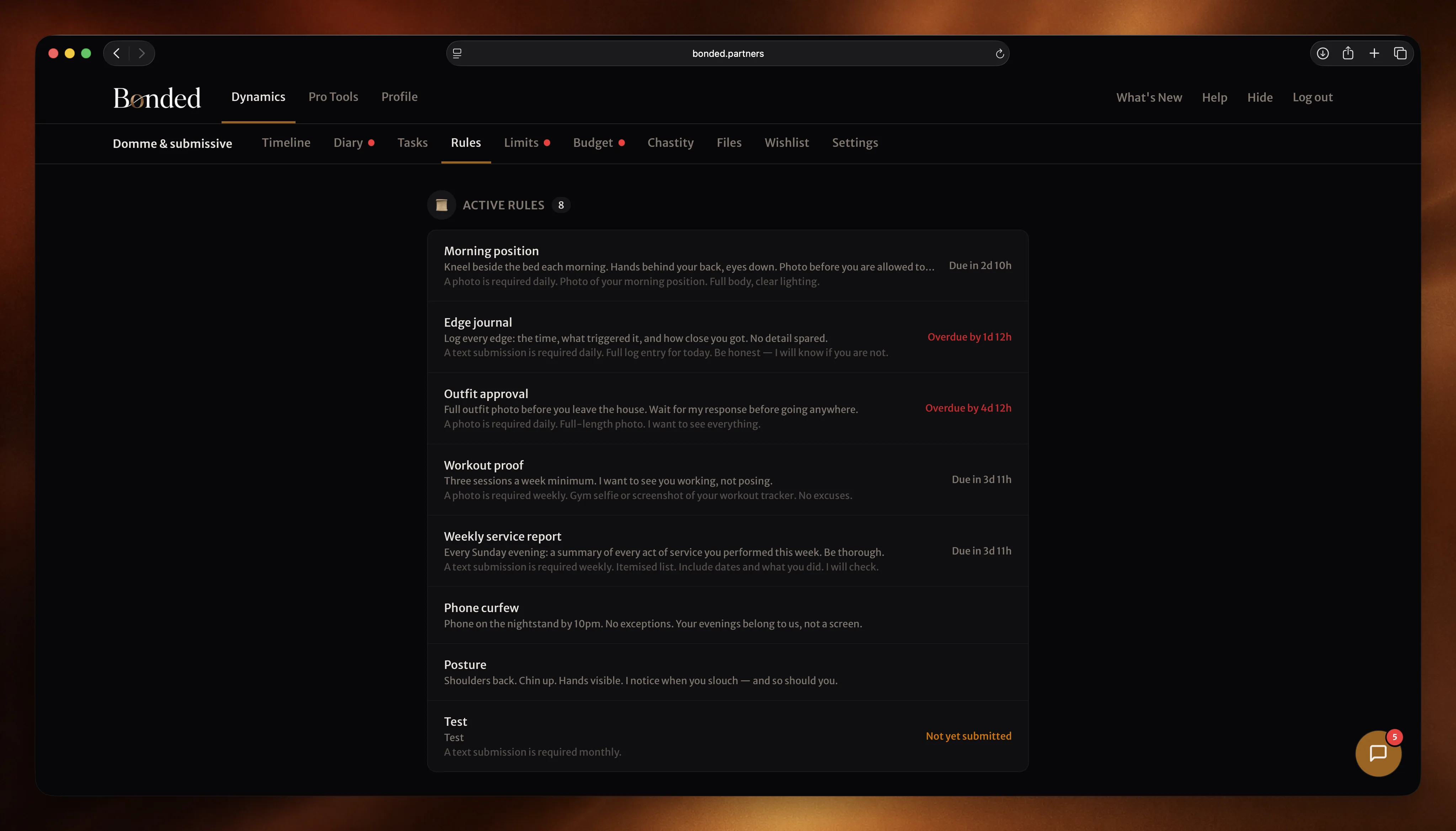
One to Two Rules
Not ten. Not five. One or two. The goal of week one is to experience what it feels like to have a rule, to follow a rule, and to enforce a rule. You cannot learn that from a rulebook. You learn it from living it.
Choose rules that are:
Simple. "Send me a good morning text before 9am" is simple. "Maintain the house to my standards at all times" is not. Start with something that has clear, unambiguous compliance criteria.
Meaningful. The rule should connect to the dynamic's purpose, not just be an arbitrary exercise of authority. A rule about greeting protocol connects to the power exchange. A rule about how to fold towels might not (unless domestic service is a core element of your dynamic).
Observable. Both people should be able to tell whether the rule is being followed. Rules that depend on subjective interpretation create ambiguity, and ambiguity in week one creates confusion.
Example rules for week one:
- A daily check-in message at a specific time
- A specific form of address (Sir, Ma'am, or whatever title you have negotiated)
- A bedtime ritual (a goodnight message with specific content)
- Asking permission for one specific thing (staying up past a certain time, for instance)
The Dom(me)'s Week 1 Job
Pay attention. Your submissive is showing you how they respond to structure. Do they light up? Do they struggle? Do they forget the rule (nervous energy, not defiance) or resist it (testing the boundary)?
Acknowledge compliance. Every time. This does not have to be dramatic. A simple "Good. Thank you." when the morning message arrives is sufficient. The acknowledgment tells your submissive that the rule matters, that you are paying attention, and that their compliance is seen.
Do not add more rules because things are going well. The temptation to build quickly when it is working is strong. Resist it. Let week one be week one.
The Submissive's Week 1 Job
Follow the rule or rules to the letter. If something is unclear, ask. If something feels wrong, say so in your meta-communication channel. This is not the time for silent compliance through discomfort.
Notice how it feels. Not just during the action of following the rule, but in the spaces between. The anticipation of the morning message. The awareness of the protocol throughout the day. The feeling of the dynamic existing in the background of your regular life. That awareness is the dynamic beginning to take shape.
Week 1 Check-In Prompts
At your first weekly check-in, discuss:
- How did following/enforcing the rule(s) feel?
- Was anything unexpectedly easy or hard?
- Did anything come up emotionally that surprised you?
- Is the scope of the dynamic comfortable, or does it need adjusting?
- Are we ready to add anything for week two?
Week 2: Adding Depth
Introduce Evidence and Accountability
If your rules lend themselves to it, add a layer of evidence. A photo of the completed task. A timestamp on the check-in message. A diary entry about the experience.
Evidence does two things: it gives the Dom(me) visibility into compliance without requiring constant monitoring, and it gives the submissive a tangible expression of their submission. There is something that shifts when you document your obedience. It makes it more real.
Start a Diary Practice
Both people. Not just the submissive.
The submissive's diary is a space for processing the experience of submission: what it feels like, what is working, what is hard, what they want more of. It is also a communication tool. Things that are difficult to say out loud are often easier to write.
The Dom(me)'s diary is a space for processing the experience of leadership: decisions made and their outcomes, observations about the submissive's responses, personal reflections on the emotional weight of dominance. If shared with the submissive, it gives them a window into their Dom(me)'s inner world that deepens the connection.
Bonded's Diary feature supports both private entries and shared entries, so each person controls what is visible. Start with whatever sharing level feels comfortable. You can increase it as trust deepens.
Add a Communication Ritual
Beyond the check-in message, add a structured communication point. Some options:
- A daily debrief where both people share one thing that went well in the dynamic that day
- A weekly letter where the submissive reflects on the week's dynamic in more depth
- A mid-week temperature check: a quick "how are we doing?" exchange
The specific format matters less than the consistency. You are building a communication habit that will serve the dynamic for its entire duration.
Week 2 Check-In Prompts
- How is the diary practice working? What is surfacing?
- Does the evidence/accountability layer feel appropriate or excessive?
- Are the existing rules still working? Need adjustment?
- Are we ready to add a task or additional element?
- How is the emotional weight of this? Too much? Not enough? About right?
Week 3: Expanding Carefully
Introduce Tasks
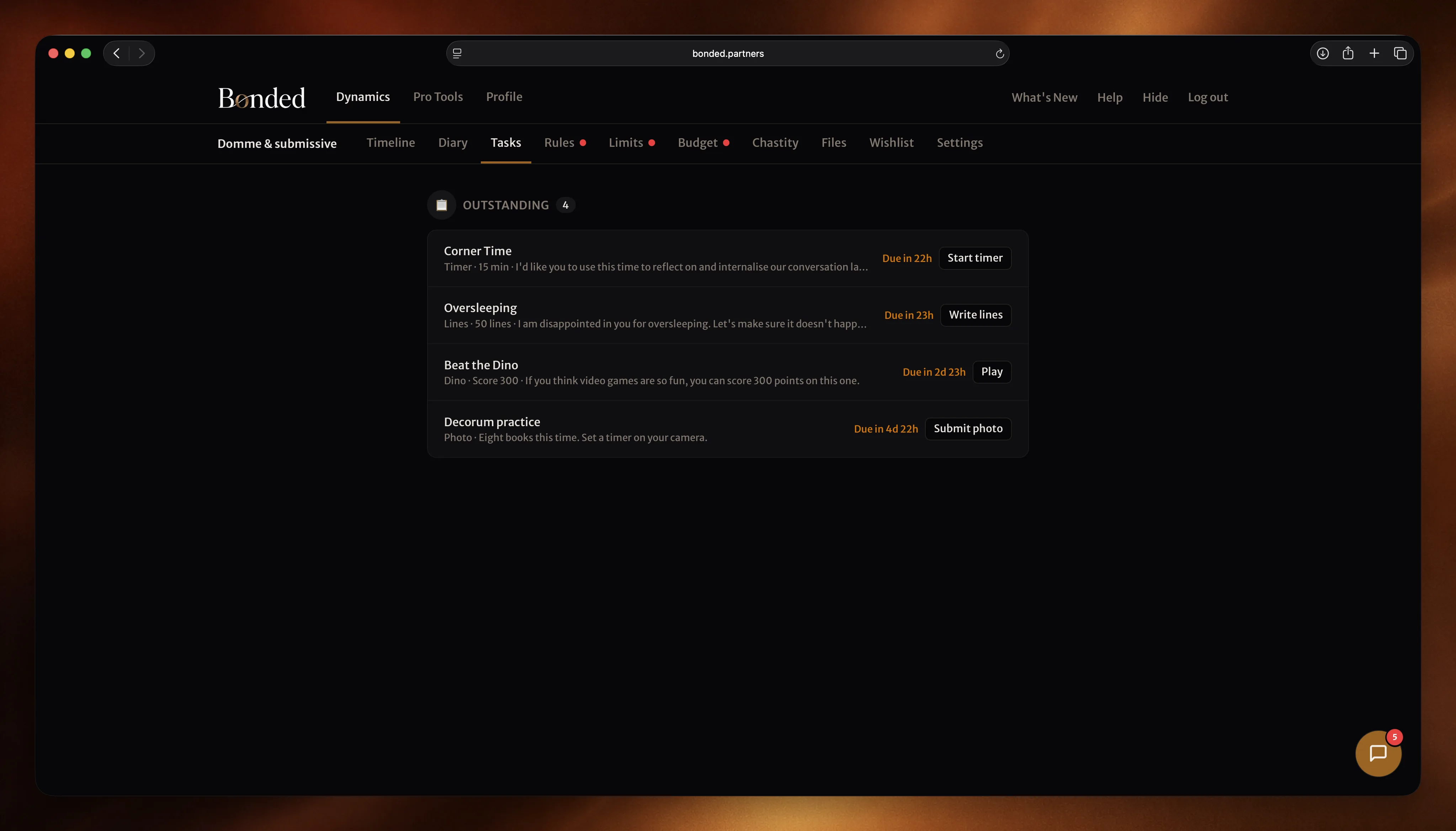
Rules are ongoing expectations. Tasks are one-time assignments. Week three is a good time to introduce them.
Tasks can be:
Practical. "Prepare a specific meal on Thursday." "Research a topic and report back." "Lay out my clothes for tomorrow."
Developmental. "Read this article about a kink we're both curious about and share your thoughts." "Practise the kneeling position we discussed for five minutes each evening."
Expressive. "Write me a description of your ideal scene." "Create a playlist that captures how submission feels to you."
The Dom(me) should be thoughtful about task design. Good tasks connect to the dynamic's themes, are achievable within the submissive's actual life constraints, and produce something: a result, a reflection, a growth point. Arbitrary tasks ("do fifty jumping jacks") might test obedience but do not build the dynamic.
Bonded's Tasks feature lets you assign tasks with deadlines, descriptions, and evidence requirements. The submissive completes and submits, the Dom(me) reviews and responds. It creates a clear workflow for this element of the dynamic.
Allow for Surprises
By week three, you know enough about each other's dynamic selves to introduce small surprises. An unexpected task. A rule modification that adds a playful element. A scene that pushes slightly beyond what you have done before (within established limits).
Surprises keep the dynamic alive. If everything is predictable after three weeks, something is too rigid. Power exchange thrives on a balance of structure and spontaneity.
Make Adjustments Without Drama
Something from weeks one or two is probably not working perfectly. A rule that sounded good in theory is annoying in practice. A communication rhythm that felt right is too frequent or not frequent enough. A dynamic element that excited you both is landing flat.
Adjust. Without treating it as failure. "This isn't working, let's change it" is not a problem. It is the dynamic doing what dynamics do: evolving based on actual experience. The Dom(me) who is too proud to modify a rule they set is prioritising their authority over the dynamic's health. The submissive who is too afraid to say "this isn't working" is prioritising compliance over honesty.
Week 3 Check-In Prompts
- How are tasks landing? Too much, too little, about right?
- Has anything surprised you this week, good or bad?
- What adjustments would improve things?
- Are there any limits you want to revisit based on experience so far?
- What do you want more of? Less of?
Week 4: Review and Decide
The First Month Review
This is bigger than a weekly check-in. This is a comprehensive look at everything you have built and a decision about where to go next.
Block out real time for this. An evening, minimum. Prepare independently first.
Each person should come prepared with:
- What worked best in the first month
- What did not work or felt off
- What they want more of going forward
- What they want less of or want to stop
- Any limits that have changed based on experience
- Their vision for the next month
The Conversation
Walk through each person's preparation. Listen fully before responding. This is not a debate. It is a mutual download followed by joint planning.
Discuss the rules. Which survive? Which get modified? Which get retired? Are there new rules that the first month's experience suggests?
Discuss the tasks. What kind of tasks worked? What kind fell flat? What does the submissive want more of?
Discuss communication. Is the check-in rhythm working? Is the diary valuable? Do you need more or less structured communication?
Discuss intensity. Is the dynamic intense enough? Too intense? Do you want to expand the scope (more hours, more contexts, more areas of life)?
Discuss the dynamic itself. Does this feel like what you both wanted? Is the power exchange landing the way you imagined? What is different from your expectations, and is that difference good or bad?
Decide the Direction
At the end of the review, make a clear decision. This is not about the entire future of the dynamic. It is about the next month. Options include:
Continue and expand. Things are working. You want to add more: more rules, wider scope, new activities, deeper power exchange.
Continue and consolidate. Things are working, but you want to deepen what you have rather than add more. Solidify the existing rules. Build consistency. Let the foundation set.
Continue and adjust. The core is good but specific elements need changing. Modify and continue.
Pause. Not stop. Pause. If one or both of you needs breathing room, take it. A pause is not a failure. It is a recognition that the pace needs adjustment.
Stop. If this genuinely is not working for one or both people, stopping is a valid and brave decision. Better to stop honestly than to continue out of obligation or fear of disappointing your partner.
What Is Normal After 30 Days
Because new dynamics generate anxiety about whether you are "doing it right," here is a reality check on what is normal after the first month:
Normal: Feeling excited, nervous, awkward, and uncertain, sometimes all at once.
Normal: Having rules you need to adjust or retire.
Normal: Forgetting a rule or task because you are still building the habit.
Normal: Feeling closer to your partner than you have in a long time.
Normal: Having moments of doubt about whether you are "dominant enough" or "submissive enough."
Normal: Discovering that some things you were curious about do not appeal to you in practice.
Normal: Wanting more, faster, than is probably wise.
Not normal: Feeling afraid of your partner. Dreading the dynamic rather than anticipating it. Feeling that your limits are not being respected. Feeling pressured to do things you have said no to. Feeling worse about yourself than you did before the dynamic started.
If any of the "not normal" items apply, stop and address them. These are not growing pains. They are warning signs.
Common Pitfalls
Doing Too Much Too Fast
The single most common new-dynamic mistake. You are excited. It is working. So you add rules, expand scope, increase intensity, and try advanced activities all in the first week. Then someone crashes. The submissive feels overwhelmed. The Dom(me) cannot maintain the pace. The whole thing implodes not because it was wrong, but because it was too much too soon.
The antidote is this roadmap's philosophy: incremental. One or two things per week. Let each addition settle before adding the next.
All Structure, No Connection
Rules and tasks are tools. They are not the dynamic itself. If you are so focused on compliance, evidence, and enforcement that you forget to connect as people, the dynamic becomes a performance rather than a relationship. Make sure the human moments, the laughter, the tenderness, the checking in without an agenda, are present alongside the structure.
Avoiding Difficult Conversations
The weekly check-in feels awkward. You skip it. A rule is not working but neither of you mentions it. Something in a scene felt off but you do not debrief. Each avoided conversation adds a layer of unspoken material that will eventually surface, usually at the worst possible time.
The check-in is not optional. The debrief is not optional. Honest communication is the oxygen of a dynamic.
Comparing to Other Dynamics
"But I read that they do XYZ by week two." "My friend's dynamic is way more intense." "Real Dom(me)s/submissives would..."
Stop. Your dynamic is not their dynamic. What works for someone else on the internet or in your community is irrelevant to what works for you. The only comparison that matters is between what you are doing and what both of you actually want.
Practical Takeaways
Prepare before day one. Limits list, communication protocols, and defined scope are prerequisites, not week-one activities.
Week 1: Start simple. One or two rules. Observe, acknowledge, feel.
Week 2: Add depth. Evidence, diary, communication rituals.
Week 3: Expand carefully. Tasks, small surprises, honest adjustments.
Week 4: Review everything. Comprehensive evaluation and a clear decision about direction.
Incremental is the word. The fastest way to kill a new dynamic is to do too much too fast.
Check in weekly without exception. These conversations are the dynamic's immune system.
Normal includes awkward. You are learning a new way of relating. Of course it is not smooth yet.
Bonded's integrated toolkit, Rules, Limits, Diary, Tasks, and Timeline, provides the structure this roadmap describes. Rules with accountability. Limits with independent classification. Diary with private and shared entries. Tasks with evidence and review. And a Timeline that shows the full arc of your first month and beyond.
Go deeper
Read the full guide→