



Topping From the Bottom: Myth, Reality, and Nuance
Topping from the bottom is the most misused phrase in D/s. Learn what it actually means, what it doesn't, and how to tell the difference.

Few phrases in the D/s world cause more confusion, more arguments, and more harm than "topping from the bottom." It gets thrown around in community discussions like a verdict. A submissive expresses a preference? Topping from the bottom. A submissive uses their safeword? Some people will mutter it. A submissive asks for what they want in a negotiation? Topping from the bottom. A submissive breathes in a way their Dom(me) did not specifically authorise? Well.
The phrase has become so overused and so loosely applied that it has lost most of its meaning. Which is a problem, because the legitimate concern at its core — the one worth talking about — gets drowned out by the noise.
Let us separate the signal from the noise.
What It Actually Means
At its core, topping from the bottom describes a pattern where a submissive covertly controls the dynamic while maintaining the appearance of submission. The "topping" is the control. The "from the bottom" is the position from which it is exercised.
The key word is covertly. This is not about influence, communication, or expressed preference. It is about manipulation — steering the Dom(me)'s behaviour through indirect means while both parties ostensibly maintain their agreed roles.
Genuine topping from the bottom might look like:
Engineered punishment. The submissive deliberately breaks rules to provoke a specific response. Not in the playful brat sense (more on that later), but strategically — controlling when and how the Dom(me) engages with them by manufacturing infractions. The Dom(me) thinks they are correcting disobedience. They are actually being puppeted.
Emotional manipulation to control scenes. Using tears, guilt, sulking, or emotional withdrawal not as genuine responses but as tools to redirect a scene in the direction the submissive wants. "If I act upset enough, they will switch to comfort mode, which is what I actually wanted."
Selective obedience as direction. Obeying enthusiastically when the Dom(me)'s choices align with the submissive's preferences and showing obvious reluctance or passive resistance when they do not, thereby training the Dom(me) to only give certain kinds of instructions. Over time, the Dom(me) is unknowingly following the submissive's script.
Undermining authority through third parties. Complaining about the Dom(me)'s decisions to friends, community members, or online spaces in a way that pressures the Dom(me) to change — not through direct conversation, but through social leverage.
Weaponised vulnerability. Using moments of genuine vulnerability to extract concessions that serve the submissive's agenda rather than the dynamic's health. "I was so fragile after that scene that my Dom(me) agreed to drop the rule I did not like." If the fragility is genuine, this is aftercare. If it is performed, it is manipulation.
Notice the common thread: in each case, the submissive is controlling the dynamic's direction while both partners officially maintain their roles. The Dom(me) does not know they are being steered. That is what makes it problematic — not the influence itself, but the covert nature of it.
What It Does Not Mean
Here is the longer, more important list. These things are frequently labelled as topping from the bottom, and they are not:
Expressing Preferences Is Not Topping From the Bottom
"I would really like it if you used the leather flogger instead of the rubber one." That is a preference. The submissive is providing information that helps the Dom(me) make better decisions. The Dom(me) is free to use that information or ignore it. Expressing what you want is communication, not control.
A submissive who never expresses preferences is not more submissive. They are less communicative, which makes the Dom(me)'s job harder and the dynamic less informed. Dom(me)s who shut down preference expression because it feels like "topping from the bottom" are not protecting their authority. They are impoverishing it.
Using a Safeword Is Not Topping From the Bottom
This should not need saying, but it does, because there are people in this community who frame safeword use as a submissive "taking control." A safeword is a safety mechanism. Using it is the submissive fulfilling their fundamental obligation in the dynamic: to communicate when a limit has been reached.
If a Dom(me) treats safeword use as topping from the bottom, they are telling their submissive that safety and submission are incompatible. They are not. Any Dom(me) who resents safeword use has a dangerous misunderstanding of consent.
Communicating Needs Is Not Topping From the Bottom
"I need more aftercare." "I need you to check in during scenes." "I need the rule about bedtime to be adjusted because my work schedule changed." These are needs, communicated directly. Direct communication is the opposite of covert control. It is the healthiest thing a submissive can do.
Negotiating Is Not Topping From the Bottom
Negotiation is the foundation of ethical D/s. During negotiation, both partners have equal voice. The submissive who says "I want these things, I do not want those things, these are my limits, these are my desires" is not topping. They are building the framework within which topping and bottoming will occur. You cannot top from the bottom if you are not in the dynamic yet — and negotiation happens before (or alongside, or as renegotiation of) the dynamic.
Having Limits Is Not Topping From the Bottom
Limits define the playing field. They are not restrictions on the Dom(me)'s power — they are the boundaries that make the power exchange possible. Without limits, there is no consent. Without consent, there is no D/s. There is just abuse.
A submissive who has extensive limits is not topping from the bottom. They are a person with boundaries. A submissive who adds new limits over time is not becoming "more controlling." They are learning about themselves and communicating what they learn.
Bonded's Limits feature makes limits visible and self-editable by the submissive specifically because limits belong to the person who holds them. The submissive can update their limits at any time without asking permission, because limits are not subject to the power exchange. They define it.
Giving Feedback Is Not Topping From the Bottom
"That scene was really intense and I did not enjoy the part where..." This is feedback. It is essential data for a Dom(me) who wants to lead well. Shutting it down as "topping from the bottom" is like a manager telling an employee that performance reviews are insubordination. It is nonsensical and it kills the dynamic's ability to improve.
Bratting Is Not (Usually) Topping From the Bottom
Bratting — playful resistance, deliberate provocation, testing boundaries as a form of engagement — is a widely practiced and valid expression of submission. The brat is not covertly controlling the dynamic. They are playing a role within it, one that both partners have agreed to and enjoy.
The distinction is consent and awareness. In bratting, the Dom(me) knows what is happening. They are playing the game too. The "struggle" is collaborative, not deceptive. The brat says "make me" and the Dom(me) says "gladly" and everyone is having a good time.
That said, bratting can cross into genuine topping from the bottom if:
- The Dom(me) has not consented to brat play and finds it genuinely undermining
- The bratting is a cover for real resistance that the submissive will not express directly
- The escalation is designed to force a specific Dom(me) response rather than to play within the dynamic
Context and intent matter. The same behaviour can be healthy play in one dynamic and problematic in another.
Why the Phrase Gets Misused
The phrase "topping from the bottom" is weaponised for several reasons, most of them bad:
To silence submissives. A Dom(me) who does not want to hear feedback, preferences, or needs can dismiss all of it as "topping from the bottom." This is a power move disguised as a dynamic observation. It says: your input is not welcome here. That is not dominance. That is insecurity wearing a costume.
To enforce a narrow view of submission. Some corners of the community hold that "real" submission means total passivity — no opinions, no preferences, no influence. By this standard, any submissive behaviour that is not complete compliance is topping from the bottom. This view is harmful and, frankly, boring. It reduces submissives to props and Dom(me)s to directors of one-person plays.
To avoid accountability. If a Dom(me) does something that does not work and the submissive says so, calling it "topping from the bottom" shifts blame from the Dom(me)'s decision to the submissive's response. It is a deflection strategy.
Community gatekeeping. "You're topping from the bottom" is sometimes used in community spaces to police other people's dynamics. This is almost always inappropriate. How another couple navigates their power exchange is their business, provided everyone is consenting.
How to Tell the Difference
For Dom(me)s trying to distinguish between healthy communication and genuine topping from the bottom, ask:
Is it overt or covert? If your submissive is telling you directly what they want, need, or feel, that is communication. If you are being steered without realising it, and only notice the pattern in retrospect, that might be topping from the bottom.
Is it consistent or strategic? A submissive who always expresses preferences is communicative. A submissive who only pushes back when it serves a specific agenda might be manipulating.
Does it respect your authority to decide? "I would prefer X" respects your authority — you can still choose Y. "If you do not do X, I will withdraw / punish you emotionally / complain to our friends" does not respect your authority. It coerces.
Is the submissive aware of what they are doing? Sometimes topping from the bottom is unconscious. The submissive does not realise they are steering. In these cases, the conversation is not about blame but about awareness. "I have noticed a pattern where..." opens dialogue. "You are topping from the bottom" opens conflict.
Have you actually told them what you expect? Before labelling behaviour as topping from the bottom, make sure there is a clear expectation to top from. If the rules are vague, the protocols are unspoken, and the boundaries of the power exchange are undefined, the submissive is not undermining your authority. They are operating in a vacuum.
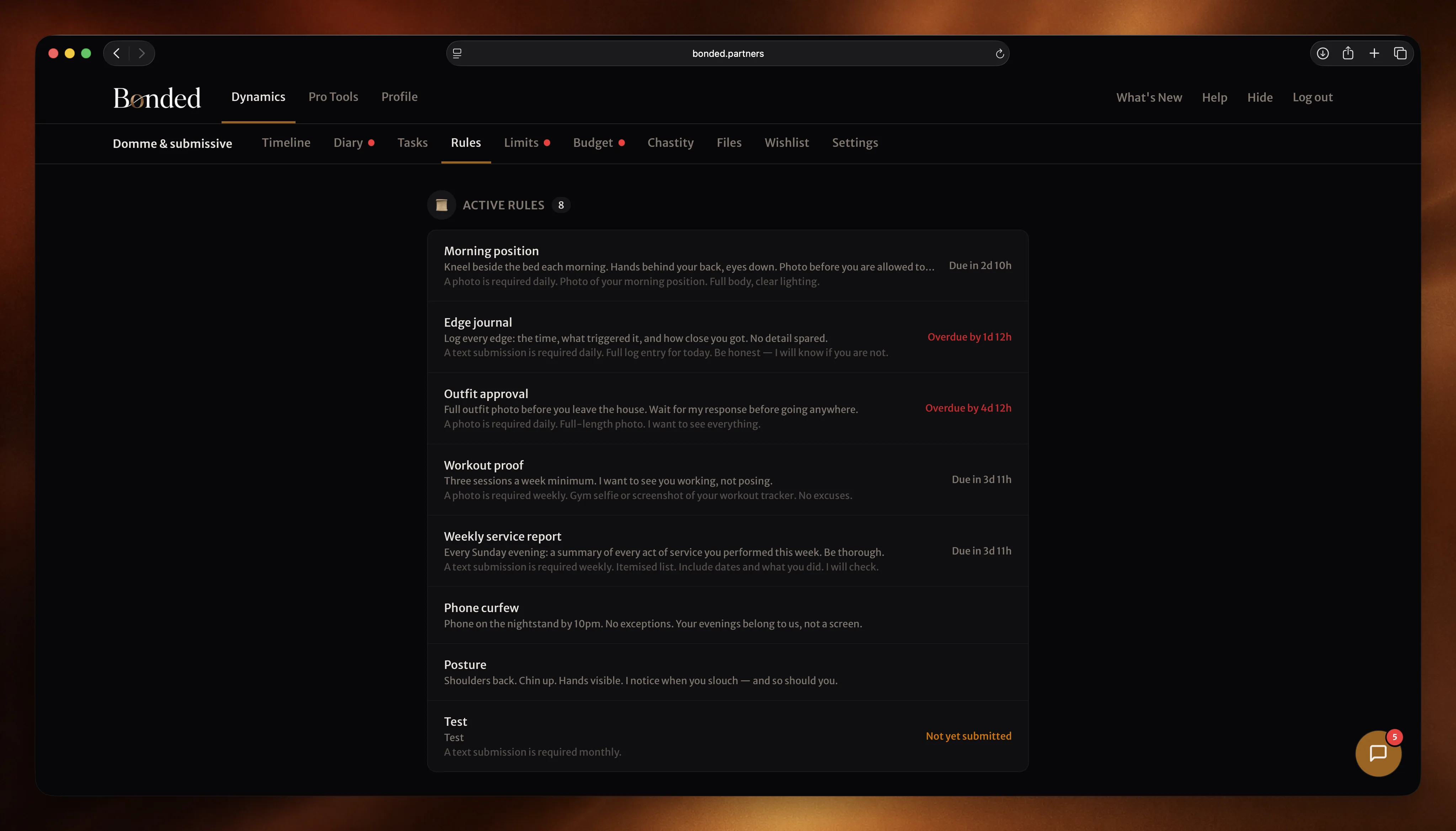
This is where having a clear, documented reference point helps enormously. Bonded's Rules feature creates an agreed-upon record of what has been negotiated and committed to. When both partners can see the same rules, "topping from the bottom" becomes a much more precise observation. You can point to specific patterns against specific agreements, rather than a vague sense that your authority is being challenged.
For Submissives: Self-Examination
If you are a submissive reading this and wondering if you top from the bottom, honest self-examination is valuable. Ask yourself:
- Am I communicating my needs directly, or am I trying to get them met through indirect means?
- When I push back, am I expressing genuine feelings or engineering a specific response?
- Am I giving my Dom(me) real information, or curated information designed to lead them to the conclusion I want?
- Do I trust my Dom(me) enough to tell them what I want and let them decide, or do I feel the need to control the outcome?
- Is my behaviour consistent with what we negotiated, or am I gradually moving the goalposts?
If the answer to any of these reveals covert steering, the solution is not shame. It is honest conversation. "I have realised I sometimes try to control things indirectly instead of telling you what I need. I want to work on that." That statement is the opposite of topping from the bottom. It is radical vulnerability and direct communication.
A Diary practice can help with this self-examination. Writing honestly about your motivations, your reactions, and your patterns over time reveals things that are invisible in the moment. If you notice yourself writing "I did X because I wanted them to do Y" repeatedly, that is data worth examining.
For Dom(me)s: Self-Examination
The flip side is equally important. If you frequently feel that your submissive is topping from the bottom, examine whether:
- You have created enough space for direct communication that indirect influence is not their only option
- Your expectations are clearly stated and realistic
- You are interpreting healthy communication as a threat to your authority
- You are using "topping from the bottom" to avoid engaging with legitimate feedback
- Your submissive feels safe enough to be direct with you
A Dom(me) whose submissive resorts to indirect influence should ask why before asking them to stop. Is the submissive inherently manipulative, or have they learned that direct communication is not safe in this dynamic? If expressing preferences gets labelled as topping from the bottom, the submissive will still have preferences — they will just learn to get them met covertly. You will have created the very dynamic you are complaining about.
Moving Past the Label
The most productive approach to this issue is to move past the label entirely and talk about what is actually happening.
Instead of "you are topping from the bottom," try:
- "I have noticed that when I choose X, you tend to react in a way that makes me choose Y instead. Can we talk about that?"
- "I want to make sure you feel comfortable telling me what you want directly, because I have noticed some indirect patterns."
- "Help me understand what you need here. I want to make good decisions and I need honest input to do that."
Instead of "am I topping from the bottom?" try:
- "I want to express a preference. Is now a good time?"
- "I have been feeling frustrated about something in our dynamic. Can we discuss it outside our roles?"
- "I notice I have been trying to steer things rather than communicating directly. I want to change that."
The conversation about influence, communication, and control within a power exchange is important and nuanced. It deserves better than a four-word accusation.
The Real Issue Underneath
Underneath the topping-from-the-bottom debate is a fundamental question: how much influence should a submissive have?
The answer is: significant influence, exercised through direct, honest communication.
A submissive who has no influence is a submissive whose needs are invisible. A Dom(me) who cannot tolerate influence is a Dom(me) who cannot handle feedback. Neither produces a healthy dynamic.
The power exchange is not about the submissive having zero agency. It is about the submissive choosing to direct their agency through the Dom(me). The submissive communicates. The Dom(me) decides. Both roles are active. Both require trust. And both fall apart without honest, direct, ongoing communication.
That is the real conversation worth having. Not "are you topping from the bottom?" but "are we communicating well enough that neither of us needs to?"
Go deeper
Read the full guide→