



When Your Dynamic Fizzles: How to Reignite D/s
D/s dynamics fizzle sometimes. It's normal, not fatal. Here's how to diagnose the cause and rebuild with a soft restart approach.

You used to feel it all the time. The hum of the power exchange beneath everything. The thrill of a rule followed, a task completed, an order given. The dynamic was alive and electric and it coloured your whole relationship with something extraordinary.
Now it is... quiet. The rules still technically exist but nobody is really tracking them. The protocols have slipped. Scenes have become infrequent, then rare, then basically nonexistent. You still love each other. You are still attracted to each other. But the D/s part — the thing that made your relationship feel like something more — has gone flat.
If this is you, take a breath. This is normal. It is not a death sentence for your dynamic. And it is almost certainly fixable, if you want it to be.
Why Dynamics Fizzle (And Why It Is Not Failure)
First, the most important thing: a dynamic that loses intensity is not a failed dynamic. It is a dynamic in a natural phase. Every long-term relationship has periods of intensity and periods of plateau. D/s dynamics are relationships. They follow the same patterns.
The fizzle happens for identifiable reasons:
Life Got In the Way
This is the most common cause and the least dramatic. Work got busy. Someone got ill. You moved house. A family member needed care. Sleep became more appealing than scenes. The dynamic did not die — it just got deprioritised by things that demanded immediate attention. The problem is that "temporary" deprioritisation has a way of becoming permanent if nobody actively reverses it.
The Novelty Wore Off
Early dynamics run on discovery. Everything is new — new sensations, new power dynamics, new emotional territory. That novelty generates its own energy. Over time, the novelty fades. This is not disillusionment. It is familiarity. What was once thrilling becomes routine, and routine does not generate the same chemical rush as discovery.
One or Both Partners Changed
People evolve. The submissive who craved strict protocol two years ago might now need something softer. The Dom(me) who loved elaborate scenes might have shifted toward a more nurturing style. If the dynamic has not evolved with the people in it, there is a growing gap between what is practiced and what is actually wanted.
Communication Eroded
In the early days, you probably talked about the dynamic constantly. What you liked, what you wanted to try, how things felt. Over time, those conversations become less frequent. You assume your partner knows. They assume you know. Neither of you is actually saying anything, and the dynamic drifts on autopilot until it drifts into nothing.
Resentment Accumulated
Small, unaddressed issues build up. The submissive felt a rule was unfair but did not say anything. The Dom(me) was disappointed by something but let it slide. Over months, these unspoken grievances form a layer of resentment that smothers the dynamic's energy. Nobody wants to engage deeply with something that carries unresolved hurt.
The Dynamic Was Unsustainable
Sometimes the fizzle is the dynamic correcting itself. If you started at a level of intensity that required constant energy and attention, the fizzle is simply the arrival at a sustainable baseline. The problem is not the lower intensity — it is the expectation that the early intensity was the "real" level. It was not. It was the honeymoon. The question is what the sustainable version looks like, and whether both partners can find fulfilment there.
Diagnosing the Cause
Before you can fix it, you need to understand it. Attempting to reignite a dynamic without diagnosing why it fizzled is like restarting a car without checking why it stalled. You might get lucky. You might also flood the engine.
Questions to ask yourselves — separately first, then together:
For both partners:
- When did I first notice the dynamic shifting? What was happening in our lives at that time?
- Do I still want a D/s dynamic? (Be honest. "I think I should want it" is not the same as wanting it.)
- What do I miss most about the dynamic at its best?
- What am I relieved to not be doing?
- Is there anything I have been avoiding saying?
For the Dom(me):
- Am I still energised by the idea of leading this dynamic, or does it feel like a burden?
- Have I been consistent? If not, what caused the inconsistency?
- Are the rules and protocols we have still relevant to who we are now?
- Have I been paying attention to my submissive's evolving needs?
For the submissive:
- Do I still feel safe and valued in this dynamic?
- Is there accumulated frustration or resentment I have not expressed?
- Have my needs changed? Do I want something different than what we have been doing?
- Am I craving more structure, or am I relieved by the looseness?
Looking at your Timeline in Bonded can help with this diagnostic work. Scroll back through your activity. Where were the peaks? When did things start thinning out? Are there patterns — did things always dip during certain seasons, after certain events, in response to certain stressors? Data helps you see what feelings might obscure.
The Soft Restart
The answer to a fizzled dynamic is rarely to go from zero to a hundred. That is how you get a brief flare followed by another, faster fizzle. Instead, try what some practitioners call a "soft restart" — a deliberate, graduated return to active D/s.
Step 1: Have the Conversation
Sit down — outside the dynamic, as equals — and talk honestly about where things are. This is not a scene. It is not a D/s conversation. It is two adults who love each other acknowledging that something they value has slipped and deciding together to attend to it.
Ground rules for this conversation:
- No blame. The fizzle is something that happened to the dynamic, not something one person did to the other.
- No defensiveness. If your partner says something uncomfortable, sit with it.
- No immediate solutions. Diagnose first. Fix later.
- Complete honesty, including the possibility that one or both of you might not want the same dynamic you had before.
Step 2: Renegotiate From Scratch
Do not try to return to the old dynamic. Return to the negotiation stage and build a new one. You are different people than you were when you last negotiated, even if only subtly. Your needs, limits, desires, and capacities have shifted.
Go back to basics:
- What kind of dynamic do we each want right now?
- What are our current limits? (These may have changed — use a limits checklist, like the one in Bonded's Limits feature, and go through it fresh.)
- What level of intensity is sustainable for both of us given our current lives?
- What rules or protocols feel meaningful right now versus which ones are leftover from a different phase?
- How will we maintain this dynamic differently than before?
The renegotiation itself is revitalising. It brings back the intentionality and conversation that characterised the early dynamic. And it gives both partners ownership of the new version.
Step 3: Start With a Minimal Viable Dynamic
Pick two or three rules. Not twenty. Not your full protocol sheet from two years ago. A handful of small, consistent practices that you can both commit to without strain.
Examples:
- One daily check-in at an agreed time
- One rule about a daily habit (hydration, bedtime, journaling)
- One weekly scene or dedicated dynamic time
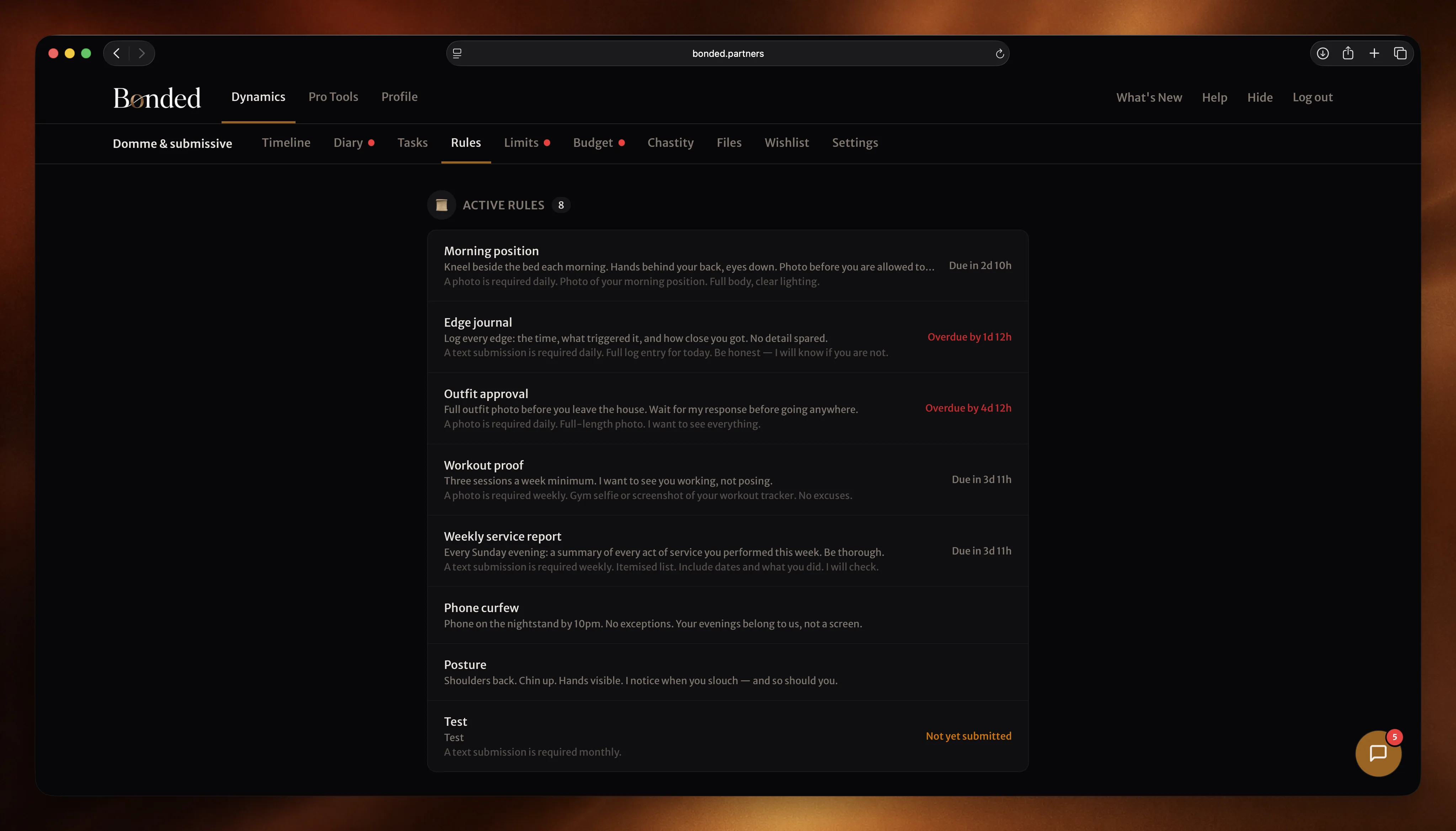
The Rules feature in Bonded is useful here because you can start fresh — create just the rules you are committing to now, rather than being haunted by a list of dormant expectations. Active rules only. Everything else can wait.
The goal is not to create the dynamic you ultimately want. It is to rebuild the habit of engaging with the dynamic at all. Consistency with three rules beats ambition with thirty.
Step 4: Rebuild Gradually
Once the minimal set feels natural and consistent — give it at least two to three weeks — add something. Another rule, a new ritual, a reintroduced protocol. One thing at a time. Each addition should be discussed, agreed upon, and given time to settle before the next one arrives.
This graduated approach respects the fact that you are rebuilding a practice, not flipping a switch. D/s engagement is like fitness. You do not go from couch to marathon. You train progressively and give your muscles time to adapt. Trying to do too much too fast leads to burnout, which is worse than the fizzle because it comes with a sense of failure.
Step 5: Reintroduce Novelty
Part of what made the early dynamic exciting was discovery. You can deliberately reintroduce this by:
- Exploring limits you have not revisited in a while (not pushing them — just reviewing and discussing them)
- Trying a new type of scene or play you have not done before
- Reading or learning about a new aspect of D/s together
- Attending a workshop or event
- Setting a dynamic challenge or goal that is new to both of you
Novelty does not require escalation. You do not need to go harder or more extreme. You need to go somewhere you have not been. That can be softer, gentler, more emotional, more creative. The key is unfamiliarity, not intensity.
Step 6: Build in Maintenance
The old dynamic fizzled partly because it lacked maintenance structures. This time, build them in from the start:
- Regular check-ins. Weekly or fortnightly, outside the dynamic, to discuss how things are going. Not optional, not skippable, not "we will do it when we have time."
- Periodic renegotiation. Quarterly review of rules, protocols, limits, and goals. Everything is on the table. Nothing is sacred except the relationship itself.
- Reflective practice. Both partners writing or speaking regularly about their experience. The Diary feature gives this practice a home — a place where the submissive's reflections and the Dom(me)'s observations accumulate over time, creating a record that makes drift visible before it becomes a fizzle.
- Dynamic dates. Scheduled time that is specifically for the dynamic — not vanilla date nights, but time dedicated to D/s engagement. Scenes, rituals, protocol practice, or just being in your roles together with intention.
When It Has Run Its Course
Not every fizzle is fixable, and that is okay.
Sometimes the honest answer to "do we want to reignite this?" is "no" — or "not this version." Sometimes people discover through the diagnostic process that they have grown in different directions. That the submissive no longer wants to submit to this person, or at all. That the Dom(me) no longer wants the responsibility. That what they have now — the love, the partnership, the companionship — does not need a D/s framework to be complete.
This is not failure. It is evolution.
Signs that the dynamic may have genuinely run its course, rather than just needing attention:
- One or both partners feel relief rather than loss at the reduced D/s
- Attempts to reignite feel forced and performative rather than exciting
- The desire for the dynamic has faded, not just the practice of it
- One partner wants it and the other genuinely does not (not "does not feel like it right now" but fundamentally does not want it)
- The dynamic has become a source of stress rather than connection
If this is where you land, honour what the dynamic was. It was real and valuable for the time it existed. Relationships grow and change. A dynamic that served you beautifully for three years and then ended served you beautifully for three years. That counts.
The Difference Between Fizzle and Failure
Fizzle is quiet. It is gradual. It is nobody's fault.
Failure is different. Failure is a broken trust, a crossed limit, a dynamic that was never built on solid foundations. Fizzle can be fixed with attention and intention. Failure requires deeper work — often with professional support.
If your dynamic did not just fizzle but fractured — if there was a breach of consent, a betrayal of trust, a pattern of harm — the restart process above is not sufficient. That requires a different kind of repair: honest accountability, possible professional mediation, and a genuine reckoning with what happened. Do not paper over a fracture with a soft restart. It will not hold.
The Restart Is Itself an Act of D/s
Here is something worth recognising: the process of reigniting your dynamic is itself an act of power exchange. The Dom(me) who says "I have noticed we have drifted and I want to bring us back" is exercising leadership. The submissive who says "I miss what we had and I am ready to work on it" is exercising courage. The negotiation, the vulnerability, the commitment to rebuild — all of this is D/s in action.
You do not need to wait until the dynamic is "back" to feel like you are in a dynamic. The work of rebuilding is the dynamic. It is two people choosing power exchange, choosing each other, choosing to do the hard thing of starting again.
That is not a fizzle. That is a fire being relit.
Go deeper
Read the full guide→