



Maintaining Your Dynamic When Life Gets Busy
Jobs, kids, illness, burnout — life doesn't pause for D/s. Here's how to maintain your dynamic when everything else demands your attention.

Here is the fantasy: you and your partner exist in a bubble where the only thing that matters is your dynamic. Endless time for scenes, rituals, connection. No deadlines, no childcare, no commute, no illness, no exhaustion that is not the fun kind.
Here is reality: you have a job. Maybe two. Maybe you have children who need things constantly and do not care about your protocol schedule. Maybe one of you is dealing with a health issue or a family crisis or just the relentless grind of being a functional adult in an expensive world. The dynamic is important to you — deeply, genuinely important — but it is competing for bandwidth with everything else, and everything else has deadlines.
This is not a failure of your dynamic. It is the conditions under which most dynamics actually operate. The question is not how to eliminate the competition for your attention. You cannot. The question is how to maintain something meaningful when your resources are finite and frequently depleted.
The Minimum Viable Protocol
Every dynamic needs a version of itself that can survive on minimal resources. Think of it as the minimum viable protocol — the smallest set of practices that keep the power exchange alive and felt, even when you cannot give it more.
Your minimum viable protocol should be:
Short. If it takes more than ten minutes a day in total, it is not minimum viable. You need something you can do when you are exhausted, distracted, and have seventeen other things demanding attention.
Non-negotiable. The whole point of a minimum is that it happens no matter what. If it is optional, it will be the first thing dropped, and then you have nothing. Protect these few things fiercely.
Felt by both partners. It should create a moment of connection and role awareness for both the Dom(me) and the submissive. A rule that runs entirely in the background without either person registering it is not maintaining the dynamic. It is just a habit.
Low-effort but high-meaning. The best minimum viable practices are small acts with outsized emotional resonance.
Examples of minimum viable protocols:
- A daily good morning message with a specific format or sign-off that signals the dynamic
- One standing rule about self-care (hydration, sleep, a meal) that the submissive reports on
- A two-minute evening check-in where both partners acknowledge each other's day
- A physical gesture — a specific touch, a positioning, a moment of eye contact — that says "we are still here"
- A single diary sentence. Not a paragraph, not a reflection essay. One sentence about the day. That is enough.
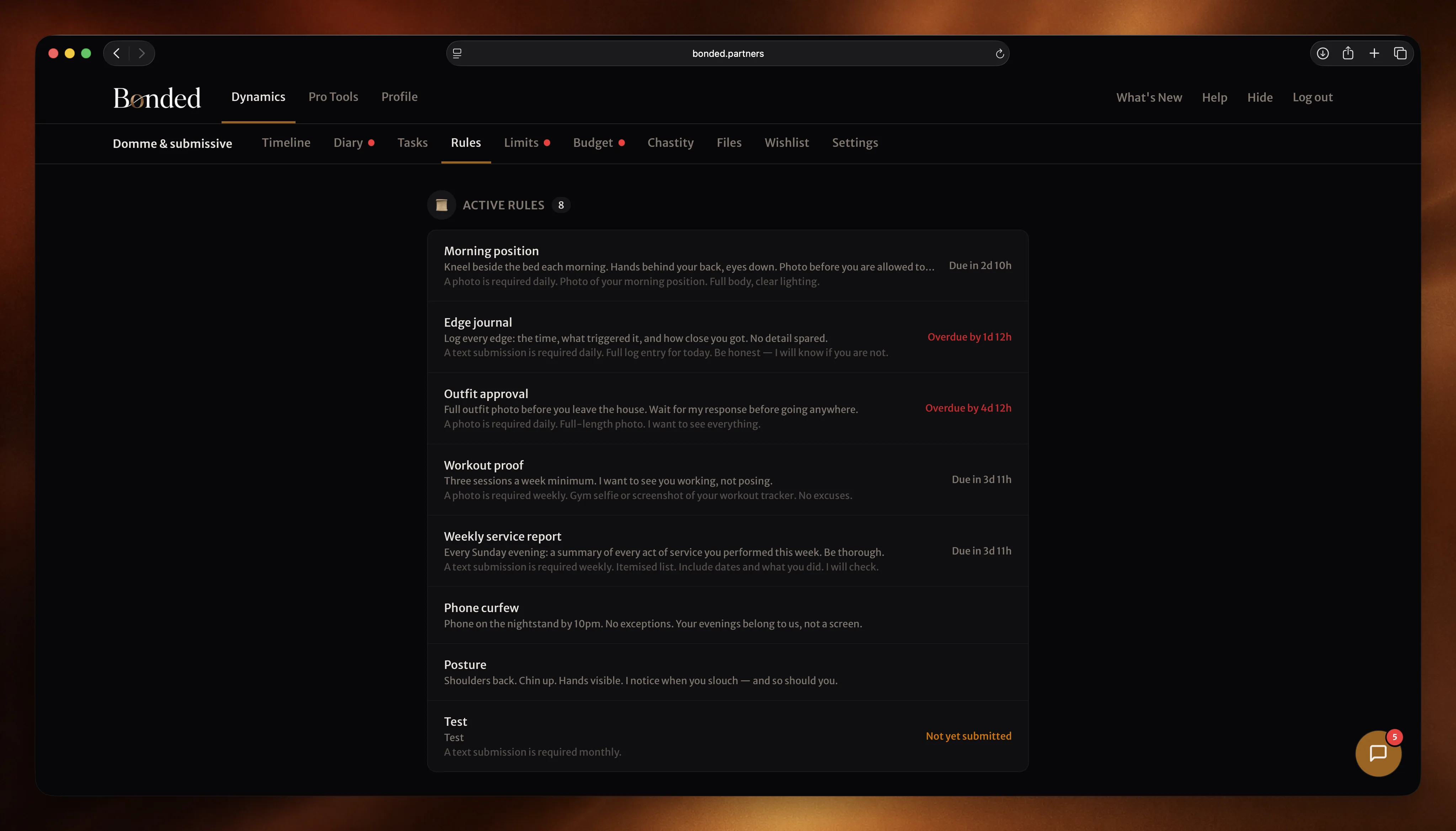
In Bonded, you can toggle rules between active and inactive without deleting them. During busy periods, set most rules to inactive and keep only your minimum viable set active. This is not abandoning your dynamic. It is maintaining it intelligently. When things ease up, reactivate rules one at a time.
The Grace Period
Every dynamic should have an explicit concept of a grace period — a defined time during which normal expectations are reduced without guilt, explanation, or loss of dynamic standing.
Grace periods are triggered by:
- Illness (physical or mental)
- Family emergencies
- Work crises (project deadlines, job changes, unexpected demands)
- Grief
- Burnout
- Any situation where maintaining the full dynamic would add stress rather than relieve it
What a grace period looks like:
The Dom(me) (or either partner, depending on the dynamic) declares a grace period. During this time, protocols reduce to the minimum viable set. Rules are simplified or paused. Scenes are off the table. The focus shifts from dynamic maintenance to human maintenance.
Critically, a grace period is not a break from the dynamic. The dynamic is still there. The roles are still there. But the expectations adjust to match current capacity. The Dom(me) is still leading — they are leading by recognising that their partner (or they themselves) needs less structure right now, not more. That is intelligent leadership, not abdication.
Having this concept pre-negotiated means nobody has to ask for it in the moment. "I think we need a grace period" should be as normal and uncharged as "I think we need an early night." It is a tool, not a crisis signal.
Modified Rules for Reduced Capacity
When life gets busy, rules do not have to be all-or-nothing. They can scale.
Full version: The submissive writes a daily diary entry of at least 200 words reflecting on their submission.
Reduced version: The submissive writes one sentence about their day.
Minimum version: The submissive checks a box that says "I thought about us today."
Full version: Morning protocol including physical ritual, outfit approval, and task assignment.
Reduced version: A good morning text with a specific sign-off.
Minimum version: Any acknowledgement of each other before noon.
Full version: Weekly formal scene with preparation and aftercare.
Reduced version: One intentional dynamic moment per week — could be as brief as five minutes of deliberate D/s interaction.
Minimum version: A conversation about the dynamic this week, even if it is just "I miss playing. Me too. Soon."
Building these tiers into your rules from the start means you never have to improvise during stress. You already know what the reduced version looks like. In Bonded's Diary, even a one-sentence entry still counts as engagement. The tool does not judge the length. What matters is the practice of showing up.
Low-Effort Rituals That Punch Above Their Weight
When time and energy are scarce, the rituals that survive are the ones that require almost nothing but deliver genuine connection. These become the backbone of your dynamic during hard times.
The three-word check-in. At an agreed time each day, both partners share three words describing their current state. "Tired. Loved. Stressed." or "Grateful. Exhausted. Yours." Takes seconds. Creates a moment of mutual visibility that maintains the thread.
The permission text. The submissive asks permission for one thing each day — it can be anything, even something trivial. "May I have a second coffee?" The act of asking, and the Dom(me)'s act of granting (or playfully denying), keeps the power exchange active in a way that takes thirty seconds but feels real.
The assigned comfort. Instead of adding tasks during busy periods, the Dom(me) assigns comfort. "Your task tonight is to take a bath" or "I am ordering you to go to bed early." This reframes the dynamic from burden to care. The authority is still exercised. The submissive still obeys. But the content is kindness, and both partners feel the dynamic without being drained by it.
The nightly gratitude. Before sleep, each partner names one thing about the other they are grateful for. This takes less than a minute and counteracts the erosion that busyness causes. When you are both running on fumes, hearing "I am grateful that you still texted me your check-in even though your day was terrible" lands differently than you might expect.
The symbolic carry. An object that represents the dynamic — a bracelet, a specific piece of clothing, a keychain, anything — that one or both partners carry or wear. On the worst days, when there is no time for anything else, touching the object is a private moment of "I am still in this."
Communicating a Scale-Back Without Rejection
This is where dynamics often stumble. One partner needs to reduce engagement, and the other hears rejection.
For Dom(me)s communicating reduced capacity to their submissive:
"I need to scale our dynamic back this week" can sound like "I do not want you" or "you are not important enough." Reframe it:
"I need to scale back this week because I want to give you my best when I engage, and right now I cannot. You deserve more than me going through motions. Let us go to our minimum set and I will bring us back when I can."
This frames the scale-back as care, not neglect. It names the reason (preserving quality), affirms the submissive's value, and commits to return. It is leadership, not retreat.
For submissives communicating reduced capacity to their Dom(me):
"I cannot do all of this right now" can sound like "I do not want to submit" or "your rules are too much." Reframe it:
"I am struggling to meet all of my commitments right now, and I do not want to fail at the things that matter most. Can we talk about what our must-haves are so I can give those my best?"
This frames the request as prioritisation, not rejection. It affirms the desire to serve well and invites the Dom(me) into the solution.
Bonded's Chat feature is useful for these conversations when you cannot have them in person. A quick message — "Hard day. Running on minimum today. Still yours." — takes seconds and closes the gap that silence would create.
Both Roles Struggle: Addressing Each Side
The Tired Dom(me)
Dominance during busy periods is exhausting because it adds a layer of responsibility on top of everything else. The Dom(me) is supposed to lead, direct, decide, monitor, and care — and they are also supposed to manage their own life, career, health, and energy.
Common experiences:
- Decision fatigue making it hard to make dynamic decisions on top of all the other decisions
- Guilt about not being "present enough" or "dominant enough"
- Irritability that bleeds into the dynamic
- The dynamic feeling like another job rather than a source of energy
What helps:
- Accept that low-output dominance is still dominance. You do not have to be "on" at full intensity to be a Dom(me). Saying "I am too tired to direct tonight, but I want you close" is a dominant act. It is honest, it sets expectations, and it maintains connection.
- Let the structure do the work. This is what rules are for. When you cannot actively direct, the standing rules carry the dynamic. The submissive follows them. You do not have to micromanage. Trust the system you built.
- Ask for support from your submissive. This is not weakness and it is not breaking role. A submissive who brings their Dom(me) tea without being asked, who says "You seem tired — what do you need?", who takes care of the logistics of life so the Dom(me) can breathe — that submissive is serving powerfully.
- Drop the performance. You do not have to perform dominance. You have to be the Dom(me). Sometimes being the Dom(me) looks like sitting quietly while your submissive reads beside you, the power exchange humming at a level so low it is almost subliminal. That counts.
The Overwhelmed Submissive
Submission during busy periods is hard because the submissive is managing their own cognitive and emotional load while also carrying the load of the dynamic. Rules, tasks, protocols, reflective practices — these require bandwidth, and bandwidth is exactly what busyness depletes.
Common experiences:
- Feeling stretched between dynamic obligations and life obligations
- Guilt about not being a "good enough" submissive
- Resentment toward rules that feel like additional burdens during stressful times
- The desire to submit emotionally but lacking the energy to submit practically
What helps:
- Communicate before you hit the wall. Do not wait until you are drowning to say you need a reduction. Proactive communication is easier for both partners than crisis management.
- Remember that imperfect submission is still submission. Following seven out of ten rules on a hard day is not failure. It is showing up with what you have. Do not let perfectionism convince you that anything less than total compliance means you are not submissive enough.
- Ask for the dynamic to support you. Sometimes what an overwhelmed submissive needs is more dynamic presence, not less — but a different kind. "I need you to make the decisions tonight because I am out of decision-making capacity" is a submissive using their dynamic as the support system it is meant to be.
- Use micro-submissions. When you cannot do the big things, do tiny ones. A text with a respectful address. A small act of service that takes one minute. Choosing to follow one rule with real intention. These keep the channel open.
Push Notifications as Connection Points
When you are both busy and barely overlapping in person, technology can maintain the thread. Bonded's push notifications are designed to be connection points, not interruptions — a brief reminder that the dynamic exists, that someone is thinking about you, that the structure holds even when you cannot actively tend it.
A notification that a diary entry has been written. A rule reminder that prompts a moment of awareness. A chat message that arrives during a meeting and sits there until you can read it, a small signal through the noise that says "I am still here."
These are not substitutes for real connection. They are bridges between moments of real connection, keeping the dynamic present in the margins of a full life.
The Counter-Intuitive Truth
Here is what nobody tells you about maintaining a dynamic during busy periods: sometimes the reduced version is better than the full version.
When you strip away everything non-essential, what remains is the core of your dynamic — the parts that are truly meaningful, the practices that actually generate connection, the rules that matter rather than the rules that just exist. Busy periods force you to identify what is essential and what is decoration.
Many couples discover, during and after a busy period, that they do not need or want to return to the full previous set of practices. The reduced version felt cleaner, more intentional, less cluttered. The busy period did not damage the dynamic. It refined it.
This is not always the case, and it is not a reason to permanently operate at minimum. But it is worth paying attention to. If your scaled-back dynamic feels more connected than your full dynamic did, that is information about what your full dynamic actually needs.
Building a Dynamic That Survives Reality
The dynamics that last are not the ones practiced in ideal conditions. They are the ones that have been tested by terrible conditions and survived. A dynamic that can only exist when both partners have unlimited time, energy, and bandwidth is a hobby. A dynamic that persists through job losses, sick children, exhausting weeks, and seasons of grey is a relationship.
Build yours for reality from the start:
- Define your minimum viable protocol before you need it
- Negotiate grace periods before the crisis hits
- Create tiered versions of your rules
- Talk openly about what happens when capacity is low
- Invest in tools — like Bonded — that reduce the friction of maintaining connection
Your dynamic does not need ideal conditions. It needs two people who keep choosing it, even imperfectly, even briefly, even in the margins. That is not the minimum. That is everything.
Go deeper
Read the full guide→