



Service Submission: When Obedience Is the Love Language
Service submission is the most common and least dramatic form of power exchange. Learn how it works, how it differs from just being helpful, and how to structure it for depth and satisfaction.

There's a version of submission that doesn't involve restraints, impact play, or kneeling at someone's feet. It involves doing the dishes.
Not metaphorically. Literally. Washing the dishes, folding the laundry, preparing a meal to specification, running an errand, organising a wardrobe, maintaining a household to a standard someone else sets. Service submission is the most widespread form of power exchange in practice, and the one that gets the least attention -- because it doesn't look like what people expect submission to look like.
It looks like work. Deliberate, accountable, structured work in service of another person. And for the people who practice it, that work is one of the most fulfilling expressions of devotion they've found.
What Service Submission Is
Service submission is a form of power exchange in which the submissive's primary expression of submission is acts of service -- practical tasks performed for or directed by the Dom(me). The service might be domestic (cleaning, cooking, household management), personal (care tasks, errands, grooming), professional (administrative support, scheduling, research), or any other category of practical labour.
What distinguishes service submission from the broader D/s landscape is emphasis. Every dynamic involves some element of service. But for service-oriented submissives, service is not a component of the dynamic -- it is the dynamic. The acts of service are the power exchange. The doing is the point.
This doesn't mean service submissives don't enjoy other aspects of D/s. Many do. But if you took away the scenes, the toys, the protocols, and left only the service, many of them would say the essential thing remains.
The Difference Between Being Helpful and Being of Service
This is the distinction that matters most, and the one that people outside D/s find hardest to grasp.
Helpful people do nice things. They pitch in because it needs doing, because they're generous, because they were raised to contribute. There's no power exchange involved. The helpful person decides what to do, when to do it, and how. If they stop, nobody has the authority to require them to continue.
Service submission is different in three fundamental ways.
Intention
A service submissive doesn't clean the kitchen because it's dirty. They clean it because their Dom(me) expects it, because the act of cleaning it to a specific standard is an expression of obedience, and because the completion of that task reinforces their place in the dynamic.
The kitchen might need cleaning regardless. But the submissive's relationship to the task is transformed by the context. It's not a chore. It's an offering. The difference is invisible from the outside and enormous from the inside.
A submissive described it this way: "I cleaned the house before I was in a dynamic. The house looked the same. But when I clean it now, I feel my Dom(me) in every action. The standard is theirs. The satisfaction is mutual. I'm not just cleaning a house. I'm serving a person."
Protocol
Service submission usually involves protocols that helpful behaviour doesn't. Protocols might include:
- Specific standards. Not just "clean the bathroom" but "clean the bathroom to inspection standard, including grout lines, mirror edges, and the underside of the toilet seat."
- Defined timing. The task is done at a specific time or within a specific window. Not "whenever you get to it."
- Required reporting. The submissive reports completion -- through a message, a photo, a diary entry. The Dom(me) knows it's done because the submissive tells them, not because they happen to notice.
- Feedback loops. The Dom(me) reviews the service and provides feedback. Praise, correction, or direction for next time. The submissive's work is seen and evaluated.
These protocols transform a domestic task into a structured act of submission. The structure is the point. Without it, you're just a tidy person. With it, you're a submissive in service.
Accountability
A helpful person who forgets to do the dishes has forgotten to do the dishes. A service submissive who fails to complete an assigned task has failed in their submission. The accountability isn't about the dishes. It's about the commitment.
This accountability goes both directions. The submissive is accountable for completing the service. The Dom(me) is accountable for noticing. A Dom(me) who assigns service tasks and then doesn't check whether they're done has abandoned their side of the exchange. The submissive's effort deserves attention. Without it, service becomes invisible labour, which is the opposite of power exchange.
What Service Submission Looks Like
The range is enormous. Here are some common expressions.
Domestic Service
The most traditional form. The submissive maintains the household to the Dom(me)'s standards. This might include:
- Cooking meals according to a meal plan or the Dom(me)'s preferences
- Maintaining cleanliness to a specified standard
- Managing household supplies and shopping
- Laundry, ironing, wardrobe maintenance
- Home organisation and tidying
For submissives who find satisfaction in domestic service, the home becomes a canvas for their submission. Every clean surface, every prepared meal, every organised drawer is evidence of their devotion. The home itself reflects the dynamic.
Personal Service
Service directed at the Dom(me)'s personal needs and preferences:
- Preparing the Dom(me)'s clothes, coffee, meals
- Running personal errands
- Managing appointments and schedules
- Drawing baths, laying out supplies, anticipating needs
- Physical care: massage, grooming assistance, comfort provision
Personal service is intimate in a way that domestic service sometimes isn't. When you're preparing someone's morning coffee exactly how they like it, you're saying: I know you. I pay attention to you. Your preferences matter enough that I've memorised them.
Administrative Service
Some submissives provide practical support that extends beyond the household:
- Managing correspondence or scheduling
- Research and information gathering
- Financial record-keeping and reporting
- Project management for the Dom(me)'s personal projects
- Event planning and coordination
This form of service is common in dynamics where the submissive has strong organisational skills and the Dom(me) benefits from delegation. It's also common in long-distance dynamics, where physical domestic service isn't possible but administrative service can happen from anywhere.
Anticipatory Service
The most advanced form: service that isn't assigned but anticipated. The submissive notices what the Dom(me) needs before they ask. The coffee appears without a request. The appointment is scheduled before the Dom(me) remembers they need it. The bag is packed before the trip is mentioned.
Anticipatory service requires deep knowledge of the Dom(me) and develops over time. It's not expected from new submissives -- it's a mark of an experienced dynamic where the submissive has internalised the Dom(me)'s preferences and patterns.
Dom(me)s: when your submissive anticipates correctly, acknowledge it explicitly. Anticipatory service is hard, and the reward of being seen for it reinforces the behaviour and the bond.
How to Structure Service
Unstructured service quickly becomes invisible labour. "Just help out around the house" is not service submission. It's cohabitation. Structure is what separates the two.
Define Specific Tasks
Vague expectations create anxiety. "Keep the house clean" leaves the submissive guessing at the standard, wondering what counts, and anxious about whether they've done enough.
Specific assignments remove the ambiguity:
- What: Clean the kitchen
- Standard: All surfaces wiped, dishes done, floor swept, bins emptied
- When: Daily, completed by 7pm
- Evidence: Photo of the completed kitchen
This specificity isn't about micromanaging. It's about creating clear goalposts that the submissive can meet and the Dom(me) can verify. Clarity is kindness.
Create Schedules
Service tasks benefit from schedules that create predictable rhythms:
- Daily tasks: Routine maintenance that happens every day. Morning coffee, kitchen cleaning, evening meal preparation.
- Weekly tasks: Deeper cleaning, laundry, shopping, specific projects.
- Monthly tasks: Deep clean rotations, wardrobe reviews, supply inventories.
The schedule gives the submissive structure and the Dom(me) predictability. When both parties know what's expected and when, the dynamic runs smoothly.
Require Evidence
Evidence transforms service from something the submissive does alone into something shared. Options include:
- Photo evidence: Before and after shots of cleaning. A photo of the prepared meal. A screenshot of the completed errand.
- Text evidence: A diary entry describing the service performed. A completion report.
- In-person inspection: The Dom(me) reviews the service directly. This is the most impactful form of evidence -- the submissive watches the Dom(me) evaluate their work.
Evidence creates a moment of connection around each task. The submissive presents their work. The Dom(me) receives it. The exchange is complete.
Provide Feedback
This is where many dynamics fall short. The submissive completes the service, submits evidence, and receives... nothing. Or receives a generic "good job" that doesn't acknowledge the specific effort.
Effective feedback for service submission:
- Specific praise: "The kitchen was spotless, and I noticed you cleaned the backsplash behind the stove -- that level of detail matters to me."
- Specific correction: "The bathroom was good overall, but the mirror had streaks. I want it redone by tonight."
- Growth acknowledgement: "Your cooking has improved significantly since we started the meal plan. The seasoning tonight was perfect."
Feedback tells the submissive that their service was not just completed but observed. That observation is the dominant act that completes the submissive's offering.
The Deep Satisfaction
Why do people find satisfaction in doing someone else's laundry? From the outside, it can look like exploitation with extra steps. From the inside, it's something else entirely.
Service submissives consistently describe several sources of satisfaction:
Tangible evidence of submission. Unlike emotional submission or psychological submission, service produces visible results. A clean house. A prepared meal. An organised schedule. The submissive can see their submission reflected in the physical world. It's concrete in a way that feelings aren't.
Flow state. Many service submissives describe entering a meditative state during service. The repetitive physical labour, the focus on meeting a standard, the absence of decision-making (the Dom(me) decided what to do; the submissive simply does it) -- this combination creates a state of calm focus that resembles what psychologists call flow.
Being useful. This sounds simple because it is. Some people are wired to find deep satisfaction in being useful to someone they care about. Service submission provides a structured, acknowledged framework for that wiring. You're not just useful. You're useful on purpose, with intention, within a dynamic that values and recognises the contribution.
Closeness through care. Service is an act of care. Preparing someone's meal is caring for their body. Maintaining their home is caring for their environment. Managing their schedule is caring for their time. The accumulation of these acts creates a form of closeness that conversation alone doesn't achieve. You are woven into the fabric of another person's daily life.
The cycle of direction and completion. The Dom(me) directs. The submissive completes. The Dom(me) evaluates. The submissive adjusts. This cycle, repeated daily, creates a rhythm that many people find profoundly settling. The structure itself is the reward.
Intersection with Other Dynamics
Service submission doesn't exist in isolation. It intersects with several other D/s frameworks.
Domestic Discipline
Domestic discipline dynamics emphasise rules and consequences within a household context. Service submission fits naturally here -- the service tasks are the rules, and failure to meet the standard triggers consequences. The two frameworks reinforce each other.
FLR (Female-Led Relationships)
Many FLR dynamics are built primarily on service submission. The female partner directs the household management and the male partner provides the labour. The authority is exercised through service expectations. For FLR couples, service submission is often the most visible daily expression of the power exchange.
24/7 Dynamics
Service is the backbone of many 24/7 dynamics. When power exchange is continuous rather than scene-based, service provides the day-to-day structure that keeps the dynamic alive. The submissive always has a task, always has a standard, always has a way to express their submission. This continuity is what makes 24/7 sustainable -- not intense scenes every day, but consistent service that maintains the power exchange at a steady hum.
Long-Distance Dynamics
Service submission adapts remarkably well to long distance. Administrative service, financial management, scheduled tasks with photo evidence, meal planning and documentation -- all of these can happen across any distance. The submissive serves. The Dom(me) reviews. The dynamic sustains.
For the "I'm Not Kinky Enough" Crowd
There are people reading this who have been circling the edges of D/s for months or years, curious but hesitant because they're not interested in the dramatic stuff. The whips, the chains, the elaborate scenes. They think that if those things don't appeal to them, they're not "really" into power exchange.
You might be a service submissive.
If the idea of maintaining someone's household to their exact specifications makes you feel a pleasant tightness in your chest -- you might be a service submissive. If the thought of receiving detailed instructions for a task and executing them perfectly sounds like peace -- you might be a service submissive. If you've been the person who always volunteers to help, always takes on the logistics, always makes sure everything runs smoothly, and you've wondered if there's a version of that where someone notices and it means something -- you might be a service submissive.
D/s does not require a dungeon. It doesn't require equipment. It doesn't require anything except two people and a deliberate power exchange between them. If your version of that exchange involves a mop and a specific standard for how the floors should look, that's as valid as any leather-clad scene.
More valid, maybe. Because you'll do it every day.
Building a Service Practice
If service submission resonates and you want to build it into your dynamic, here's a practical path.
Start with one task. Not a household overhaul. One specific, daily task with a clear standard and evidence requirement. Maybe it's preparing the Dom(me)'s morning coffee. Maybe it's making the bed. One task, done consistently, with feedback.
Add complexity gradually. After two weeks of consistent completion, add a second task. Then a third. Build a schedule. Introduce weekly tasks alongside daily ones. Let the service expand organically rather than arriving all at once.
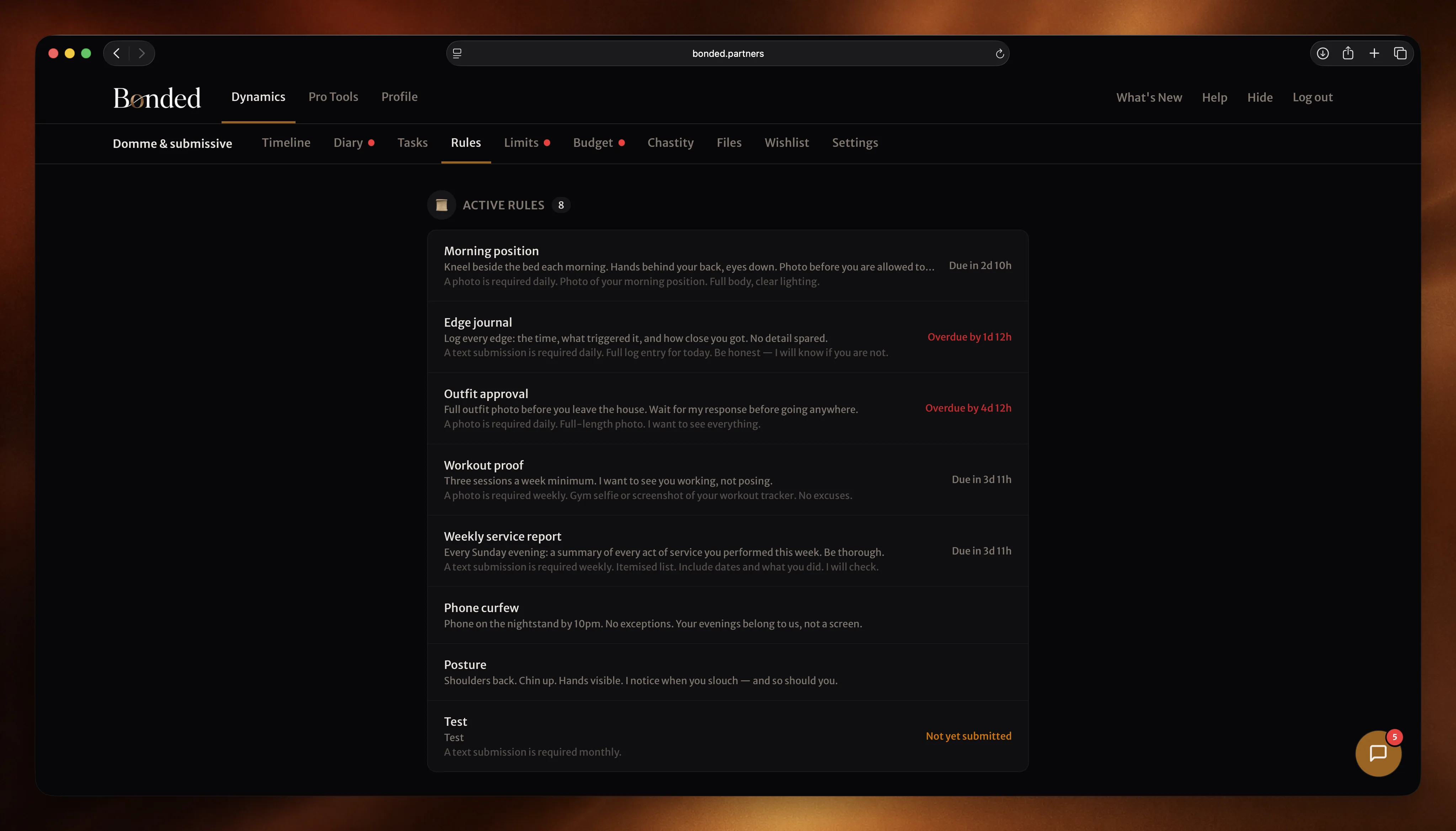
Use rules for standing expectations. Tasks that happen on the same schedule with the same standard can be formalised as rules. "Kitchen cleaned to inspection standard by 7pm daily, photo evidence submitted" is a rule. Build it as one. Track it as one.
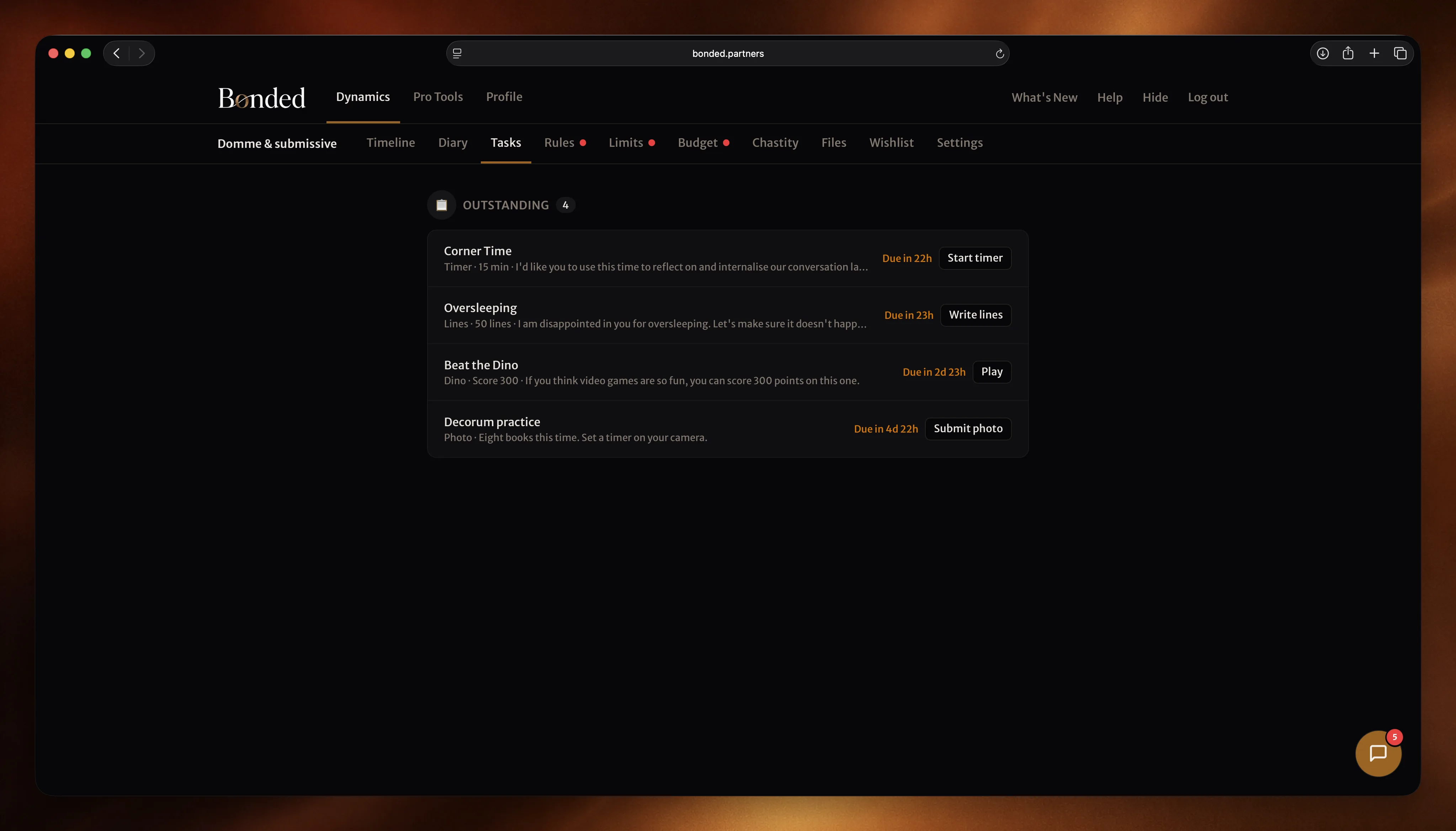
Use tasks for one-off assignments. The Dom(me) needs something specific done today? That's a task. "Pick up the dry cleaning and photograph the receipt" doesn't need to be a standing rule. It needs to be assigned, completed, and acknowledged.
Journal about the service. The diary is where the service submissive processes the experience. Not just "I did the tasks." But "This is what it felt like. This is what was hard. This is what was satisfying. This is what I want to do better." The diary turns mechanical service into reflective practice.
Review regularly. Monthly, sit down together and discuss the service. What's working? What needs adjustment? Is the standard right? Is the schedule sustainable? Are there new areas where service would benefit the dynamic? The review keeps the practice alive and evolving.
The Quiet Power
Service submission will never be the flashiest form of power exchange. It won't make for dramatic social media posts. It won't impress people at play parties. It's a person scrubbing a bathtub because someone they love set a standard and they want to meet it.
But there's a quiet power in that. In the daily, unglamorous, disciplined act of serving another person with intention and care. In the Dom(me) who notices. In the submissive who glows when the standard is met and acknowledged.
Not every expression of devotion needs to be dramatic to be profound. Sometimes the most powerful submission is the one that looks like Tuesday -- unremarkable on the surface, and underneath, a choice being made again and again to serve, to obey, to love through labour.
That's service submission. And for the people who live it, it's more than enough.
Go deeper
Read the full guide→