



D/s for Queer Couples: Beyond the Heteronormative Script
Power exchange without patriarchal templates. How queer couples build D/s dynamics on their own terms -- finding language, navigating identity, and creating structure without gendered assumptions.
Most D/s content assumes a specific pairing. You know the one. He's dominant, she's submissive, and the entire framework is built on a heterosexual template that borrows -- consciously or not -- from patriarchal norms of authority.
This isn't that post.
If you're queer and interested in power exchange, you've probably already noticed the gap. The guides assume pronouns that don't fit. The examples describe dynamics that don't map to your relationship. The community spaces are welcoming in theory and heteronormative in practice. You're left doing translation work -- extracting the useful parts and discarding the parts that assume your Dom(me) is a man with a deep voice and your submissive is a woman who needs protecting.
That translation work shouldn't be necessary. Power exchange is not inherently gendered. Authority doesn't require testosterone. Submission doesn't require femininity. The structures of D/s -- rules, protocols, service, oversight, rituals -- work for any combination of people who want them.
This post centres queer experience. Not as a special case. Not as a sidebar. As the main text.
Power Exchange Without the Script
Heterosexual D/s dynamics, for better or worse, come with a pre-loaded script. Cultural assumptions about who leads and who follows, who controls and who yields. A straight couple can lean on those assumptions without examining them. They might examine them anyway -- many do -- but the script is there if they want it.
Queer couples don't have that script. Which means the negotiation is, by necessity, more intentional.
This is often framed as a disadvantage. It's not. It's an advantage. When there's no default, every choice is deliberate. Why are you the Dom(me)? Not because of your gender. Because you want it, you're suited to it, and your partner wants you in that role. Why are you the submissive? Not because society told you to yield. Because you chose it. The intentionality runs deeper when the script is absent.
Two men building a D/s dynamic have to decide from scratch who leads. Two women building a D/s dynamic have to navigate the assumption that women are "naturally" submissive -- and either claim or reject it on their own terms. Non-binary people building a D/s dynamic have to create language and frameworks that don't exist yet in most guides.
All of this is work. It's also freedom.
Finding Your Own Language
The vocabulary of D/s carries gendered weight. "Sir" and "Ma'am" assume a binary. "Daddy" carries specific connotations. "Mistress" assumes a woman. Even "Dom" and "sub" are often gendered in practice if not in definition.
Queer dynamics often develop their own language. Some examples of how people navigate this:
Titles. Choose what resonates, not what's traditional. Some queer Dom(me)s use "Sir" regardless of gender because the authority it conveys feels right. Some reject titles entirely. Some invent their own. A title should make both people feel the dynamic, not perform someone else's version of it.
Role names. "Dom(me)" and "submissive" are functional and gender-neutral. So is "top" and "bottom" in the power exchange sense (distinct from the sexual sense, though they can overlap). Some dynamics use "lead" and "follow." Some use terms drawn from their cultural background, their shared interests, or their own creativity.
Relationship labels. "My Dom(me)" and "my sub" work universally. Beyond that, queer couples often need to find labels that describe their specific arrangement without defaulting to heteronormative frames. "My partner leads our dynamic" says what it needs to without importing assumptions.
The point is not to create a queer D/s dictionary. It's to recognise that language shapes experience, and choosing your own language is itself an act of power -- one that queer people are already practiced at.
M/M Dynamics
D/s between men carries its own textures. Some of what's specific to M/M power exchange:
Masculinity as material. In a culture that tells men to be dominant, choosing submission is a particular kind of radical. A man who kneels for another man is defying two expectations simultaneously -- that men lead, and that men don't kneel. The subversion itself can be part of the charge.
Conversely, dominance between men can carry different weight than in mixed-gender dynamics. The authority is physical peer-to-peer in a way that heteronormative dynamics aren't. When your Dom(me) is the same size and strength as you, the authority comes entirely from the dynamic, not from physical disparity. That's clarifying.
Navigating gay community norms. The gay community has its own power dynamics around masculinity, physique, age, and experience. D/s in a gay context sometimes intersects with these -- the leather community has deep roots in gay male culture -- and sometimes pushes against them. A younger man dominating an older one. A smaller man leading a larger one. These dynamics challenge assumptions within the queer community itself.
Emotional range. Men in D/s dynamics with other men often describe a freedom to express vulnerability that they don't find elsewhere. Submission provides a sanctioned space for tenderness, for need, for the emotional intensity that men are often discouraged from expressing. The dynamic creates permission.
F/F Dynamics
D/s between women navigates a different set of cultural assumptions.
The double bind of femininity. Women in D/s dynamics with other women are often told their dominance isn't real ("you're both women, who's really in charge?") or their submission is regressive ("women fought for equality and you're choosing to serve someone?"). Both of these are external projections that have nothing to do with the actual dynamic.
A woman who dominates another woman is not performing masculinity. She's exercising authority as a woman, and her submissive is yielding to that authority on its own terms. The dynamic doesn't need a masculine element to function. Power exchange between women can be intensely feminine, intensely butch, intensely androgynous, or anything else -- because the power exchange is the point, not the gender performance.
Egalitarian pressures. Lesbian and bi women's communities often emphasise radical equality. This can make it harder to name and claim a power differential, even a consensual one. "We're supposed to be equals" is a pressure that straight couples feel less acutely.
The answer is the same as in any D/s context: equality of value is not the same as equality of authority. Two people can be equal in worth, respect, and agency while choosing an asymmetric power structure. Egalitarianism is about having the choice, not about mandating that every choice look the same.
Intimacy and intensity. Many women in F/F dynamics describe the emotional intimacy of power exchange as amplified. Whether this is inherent or cultural -- women are socialised to be emotionally available, and D/s puts that availability under a magnifying glass -- the result is dynamics that often dive deep quickly.
Non-Binary Dynamics
Non-binary people in D/s face the most fundamental language and framework challenges, because so much of the existing vocabulary and structure was built on a binary.
Beyond "Dom" and "sub." For some non-binary people, the standard terms work fine. For others, the associations are too gendered. What matters is finding terms that feel authentic to both parties. This might mean using the standard terms with a personal understanding of what they mean in context. It might mean creating entirely new vocabulary.
Role without gender. Non-binary D/s dynamics prove something important: power exchange is about power, not about gender. The desire to lead, to follow, to serve, to direct -- these exist independent of gender identity. A non-binary Dom(me) has authority because they claim it and their partner grants it, not because of any gendered expectation. A non-binary submissive yields because the structure serves them, not because their gender "fits" the role.
Navigating others' assumptions. Non-binary people in D/s dynamics often face assumptions from the broader kink community about which role they "should" play based on their presentation. This is tiresome and irrelevant. The dynamic is between the people in it, not between the people in it and the community's assumptions about them.
Switching
Switching -- alternating between dominant and submissive roles -- is more common and more openly practiced in queer dynamics. This isn't because queer people are inherently more switch-oriented. It's because the absence of gendered role assumptions makes switching a more natural possibility.
When there's no script that says "you're always the Dom(me) because you're the man," the question of whether to switch becomes open. Some couples switch regularly -- dominant on weekdays, reversed on weekends. Some switch based on emotional state, energy, or desire. Some never switch at all.
All of these are valid. The point is that the decision happens in a space free from gendered expectation, which means it's more likely to reflect what both people actually want rather than what they think they're supposed to want.
For couples who do switch, a few practical notes:
- Explicit transitions. Switching works best when the transition is marked. A conversation, a ritual, a specific signal. Without a clear marker, both people can end up uncertain about who's leading, which creates anxiety rather than power exchange.
- Separate rule sets. If both people have rules for their submissive phases, keep them distinct. What applies when A is leading doesn't automatically apply when B is leading.
- Processing time. Moving from Dom(me) headspace to submissive headspace (or vice versa) takes time. Rapid switching can be disorienting. Build in transition space.
The Intersection of Queer and Kink Identity
For many queer people, coming into kink feels like a second coming-out. You've already done the work of understanding yourself as outside one norm. Now you're understanding yourself as outside another. The skills transfer: self-examination, honesty about desire, willingness to defy expectations, comfort with being misunderstood.
But the intersection also creates specific challenges:
Community navigation. Queer kink spaces exist and are growing. But they're not universal. Many people find themselves in kink communities that are predominantly straight, where their queerness is tolerated but not centred. Or in queer communities where their kink is tolerated but not understood. Finding spaces where both identities are fully welcome takes effort.
Layered stigma. Being queer and kinky means managing two layers of social judgment. This can make it harder to be open about either identity, even in theoretically safe spaces. The diary practice becomes especially valuable here -- a private space to process both identities without performing for an audience.
Representation. If you're looking for models of what your specific dynamic could look like -- two trans women in a D/s dynamic, a non-binary person and a cis man, two queer men with a switching arrangement -- you may not find many. This is changing, slowly, but the shortage of visible representation means more dynamics are being built from scratch. That's harder. It's also more authentic.
Building Structure Without Gendered Assumptions
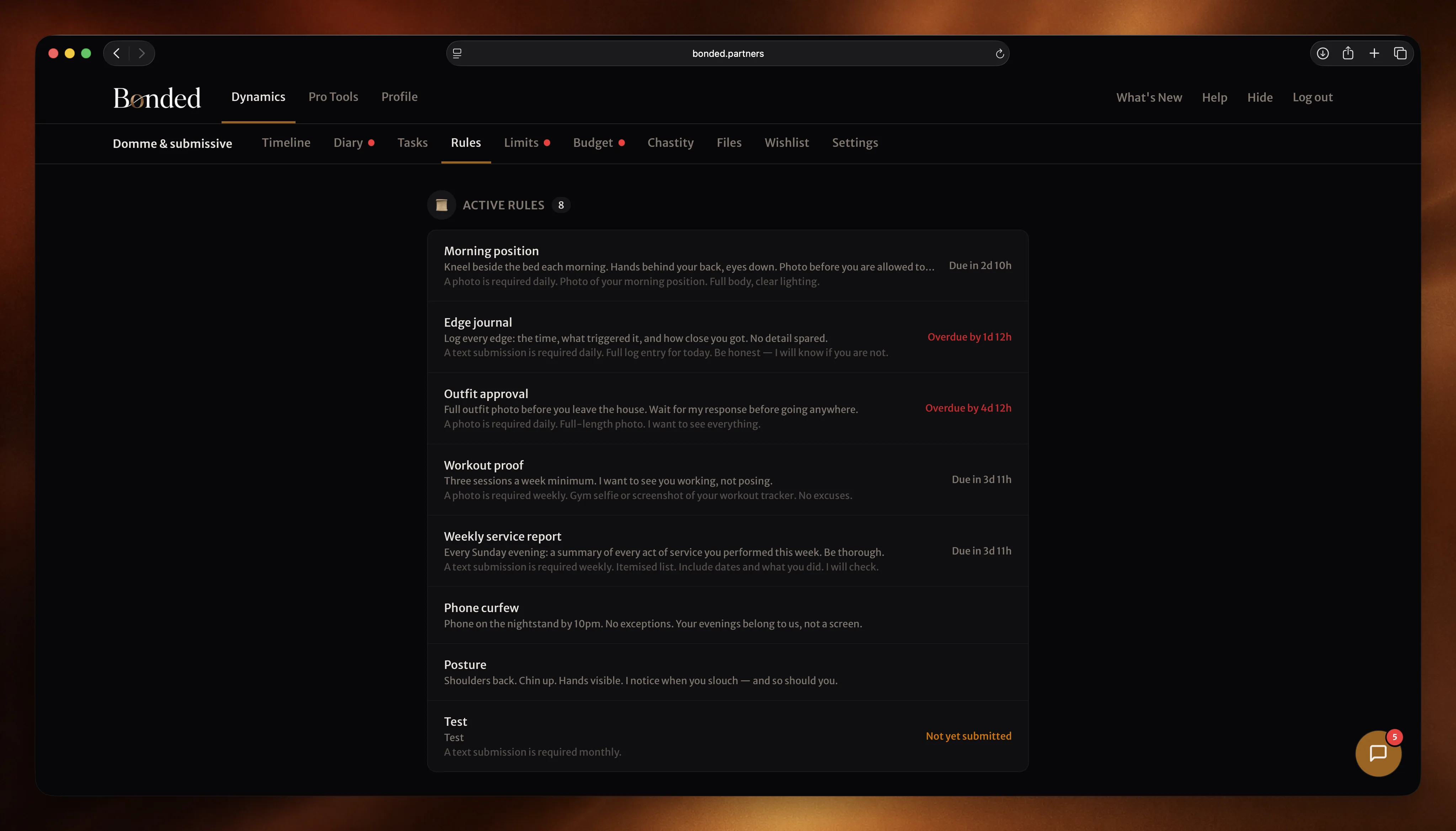
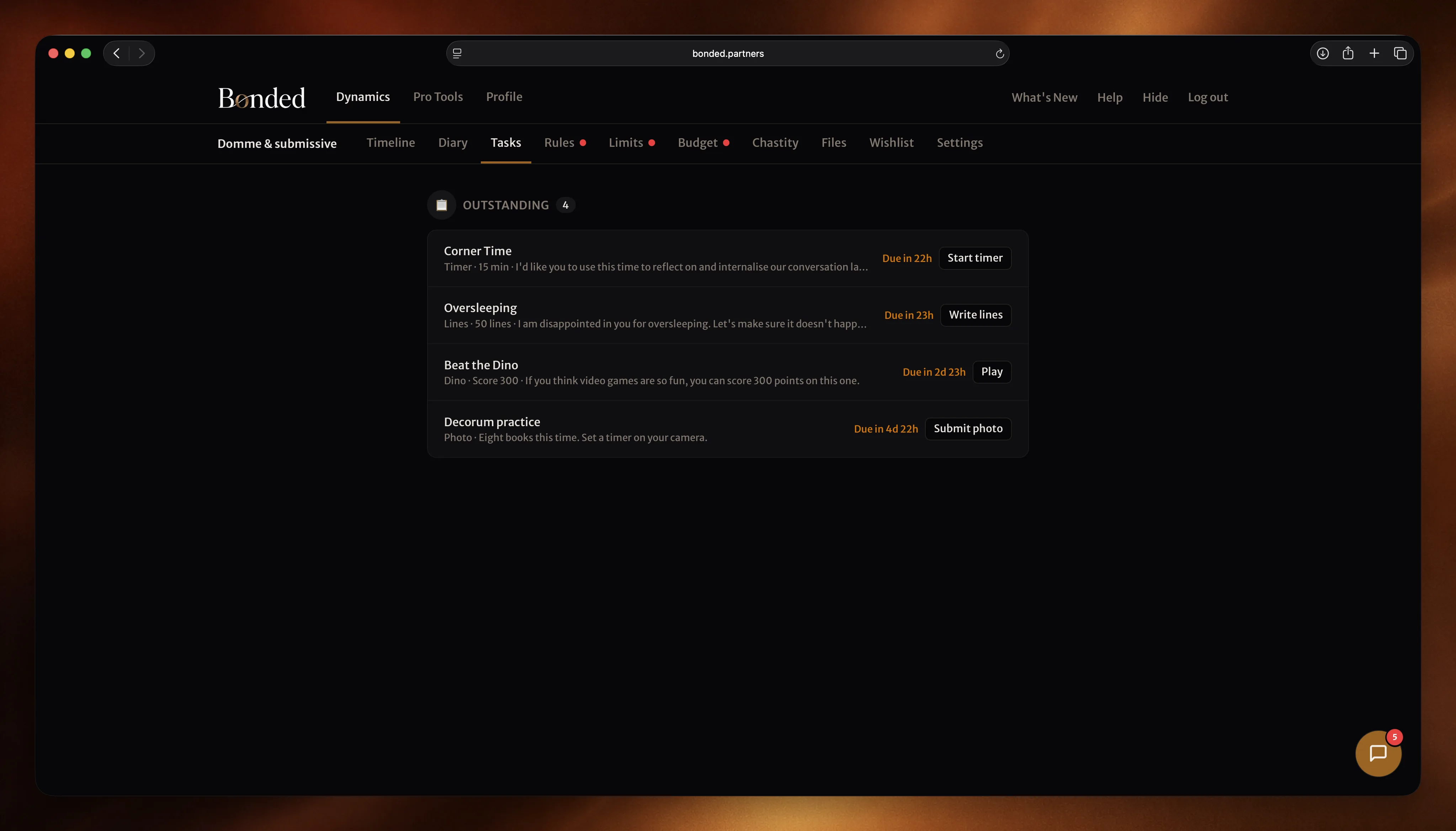
The practical tools of D/s -- rules, protocols, budgets, tasks, reviews -- are inherently gender-neutral. A rule is a rule regardless of who sets it. A budget category doesn't care about anyone's gender. A diary entry is intimate regardless of who wrote it.
Where gendered assumptions sneak in is in the framing. "She manages his budget" assumes an FLR. "He sets her bedtime" assumes a male Dom(me). The actual mechanics are identical. The only difference is the story we tell about them.
When building your dynamic, focus on the mechanics and let the story be yours:
- Who leads, and why? Not because of gender. Because of temperament, desire, skill, and mutual agreement.
- What does the submissive provide? Service, obedience, vulnerability, devotion -- all gender-neutral, all available to anyone.
- What does the Dom(me) provide? Structure, attention, care, direction -- same.
- What tools serve the dynamic? Rules, tasks, budgets, diaries, wishlists, chastity, whatever serves your specific arrangement. Choose based on what works, not on what a heteronormative guide says your "type" of dynamic should include.
The architecture of a good D/s dynamic is the same regardless of the genders involved. The content -- the specific rules, the particular protocols, the language, the tone, the texture -- that's where your dynamic becomes uniquely yours.
You Don't Need Permission
If you're queer and you've been waiting for a guide that tells you it's okay to want power exchange -- here it is. It's okay. You don't need a heteronormative template to structure your dynamic. You don't need to explain why your version of D/s doesn't look like the ones in the mainstream guides. You don't need to translate.
You need the same things every D/s dynamic needs: honesty about what you want, a partner who wants it too, the willingness to build something deliberate, and tools that support the structure.
Everything else is yours to invent.
Go deeper
Read the full guide→