



Dom Drop Is Real: A Guide for Dominants
Dom drop is real, common, and nothing to be ashamed of. Learn what it feels like, why it happens, and practical ways to manage it.

Sub drop gets all the attention. There are articles about it everywhere, checklists for aftercare, community posts full of advice. Ask about Dom drop and the room gets quieter. There is an unspoken assumption that the person holding the power does not get to struggle with it afterwards. That the responsibility flows one way. That dominance means invulnerability.
It does not. Dom drop is real, it is common, and the silence around it causes genuine harm. This is the guide that should already exist.
What Dom Drop Feels Like
Dom drop is the emotional and sometimes physical crash that a Dom(me) can experience after a scene, an intense dynamic interaction, or sometimes just from the ongoing weight of their role. It is the dominant counterpart to sub drop, but it wears different clothes.
Where sub drop often manifests as vulnerability and neediness, Dom drop tends to show up as:
Guilt. This is the big one. A creeping, sometimes overwhelming sense that you have done something wrong. You hit your partner. You degraded them. You controlled them. You enjoyed it. The rational mind knows this was consensual, negotiated, desired. The dropping mind does not care about rational. It replays the scene and strips out the context, leaving only the raw acts. You hurt someone you love. The guilt can be suffocating.
Emptiness. A flat, hollow feeling. The intense connection of the scene is gone, and what replaces it is nothing. Not sadness exactly — just absence. The adrenaline and focus and power have drained away and left a vacuum. You were completely present and alive twenty minutes ago. Now you feel like a shell.
Self-doubt. Did they really want that? Was I too much? Am I a bad person for enjoying this? Should I be doing this at all? The doubt spirals. It questions not just the scene but the dynamic, the relationship, your identity. Everything you felt certain about during the scene becomes uncertain after it.
Irritability. Sometimes drop does not look like sadness. It looks like snapping at your partner, being short-tempered, withdrawing. The emotional overwhelm converts to agitation rather than melancholy. This version is particularly insidious because it can damage the very relationship that needs care in that moment.
Physical symptoms. Fatigue, headaches, shaking, nausea, difficulty sleeping, or sleeping too much. The body held enormous tension during the scene — physical exertion, hypervigilance, emotional intensity — and the crash is physical as well as mental.
Questioning the dynamic entirely. In the depths of drop, some Dom(me)s question whether they should be doing D/s at all. Whether the whole thing is wrong. Whether their partner would be better off with someone "normal." This is the drop talking, but it feels like clarity. That is what makes it dangerous.
Not every Dom(me) experiences all of these, and not after every scene. Drop can be mild — a brief dip in mood — or severe enough to last days. It can show up immediately or be delayed by hours or even a day or two. Some Dom(me)s experience it rarely. Others deal with it regularly. All of this is within the range of normal.
Why It Happens
Understanding the mechanics helps. Dom drop is not a moral failing or a sign of weakness. It has identifiable causes.
The Neurochemical Crash
During an intense scene, the Dom(me)'s brain is flooded with neurochemicals. Adrenaline from the intensity and physical exertion. Dopamine from the pleasure and the power. Endorphins from exertion. Oxytocin from the intimate connection. This cocktail creates the euphoria, the focus, the sense of invincibility that many Dom(me)s describe during a scene.
When the scene ends, production drops. The brain has been running hot and now it is cooling down. The contrast between "flooded with feel-good chemicals" and "returning to baseline" registers as a crash. This is the same mechanism behind sub drop, runner's crash, or the comedown after any peak experience. It is biochemistry, not psychology, and it does not care how dominant you are.
Empathy Overload
Good Dom(me)s are deeply attuned to their submissive during a scene. They are reading body language constantly, monitoring emotional state, adjusting in real time. This level of sustained empathic attention is exhausting. It is the emotional equivalent of running a marathon while also doing calculus.
After the scene, all that empathic data lands. You fully register the tears, the marks, the vulnerability, the pain you caused. During the scene, this was information guiding your actions. After the scene, without the adrenaline and focus, it can become overwhelming. You saw someone you love in pain. You caused it. Processing that takes real emotional work.
The Weight of Responsibility
During a scene, the Dom(me) holds responsibility for everything. The submissive's physical safety, emotional wellbeing, the trajectory of the experience, the monitoring of limits, the reading of nonverbal cues. This is an enormous cognitive and emotional load. Most Dom(me)s carry it willingly and well, but that does not mean it costs nothing.
After the scene, the weight does not just disappear. It converts. The question shifts from "am I keeping them safe right now?" to "did I keep them safe?" And unlike the real-time version, which has clear answers (they are conscious, they are responsive, they used their safeword or they did not), the retrospective version is ambiguous. Did I push too far? Were they really okay? The uncertainty feeds the drop.
Cultural Conditioning
We live in a world that says hitting people is wrong, control is abusive, and enjoying someone's pain is pathological. D/s practitioners know these rules do not apply cleanly to consensual power exchange, but that intellectual understanding does not fully override decades of cultural programming. In a vulnerable post-scene state, the cultural messages rush in. You did bad things. You are a bad person.
This is particularly acute for Dom(me)s who are socialised as men and told simultaneously to be strong and to never hurt anyone, or for Dom(me)s socialised as women who are told they should not enjoy power. The cultural contradictions hit hardest when your defences are down.
Isolation
Sub drop is publicly acknowledged. There are protocols for it, discussions about it, a shared vocabulary. Dom(me)s are expected to provide aftercare for sub drop without much acknowledgement that they might need care too. This isolation — the sense that you should not be struggling, that your feelings are less valid because you were "in control" — makes drop worse. Shame compounds every other symptom.
How to Manage Dom Drop
Management starts with one radical act: acknowledging that you are human and that holding power does not make you impervious.
Before the Scene
Normalise it in advance. Talk to your partner about the possibility of Dom drop before you are in it. Make it a known quantity. "Sometimes after intense scenes, I might feel off. Here is what that looks like for me. Here is what helps." This conversation is infinitely easier when you are not actively dropping.
Plan mutual aftercare. Aftercare is not just for the submissive. Build a plan that includes care for the Dom(me). What do you need? Physical closeness? Verbal reassurance? Time alone? A specific comfort activity? Know this about yourself and communicate it.
Check your headspace before playing. If you are already stressed, exhausted, or emotionally fragile, intense play is more likely to trigger drop. This is not a reason to never play when you are imperfect — you would never play at all — but it is a reason to calibrate.
During Aftercare
Do not perform being fine. This is the hardest one. The instinct is to hold it together, to focus entirely on the submissive's aftercare, to be the strong one. Resist this. You can care for your partner and be honest about your own state. "I want to hold you and I also need to be held" is a complete sentence.
Physical comfort. Blankets, warmth, water, food. The same physical care that helps sub drop helps Dom drop. Your body went through something intense. Tend to it.
Verbal processing. Talk about the scene while it is fresh. Not a formal debrief — just sharing. "That was intense." "When you cried, I felt..." "I loved the moment when..." Hearing your partner's positive experience of the scene is one of the most effective antidotes to the guilt spiral.
Stay close. The impulse to withdraw is strong during Dom drop. The need to process alone. Sometimes that is genuinely what you need, and that is fine. But often, the withdrawal is avoidance disguised as preference. If you can, stay physically close to your partner in the hours after a scene, even if you are not talking.
In the Hours and Days After
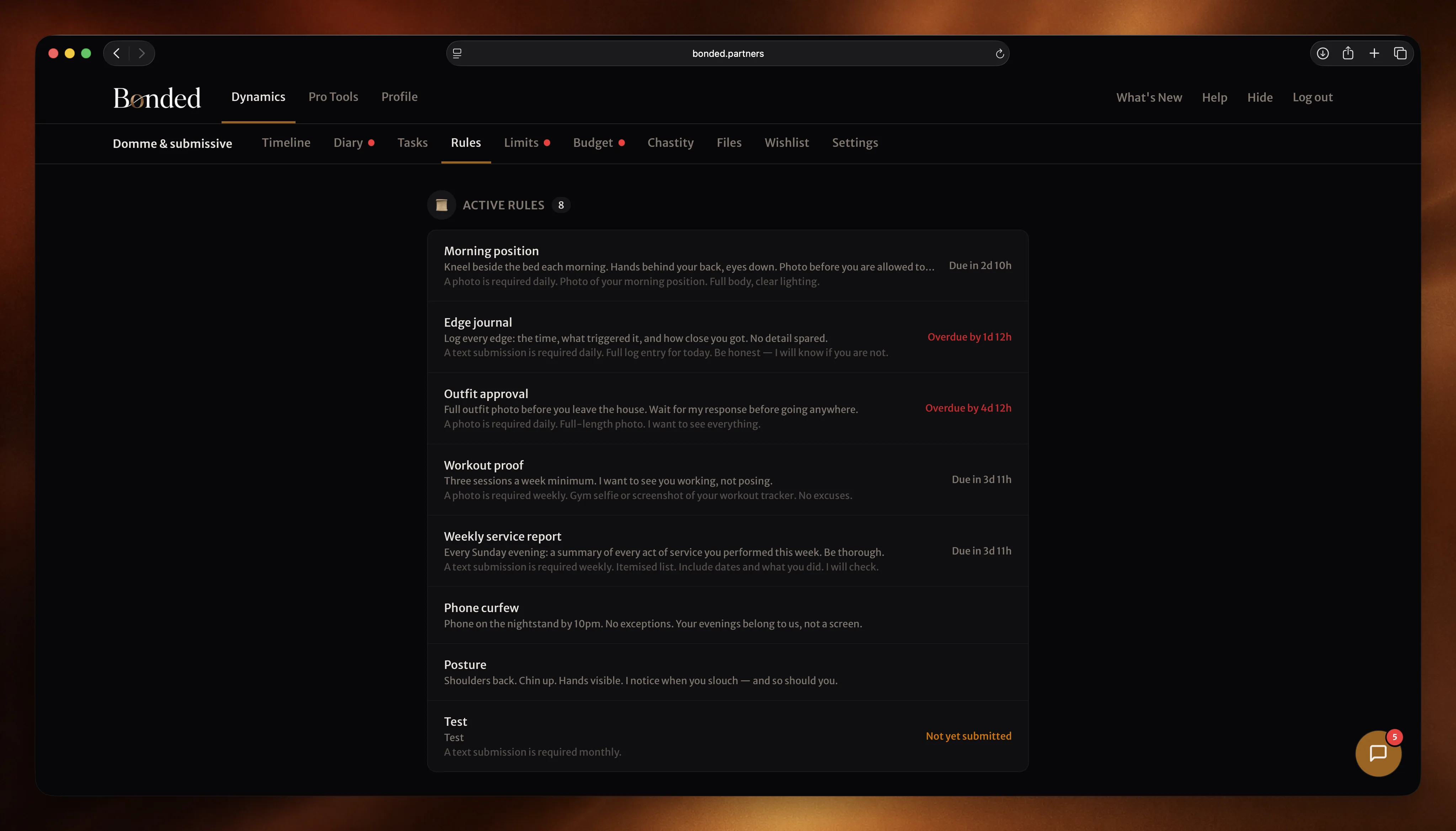
Journal. Write about what you are feeling. Not for anyone else — for yourself. Getting the thoughts out of your head and onto a page (or screen) breaks the spiral. You can see the guilt or doubt as words rather than experiencing it as an all-consuming fog.
Bonded's Diary feature provides a space for this within your dynamic. Dom(me)s can write entries too — it is not only a submissive's tool. Processing your experience in a space that is connected to your dynamic can help integrate the feelings rather than compartmentalising them.
Check in with your partner. Not just to monitor their wellbeing, but to share yours. A message that says "I am feeling some drop today — just wanted you to know" does two things: it gets you support, and it normalises vulnerability within the dynamic. Use Chat for these check-ins when you are not in the same place.
Physical self-care. Exercise, sleep, good food, sunlight. Dom drop, like sub drop, has a physical component. Supporting your body supports your mood. This is not a cure, but it creates conditions for recovery.
Revisit your "why." When doubt creeps in about whether you should be doing D/s at all, return to the foundations. Why did you choose this? What does it give you? What does it give your partner? Read old journal entries or diary entries from good moments. Remind yourself of the whole picture, not just the post-scene distortion.
Time. Drop passes. It always passes. Sometimes you just have to ride it out, knowing that the feelings are temporary and chemically driven. Give yourself the grace you would give your submissive if they were experiencing drop.
When It Is Severe or Persistent
If Dom drop is regularly severe, lasting more than a day or two, or significantly impacting your life, it is worth examining whether something deeper is going on.
Persistent, intense drop might indicate:
- Unresolved guilt about your desires that predates the scene
- A scene that actually did push past someone's limits (yours or your partner's), and the drop is your psyche's accurate signal, not a chemical artefact
- Broader mental health issues (depression, anxiety) that are exacerbated by the neurochemical volatility of intense play
- A dynamic or relationship that is not meeting your actual needs, and the drop is pointing at something real
Not all drop is just neurochemistry. Sometimes the bad feeling contains real information. The skill is learning to tell the difference — and a kink-aware therapist can be invaluable here.
The Stigma Problem
The silence around Dom drop is not accidental. It grows from a toxic equation: dominance equals strength, and strength equals imperviousness. Within this framework, a Dom(me) who struggles after a scene is failing at dominance. They should be able to handle it. They wanted the power — they should not complain about the cost.
This is, to put it plainly, rubbish.
Vulnerability after wielding power is not weakness. It is the natural consequence of caring about what you do with that power. A Dom(me) who never feels anything after an intense scene is either extraordinarily well-regulated or insufficiently connected to their partner. The capacity to be affected — to feel guilt, doubt, tenderness, overwhelm — is what makes a good Dom(me). It is the empathy that keeps the power exchange safe.
The community does itself a disservice by not talking about this more openly. When Dom(me)s hide their drop, several things happen:
- They do not get the support they need, so drop lasts longer and hits harder.
- Their partners do not understand why they are withdrawn or irritable, which creates relationship friction.
- New Dom(me)s encounter drop and think something is wrong with them, potentially abandoning D/s altogether.
- The myth of the invulnerable Dom(me) perpetuates, making it harder for everyone.
If you are a Dom(me) reading this and recognising yourself: you are not broken. You are not weak. You are having a completely normal response to an intense experience. The fact that you are the one who held the flogger does not disqualify you from feeling things about it afterwards.
What Submissives Can Do
If your Dom(me) experiences drop, here is how you can help:
Do not panic. Their drop is not about you being damaged or the scene being wrong. It is a normal neurochemical and emotional process. Stay calm.
Ask what they need. Do not assume. Some Dom(me)s want closeness. Others want space. Some want to talk. Others want distraction. Ask, listen, and believe the answer.
Reassure without being condescending. "I loved that scene. I wanted everything that happened. You are an incredible Dom(me)" is reassurance. "It is okay, you did not do anything wrong, do not worry about it" can feel patronising. Affirm your experience and your choice. That is the most powerful antidote to their guilt.
Normalise it. If your Dom(me) discloses drop and you treat it as a crisis, you are inadvertently reinforcing the idea that it should not happen. Treat it as you would want your sub drop treated — with warmth, practicality, and zero judgement.
Follow up. Drop can be delayed. Check in the next day. "How are you feeling about last night?" shows that you see them as a whole person, not just a role.
Do not weaponise it. This should go without saying, but Dom drop is not leverage. It is not a moment to renegotiate terms or push boundaries while your Dom(me) is vulnerable. The trust that allows them to show you their drop is sacred. Treat it accordingly.
A Note on Ongoing Dom Drop
Everything above focuses on scene-related drop, but Dom(me)s in 24/7 or high-involvement dynamics can experience a more chronic version. The ongoing weight of responsibility, the constant attunement, the decision fatigue — these accumulate. The result is not a sharp drop but a slow drain.
Signs of chronic dominant fatigue:
- Decreasing interest in directing the dynamic
- Feeling like the dynamic is a chore
- Resentment toward the submissive (often irrational)
- Going through the motions without feeling connected
- Wanting to be taken care of but not knowing how to ask
This is burnout more than drop, and it requires different interventions: renegotiating the dynamic's demands, sharing responsibility for maintenance, taking genuine breaks, and addressing the underlying belief that a Dom(me) must always be "on."
Regular self-reflection helps catch this before it becomes a crisis. A Diary practice is not just for processing individual scenes — it is for tracking your long-term relationship with your own dominance. Patterns become visible over time that are invisible in the moment.
The Strength in Vulnerability
Here is the thing about Dom drop that nobody says enough: experiencing it and moving through it honestly makes you a better Dom(me). Not despite the vulnerability — because of it.
A Dom(me) who has sat with guilt and worked through it understands the gravity of what they do. They do not take their partner's submission for granted. A Dom(me) who has felt the emptiness of drop understands why aftercare matters — not as a checklist item but as a human need. A Dom(me) who has questioned their desires and chosen them again does so with integrity that an unexamined Dom(me) cannot match.
Drop is not the price of dominance. It is part of the practice. It is how you digest the intensity, integrate the experience, and return to your role with renewed intention.
You do not have to enjoy it. You do not have to seek it out. But you do not have to be ashamed of it, and you absolutely do not have to go through it alone.
Go deeper
Read the full guide→