



24/7 D/s: What It Actually Looks Like Day to Day
24/7 D/s isn't constant scenes. Discover what full-time power exchange actually looks like — daily protocols, mundane rules, and sustainable structure.

There is a fantasy version of 24/7 D/s that lives in people's heads. In this version, every moment crackles with intensity. The Dom(me) issues commands in a low voice. The submissive kneels beautifully. Leather is somehow always involved. Nobody has a mortgage.
Then there is the real version. The one where someone has to take the bins out, where you both catch the flu at the same time, where the power exchange coexists with Tuesday. That version is less cinematic but far more interesting — and far more sustainable.
If you have ever wondered what full-time D/s actually looks like when the bedroom door is open, the alarm has gone off, and there are emails to answer, this is for you.
What 24/7 Actually Means
First, a definition that might disappoint: 24/7 D/s does not mean power exchange is actively expressed every second of every day. That would be exhausting and, frankly, impossible. What it means is that the dynamic is always present as an underlying framework. The roles do not switch off when a scene ends. The authority structure persists even when nobody is thinking about it consciously.
Think of it like a marriage. You do not stop being married when you are at work or grocery shopping. The commitment exists as a constant, even when it is not at the forefront of your mind. A 24/7 dynamic works the same way. The power exchange is the container your relationship lives inside, not a hobby you pick up and put down.
This distinction matters because it immediately takes the pressure off. You do not have to perform your dynamic every waking moment. You have to live it. Those are very different things.
The Morning: Where Structure Starts
Most 24/7 dynamics have some kind of morning protocol. Not because mornings are inherently kinky, but because how you start the day sets its tone. These protocols range from minimal to elaborate, and the right level depends entirely on the people involved.
Low intensity: The submissive sends a good morning text with a specific sign-off. They make coffee for the Dom(me) before making their own. That is it. Two small acts that take thirty seconds combined, but they ground the dynamic before the day scatters it.
Medium intensity: A brief morning check-in. The submissive reports how they slept, their mood, their plan for the day. The Dom(me) reviews and might adjust expectations — lighter tasks if sleep was bad, more structure if the sub says they need grounding. This might take five minutes over breakfast.
Higher intensity: A set wake-up routine. The submissive rises first, prepares the Dom(me)'s morning (coffee, laid-out clothes, whatever is agreed). A brief physical ritual — kneeling for a moment, a specific greeting, a collar being put on. Morning tasks assigned. This can take fifteen to twenty minutes and becomes a kind of daily ceremony.
None of these are more valid than the others. The couple working with a good morning text is no less 24/7 than the couple with an elaborate protocol. What matters is consistency and intention.
The Mundane Rules That Hold Everything Together
Here is the part that surprises people who are new to full-time dynamics: the most important rules are usually boring. Not degradation, not punishment protocols, not elaborate service rituals. The rules that actually sustain a 24/7 dynamic are small, repeatable, and woven into ordinary life.
Common examples:
- Hydration and meal rules. The submissive eats three meals a day and drinks a set amount of water. This is not glamorous. It is profoundly caring. Many submissives will neglect their own needs while attending to everything else. A rule that says "you will eat lunch" is an act of dominance that looks like love.
- Bedtime rules. Devices down by a certain time. In bed by a certain hour. Again, not dramatic. But sleep deprivation destroys dynamics faster than almost anything else, and a Dom(me) who enforces rest is doing real work.
- Communication rules. Check in at certain times during the day. Report certain things (mood shifts, completed tasks, struggles). Ask permission for specific categories of decisions. These maintain the thread of connection when you are physically apart.
- Appearance or presentation rules. These might be as simple as "wear the bracelet I gave you" or as specific as clothing guidelines. They serve as tactile, constant reminders that the dynamic is present.
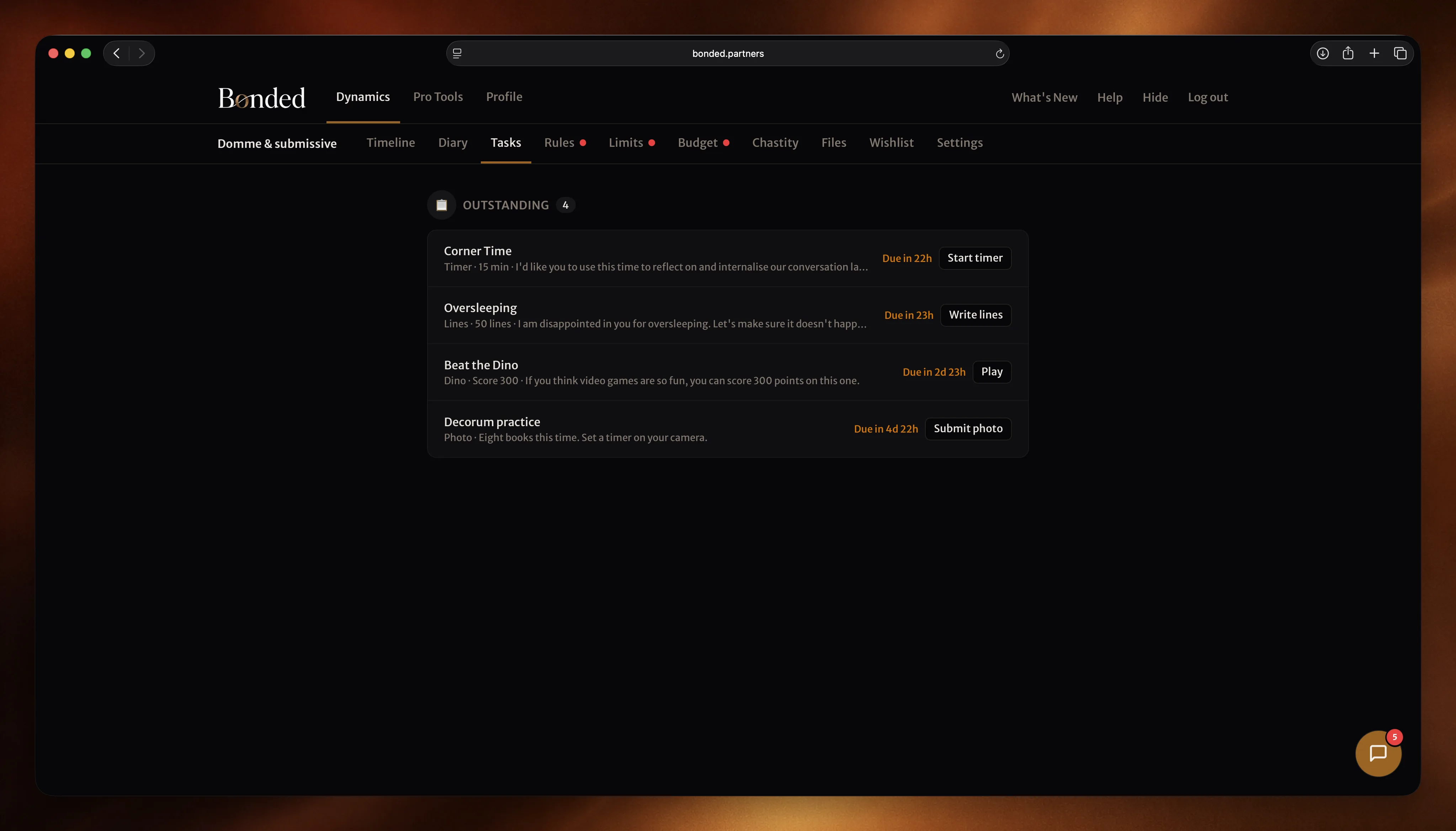
- Task rules. Household responsibilities, personal development tasks, fitness routines. A Dom(me) who assigns a submissive to study for their certification exam every evening for an hour is exercising authority in a way that builds the sub's life up.
Notice that none of these require a dungeon. They require attention, consistency, and a shared understanding of why they exist.
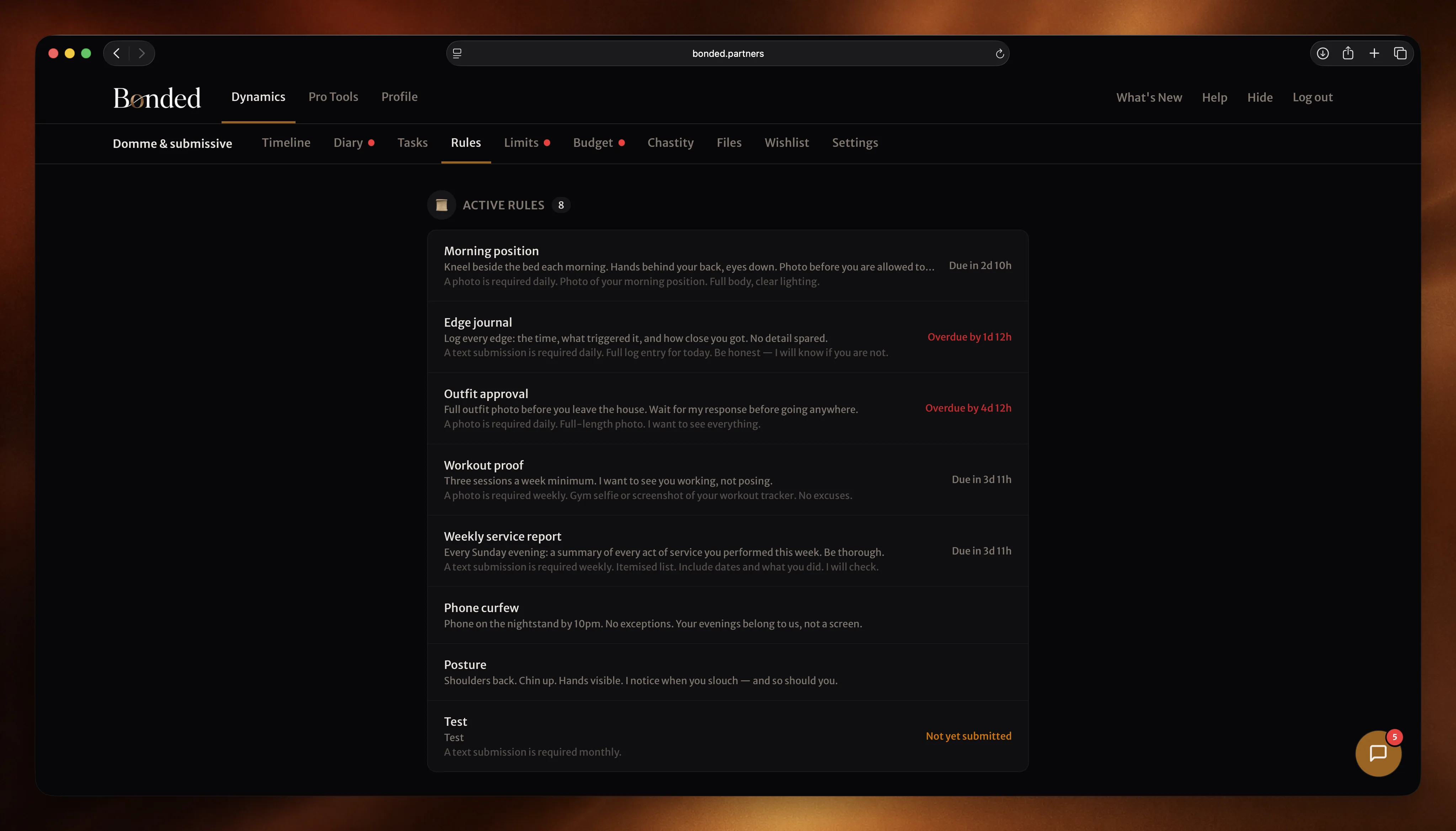
Tracking these rules matters. When you have five or ten small daily expectations, it is easy for things to slip without either person noticing. Tools like Bonded's Rules feature let you set daily and weekly rules with clear tracking, so both partners can see at a glance what is active and what has been completed. That visibility prevents the slow erosion that kills consistency.
The Workday: Power Exchange in the Background
For most people in 24/7 dynamics, a significant chunk of the day involves work, school, parenting, or other obligations that have nothing to do with D/s. This is where the "always present but not always active" distinction becomes critical.
During work hours, the dynamic might express itself through:
- A midday check-in text
- The submissive following a rule about taking their lunch break (and reporting it)
- The Dom(me) sending a brief message of acknowledgement or direction
- The submissive asking permission for something that falls within the agreed scope (spending over a certain amount, making social plans, etc.)
What it does not look like: the Dom(me) texting commands every twenty minutes while the sub tries to do their job. A sustainable 24/7 dynamic respects the fact that both people have lives, obligations, and identities beyond the power exchange. A Dom(me) who cannot tolerate their submissive being unavailable during work hours is not exercising good authority. They are exercising insecurity.
The best full-time dynamics have clear understanding about when the exchange is foreground and when it is background. During work? Background. The rules are running, the structure is there, but active engagement is minimal. During the evening together? Foreground. More direct interaction, more visible protocol, more conscious inhabiting of the roles.
Evening Rituals: Reconnection
If mornings set the tone, evenings consolidate it. This is when many 24/7 couples bring the dynamic back into active focus after a day spent in the vanilla world.
Evening rituals vary enormously, but common elements include:
Debriefing. The submissive reports on their day — not just facts, but feelings. How did they handle things? Where did they struggle? What are they proud of? The Dom(me) listens, acknowledges, and might note things to address. This is not an interrogation. It is structured intimacy.
Journaling or diary entries. Many dynamics include a regular writing practice where the submissive reflects on the day, their headspace, their feelings about the dynamic. This is valuable for both partners. For the submissive, it is processing. For the Dom(me), it is intelligence — understanding what is happening beneath the surface. Bonded's Diary feature is designed exactly for this: a private-to-the-dynamic space where submissives can write and Dom(me)s can read and respond.
Physical reconnection. This might be sexual, but often it is not. A set position for watching television together. The submissive sitting at the Dom(me)'s feet. A nightly massage. A specific way of preparing for bed. Physical rituals anchor the dynamic in the body, which is important when so much of 24/7 lives in the mind.
Review and planning. Some couples do a brief nightly review: what rules were followed, what was missed, what needs adjusting. Others save this for a weekly sit-down. The rhythm depends on the couple, but regular review is what separates a dynamic from a set of good intentions.
Coexisting With Vanilla Life
This is the part nobody talks about enough. Most people in 24/7 dynamics do not live in isolation. They have families, friends, colleagues, and neighbours who know nothing about the power exchange. Navigating this requires thought.
Social situations. The dynamic does not disappear at a dinner party, but it becomes invisible. The submissive might defer to the Dom(me) in ways that look like politeness. The Dom(me) might make small decisions for both of them (ordering wine, choosing where to sit) in ways that read as confidence rather than control. Subtle cues — a touch on the back, a specific look — maintain the connection without broadcasting it.
Family and children. Couples with children face particular considerations. The dynamic should never be visible to kids in ways they cannot understand or consent to. This means protocols adjust when children are present. Rules about kneeling or formal address pause. The power exchange runs entirely underground, expressed through private signals and deferred to child-free moments. This is not "switching off" the dynamic. It is being responsible adults who also happen to have a power exchange.
Vanilla friends. Some people are out about their dynamic. Many are not. Either is fine, but the decision should be mutual and considered. If you are not out, maintaining the dynamic in public relies on what practitioners sometimes call "invisible protocols" — small acts of service, deference, or control that are visible only to the people who know what to look for.
Bonded's visibility settings let you customise what is visible within your dynamic, which matters when you are sharing a device or screen with someone outside it. Not every tool needs to be on display at all times.
Different Intensity Levels
One of the biggest misconceptions about 24/7 is that it comes in one flavour: total power exchange. In reality, full-time dynamics exist on a spectrum.
Light 24/7. The roles are acknowledged and consistent, but protocols are minimal. Maybe a few standing rules, regular check-ins, and an understanding that one person leads and one follows. Daily life looks mostly vanilla to an outside observer. The power exchange is felt more than seen.
Moderate 24/7. Clear protocols for different parts of the day. A defined set of rules covering health, communication, household duties, and personal development. Regular structured check-ins. Visible (to each other) expressions of the dynamic — specific language, physical rituals, task-based service. An outsider might notice some unusual patterns but probably would not clock it as D/s.
High-protocol 24/7. Formal address at all times (or almost all times). Extensive rules governing behaviour, appearance, and decision-making. Significant authority transfer — the Dom(me) makes most or all decisions within agreed domains. Daily structure is heavily shaped by the dynamic. This requires enormous trust, communication, and both partners being deeply invested.
Each level is legitimate. Many couples move between levels depending on circumstances — higher protocol during good periods, dialling back during stress or illness. The Timeline feature in Bonded can help track how your dynamic evolves over time, making it easier to spot patterns in what works and what does not.
What Makes 24/7 Sustainable
Sustainability is the real question. Anyone can do high-intensity D/s for a weekend. Doing it for years requires specific things:
Flexibility. Rigid dynamics break. Sustainable ones bend. When someone is ill, grieving, overwhelmed, or just having a terrible week, the dynamic needs to accommodate that without either person feeling like it has failed. Build in explicit "low power mode" agreements from the start. Know what the minimum viable version of your dynamic looks like.
Regular renegotiation. What worked six months ago might not work now. People change. Circumstances change. Desires change. Schedule regular (monthly or quarterly) conversations where nothing is off the table. Review everything: rules, protocols, boundaries, goals. A dynamic that never updates is a dynamic that is slowly becoming irrelevant.
Aftercare as a lifestyle. In scene-based play, aftercare happens after scenes. In 24/7, aftercare is ongoing. The Dom(me) regularly checks in about headspace, not just behaviour. The submissive has permission and encouragement to express when something is not working. Care is not an event. It is the atmosphere.
Individual identity. The submissive is a whole person who also submits. The Dom(me) is a whole person who also leads. If the dynamic becomes the only thing either person is, it will collapse under its own weight. Hobbies, friendships, personal goals, and time alone are not threats to the dynamic. They are what keep the people inside it healthy enough to sustain it.
Honest communication. This one is obvious but bears repeating because so many dynamics fail here. The submissive needs to be able to say "this rule is not working for me" without it being treated as defiance. The Dom(me) needs to be able to say "I am too tired to lead tonight" without it being treated as weakness. Honesty is the foundation. Everything else is decoration.
What Collapse Looks Like (And How to Avoid It)
24/7 dynamics fail for predictable reasons. Knowing them helps:
Burnout on either side. The Dom(me) gets tired of being "on" all the time. The submissive gets tired of performing. Solution: built-in rest. Scheduled vanilla time. Low-effort days where the dynamic runs on autopilot rules rather than active direction.
Resentment from unbalanced effort. If one person is doing all the emotional and logistical work of maintaining the dynamic, resentment builds. Solution: acknowledge that maintaining a 24/7 dynamic is labour for both roles and distribute that labour consciously.
Life overwhelming the dynamic. A new baby, a job loss, a health crisis. The dynamic cannot compete with survival needs and should not try to. Solution: have an explicit plan for scaling back. Know what "emergency mode" looks like for your dynamic.
Growing apart. Sometimes people change in directions that make the dynamic no longer fit. This is not failure. It is life. Solution: regular honest check-ins about whether the dynamic still serves both people.
A Day in the Life: One Example
Here is what a moderate-intensity 24/7 day might look like for a working couple:
6:30 AM. Submissive's alarm. They get up, start coffee, take their medication (a standing rule). They send a morning greeting via the dynamic's agreed channel.
7:00 AM. Both getting ready. The submissive has a clothing guideline for workdays — nothing extreme, but the Dom(me) has input on presentation. The Dom(me) reviews the submissive's calendar and notes anything relevant.
7:30 AM. Breakfast together. Brief discussion of the day ahead. The Dom(me) might assign one specific task for the day beyond standing rules — "I want you to take a walk at lunch" or "finish that thing you have been putting off."
8:00 AM – 12:00 PM. Work. Dynamic is background. Standing rules are running (hydration, posture breaks). No active engagement required.
12:30 PM. Midday check-in. Quick message exchange. The submissive reports on their morning, confirms lunch. The Dom(me) acknowledges.
1:00 PM – 5:30 PM. More work. Background mode continues.
6:00 PM. Home. Physical reconnection — a specific greeting, a hug with a particular dynamic-coded gesture, a moment of deliberate transition from vanilla to foreground mode.
6:30 PM. Dinner together. The submissive has meal prep responsibilities on certain nights (an agreed rule, not arbitrary servitude). Conversation is normal — work stories, plans, jokes. The dynamic is present but not performing.
8:00 PM. The submissive writes their diary entry for the day. The Dom(me) reviews it later. This is when deeper feelings get expressed — things that do not come out easily in conversation.
9:00 PM. Evening together. The physical dynamic is more visible now — positioning, touch, the submissive asking before making small decisions. This is where the day's accumulated structure pays off in felt connection.
10:00 PM. Bedtime protocol. Devices away (standing rule). A brief physical ritual — whatever this couple has established. Goodnight.
That is it. No dungeons. No constant intensity. Just two people living inside a structure they have chosen, tending it like a garden. Some days it is lush. Some days they are just pulling weeds. Both count.
Getting Started or Going Deeper
If you are considering 24/7 or already living it and want to strengthen your practice, start with what you can sustain, not what impresses you. Three consistent rules will do more for your dynamic than thirty aspirational ones.
Track what you commit to. Use tools that make the structure visible to both partners. Bonded was built for exactly this kind of daily practice — Rules for your agreed protocols, Diary for the reflective layer, Timeline for seeing your dynamic's arc over weeks and months.
And remember: the most radical thing about 24/7 D/s is not the power exchange. It is the commitment to showing up for it on ordinary days, in ordinary ways, when nobody is watching and there is nothing to perform. That is where the real depth lives.
Go deeper
Read the full guide→