



The Wishlist as a Power Exchange Tool
A D/s wishlist is more than a shopping list. Learn how structured desire and deliberate gift-giving work as power exchange -- from both the Dom(me) and submissive perspective.

A wishlist in a vanilla relationship is simple. You want something, you add it to a list, someone buys it for you on your birthday. Transaction complete.
A wishlist in a D/s dynamic is something else entirely. It's a structured expression of desire, a tool for generosity with intention, and -- depending on how you use it -- one of the quieter forms of power exchange that most people overlook.
This isn't about Amazon links and holiday shopping. It's about what it means to want something and place that want in someone else's hands.
The Power in Wanting
Desire is vulnerable. Telling someone what you want -- really want, not the safe version -- requires trust. What if they judge the want? What if they ignore it? What if they use the knowledge of what you want as leverage?
In a D/s context, all of those possibilities are live. And that's what makes a wishlist more than a convenience feature. When a submissive adds an item to a shared wishlist, they're disclosing desire. When a Dom(me) adds an item, they're signalling intention. Both acts carry weight.
A wishlist becomes a power exchange tool when the dynamic acknowledges that weight. When there's protocol around it. When it's not just "stuff I want" but a curated, deliberate expression of desire within a structure that both parties take seriously.
From the Dom(me)'s Perspective
The Wishlist as Reconnaissance
A submissive's wishlist tells you things they might not say directly. The items reveal interests they're exploring, comforts they're missing, aspects of the dynamic they want to deepen. A submissive who adds a specific collar isn't just shopping -- they're telling you something about how they see themselves in the dynamic. A submissive who adds a weighted blanket might be telling you they need comfort more than intensity right now.
Pay attention to what appears on the list. Pay attention to what gets removed. Pay attention to the descriptions they write. A wishlist, reviewed thoughtfully, is a window into your submissive's inner world.
The Power of Selection
When a Dom(me) decides which wishlist item to fulfil, that's an exercise of authority. The submissive has expressed desire. The Dom(me) chooses which desire gets met, and when, and how.
This isn't about withholding for cruelty. It's about the dynamic of "you want, and I decide." The submissive knows their wants are seen. They also know they don't control the outcome. That tension -- being known and not in control -- is power exchange distilled.
Some Dom(me)s buy exactly what the submissive asks for. Some buy something adjacent -- a version they prefer, or something the submissive didn't think to ask for but clearly needs. Some fulfil a wish as a reward for specific behaviour. The approach depends on the dynamic, but the underlying message is consistent: your desires matter, and they flow through me.
The Dom(me)'s Own Wishlist
Dom(me)s have wishlists too, and they work differently. A Dom(me)'s wishlist within the dynamic might include items they want their submissive to acquire -- specific clothing, equipment, household items that serve the dynamic. It might include things the Dom(me) wants for themselves, creating a gifting protocol where the submissive saves toward or purchases items for the Dom(me).
This intersects with financial oversight in interesting ways. A submissive whose budget includes a "dynamic-related" category might allocate a portion toward fulfilling items on the Dom(me)'s wishlist. The act of saving toward a specific gift, anticipating the Dom(me)'s pleasure, and presenting it -- that's a form of service that unfolds over weeks or months.
From the Submissive's Perspective
Curating Desire
For submissives, the wishlist is an exercise in self-knowledge and communication. What do you actually want? Not what you think you should want, not what would impress your Dom(me), but what genuinely calls to you.
This is harder than it sounds. Many submissives, particularly those new to dynamics, have spent years minimising their own desires. "I don't need anything" is a reflex, not a truth. A Dom(me) who insists on a maintained wishlist is asking the submissive to practice wanting -- to get comfortable with desire as something that deserves expression.
Some submissives find it helpful to think in categories:
- Things that serve the dynamic: Collars, cuffs, protocol clothing, toys, kneeling cushions
- Things that serve wellbeing: Comfort items, self-care products, books, fitness equipment
- Things that bring joy: Hobbies, entertainment, experiences, treats
- Things that represent growth: Courses, tools for a new skill, equipment for a goal
A well-curated wishlist across these categories gives the Dom(me) options and gives the submissive practice in articulating need.
The Vulnerability of Asking
Adding an item to a wishlist that your Dom(me) can see is a small act of exposure. Especially for items that reveal something personal -- a book about a kink you haven't discussed, a piece of clothing that represents an identity you're still exploring, something expensive enough that asking for it feels greedy.
That vulnerability is a feature, not a bug. A dynamic deepens when submissives can express want without guarantee, and Dom(me)s can receive those wants without obligation. The wishlist creates a structured space for this exchange. It's not a demand. It's not begging. It's a curated offering of "here is what I want, and I trust you with that knowledge."
When the Wish Is Fulfilled
The moment a wishlist item is marked as bought -- and the submissive sees that notification -- is its own small event. Someone saw what you wanted. Someone chose to provide it. In a dynamic where generosity is intentional rather than obligatory, that carries real emotional weight.
Some dynamics build protocol around this moment. The submissive might be required to express gratitude in a specific way -- a diary entry, a photograph of themselves with the gift, a handwritten note. The gift becomes a point of connection that extends beyond the transaction itself.
Gift-Giving as Love Language
The "love languages" framework is imperfect but useful. For many people, gifts are a primary way of feeling cared for -- and in a D/s context, gift-giving takes on additional dimensions.
A gift from a Dom(me) to a submissive can communicate:
- I was paying attention. You mentioned this once, three months ago, and I remembered.
- I'm investing in the dynamic. This collar, this toy, this equipment -- I'm building something with you.
- You earned this. Your behaviour, your growth, your service -- this is what that looks like, rewarded.
- I'm thinking of you. Even when we're not together, even when the dynamic is quiet, you're on my mind.
A gift from a submissive to a Dom(me) can communicate:
- I want to provide for you. Service extends beyond tasks. I want to give you tangible things.
- I saved for this. This gift represents time and discipline and intention.
- I know what you like. I pay attention to you, not just to your instructions.
- You deserve this. An expression of admiration that takes physical form.
In both directions, the wishlist transforms gift-giving from guesswork into informed generosity. You're not hoping you picked the right thing. You know, because they told you. And choosing from what they've revealed they want is its own kind of intimacy.
Expectation vs. Freedom
One tension worth navigating: when does a wishlist become an expectation?
A submissive who adds items and then resents them not being purchased has shifted from expressing desire to making demands. A Dom(me) who expects their wishlist to be fulfilled on a timeline is applying pressure that may not belong in the dynamic.
The wishlist works best when both parties understand its nature:
- Items on the list are desires, not entitlements
- Fulfilment happens at the other person's discretion and pace
- The list is a living document -- items can be added, removed, or revised
- Not every item needs to be fulfilled. Some wants are worth expressing even if they're never met
This is especially important to discuss when financial situations are unequal. If one partner earns significantly more, the wishlist shouldn't become a source of guilt or obligation. "I can't afford that right now" is a perfectly valid response, and the dynamic should accommodate it without shame.
Some dynamics address this by setting explicit parameters. "Wishlist items under $50 are fair game anytime. Items over $50 are for special occasions or require discussion." This removes the ambiguity and lets both parties engage with the list freely.
Practical Structure
A functional wishlist in a D/s dynamic benefits from more detail than "link + price." Consider including:
Name: What it is, clearly stated.
Description: Why you want it. This is the part that creates intimacy. "A leather journal" is an item. "A leather journal because I want to handwrite my evening reflections for you instead of typing them" is a window into the submissive's inner world.
Link: Where to get it. Practical, but also communicates that the want is specific and considered.
Price: Transparency. Especially important in dynamics with financial oversight, where the wishlist should align with budget categories and limits.
Priority: Not everything is equally wanted. Some items are "this would be lovely someday" and others are "I think about this daily." Distinguishing between them helps the other person make informed choices.
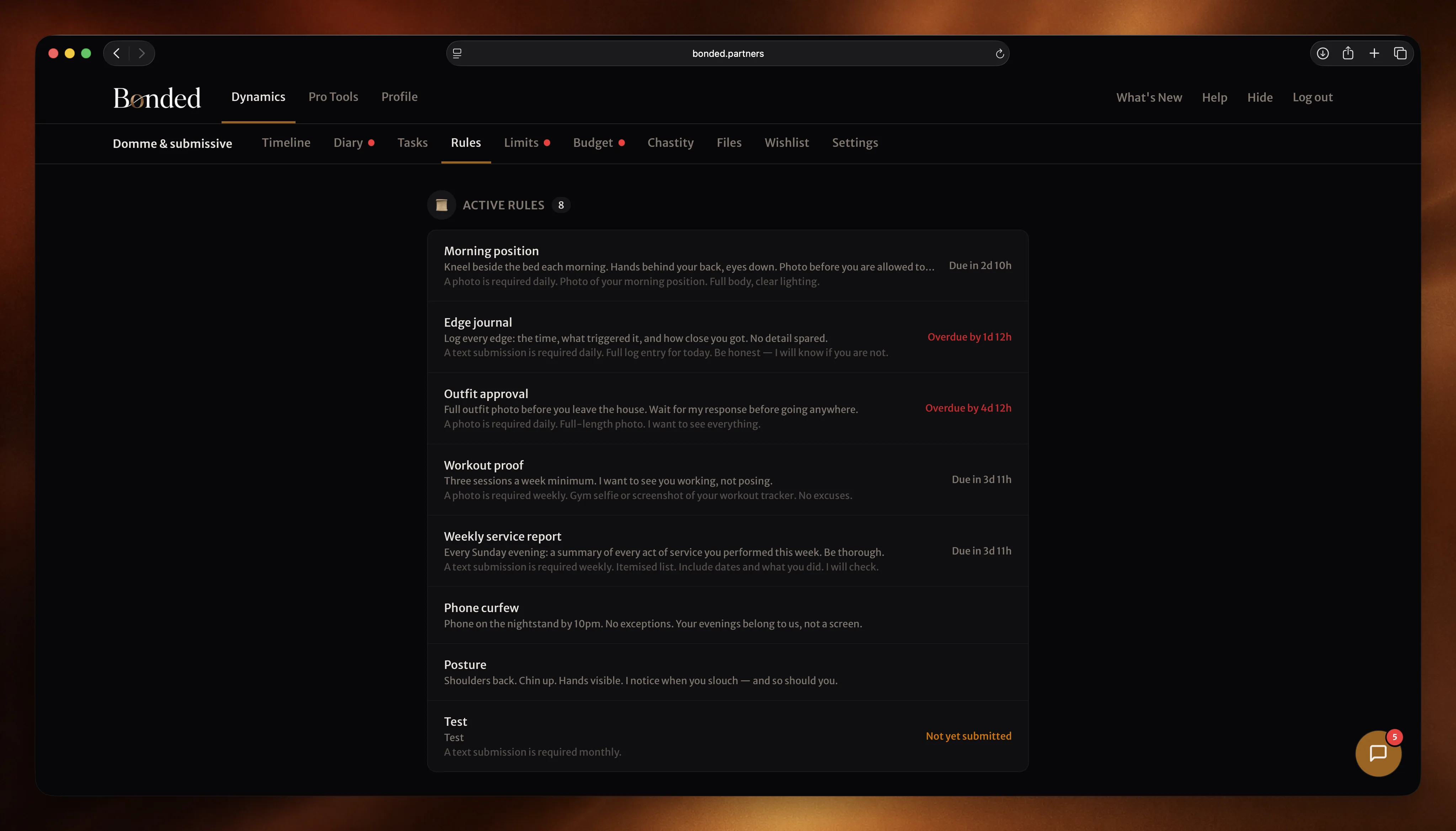
Bonded's Wishlist feature captures this structure -- name, description, link, and price for each item, with the ability to mark items as bought and track fulfilment over time. It turns the wishlist from a scattered collection of links into a managed, shared space.
Integrating the Wishlist Into Your Dynamic
The wishlist doesn't exist in isolation. It connects to other aspects of the dynamic:
Timeline. When an item is fulfilled, it appears in your shared timeline. Over months and years, the pattern of gifts given and received tells a story about the dynamic's evolution. Early items might be functional -- equipment, basic protocol clothing. Later items might be more personal, more specific, more expensive. The trajectory reveals growing trust and deepening knowledge.
Budget. If your dynamic includes financial oversight, the wishlist should align with it. A submissive might have a monthly "wishlist fund" category in their budget -- a set amount saved toward fulfilling the Dom(me)'s wishes or earmarked for the Dom(me) to spend on the submissive's list. This integration prevents gift-giving from disrupting financial structure.
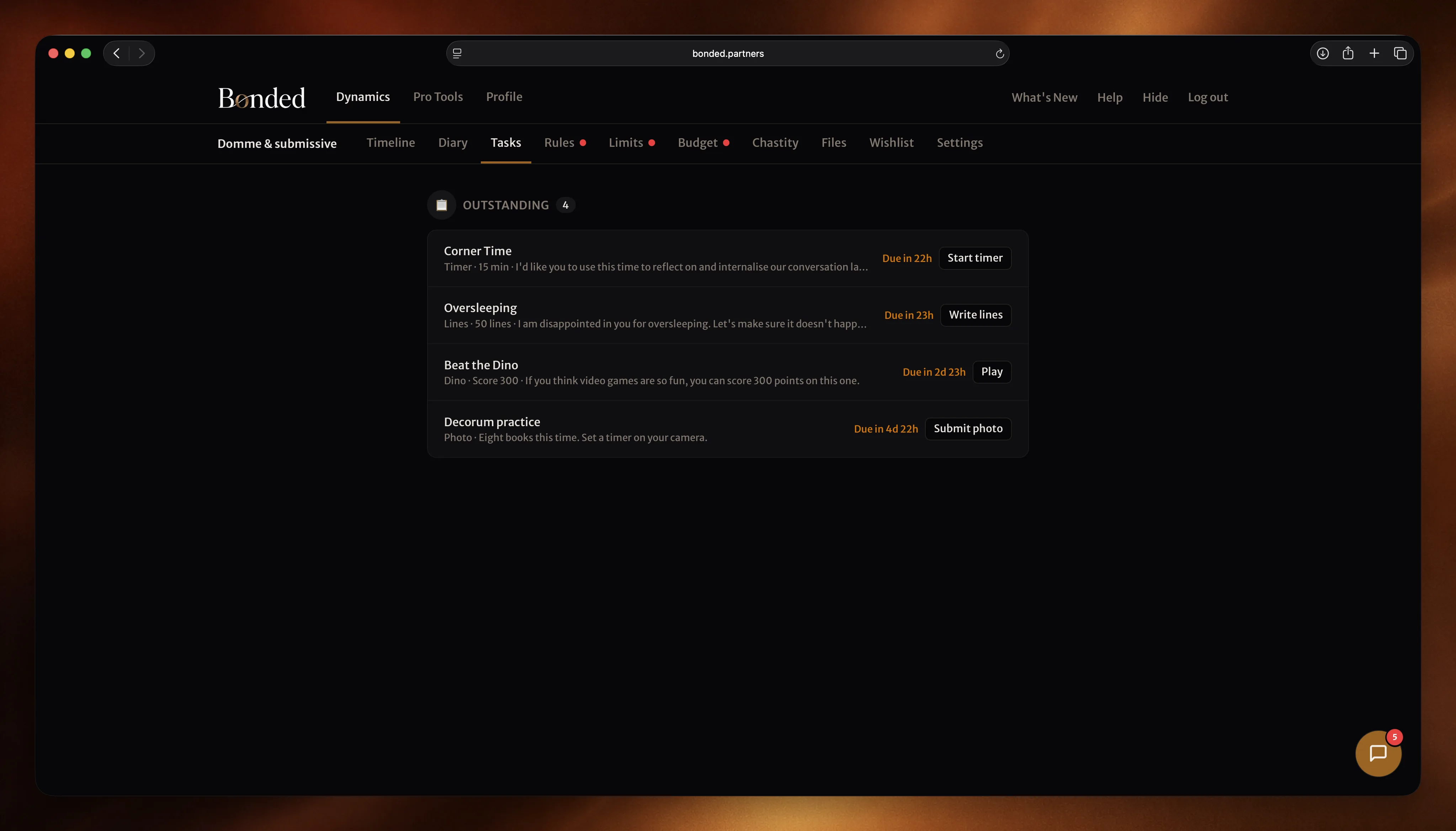
Rules and rewards. Some dynamics tie wishlist fulfilment to behaviour. A month of perfect compliance earns an item from the list. A specific achievement unlocks a specific wish. This creates anticipation and ties generosity to the dynamic's structure rather than making it arbitrary.
Special occasions. Birthdays, collaring anniversaries, milestones in the dynamic. The wishlist ensures these occasions are meaningful rather than stressful. No guessing what the other person wants. The information is right there, curated and waiting.
What the Wishlist Teaches
Used well over time, the wishlist becomes a practice in several things at once.
For submissives, it teaches the practice of wanting openly. Of articulating desire without controlling the outcome. Of trusting that expressing a want won't be punished, even if it isn't fulfilled.
For Dom(me)s, it teaches the practice of attentive generosity. Of choosing with intention. Of using knowledge of the other person's desires as a tool for care rather than control.
For the dynamic, it teaches that desire is relational. That what we want is shaped by who we're with, and that sharing wants is an act of intimacy that deepens the bond whether or not the specific item ever arrives.
A wishlist isn't a shopping list. It's a record of what two people want, offered to each other with trust and received with care. In a dynamic built on intentional power exchange, that's not a small thing.
Go deeper
Read the full guide→