



Financial Control in D/s: How Budget Oversight Actually Works
Financial domination and financial oversight are not the same thing. Learn how structured budget control works in D/s dynamics -- categories, limits, receipts, and the intimacy of transparency.

Say "financial control" in a kink space and half the room pictures someone draining a stranger's bank account on a webcam. The other half gets quiet, because they've been doing it for years and it looks nothing like that.
Financial oversight in D/s is one of the most misunderstood, most intimate, and most practically useful forms of power exchange. It's also one that people rarely talk about in detail, because money is the last taboo -- more private than sex, more revealing than a diary entry, and more vulnerable than anything you'll do in a dungeon.
This post is about the version that happens in committed dynamics. The spreadsheet version. The version where a submissive texts a photo of a grocery receipt and a Dom(me) reviews it while drinking their morning coffee. It's less dramatic than what the internet imagines. It's also far more powerful.
Findom vs. Financial Oversight: The Distinction That Matters
Financial domination -- findom -- is a fetish. Money itself is the erotic object. The act of sending, of being drained, of losing control of funds to another person -- that's the charge. Findom can happen between strangers. It often does. It doesn't require a relationship, a dynamic, or even a conversation beyond the transaction.
Financial oversight is structural. It's a Dom(me) taking an active role in managing, reviewing, or directing a submissive's financial life as part of an ongoing power exchange. The money isn't the fetish. The control is the framework.
Neither is inherently better or worse. They're different things that happen to involve the same resource. But confusing them leads to real problems -- submissives who agree to "financial control" expecting structured management and finding themselves pressured to send tribute, or Dom(me)s who want genuine oversight and find their submissive expecting a findom roleplay.
If you're negotiating financial elements in your dynamic, name which one you mean. Be specific. The conversation will be better for it.
Why Financial Oversight Works in a Dynamic
Money is behaviour made visible. Every transaction tells a story about priorities, impulses, planning, and self-care. When a submissive opens their financial life to a Dom(me), they're not just handing over numbers. They're offering a map of their decision-making.
For submissives who struggle with impulse spending, financial oversight provides external accountability. For those who are good with money, it provides a different kind of vulnerability -- the intimacy of being fully known in an area most people guard fiercely.
For Dom(me)s, financial oversight is one of the most tangible forms of authority. Rules about posture or tone can be hard to verify. A budget is concrete. Either the spending stayed within limits or it didn't. Either the receipt was submitted or it wasn't. The clarity is part of the appeal.
And then there's the daily texture of it. A submissive photographing a receipt in a shop. A Dom(me) reviewing the weekly spending summary. The small negotiation of "I'd like to buy this, may I?" These are micro-interactions that keep the power exchange alive between scenes, between visits, between the dramatic moments. They accumulate in your timeline as a record of daily devotion. Financial oversight is a 24/7 structure that doesn't require anyone to be in a dungeon.
How It Actually Works: The Practical Framework
Financial oversight exists on a spectrum. Some dynamics involve a Dom(me) having full access to bank accounts and making all financial decisions. Others involve light budgeting with monthly reviews. Most fall somewhere in the middle.
Here's what the middle ground typically looks like.
Categories
Divide spending into categories that reflect the submissive's actual life. Budget tracking makes this concrete. Common ones:
- Essentials: Rent, utilities, insurance, medical
- Groceries and household: Food, cleaning supplies, toiletries
- Transport: Fuel, public transport, car maintenance
- Personal: Clothing, grooming, entertainment
- Dynamic-related: Gifts, toys, wardrobe for scenes
- Savings: Emergency fund, goals, retirement
- Discretionary: Everything else
The categories aren't arbitrary. They create a shared language for talking about money. Instead of "I spent too much this month," the conversation becomes "the personal category was 40% over, and here's where it happened." Specificity turns a vague feeling into something actionable.
Limits
Each category gets a limit -- monthly, weekly, or per-transaction, depending on what makes sense. Essentials might have no per-transaction limit but a monthly cap. Discretionary spending might require approval above a certain threshold.
The threshold is where the power exchange lives. Setting it at $50 means the submissive moves through their day mostly autonomously, checking in only for larger purchases. Setting it at $10 means almost every non-routine purchase requires a conversation. Neither is inherently correct. The right threshold depends on how much structure both parties want and can sustain.
A common mistake: setting the threshold too low too soon. If every coffee requires approval and the Dom(me) is in meetings all day, the submissive is stuck waiting and the Dom(me) is drowning in notifications. Start higher. Adjust downward as you both find your rhythm.
Receipts and Tracking
This is where compliance becomes tangible. Options include:
- Photo receipts: Submissive photographs every receipt and submits it. Simple, immediate, but can be labour-intensive.
- Daily summary: A nightly report of all spending, with amounts and categories. Less intrusive, still detailed.
- Weekly review: All spending compiled at week's end. Dom(me) reviews and discusses. Lower friction, but less real-time awareness.
- Real-time tracking: Submissive logs each purchase as it happens. The Dom(me) sees spending unfold throughout the day.
Most dynamics combine approaches. Real-time logging for discretionary spending, weekly summaries for essentials, photo receipts for anything above the approval threshold.
The Review
The review is where the oversight becomes relational rather than administrative. This is not an audit. It's a conversation.
A good financial review covers:
- What happened: Where did the money go? Any surprises?
- What went well: Did the submissive stay within limits? Make good choices? Resist an impulse purchase?
- What needs attention: Any category trending over? Any pattern worth discussing?
- Forward planning: What's coming up next month? Any anticipated expenses? Adjustments needed?
Some Dom(me)s do this formally -- a scheduled weekly or monthly sit-down. Others fold it into their daily check-in. The format matters less than the consistency. If you review spending for three weeks and then ignore it for a month, you've effectively told the submissive that the structure is optional.
Currencies
If your dynamic crosses borders -- or if you simply travel -- currency becomes a practical consideration. A submissive in the UK with a Dom(me) in Australia needs a system that handles both pounds and dollars without creating confusion. Bonded supports 19 currencies for exactly this reason. When you're tracking a budget, the last thing you need is mental arithmetic muddying the picture.
The Trust Equation
Financial oversight requires more trust than most forms of power exchange. A submissive is exposing their relationship with money -- their debts, their impulse purchases, their financial anxieties, the subscription they forgot to cancel, the thing they bought that they're embarrassed about.
This vulnerability is not something to take lightly. A Dom(me) who mocks a submissive's spending mistakes, who uses financial information as ammunition during arguments, or who makes the submissive feel shame rather than accountability has violated the trust that makes the whole structure possible.
The Dom(me)'s role in financial oversight is stewardship. You are helping someone manage a critical area of their life. That means:
- No judgment about the past. Whatever their financial situation was before oversight, it was theirs. Start from where they are.
- Proportional responses. Overspending by $20 on groceries is not a crisis. Treat it like what it is -- a data point, a conversation starter, maybe a minor adjustment.
- Genuine engagement. If you ask for receipts, review them. If you set a budget, check it. Half-hearted oversight is worse than none, because it creates the burden of compliance without the reward of attention.
- Their financial health comes first. Always. A Dom(me) who directs a submissive's spending toward gifts for themselves at the expense of the submissive's savings or debt payments has crossed from oversight into exploitation.
Safety: The Non-Negotiable Foundations
Financial control, done poorly, is one of the fastest paths to financial abuse. The line between consensual oversight and coercive control is clear in theory and can blur in practice. Here are the safeguards that should be in place before any financial oversight begins.
The submissive retains an emergency fund
This is not optional. Every submissive under financial oversight should have access to money that the Dom(me) cannot see, control, or question. Enough to cover at least one month of living expenses. This fund exists so that if the dynamic ends -- for any reason, including reasons the Dom(me) wouldn't agree with -- the submissive can support themselves.
A Dom(me) who resists this is telling you something. Listen.
The submissive retains independent banking
The Dom(me) may have visibility into accounts. They may have agreed-upon authority over spending. But the accounts remain in the submissive's name, and the submissive retains the ability to close access at any time. Financial oversight is a power exchange, not a power seizure.
Exit planning exists
What happens to shared financial arrangements if the dynamic ends? If the Dom(me) has been managing investments, paying bills, or directing savings, there needs to be a clear path back to full autonomy. Discuss this before you start, not when you're already entangled.
Regular consent check-ins
Financial oversight should be renegotiated periodically. What felt right at month three might feel suffocating at month twelve -- or it might feel too loose. Build in explicit check-ins where the submissive can honestly say "this is working," "this needs adjustment," or "I want to stop this."
No financial isolation
Financial oversight should never result in the submissive being unable to access their own money. If "I need to ask permission" functionally means "I can't buy things I need because my Dom(me) is unavailable," the system is broken. Build in fallbacks. Automatic approvals after a time window. Categories that don't require approval at all. The structure should support the submissive's life, not obstruct it.
The Intimacy Nobody Talks About
Here's the thing that surprises people who haven't done this: financial oversight is deeply intimate. Not in a sexual way -- though it can intersect with that -- but in the way that being truly known is intimate.
A submissive who shares their spending is sharing their daily choices. The coffee they bought when they were stressed. The impulse purchase that reveals a hobby they're embarrassed about. The subscription they keep paying for because cancelling it means admitting they failed at something. Money is autobiography.
A Dom(me) who reviews that spending thoughtfully is saying: I see all of this, and I'm still here. I'm paying attention to the details of your life. Your $4 coffee matters to me -- not because of the $4, but because it tells me you were having a hard day.
That's the version of financial control that doesn't make it into the dramatic portrayals. It's not about draining wallets or restricting freedom. It's about one person saying, "Let me help you carry this," and another saying, "I trust you enough to let you."
Structuring Financial Rules
Financial oversight works best when it's woven into your broader rules structure rather than floating as a separate arrangement. Some approaches:
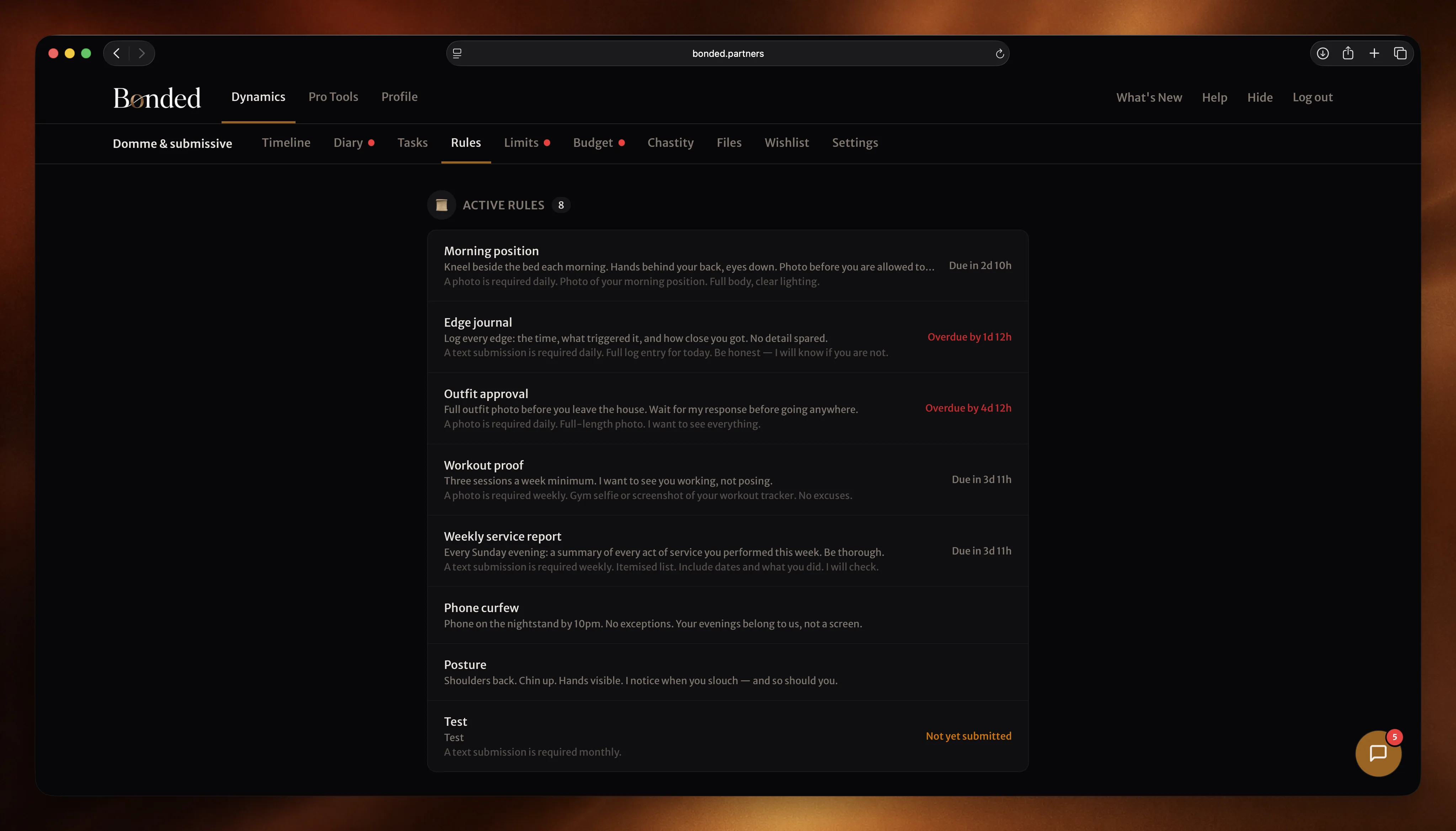
The receipt rule: Submit a photo of every receipt over a set amount within 24 hours. Evidence type: photo. Frequency: ongoing. This creates a steady rhythm of financial transparency without requiring real-time logging.
The budget review rule: Compile weekly spending by category and submit as a diary entry every Sunday. Evidence type: text. Frequency: weekly. This gives the Dom(me) a regular snapshot and the submissive a weekly practice of financial awareness.
The permission rule: Request approval for any non-essential purchase over the agreed threshold. Include: item, cost, category, and reason. Evidence type: text (screenshot of request and approval). Frequency: ongoing. This is the rule that creates the most daily interaction.
The savings rule: Transfer a set amount to savings on the first of every month. Submit confirmation. Evidence type: photo. Frequency: monthly. This turns financial health into a compliance metric -- the submissive isn't just saving for themselves, they're obeying.
The forward-planning rule: Submit a list of anticipated non-routine expenses for the coming month during the monthly review. Evidence type: text. Frequency: monthly. This teaches proactive financial thinking and gives the Dom(me) foresight.
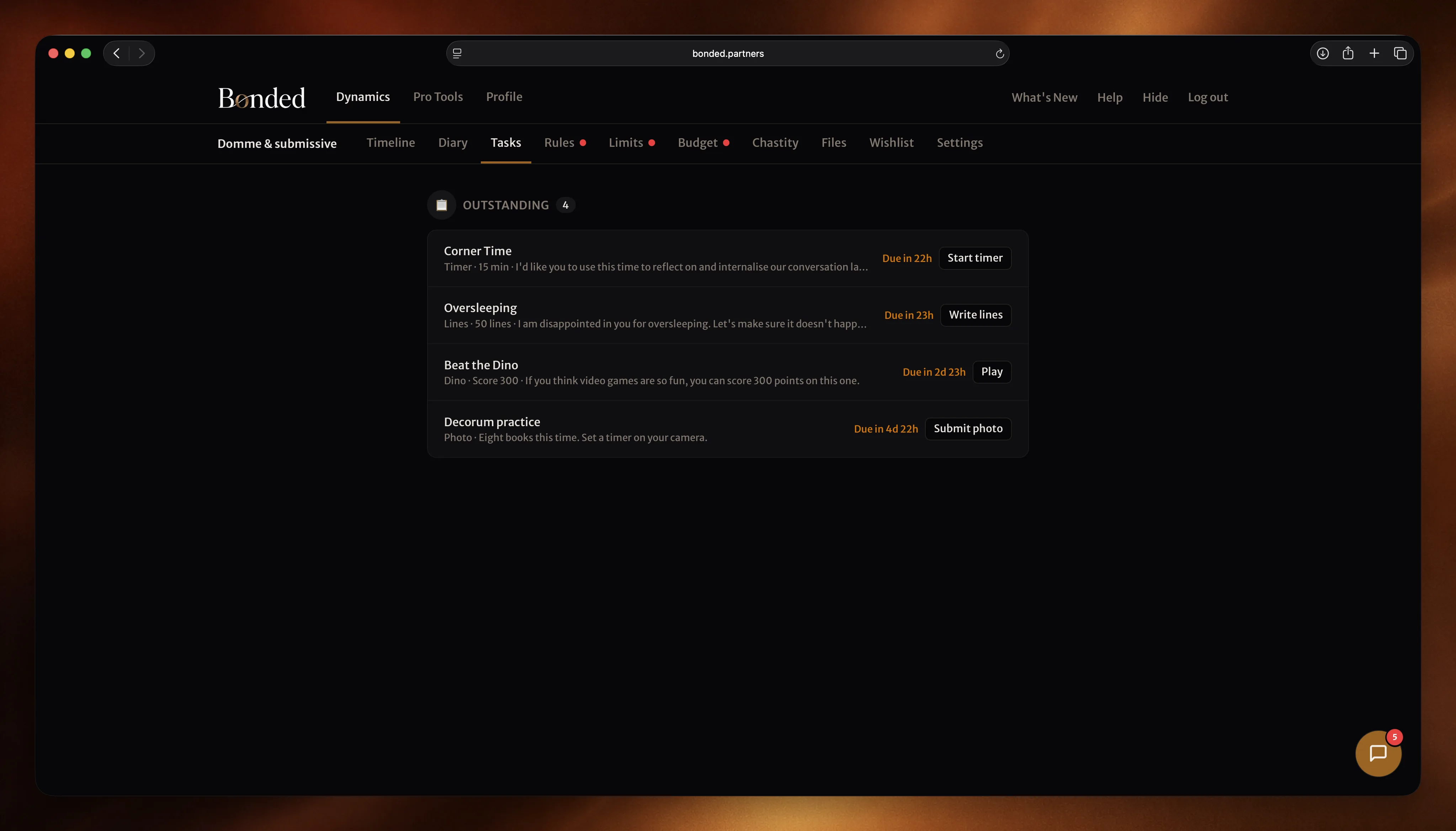
Each of these can be built as a Rule in Bonded with the appropriate evidence type, frequency, and description. The Budget feature handles the categories, limits, and currency -- tracking spending against the agreed framework and making the review process concrete rather than a vague conversation about "how the money went."
Starting Small
If financial oversight interests your dynamic but feels daunting, start with visibility before control.
Phase 1: Transparency. The submissive tracks their spending for a month and shares it with the Dom(me). No limits, no consequences. Just information. This builds the habit of financial openness and gives both parties data to work with.
Phase 2: Categories. Together, organise spending into categories. Discuss what feels reasonable for each. The submissive begins logging purchases by category.
Phase 3: Limits. Set soft limits -- targets rather than hard caps. The submissive aims to stay within them. Review together weekly.
Phase 4: Structure. Introduce approval thresholds, receipt requirements, and consequences for exceeding limits. Now the oversight has teeth.
Phase 5: Refinement. Adjust based on what's working. Tighten categories that need attention. Loosen ones that are running smoothly. Add forward planning. This is an ongoing process, not a destination.
Each phase might last a month or several months. There's no rush. Financial habits are deeply ingrained, and reshaping them within a power exchange requires patience from both sides.
When It Goes Wrong
Financial oversight goes wrong in predictable ways. Knowing the patterns helps you avoid them.
The Dom(me) stops paying attention. The submissive is diligently logging receipts into a void. No review, no acknowledgement, no feedback. The structure becomes a chore without a reward. If you institute financial oversight, you are committing to engagement. If you can't sustain that, scale back the requirements to something you can.
The limits don't match reality. A budget built on ideals rather than actual spending patterns will fail immediately. Start with what the submissive actually spends, then adjust. A grocery budget of $200/month sounds disciplined until you realise it's half of what they need to eat.
Financial control becomes financial abuse. If the submissive cannot meet their basic needs, cannot access emergency funds, cannot leave the dynamic without financial devastation -- that's not power exchange. That's coercive control. The presence of consent at the beginning does not justify harm in the present. Both parties should know the signs and be willing to name them.
Money replaces communication. Financial oversight should generate conversation, not replace it. If the weekly review is the only time you discuss the dynamic, the budget has become a substitute for genuine check-ins. Money is one thread. It shouldn't be the whole fabric.
The Long Game
Dynamics that sustain financial oversight over years often report something unexpected: the submissive's financial health improves. Debt decreases. Savings increase. Impulse spending drops. The external accountability that felt like control at the beginning starts to feel like care.
This isn't universal, and it shouldn't be the justification for financial oversight. The justification is that both parties find meaning in it. But the practical benefits are real, and they're worth naming.
Financial control in D/s is not about one person taking another's money. It's about one person taking responsibility for paying attention to how another person moves through the world, one transaction at a time. That attention, sustained over months and years, is one of the most profound forms of dominance there is.
It just doesn't look like what most people imagine.
Go deeper
Read the full guide→