



Why Spreadsheets Break (And When to Move to Something Purpose-Built)
Spreadsheets are the most popular D/s management tool in existence. Here's where they fall apart — and how to know when your dynamic has outgrown them.

Let us start with respect. If you are running your dynamic from a Google Sheet right now and it is working, you are doing something right. The fact that you have created structure at all puts you ahead of most dynamics that rely on memory and good intentions. Spreadsheets have held together more D/s relationships than every purpose-built app combined, and that is not an exaggeration — it is arithmetic. The kink community has been managing dynamics digitally since long before anyone thought to build dedicated software for it.
This is not a piece designed to make you feel bad about your spreadsheet. It is a piece designed to help you recognise the specific failure patterns that emerge over time, so you can decide whether to fix them or whether your dynamic has reached the point where a different kind of tool would serve it better.
Because spreadsheets do break. Not dramatically. Not all at once. They break the way a favourite jacket wears out — so gradually that you do not notice until you are standing in the rain and realising the waterproofing stopped working months ago.
Where Spreadsheets Work
Before we discuss failures, let us acknowledge the genuine strengths.
Customisation is unlimited. No app will ever match the flexibility of a blank grid. You can track whatever you want, structured however you want, with whatever categories and labels make sense to your dynamic. A spreadsheet bends to your relationship. An app asks your relationship to bend to its structure.
Data ownership is clear. Your spreadsheet lives in your Google Drive or on your hard drive. You control it. You can export it, delete it, move it. No terms of service, no company pivoting or shutting down, no wondering what happens to your data if you stop paying.
The barrier to entry is zero. Both of you already have access to a spreadsheet application. There is no account to create, no app to download, no learning curve beyond basic cell editing. You can be tracking rules within ten minutes of deciding you want to.
Building it together is bonding. There is something genuinely valuable about sitting down with your partner and constructing a system from scratch. The conversations you have while building a spreadsheet — what to track, how to categorise things, what matters enough to measure — are themselves acts of negotiation and alignment.
These are real strengths. Do not let anyone dismiss them.
The Five Ways Spreadsheets Fail
1. No Notifications, No Prompts, No Momentum
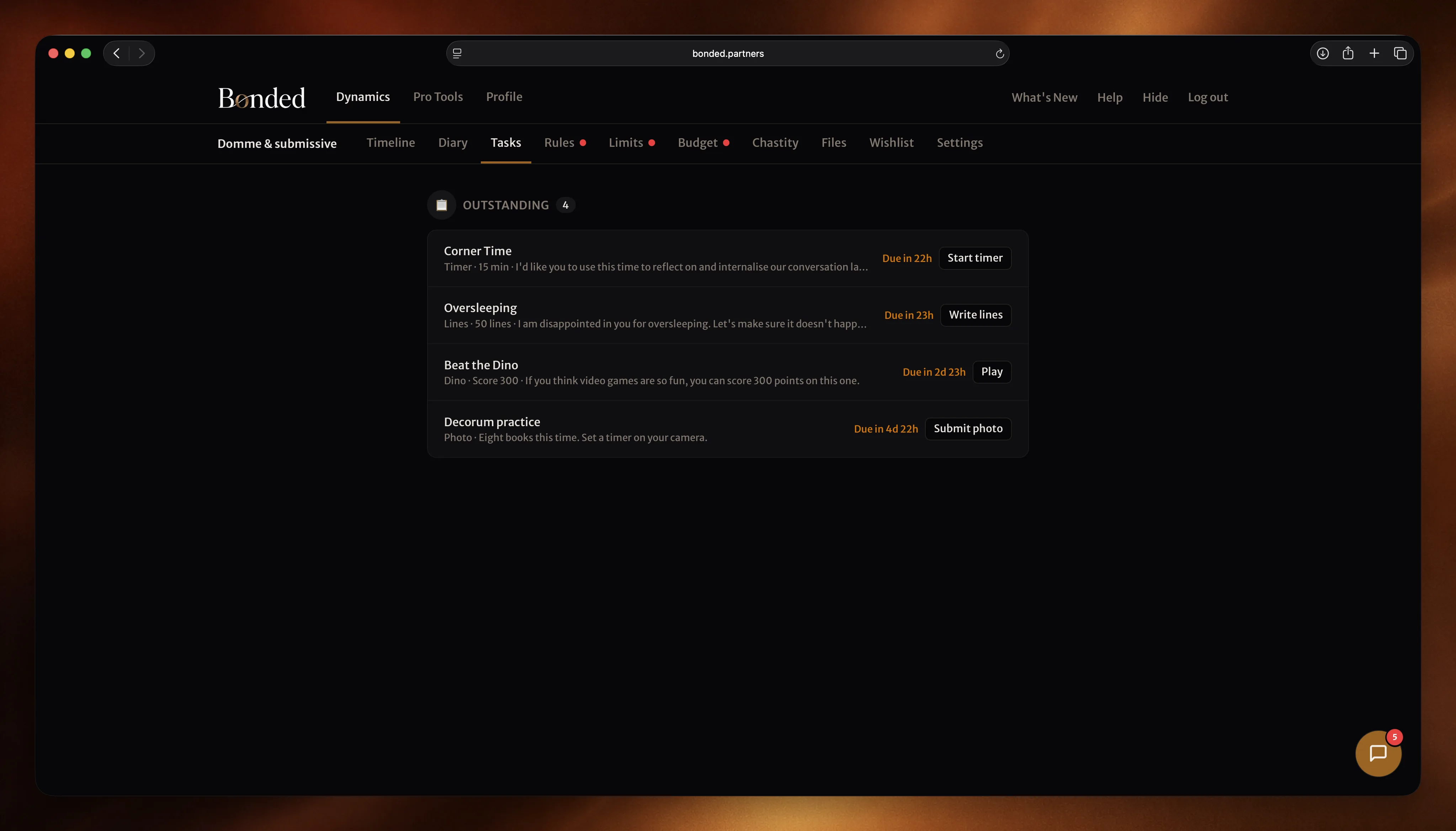
A spreadsheet waits. It does not remind your submissive that their daily check-in is due. It does not alert your Dom(me) when evidence has been submitted. It does not nudge either of you when a rule has gone unacknowledged for a week.
This matters more than it sounds like it should. The difference between a rule being followed and a rule being forgotten is often nothing more than a timely prompt. Submissives want to obey. Dom(me)s want to be attentive. But life intervenes — work, illness, distraction, exhaustion — and the thing that keeps structure alive during those low-energy periods is something external saying "hey, this matters."
Spreadsheets cannot do that. The burden of remembering falls entirely on the people in the dynamic, which means the system works perfectly when motivation is high and fails silently when motivation dips. And motivation always dips. That is not a character flaw; it is being human.
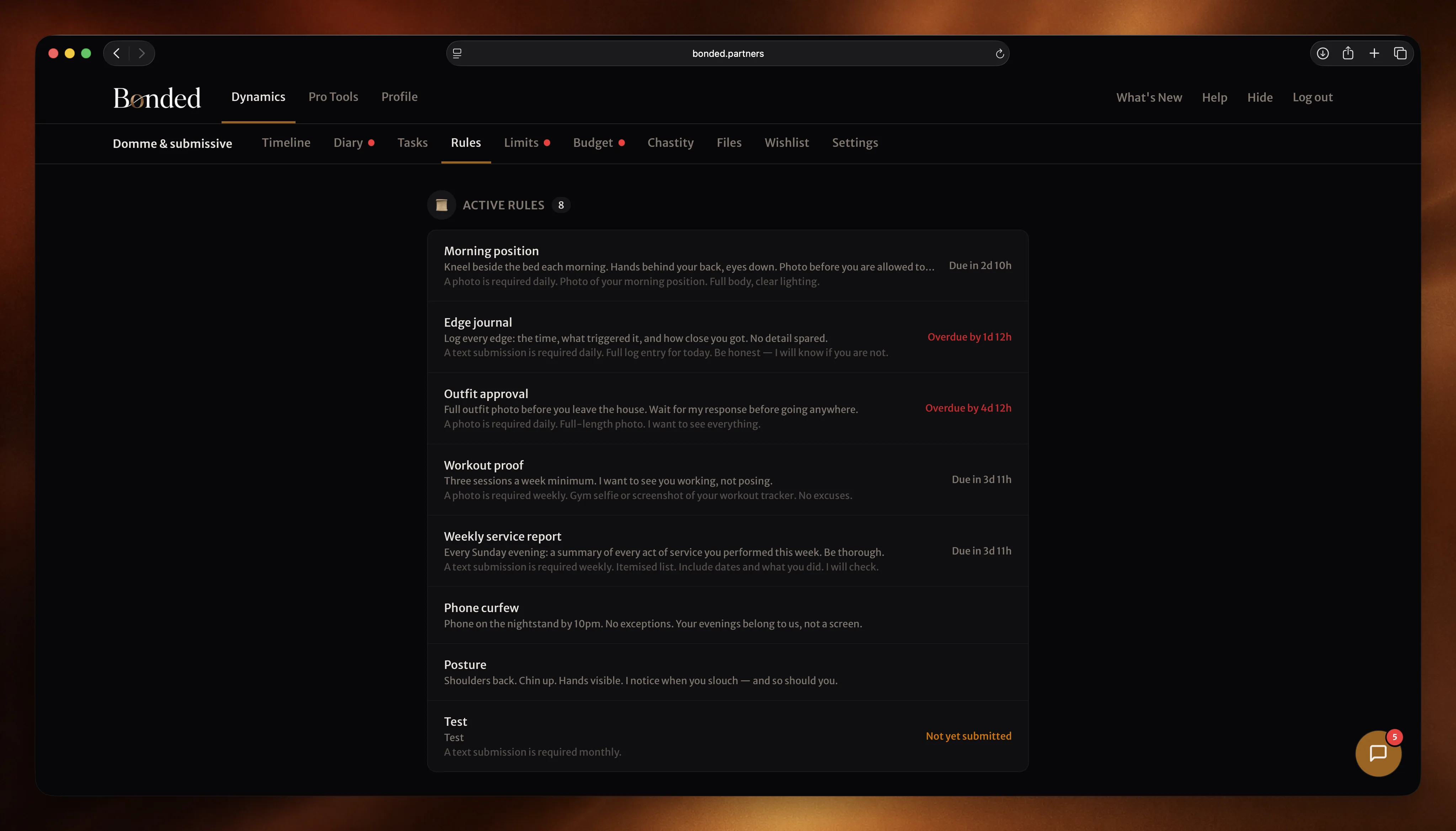
Purpose-built tools send push notifications. A submissive's phone buzzes at 9pm: "Daily reflection due." A Dom(me) gets an alert: "Evidence submitted for Rule 3." These are small things. They are also the difference between a rule that holds for three months and one that holds for three years.
2. No Evidence Layer
Your submissive logs "completed" in column D. Did they? You trust them — of course you do — but the absence of evidence changes the psychology of compliance for both parties.
For the submissive, creating evidence (a photo, a journal entry, a timestamped action) transforms obedience from a private checkbox into a shared act. The evidence itself becomes an offering. "I did this, and here is proof that I did this, and creating that proof was itself an act of submission." That psychological loop is powerful, and a spreadsheet cannot create it.
For the Dom(me), reviewing evidence is an act of attention. It says "I see you. I see the effort. This matters to me." Scrolling through a spreadsheet and seeing "yes / yes / yes / yes" in a column does not create that same moment of connection.
Evidence also protects both parties. A submissive who can point to a log of completed tasks with timestamps and photos has a record of their dedication. A Dom(me) who reviews evidence regularly demonstrates attentive leadership. When disagreements arise — and they will — evidence turns "I think I did" and "I don't think you did" into something concrete.
3. No Access Control
In a spreadsheet, both partners can see and edit everything. This sounds like transparency, and sometimes it is. But many dynamics benefit from asymmetric access.
A Dom(me) might want to see a submissive's diary entries without the submissive being able to edit or delete them after submission. A submissive might want certain limit notes to be visible only to themselves until they are ready to share. A Dom(me) might want to set up a consequence or a task in advance without the submissive seeing it coming.
Spreadsheets offer document-level sharing (view, comment, or edit) but nothing more granular. You cannot make one tab editable and another read-only for a specific person. You cannot create fields that one role can see and the other cannot. The permission model is "all or nothing," which forces dynamics into a transparency structure they may not want.
This also creates a subtle accountability problem. If a submissive can edit the spreadsheet, they can — in theory — change past entries. Most would never do this. But the possibility existing changes the dynamic of the record. A system where past entries are immutable once submitted carries different psychological weight than one where the backspace key works on everything.
4. No Mobile Experience
Open a Google Sheet on your phone. Navigate to the right tab. Find today's row. Type in a small cell. Try to enter a time stamp. Try to attach a photo (you cannot). Try to do this every day without growing to resent the experience.
Spreadsheets were designed for desktops. On mobile, they are functional but hostile — tiny text, awkward navigation, formatting that breaks on smaller screens. This matters because D/s is a daily practice, and daily practices live on phones. The tool your submissive uses to report compliance needs to be as easy as sending a text message. If it is harder than that, compliance will erode — not because of disobedience, but because of friction.
The Dom(me) side is equally affected. Reviewing a spreadsheet on a phone between meetings is not the same as glancing at a notification, tapping to review an evidence submission, and tapping again to acknowledge it. The review process needs to be fast enough to fit into the crevices of a real day.
5. No Privacy Layer
Your dynamic tracking spreadsheet lives in Google Drive. What is its filename? If someone borrows your laptop, opens Google Drive, and sees "D/s Rules and Tracking - 2026," what happens?
Spreadsheets have no concept of concealment. No biometric lock. No decoy screen. No panic button. No scene names to replace real names. The only privacy is the privacy of your Google account password, and in a world of shared devices, borrowed laptops, and screens visible to passersby, that is often not enough.
This is not paranoia. For many people in D/s dynamics, discovery carries real consequences — professional, familial, social. A purpose-built tool that understands this offers meaningful protection. A spreadsheet offers a filename you hope nobody reads.
The Maintenance Tax
Beyond these five structural failures, there is a sixth problem that is harder to articulate: spreadsheets require ongoing maintenance, and that maintenance always falls on someone.
Formulas break when someone inserts a row in the wrong place. Conditional formatting stops working when you change a column header. The neatly organised system from month one becomes a cluttered mess by month six because nobody had time to archive old data or restructure tabs that no longer make sense.
This maintenance tax is invisible at first. It grows slowly. And it almost always falls disproportionately on one partner — usually the one who built the spreadsheet — creating a dynamic where the tool that was supposed to reduce overhead is itself generating overhead.
In a purpose-built system, the structure is maintained by the software. Rules do not stop working because someone accidentally deleted a formula. Historical data does not need manual archiving. The system handles the housekeeping so that both partners can focus on the dynamic itself.
The Tipping Point
So when does a spreadsheet stop being enough? When do you move? There is no universal answer, but there are reliable signals.
You have stopped updating it. Not a conscious decision — you just realise it has been two weeks since either of you opened it. The system lost its hold because it could not remind you of itself.
You are spending more time maintaining the system than using it. When the conversation shifts from "let's talk about your compliance this week" to "the formula in column G is broken again," the tool is consuming attention that belongs to the dynamic.
You wish you had notifications. You have caught yourself thinking "I wish the spreadsheet could just remind me." That thought is the tipping point in miniature.
Evidence matters to your dynamic and you have no way to capture it. You want photos, journal entries, timestamps — and instead you have text in cells.
Privacy anxiety is real. You have renamed the file something innocuous. You have considered what would happen if someone found it. The anxiety is not about the content of your dynamic — it is about the container.
Your dynamic is growing. More rules, more complexity, more partners, more things to track. What worked for three rules does not work for twelve. What worked for one submissive does not work when a second joins the dynamic.
If three or more of these resonate, your spreadsheet has probably served its purpose well. It got you here. It created the habits and the structure. Now the question is whether a tool designed specifically for what you are doing would let you focus on the relationship instead of the infrastructure.
What Moving Looks Like
Moving from a spreadsheet to a purpose-built tool is not starting over. It is recommitting to the same structure with better infrastructure. Your rules do not change. Your limits do not reset. Your history is not erased — it is the foundation you are building on.
We have written a practical guide to making the switch: From Spreadsheets to Bonded. It covers what to bring, what to set up first, and how to transition without losing momentum.
If you are not ready to move, that is fine. Your spreadsheet is not failing you today. But now you know what to watch for, and when you see those patterns emerge, you will have a clearer sense of whether to fix the spreadsheet or move beyond it.
The goal was never the tool. The goal was always the dynamic. The tool is just the thing that holds the structure while you do the real work of power exchange. When the tool starts requiring more attention than the relationship, it has outlived its usefulness.
Go deeper
Read the full guide→