



Best BDSM Apps for Couples in 2026: An Honest Guide
A genuinely fair comparison of every D/s app and tool available in 2026 — from purpose-built platforms like Bonded and Obedience to spreadsheets, habit trackers, and encrypted messengers.

Finding the right tools for your dynamic is harder than it should be. You cannot exactly walk into the App Store and search "D/s relationship management" without wading through dating apps, hookup platforms, and products that treat kink as a novelty rather than a relationship structure. And even when you find something promising, the question remains: does it actually fit the way you and your partner practise power exchange?
This guide covers every serious option available in 2026. Purpose-built D/s apps, repurposed productivity tools, encrypted messaging platforms, and the spreadsheets that have quietly held together more dynamics than any app developer wants to admit. We will be genuinely fair. Every tool here has strengths, and every tool here has gaps — including ours.
We built Bonded, so you should know that going in. But this guide exists because we would rather you find the right tool for your dynamic than use ours for the wrong reasons. A submissive tracking rules in a Google Sheet with genuine consistency is in a better position than one using a purpose-built app they never open.
Purpose-Built D/s Apps
Bonded
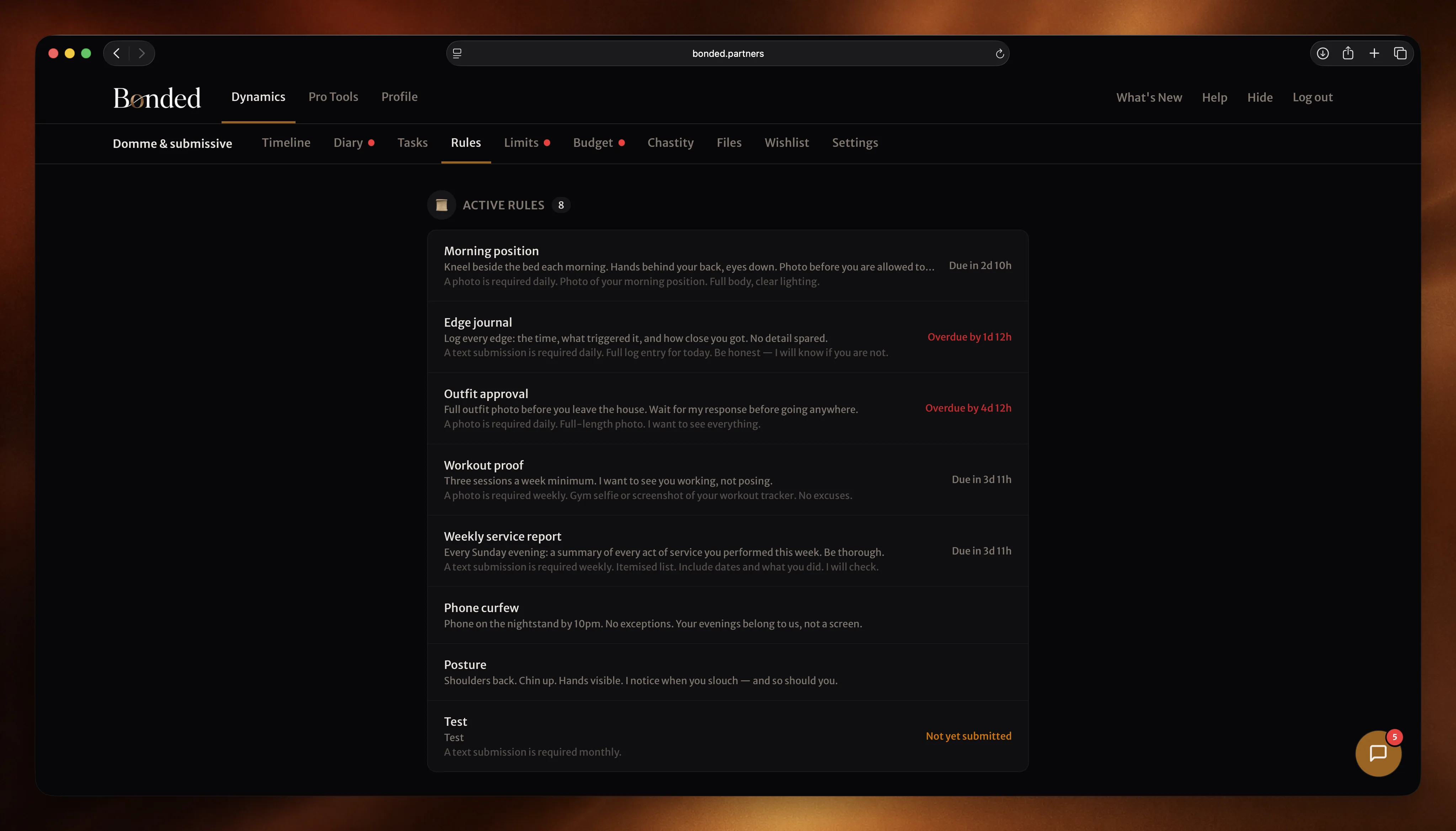
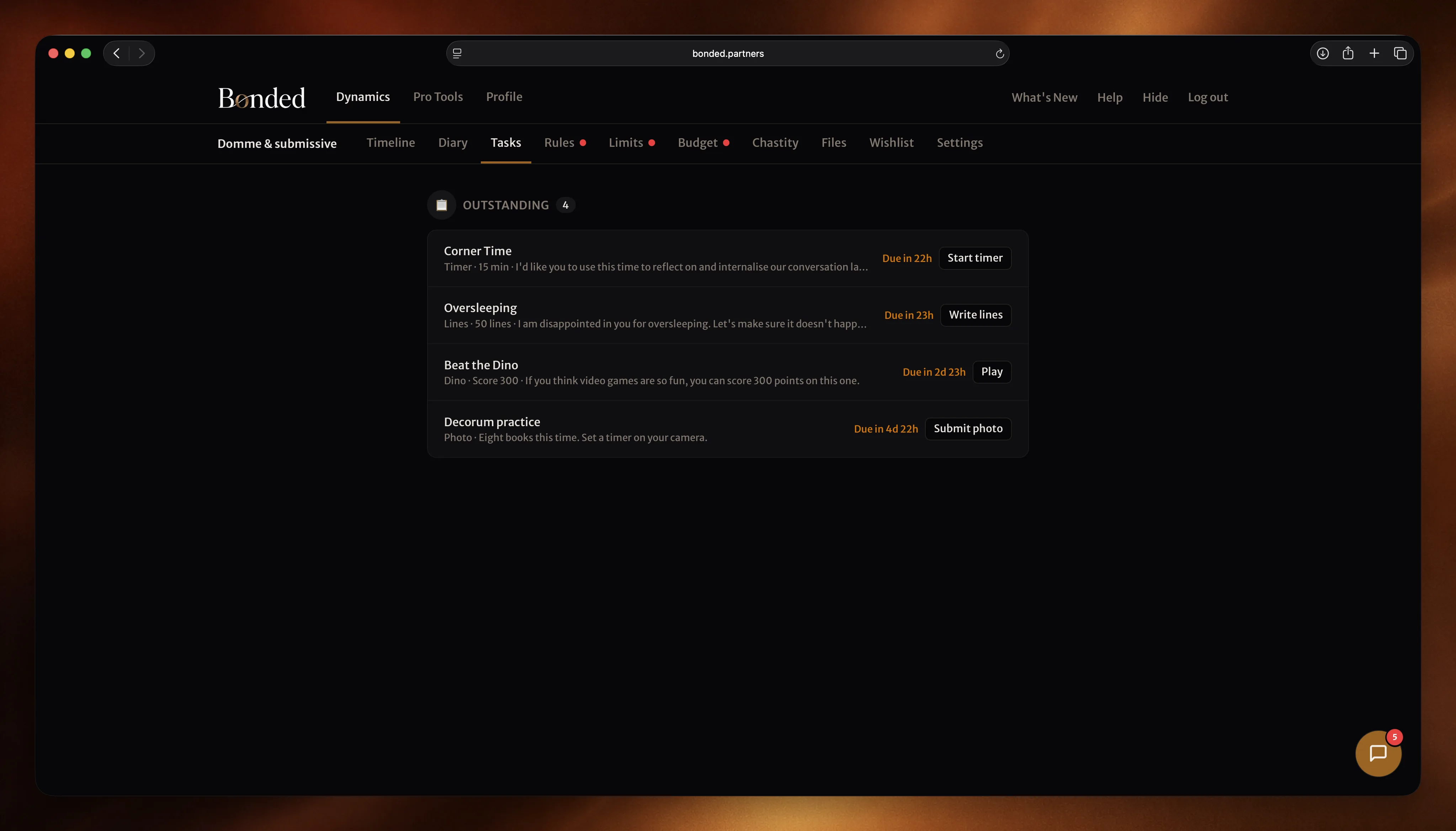
What it does: A full dynamic management platform covering rules and accountability, chastity tracking with live timers, negotiated limits, shared diary, tasks, financial oversight (budgets and allowances), file sharing, and an activity timeline. Built specifically for ongoing D/s dynamics rather than individual scenes.
Who it's for: Couples in committed power exchange dynamics — whether 24/7, structured, or part-time — who want a shared space for the ongoing work of maintaining structure. Works for both cohabiting and long-distance dynamics.
Pricing: Free tier covers core features for one dynamic. Premium and Pro tiers unlock additional dynamics, advanced features, and extended history. See full pricing.
Strengths:
- The only app that treats a D/s dynamic as its core unit. Everything is shared between partners within a dynamic, with appropriate access controls based on roles.
- Chastity tracking is genuinely excellent — live lock timers, session history, keyholder controls, lifetime statistics. Nothing else on this list comes close for chastity-focused dynamics.
- Limits are collaborative and living. Both partners can propose, and the system tracks reclassifications over time. This turns limit negotiation from a one-time conversation into an ongoing practice.
- Rules have built-in evidence requirements, schedules, and accountability. Push notifications remind submissives. Dom(me)s can review compliance without nagging.
- The diary creates a genuine shared reflective space. Daily entries, prompted or freeform, visible to both partners.
- Privacy features are strong: biometric app lock, scene names instead of real names, panic button that redirects to a decoy screen.
- Activity timeline means every significant action is logged. No more "did you do this?" — it is in the log.
Weaknesses:
- No Android app yet. Android users can access the web app, but the native experience is iOS only as of early 2026.
- The feature set is broad, which means the learning curve is steeper than simpler tools. You do not need to use everything at once, but the initial setup takes more time than downloading a habit tracker.
- Relatively new. The community is growing but smaller than established platforms.
Bottom line: If your dynamic involves ongoing structure — rules, accountability, negotiated limits, regular communication — Bonded was designed specifically for that. If you just need a chastity timer or a simple task list, it may be more than you need.
Obedience
What it does: A D/s-focused app centred on tasks, punishments, and rewards. The Dom(me) assigns tasks, the submissive completes and reports, and a point system tracks compliance over time.
Who it's for: Dynamics that are heavily task-oriented or that enjoy gamification. Particularly popular with Dom(me)s who like granular control over daily assignments.
Pricing: Free tier with limited tasks. Premium subscription unlocks unlimited tasks and additional features.
Strengths:
- The task and point system is well-designed and motivating for submissives who respond to gamification.
- Interface is straightforward. Low learning curve.
- The punishment and reward system gives Dom(me)s a structured way to respond to behaviour, which is something many apps ignore entirely.
- Established user base. Has been around long enough to have refined its core features.
Weaknesses:
- Heavily task-focused. If your dynamic is more about protocol, service, or emotional depth than completing assigned tasks, the structure may feel limiting.
- No chastity tracking, no limit negotiation system, no shared diary. The feature set is narrower than it appears.
- Less emphasis on collaborative negotiation. The flow is predominantly Dom(me)-assigns, sub-completes. Dynamics where the submissive has more input into structure may find this limiting.
- Privacy features are less developed than some alternatives.
Bottom line: A solid choice for task-driven dynamics. If your dynamic revolves around daily assignments and you want a dedicated system for that, Obedience does it well. For a deeper comparison, see Bonded vs Obedience.
Cage App
What it does: Primarily a chastity tracking application. Lock timers, keyholder controls, session logging, and community features for those in chastity.
Who it's for: Individuals and couples focused specifically on chastity play and denial.
Pricing: Free tier with basic tracking. Premium unlocks extended features.
Strengths:
- Focused. If chastity is your primary interest, the app does not distract you with unrelated features.
- Community features connect you with others practising chastity, which can be motivating and normalising.
- Simple and quick to set up.
Weaknesses:
- Chastity only. If your dynamic includes rules, tasks, limits, or other structure beyond chastity, you will need additional tools.
- The community features, while valuable, can blur the line between relationship tool and social platform in ways that not every partner is comfortable with.
- Less keyholder control granularity compared to purpose-built dynamic management platforms.
Bottom line: If chastity is the entirety of what you want to track and you value a community of others doing the same, Cage App serves that niche. For chastity as part of a broader dynamic, you will outgrow it.
Repurposed Productivity Tools
These were not built for D/s. But the kink community is nothing if not resourceful, and each of these has been pressed into service by enough couples to merit serious consideration.
Google Sheets / Excel
What it does: Whatever you build it to do. Rule tracking spreadsheets, chastity logs, punishment ledgers, limit lists, financial tracking — the community has created templates for all of it.
Who it's for: Couples who enjoy building their own systems, who want complete customisation, or who are not ready to trust their dynamic data to a third-party app.
Pricing: Free (Google Sheets) or included with Microsoft 365 subscriptions.
Strengths:
- Infinite customisation. If you can imagine a tracking system, you can build it in a spreadsheet.
- Complete data ownership. Your data lives in your Google Drive or on your machine. No third-party servers.
- No account creation on a kink-specific platform, which matters for people with strict privacy requirements.
- Collaborative editing means both partners can update in real time.
- Free. Genuinely, completely free.
Weaknesses:
- No push notifications. If a submissive forgets to check the sheet, the sheet does not remind them. This is the single biggest reason spreadsheet-based dynamics lose consistency.
- No mobile-optimised experience. Editing a spreadsheet on a phone is possible but miserable.
- No access controls beyond document-level sharing. A Dom(me) cannot make certain fields visible but not editable, or create sections that only one role can see.
- Maintenance burden falls on whoever built it. Formulas break. Formatting drifts. Tabs multiply. Over time, the system becomes fragile.
- No evidence submission. A submissive can type "done" but cannot attach a photo or timestamp completion automatically.
Bottom line: Spreadsheets work beautifully for the first few months and for simple dynamics. They break — slowly and then all at once — when the dynamic grows in complexity. We wrote a full piece on this: Why Spreadsheets Break. For a direct comparison, see Bonded vs Spreadsheets.
Notion
What it does: A flexible workspace that can be configured as a D/s management hub. Databases for rules, kanban boards for tasks, pages for contracts, calendars for schedules.
Who it's for: Couples where at least one partner is already a Notion user and enjoys building systems. Particularly popular with protocol-heavy dynamics that want extensive documentation.
Pricing: Free tier is generous. Plus and Business tiers for additional features.
Strengths:
- Beautiful. A well-built Notion D/s workspace looks and feels intentional in a way that a spreadsheet never will.
- Databases with multiple views (table, kanban, calendar, gallery) are genuinely powerful for tracking rules, tasks, and limits.
- Templates can be shared, so you benefit from what other couples have built.
- Good mobile app. Not as smooth as a purpose-built tool, but far better than editing a spreadsheet on a phone.
- Supports rich content: images, embedded files, toggle blocks for progressive disclosure of sensitive content.
Weaknesses:
- Still no push notifications for custom databases. The same core problem as spreadsheets — passive tools do not prompt action.
- Building a good Notion workspace takes hours. Many couples start enthusiastically and abandon it when the configuration fatigue sets in.
- Sharing a Notion workspace means sharing a Notion account or workspace. The access control model is not built for the Dom(me)/sub permission structure you would want.
- No encryption or kink-specific privacy features. Anyone with access to the workspace sees everything.
Bottom line: If you are already deep in the Notion ecosystem and you enjoy building systems, a Notion D/s workspace can be excellent. If "set up a Notion workspace" sounds like homework, this is not your tool.
Habitica
What it does: A gamified habit tracker that turns real-world tasks into RPG mechanics. Complete habits, earn gold, level up your character, fight monsters with a party.
Who it's for: Submissives (and Dom(me)s) who respond strongly to gamification and extrinsic motivation. Dynamics where daily habits are the primary structure.
Pricing: Free with optional premium subscription for cosmetic rewards and additional features.
Strengths:
- The gamification is genuinely motivating. For submissives who struggle with consistency, the RPG layer can provide the extra push that a plain checklist cannot.
- Party system means the Dom(me) can be in a "party" with the submissive, seeing their progress and being affected by their failures (missed habits damage the whole party).
- Habit/Daily/To-Do distinction maps reasonably well to standing rules, daily protocols, and one-off tasks.
- Strong mobile app. Notifications work.
Weaknesses:
- Not even slightly designed for D/s. The language, interface, and community are all general-purpose. You will be translating everything into Habitica's framework.
- No privacy layer. Your habit list is visible to party members. "Edge for 20 minutes" sitting next to "Drink 8 glasses of water" in a gamified to-do list is a specific vibe that not everyone wants.
- No shared diary, no limit tracking, no chastity features, no evidence submission.
- The gamification that motivates some people feels infantilising to others. Know your submissive.
Bottom line: A genuinely clever choice for habit-focused dynamics where the submissive is motivated by game mechanics. Pair it with a messaging app for the relational aspects that Habitica cannot provide.
Streaks (iOS)
What it does: A minimalist habit tracker focused on maintaining streaks. Set up to twelve habits, track daily completion, maintain your streak.
Who it's for: Submissives who want a lightweight, private way to track daily rules or protocols on their own device.
Pricing: One-time purchase (roughly $5/PS5).
Strengths:
- Beautiful, minimal design. Does one thing well.
- Completely private — data stays on-device.
- Health app integration means habits like exercise or hydration can be tracked automatically.
- The streak mechanic is psychologically effective. Not wanting to break a 47-day streak is powerful motivation.
Weaknesses:
- Solo tool. No sharing with a partner. The Dom(me) has no visibility unless the submissive screenshots and sends.
- Twelve habit limit. Fine for a focused dynamic, constraining for a complex one.
- No evidence, no diary, no context. Just checkmarks.
- iOS only.
Bottom line: An excellent personal accountability tool for a submissive who wants to track their own compliance. Not a relationship tool. Works well as a supplement to a shared platform.
Encrypted Messaging Apps
Telegram
What it does: A messaging app with bots, channels, scheduled messages, and self-destructing media. The kink community has adopted it heavily for its flexibility and bot ecosystem.
Who it's for: Dynamics that want to build a D/s communication layer on top of a messaging platform. Particularly popular with long-distance dynamics and those who use community bots.
Pricing: Free.
Strengths:
- Bots can automate reminders, check-ins, task assignments, and even basic compliance tracking.
- Secret chats with end-to-end encryption and self-destructing messages provide genuine privacy for sensitive exchanges.
- Scheduled messages let a Dom(me) pre-plan check-ins, prompts, or tasks days in advance.
- Large kink community presence means access to groups, resources, and bot templates.
- Cross-platform. Works everywhere.
Weaknesses:
- Standard chats are not end-to-end encrypted. Only "secret chats" are, and those do not sync across devices.
- Building a D/s system in Telegram requires significant setup and bot configuration. It is a messaging app with tools, not a structured platform.
- No centralised view of rules, limits, or history. Everything lives in chat history, which means searching and referencing past agreements is cumbersome.
- The social and community features that make Telegram attractive can also be distracting or create boundary issues within a dynamic.
Bottom line: Telegram is where many dynamics live day-to-day for communication. It supplements other tools well but struggles as a standalone D/s management platform because conversations scroll away and structure is hard to maintain.
Signal
What it does: An encrypted messaging app focused purely on privacy. End-to-end encryption by default, disappearing messages, no data collection.
Who it's for: Couples whose primary concern is communication privacy. Dynamics where the content of conversations is sensitive and discretion is paramount.
Pricing: Free.
Strengths:
- Best-in-class encryption. Every message, every call, every file — encrypted by default, no special mode required.
- Disappearing messages with customisable timers.
- No data collection, no ads, no algorithmic anything. The nonprofit structure means your conversations are not a product.
- Simple, clean interface that stays out of the way.
Weaknesses:
- Just a messenger. No bots, no automation, no structure. Signal does one thing — private communication — and nothing else.
- No read receipts by default (can be enabled), which matters for dynamics where acknowledgement of messages is part of the protocol.
- No scheduling, no channels, no multimedia organisation.
Bottom line: Use Signal for sensitive conversations. Do not expect it to manage your dynamic. It pairs well with any structured tool on this list.
Recommendation Matrix
Choosing the right tool depends on what your dynamic actually looks like day to day. Here is how each option maps to common dynamic types.
Task-Heavy Dynamics
The Dom(me) assigns daily tasks, the submissive reports completion, and accountability is the core rhythm.
Best fit: Bonded (rules + tasks + evidence) or Obedience (tasks + points). If gamification motivates your submissive, Habitica is a strong supplement.
Chastity-Focused Dynamics
Chastity is the primary or central element of your power exchange.
Best fit: Bonded (full chastity tracking integrated with the rest of your dynamic) or Cage App (chastity-specific community and tracking). If chastity is your only structure, Cage App may be sufficient. If chastity sits within a broader dynamic, Bonded keeps everything in one place.
Protocol-Heavy / High-Protocol Dynamics
Extensive rules, detailed expectations, documented procedures, contracts.
Best fit: Bonded (rules + limits + files for contracts) or Notion (if you enjoy building elaborate documentation systems). Google Sheets works for tracking but lacks the relational features that high-protocol dynamics usually need.
Long-Distance Dynamics
Physical distance means digital tools carry even more weight. Communication, visibility, and shared experience are essential.
Best fit: Bonded (shared timeline, push notifications, diary, real-time chastity tracking) supplemented by Telegram or Signal for daily communication. The activity timeline in Bonded is particularly valuable for long-distance couples because it creates a shared sense of presence.
New / Exploring Dynamics
Just starting out. Not sure what structure you want. Experimenting.
Best fit: Start simple. Google Sheets or Streaks for personal tracking, Signal or Telegram for communication. Move to a purpose-built tool when you know what structures serve your dynamic. There is no shame in starting with a spreadsheet.
Privacy-Critical Dynamics
Discretion is non-negotiable. Discovery would have real consequences.
Best fit: Bonded (biometric lock, scene names, panic button, no real names required) for structure. Signal for communication. Avoid tools that require real-name accounts or that have community features visible to other users.
A Note on Choosing
The best tool for your dynamic is the one both of you will actually use. A sophisticated platform that sits unopened is worth less than a shared Google Sheet that both partners check daily. Start with what feels manageable, not with what feels impressive.
If you are currently using spreadsheets or general-purpose tools and they are working, there is no urgency to switch. If they are starting to strain — notifications you wish you had, evidence you cannot attach, privacy you cannot guarantee — that is when a purpose-built tool earns its place.
We built Bonded because we could not find a tool that treated D/s dynamics as real, ongoing relationships deserving of real infrastructure. But we are one option among several, and the honest answer is that your dynamic matters more than your tooling. Pick what serves the relationship. Adjust when it stops serving.
Go deeper
Read the full guide→