



From Spreadsheets to Bonded: Making the Switch
A practical migration guide for D/s couples moving from spreadsheets to Bonded. What to bring, what to set up first, and a two-week transition plan.

Your spreadsheet got you here. It held your rules, tracked your compliance, documented your negotiations, and gave your dynamic a structure that most people never bother to create. That work was real, and it mattered. Moving to a different tool does not undo it.
But you are reading this because the spreadsheet is no longer enough. Maybe the notifications you wish it had. Maybe the evidence you cannot attach. Maybe the privacy you cannot guarantee. Maybe the maintenance that has started to feel like a second job. Whatever the reason, you have decided that a purpose-built tool might serve your dynamic better.
This guide will walk you through the transition — what to bring from your spreadsheet, what to set up first in Bonded, what to leave behind, and how to manage the emotional component of changing the infrastructure of your dynamic. We have also included a two-week transition plan that lets you move gradually rather than ripping everything out at once.
Before You Start: The Conversation
Do not set up Bonded and then tell your partner. This is a change to your dynamic's infrastructure, and it deserves a conversation first.
If you are the Dom(me), this conversation might sound like: "Our spreadsheet has served us well, but I think we have outgrown it. I want to move us to something purpose-built. Here is why, and here is what I am thinking for the transition."
If you are the submissive, this conversation might sound like: "I have been finding it harder to keep up with the spreadsheet, and I think it is the tool, not the commitment. Can we look at alternatives together?"
Either way, the key message is the same: this is not about dissatisfaction with the dynamic. It is about giving the dynamic better support.
What to Bring
Not everything in your spreadsheet needs to migrate. Some of it was specific to that system. Some of it was tracking you no longer need. Here is what is worth bringing.
Your Current Rules
Open your spreadsheet and identify which rules are actually active. Not the ones you wrote six months ago and quietly stopped enforcing. Not the aspirational ones that never quite took hold. The rules your submissive is following right now, today.
Write them down. For each rule, note:
- What the rule requires (specific behaviour)
- How often it applies (daily, weekly, situational)
- What evidence is expected (if any)
- What the consequence is for non-compliance
These will be the first things you set up in Bonded. Two or three rules is the right starting number, even if your spreadsheet had twelve. You can add the rest once the first ones are running smoothly in the new system.
Your Limits
If your spreadsheet includes a limits list or negotiation record, bring it. But bring it as a starting conversation, not as a direct import. This transition is an opportunity to review your limits with fresh eyes.
When you set up limits in Bonded, you will be working with a collaborative system where both partners can propose and classify. This is different from a static spreadsheet column. Use the migration as a chance to ask: are these limits still accurate? Have any shifted? Are there limits you have been meaning to discuss?
Your Contract (If You Have One)
If your dynamic includes a written contract or agreement, bring the current version. Bonded's Files feature lets you store and share documents within your dynamic. Upload your contract so both partners can reference it without hunting through email attachments or Google Drive folders.
Historical Data (Selectively)
Your spreadsheet probably contains months or years of compliance data, diary-style entries, notes from check-ins, and records of how your dynamic has evolved. You do not need to migrate all of this, and honestly, you cannot — a new platform will have its own data structure.
What is worth preserving:
- Key milestones. The date your dynamic started, significant renegotiations, major achievements. These can go in a diary entry marked as a historical note.
- Your current limit classifications. Where things stand right now.
- Any written reflections that matter. Particularly meaningful diary entries or check-in notes. These can be uploaded as files or transcribed into early diary entries.
What you can leave behind:
- Daily compliance checkmarks from eight months ago. You lived it. The data served its purpose.
- Broken formulas and abandoned tabs. Good riddance.
- Formatting that was holding together by luck and good intentions.
Setting Up Bonded: First Things First
Do not try to replicate your entire spreadsheet on day one. Bonded has more features than you need to use immediately. Start with the foundation and build from there.
Step 1: Create Your Dynamic
One partner creates the dynamic and invites the other. This takes about two minutes. Choose your roles, set your display names (scene names work perfectly here), and you are in.
Take a moment with this. Your dynamic existed before the tool, and it will exist after the tool. But there is something meaningful about establishing it in a new space. Some couples treat this as a small ritual — a quiet acknowledgement that they are recommitting to their structure.
Step 2: Set Up Limits
Do this before rules. Limits are the foundation that everything else sits on. Open the Limits section and work through it together. This is not a speed exercise. Take an evening. Pour a drink. Go through categories and classify them honestly.
Bonded uses a collaborative model — both partners can propose limits, and the system tracks reclassifications over time. This is significantly more dynamic than a spreadsheet column, and it is one of the features most couples cite as the biggest upgrade.
If your spreadsheet had a limits list, use it as a starting point, not a final answer. The act of re-entering limits in a new system is itself a re-negotiation. Let it be one.
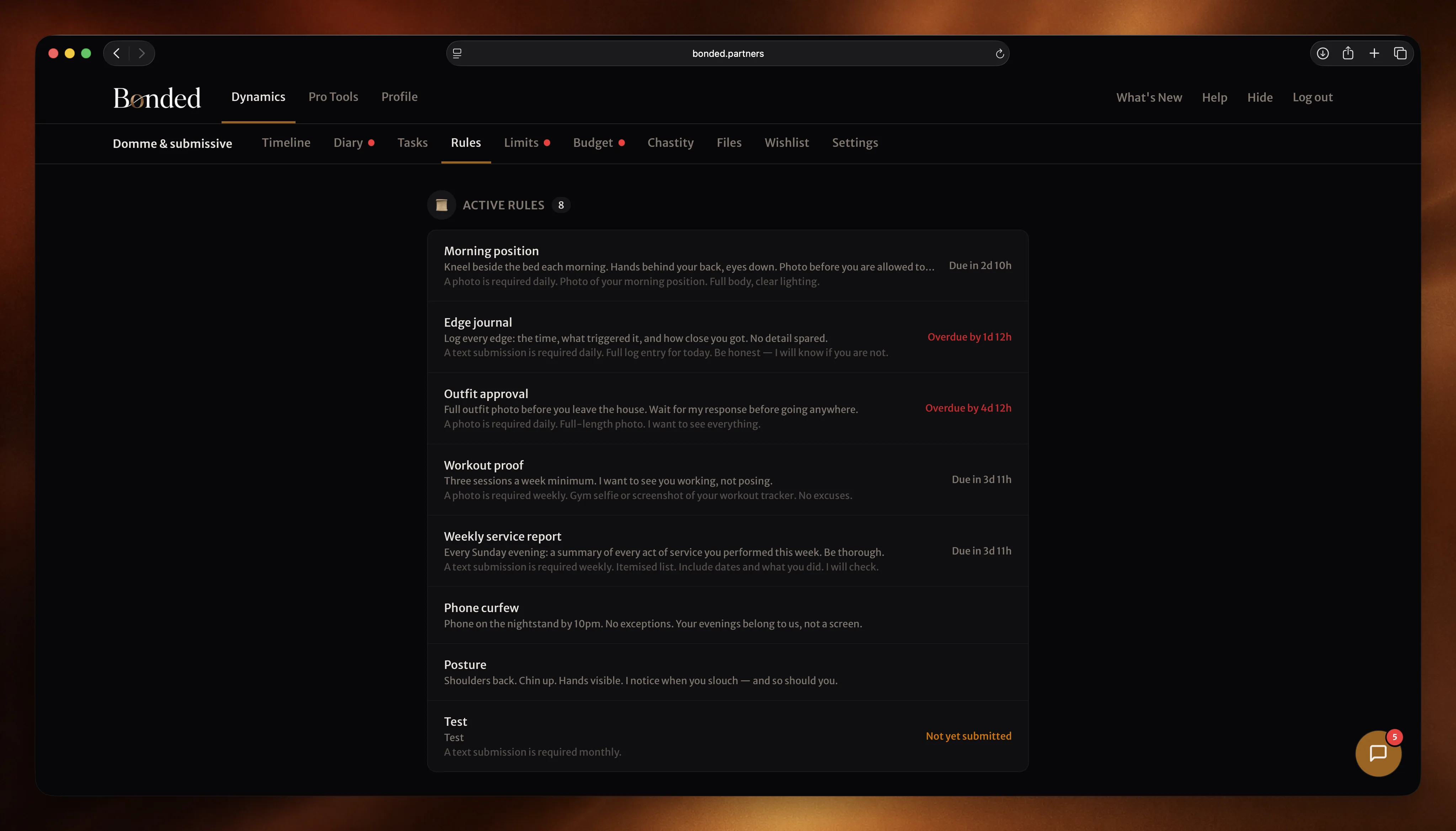
Step 3: Create Two or Three Rules
Not twelve. Two or three.
Pick the rules that are most central to your daily dynamic. The ones that create rhythm and connection. Set them up with:
- Clear compliance criteria
- A schedule (daily, weekly, etc.)
- Evidence requirements (if your dynamic uses evidence)
- Consequences (if applicable)
Push notifications will handle the reminding. This is probably the single biggest change from your spreadsheet experience. Your submissive will receive a prompt, and your Dom(me) will receive notification when evidence is submitted. The system maintains its own momentum.
Step 4: Start the Diary
The diary is the emotional centre of the platform. Where rules are about structure, the diary is about reflection. Encourage your submissive to write a first entry — it does not need to be long — about the transition itself. How does it feel to be moving to a new system? What are they hoping for?
The Dom(me) can respond. This early exchange sets the tone for how the diary will function: not as a compliance log, but as a shared reflective space.
Step 5: Upload Your Contract (If Applicable)
If you have a written contract or agreement, upload it to Files. Both partners can now access it from the same place, annotate it, and reference it during negotiations. No more hunting through email.
The Two-Week Transition Plan
Do not shut down your spreadsheet on day one. Run both systems in parallel for two weeks, gradually shifting your activity to Bonded.
Week One: Parallel Running
Days 1-2: Set up Bonded (steps above). Both systems are active. Log compliance in both places if you want, or start logging in Bonded only while keeping the spreadsheet open for reference.
Days 3-4: Pay attention to the notification experience. Is the submissive receiving prompts? Is the Dom(me) receiving evidence alerts? Adjust notification timing if needed. This is usually the moment where the value of a purpose-built tool becomes tangible — the first time a phone buzzes with "Daily reflection due" and the submissive realises they do not have to remember on their own anymore.
Days 5-7: Add any remaining active rules (if you started with two or three, you might add one or two more now). Continue the diary. Check in with each other about how the new system feels compared to the spreadsheet.
Week Two: Migration Completion
Days 8-10: Stop updating the spreadsheet. All activity now happens in Bonded. The spreadsheet remains accessible for reference but is no longer the active system.
Days 11-12: Review the first week of data in Bonded. Look at the activity timeline. Look at compliance patterns. Look at diary entries. Discuss what is working and what needs adjustment.
Days 13-14: Archive your spreadsheet. Do not delete it — it is part of your history. Move it to a folder, mark it as archived, and let it rest. It served you well.
By the end of week two, your dynamic should be running entirely in Bonded. If something is not working, adjust. The transition plan is a guide, not a mandate. Some couples finish in four days. Some take three weeks. The pace matters less than the thoroughness.
The Emotional Side
Changing tools can feel like more than a logistical shift. Your spreadsheet was not just a tracking system — it was a record of your dynamic. Every checkmark was a day of commitment. Every entry was a moment of vulnerability. Moving away from it can trigger a surprising sense of loss.
Name that feeling if it comes up. "I am sad to leave our spreadsheet" is a legitimate thing to say to your partner. It is not silly. It is a sign that your dynamic matters to you, that the structure you built together had meaning, and that you are taking the transition seriously.
The antidote is framing. This is not starting over. This is upgrading the infrastructure that supports the same dynamic, the same rules, the same commitment. Your first diary entry in Bonded does not erase the entries you wrote in a spreadsheet tab. It continues them.
Some couples mark the transition explicitly. A brief ceremony — nothing elaborate, just a moment of acknowledgement. "We built something in our spreadsheet. We are carrying it forward." If that resonates with your dynamic, do it. If it sounds like too much, skip it. There is no wrong way to handle the feelings, only wrong ways to ignore them.
Migration Checklist
Use this to make sure you have not missed anything.
- [ ] Had the conversation with your partner about why you are switching
- [ ] Identified your active rules (the ones actually being followed)
- [ ] Reviewed your current limits list
- [ ] Located your contract or written agreements (if applicable)
- [ ] Created your dynamic in Bonded
- [ ] Invited your partner
- [ ] Set up limits collaboratively
- [ ] Created 2-3 core rules with evidence and schedule
- [ ] Enabled push notifications for both partners
- [ ] Written a first diary entry
- [ ] Uploaded contract/agreements to Files
- [ ] Run both systems in parallel for Week 1
- [ ] Transitioned fully to Bonded in Week 2
- [ ] Archived (not deleted) your spreadsheet
- [ ] Had a check-in conversation about how the new system feels
What Comes Next
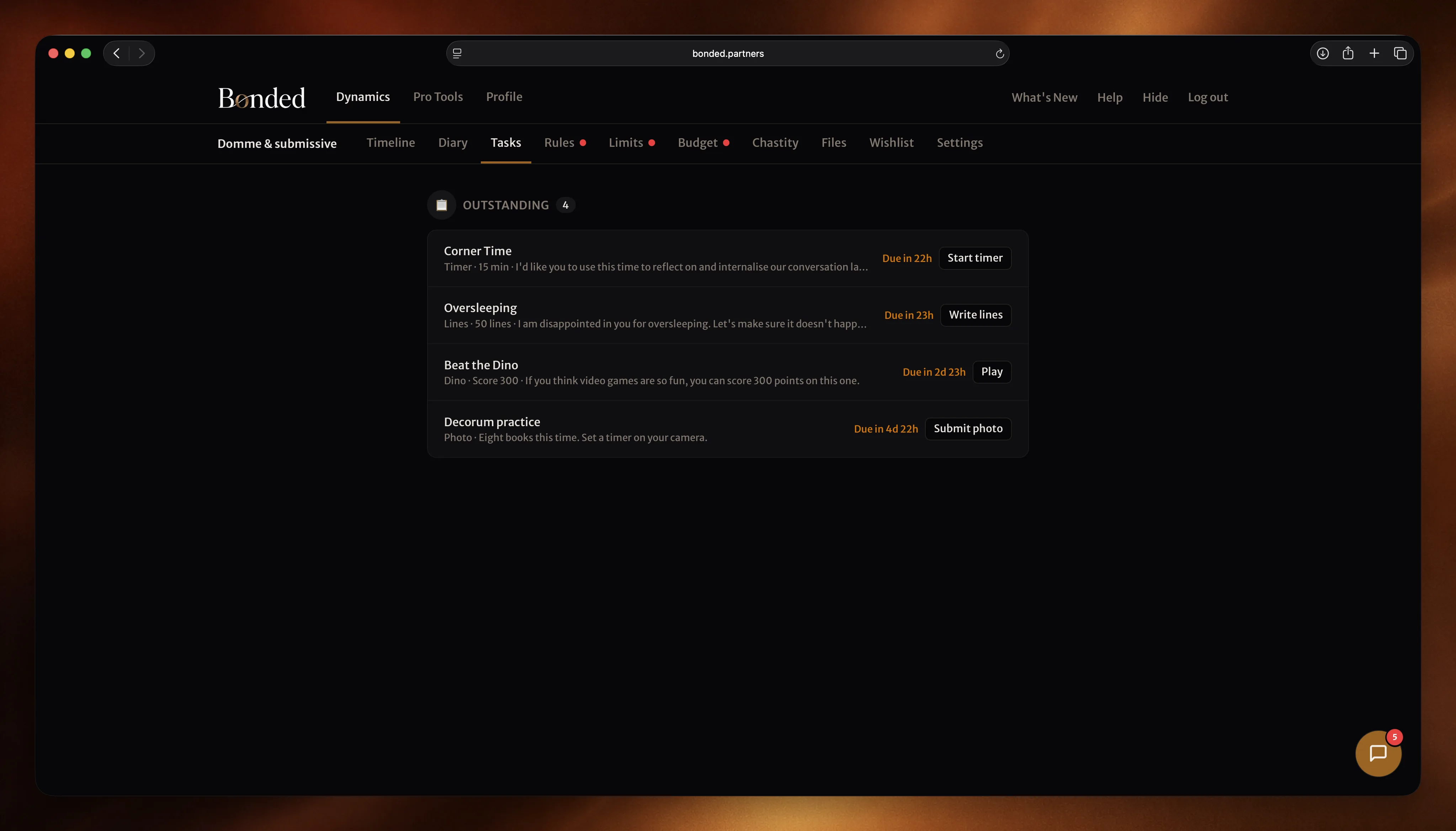
Once you are settled, explore at your own pace. Bonded has features you may not need immediately — chastity tracking, financial oversight, tasks — but they are there when your dynamic grows into them. There is no pressure to use everything.
The point of moving to a purpose-built tool was never to add complexity. It was to remove the friction that was standing between your intentions and your practice. If the tool is doing its job, you should be thinking less about the system and more about each other.
Your spreadsheet got you here. It gave your dynamic structure when nothing else would. Bonded's job is to carry that structure forward — with better notifications, stronger privacy, and a system that maintains itself so you can focus on what actually matters.
Go deeper
Read the full guide→