



Time Zones, Schedules, and Structure: Logistics of Long-Distance D/s
The practical logistics of long-distance D/s: scheduling across time zones, evidence submission windows, check-in templates, and maintaining connection when your clocks don't match.

The emotional side of long-distance D/s gets discussed plenty. The longing, the intensity, the particular quality of missing someone who holds your leash from another city. What gets discussed less is the part that actually makes or breaks these dynamics: logistics.
Scheduling. Time zones. Deadlines. Evidence windows. The unglamorous infrastructure that determines whether your dynamic runs smoothly or collapses under the weight of missed check-ins and "sorry, I fell asleep."
This is the practical guide. Not the feelings guide. The one about making the moving parts actually move.
The Time Zone Problem
Time zones don't just shift your clocks. They shift your rhythms. Your morning is their afternoon. Your wind-down is their deep sleep. Your "goodnight, I love you" arrives while they're eating lunch.
This isn't just inconvenient. It directly affects how you structure a dynamic, because most D/s structure relies on shared daily rhythms: morning check-ins, evening reports, bedtime rituals. When "morning" means two different things, those structures need redesigning.
The first step is accepting that you will not mirror an in-person schedule. Stop trying. Instead, build a schedule around overlapping windows and asynchronous touchpoints.
Mapping Your Overlap
Before you design any structure, map your actual available overlap. Not theoretical overlap -- actual. Account for work, sleep, commute, exercise, social obligations. Be honest.
Draw two timelines side by side. Mark sleep, work, and committed time. What's left is your overlap. For most long-distance pairs, the real overlap is smaller than they think.
This overlap is precious. Protect it. Use it for the things that require real-time interaction: voice or video calls, real-time scenes, live tasks, negotiation, and difficult conversations. Everything else should be designed to work asynchronously.
Templates by Time Gap
Different time differences create fundamentally different logistical challenges. Here's how to approach each.
1-2 Hour Difference
This is the gentlest gap. Your days are nearly aligned. The main challenge is edge cases: one person's deadline is the other person's just-past-deadline.
Structure approach:
- Morning and evening rituals can work in near-real-time. One person's 7am is the other's 8am or 6am -- close enough for shared routine.
- Set all deadlines in one agreed time zone. Pick whichever feels more natural, or pick the submissive's local time since they're the one meeting deadlines.
- Real-time check-ins are easy to schedule. You share most waking hours.
- Evidence submission windows can be tight -- "by 9pm your time" works because the Dom(me) will still be awake to review.
Watch for: Complacency. The gap is small enough to ignore, which means you might not build the asynchronous habits you'll need if circumstances change. Build them anyway.
3-5 Hour Difference
Now you feel it. One person's morning routine happens while the other is in deep work or commuting. Evenings diverge significantly -- one is winding down while the other has hours left.
Structure approach:
- Mornings become asynchronous. The submissive's morning check-in might be reviewed during the Dom(me)'s lunch, or vice versa. That's fine. Design for it.
- Identify your overlap window explicitly. You likely have four to six shared waking hours. Block at least one for real-time connection.
- Evidence deadlines should account for review timing. "Submit by your 8pm" means the Dom(me) reviews at their 11pm or 3pm -- make sure that works.
- Consider splitting rituals: morning ritual is asynchronous (submitted and reviewed on delay), evening ritual is real-time during overlap.
Watch for: The temptation to stay up late or wake up early to maximise overlap. It works short-term. It causes burnout and resentment long-term. Design your structure for sustainable hours, not heroic ones.
6-8 Hour Difference
This is where logistics become a real discipline. You share perhaps three to four waking hours, and they might not be convenient ones.
Structure approach:
- Accept that most interaction will be asynchronous. This is not a limitation -- it's a design parameter. Lean into it.
- The diary becomes your primary emotional channel. Real-time connection can't carry the weight; the diary can.
- Designate one daily real-time touchpoint. Even fifteen minutes. Protect it like you'd protect a therapy appointment.
- Evidence windows need to be generous. "Submit by end of your day" reviewed "at start of my day" is a natural rhythm. The delay between submission and review is not a flaw -- it's built-in anticipation.
- Weekend overlap is usually larger. Use it. Schedule your longer calls, your scenes, your planning sessions for weekends when the overlap expands.
- Push notifications become critical infrastructure. When your submissive submits evidence at their 10pm, you see the notification at your 6am and review it before your day starts. The system bridges the gap that sleep creates.
Watch for: Feeling disconnected during your non-overlap hours. This is where persistent structure -- active rules, a running chastity timer, an unread diary entry waiting -- keeps the dynamic present even when the other person is asleep.
9-12+ Hour Difference
Nearly inverted days. Your morning is their evening. Your productive hours are their sleeping hours. This is the hardest gap, and it requires the most deliberate design.
Structure approach:
- You likely share one to two waking hours, possibly during one person's early morning and the other's late evening. Find those hours. They are your golden windows.
- Build your structure around a 24-hour cycle rather than a shared day. The submissive completes tasks and submits evidence during their day. The Dom(me) reviews, responds, and sets the next day's structure during theirs. The dynamic passes back and forth like a conversation with built-in reflection time.
- Consider the "relay" model: the Dom(me) sends instructions before they sleep. The submissive wakes to them, completes them during their day, and submits before they sleep. The Dom(me) wakes to the submissions and the cycle continues. This is not slow -- it's rhythmic.
- Diary entries become the most detailed they'll ever be, because they're carrying the full weight of daily emotional connection.
- Real-time interaction is rare and therefore precious. When you have it, be fully present. Don't waste overlap windows on logistics -- do logistics asynchronously and use real-time for connection.
- Scheduled calls may need to rotate who takes the inconvenient time slot. Don't let one person always be the one staying up late. Equity in sacrifice matters.
Watch for: Drifting. When real-time interaction is scarce, the dynamic can start to feel abstract. Counter this with concrete structure: rules with evidence, tasks with deadlines, diary with responses. The structure is the dynamic. It doesn't need real-time conversation to be real.
Evidence Submission Windows
One of the most common friction points in long-distance D/s is evidence timing. The submissive submits at their local evening. The Dom(me) doesn't see it for hours. By the time feedback arrives, the submissive has moved on emotionally. The feedback feels late, disconnected.
Design around this by setting expectations explicitly:
Submission deadlines should be in the submissive's local time. They're the ones doing the work; their schedule should determine when it's due.
Review windows should be in the Dom(me)'s local time. "I review evidence within two hours of waking" or "I review evidence during my lunch break" sets a clear expectation. The submissive knows when to expect feedback. The Dom(me) isn't scrambling to check at odd hours.
Acknowledged delay removes anxiety. If both parties know that evidence submitted at the submissive's 10pm will be reviewed at the Dom(me)'s 8am, the ten-hour gap isn't stressful. It's expected. It's the system working as designed.
Some dynamics benefit from a quick acknowledgement -- a brief "received" when the evidence appears -- followed by detailed feedback later. This gives the submissive closure at their end of the day while preserving the Dom(me)'s ability to respond thoughtfully at their own pace.
Scheduling Check-Ins
Regular check-ins are the health monitoring system of any dynamic, and in long-distance D/s they're essential. But scheduling them across time zones takes more thought than "every Sunday at 3pm."
The Weekly Anchor
Every long-distance dynamic needs at least one substantial real-time conversation per week. This is where you discuss how the dynamic is working, adjust rules, address concerns, and reconnect emotionally in real time. Think of it as your dynamic's heartbeat.
To schedule it:
- Find a time that's reasonable for both parties. Mild inconvenience is acceptable; exhaustion is not.
- Rotate the inconvenience if the gap is large. Week one at a time that favours you; week two at a time that favours them.
- Protect this time. Treat it as non-negotiable. The dynamic depends on it.
- Have a loose structure. Don't wing it. Cover: what worked, what didn't, what needs adjusting, how you're both feeling, what's coming next week.
Daily Touchpoints
These don't need to be calls. In fact, for most time zone gaps, they shouldn't be.
Daily touchpoints work best as structured asynchronous exchanges:
- A morning check-in message (when you wake up, regardless of what time it is for them)
- An evening report or diary entry
- Evidence submissions per your rule schedule
- A "goodnight" or end-of-day message
The key is consistency, not synchronicity. The submissive sends their morning check-in at their 7am. The Dom(me) reads it at their 7am. Twelve hours apart, but the rhythm is there. Both start their day in the dynamic.
The "Goodnight" Problem
In almost every time-zone-separated dynamic, there's a moment that highlights the gap: saying goodnight when the other person is in the middle of their day.
Some dynamics lean into this. The submissive sends a "goodnight" message that includes a summary of their day, their evidence, their diary reflection. The Dom(me) receives it during their afternoon and responds with instructions for tomorrow. The "goodnight" becomes a handoff, not an ending.
Others use it as a point of tenderness. The Dom(me) sends a "goodnight, you did well today" message timed to arrive just before the submissive sleeps, even if the Dom(me) composed it hours earlier. Scheduled messages can carry this weight effectively.
The wrong approach is pretending the gap doesn't exist. "I'll just stay up until you go to bed" is not sustainable and both of you know it.
Schedule Shifts and Disruptions
Travel, daylight saving changes, shift work, holidays, illness. Real life doesn't respect your carefully designed D/s schedule. Planning for disruptions is as important as planning the routine.
Travel
When one or both of you travel, the time zone gap might shrink, grow, or invert entirely. Prepare for this:
- Discuss schedule adjustments before the trip, not during
- Temporarily simplify rules if the travelling person will have limited privacy or time
- Identify what's non-negotiable (daily check-in, diary) and what can flex (specific task types, evidence formats)
- If travel brings you to the same city, plan for the transition from digital to physical dynamic -- it's more jarring than people expect
Daylight Saving
Twice a year, one or both of your clocks shift. This can change a manageable overlap into a difficult one, or vice versa. Check your upcoming DST transitions and adjust your schedule proactively.
Note: not all countries shift on the same dates. For several weeks per year, your gap may be an hour more or less than usual. Track this.
Work Schedule Changes
Shift changes, new jobs, busy seasons. When someone's work schedule shifts, the entire dynamic schedule may need rebuilding. Treat this as a planned renegotiation, not a crisis. Pull out the overlap map. Redraw it. Redesign.
Illness and Low Periods
Sometimes someone is just not okay. Illness, mental health episodes, family emergencies. Your structure should have a built-in "reduced operations" mode:
- Core connection maintained (one check-in per day, even if it's just "I'm here, I'm struggling")
- Rules reduced to essentials or paused entirely
- Explicit communication about when full structure will resume
- No guilt. This is care, not failure.
The Emotional Reality
A logistics guide wouldn't be honest if it didn't address the emotional cost of time zone separation. The cost is real.
There will be moments when you want to share something immediately and they're asleep. Moments when you need reassurance and it won't come for hours. Moments when the structure feels like a poor substitute for arms around you.
Those moments are hard. They don't mean the dynamic isn't working. They mean you're human and you miss someone.
What helps:
- Acknowledge the difficulty honestly. Don't perform being fine with distance. Put it in the diary. Say it in chat.
- Identify your hardest times and build small comforts around them. If their morning (your night) is when you feel it most, have a ritual for that time. Re-read a diary entry. Review a piece of evidence that makes you smile.
- Remember what you have. The structure you've built, the evidence of your dynamic's reality, the accumulated diary entries and completed tasks on your timeline -- that's not nothing. That's a relationship, lived deliberately.
- Plan visits. Having the next in-person time on the calendar makes distance feel finite. Even if it's months away, it's there.
Building Your Schedule: A Step-by-Step Approach
If you're starting from scratch or rebuilding after a schedule change, here's the process:
- Map overlap honestly. Both of you independently mark your unavailable times, then compare. Don't optimise yet -- just see the truth.
- Identify your golden windows. The times you're both free and reasonably alert. These are for real-time connection. You may only have one or two per day.
- Set your weekly anchor. One substantial real-time check-in per week. Non-negotiable.
- Design daily touchpoints. Morning check-in, evening report, evidence windows. All with explicit expectations about submission timing and review timing.
- Choose your deadline timezone. One timezone for all deadlines eliminates confusion. The submissive's local time is usually best.
- Set rule frequencies that match your rhythm. Daily rules need daily evidence windows. Weekly rules need weekly deadlines. Match the frequency to what your schedule can support.
- Build in flexibility. Not every day will go perfectly. Define what "minimum viable structure" looks like so that a disrupted day doesn't feel like a failed day.
- Review and adjust monthly. Your schedule is not permanent. It's a living document. Review it during your weekly check-ins and do a deeper review monthly.
Tools That Bridge the Gap
Notifications are the connective tissue of long-distance D/s logistics. When evidence is submitted, when a deadline approaches, when a diary entry is waiting for review -- these pings are the system telling you the dynamic is alive.
Configure them deliberately. Not so many that they become noise. Not so few that you miss important moments. Find the settings that keep both of you connected without creating alert fatigue.
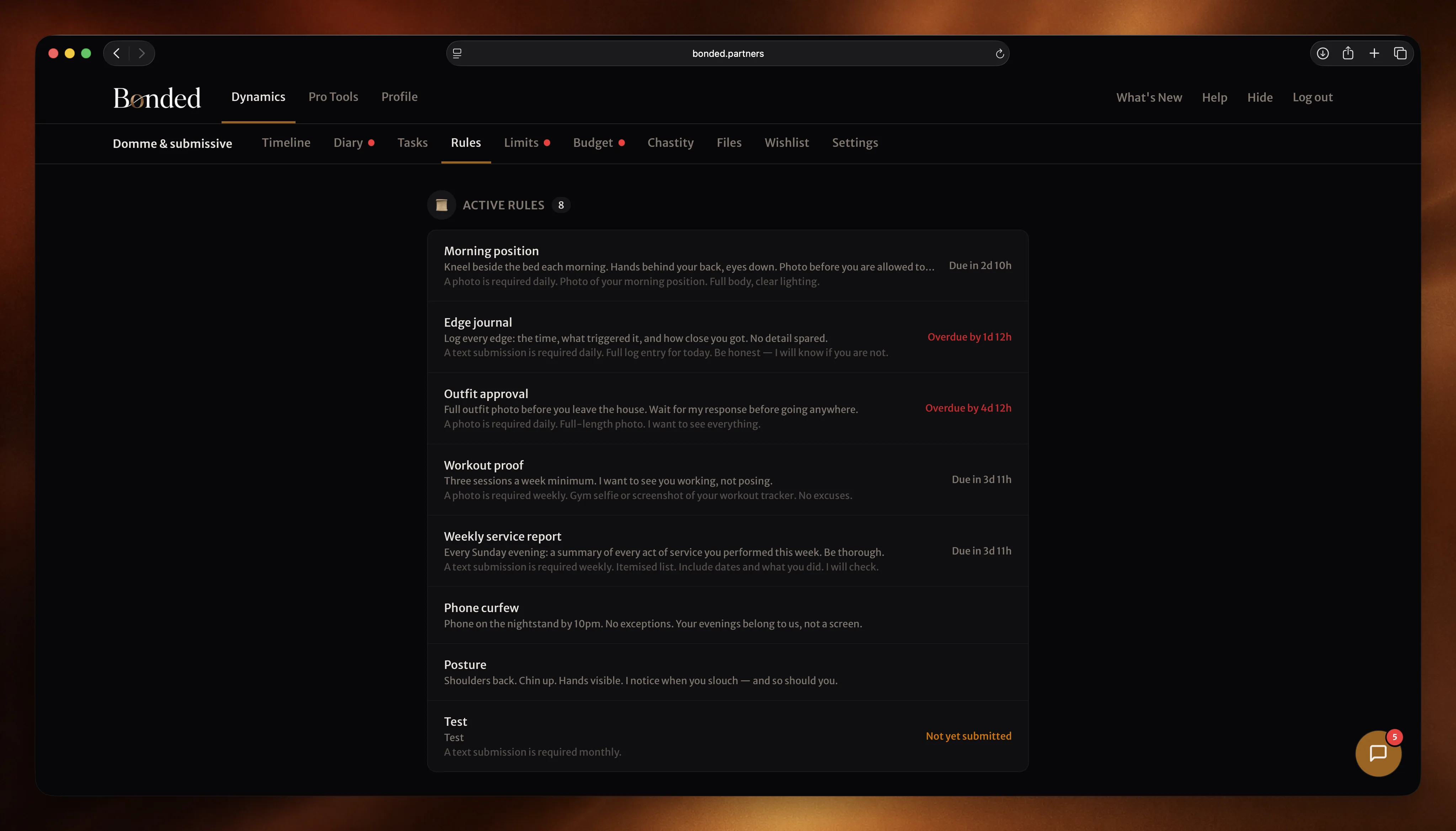
Rules with built-in frequencies handle the scheduling automatically. Set a rule as daily, and the system knows when compliance is due. That's one less thing to track manually, which matters when your brain is already juggling time zone arithmetic.
Date-based diary entries create a clear record that transcends timezone confusion. The entry is anchored to a date, not a time. Whether the submissive writes it at their 11pm and the Dom(me) reads it at their 7am, it's Tuesday's entry. Clean. Unambiguous.
What This Actually Looks Like
Here's a concrete example. A couple separated by eight hours -- the submissive in London, the Dom(me) in California.
Submissive's day (GMT):
- 7:00 -- Morning check-in sent via chat. Reviews any overnight messages from Dom(me).
- 7:30 -- Completes morning task (outfit check, photo submitted).
- Throughout day -- Follows standing rules, notes anything for diary.
- 18:00 -- Overlap begins. Brief real-time exchange if possible.
- 21:00 -- Diary entry written and submitted. Evidence for any remaining daily rules submitted.
- 22:00 -- Goodnight message. Includes anything not covered in diary.
Dom(me)'s day (PST, GMT-8):
- 7:00 (15:00 GMT) -- Wakes. Reviews overnight evidence submissions and diary entry. Sends responses.
- 8:00 -- Sets any tasks for the submissive's next day.
- 10:00 (18:00 GMT) -- Overlap window. Real-time check-in with submissive.
- Throughout day -- Reviews any additional submissions, sends messages the submissive will wake to.
- 22:00 -- Sends "goodnight" message timed for submissive's morning, along with tomorrow's instructions.
The dynamic never stops. It just moves at the speed the distance allows, and the structure ensures nothing falls through the gaps.
The Bottom Line
Long-distance D/s logistics aren't romantic. They're spreadsheets and timezone converters and "which clock are we using for this deadline." They're the least exciting part of a long-distance dynamic and the most important.
Get the logistics right and the emotional connection has a structure to live in. Get them wrong and even the strongest connection will struggle against missed deadlines, confused schedules, and the slow erosion of "I thought you'd be awake."
Design deliberately. Communicate clearly. Adjust regularly. The distance is just geography. The logistics are how you build a bridge across it.
For more on building long-distance dynamics that last, see our complete guide to long-distance D/s.
Go deeper
Read the full guide→