




Long-Distance D/s: How Technology Actually Makes It Work
Long-distance D/s isn't about coping with distance -- it's about using structure and technology to build a dynamic that works. Rules with evidence, shared timers, diaries, tasks, and more.

There's a persistent myth that D/s only works in person. That without proximity -- without being in the same room, the same bed, the same time zone -- power exchange dissolves into something thin. Play-pretend. A holding pattern until you can be together again.
It's wrong.
Long-distance D/s dynamics are not lesser dynamics. They're differently structured ones. And when you build that structure deliberately, using the tools available to you, they can carry as much weight, as much intimacy, and as much genuine power exchange as any in-person arrangement.
The difference isn't distance. It's intention.
The Shift in Thinking
The first thing to let go of is the framing of long-distance as a problem to solve. It's a constraint to design around, and constraints often produce better design.
In-person dynamics have a luxury that can become a crutch: ambient presence. You can feel the dynamic because the other person is right there. Their posture, their expression, the way they hand you your coffee. The dynamic breathes through proximity.
Remove proximity and you're forced to make the dynamic explicit. Every act of obedience has to be communicated. Every act of authority has to be expressed. Nothing is ambient. Everything is intentional.
That intentionality is where long-distance D/s gets its strength. Nothing is assumed. Everything is built.
Rules With Evidence: The Backbone of Remote Structure
Rules matter more at distance, not less. In person, a Dom(me) can observe compliance directly. At distance, rules need a reporting mechanism baked into their design.
This is where evidence changes everything.
A rule like "exercise for thirty minutes every day" is unverifiable at distance. A rule like "exercise for thirty minutes every day and submit a photo of your workout summary before 8pm" is a shared experience. The submissive does the work. The Dom(me) receives the proof. Both participate in the rule, even from different cities or continents.
Evidence types work differently depending on what the rule targets:
Photo evidence works for physical compliance. Outfit checks, meal logs, completed chores, workout summaries. The submissive captures a moment; the Dom(me) reviews it. That review is itself an act of dominance -- attention given, standards maintained.
Text evidence works for internal states. A reflection on how the day went. A gratitude entry. An acknowledgement of a rule and what it meant to follow it today. Text evidence creates introspection, which deepens the submissive's relationship to the structure.
Video evidence works for anything that needs context beyond a single frame. A morning routine. A workout. Reciting something aloud. Video creates a sense of presence that photos can't match — the Dom(me) sees and hears their submissive, not just a snapshot. At distance, that matters.
The evidence cycle -- submit, review, respond -- becomes the pulse of a remote dynamic. It's not surveillance. It's attention. And attention, more than anything else, is what makes a submissive feel held.
When rules live in a shared system rather than scattered across texts and voice notes, both parties can see the full picture. Rules are listed, evidence is tracked, compliance is visible. No "I thought you meant..." or "Wait, was that still active?" The structure holds itself together.
Diary: Ongoing Intimacy Across Distance
The diary is perhaps the single most powerful tool for long-distance D/s, and the most underrated.
At distance, you miss the small things. The shift in someone's mood after a hard day. The quiet pride after they did something difficult. The vulnerability they'd show you on the sofa but can't quite put into a text message.
A diary captures those textures.
When a submissive writes a daily diary entry, they're doing more than reporting. They're processing. They're reflecting on their submission, their emotions, their relationship to the dynamic. And when the Dom(me) reads those entries, they're receiving a form of access that even in-person dynamics don't always achieve -- unfiltered internal life, written with care.
This works in both directions. A Dom(me) who responds to diary entries -- with commentary, with praise, with questions, with corrections -- creates an ongoing conversation that transcends the limitations of real-time communication. You don't need to be awake at the same time to maintain deep emotional connection. You need a channel that accommodates asynchronous depth.
The diary is that channel.
For long-distance dynamics specifically, diary entries become a way to:
- Process scenes or tasks after the fact, especially when you can't debrief in real time
- Track emotional patterns that neither person might notice in the moment
- Maintain vulnerability even during busy periods when calls are sparse
- Create a shared record of the dynamic's evolution over time
That last point matters more than it sounds. Long-distance dynamics can feel ephemeral. A shared diary record gives the dynamic weight and history. You can look back and see growth. You can see where things shifted. It's proof that what you're building is real.
Chat: Presence Without Proximity
Not all communication is created equal. The conversations you have inside your dynamic are different from the ones you have on regular messaging apps, and they deserve a different space.
In long-distance D/s, chat within the dynamic's context serves a specific purpose: it maintains the container. When a submissive messages their Dom(me) through a space that's explicitly part of the dynamic, the act of reaching out carries weight. It's not just "hey, how's your day." It's communication within a power exchange framework.
This distinction matters psychologically. A dedicated channel for dynamic communication helps both parties shift into the right headspace, even briefly, even during a workday. The context itself does work.
For long-distance pairs, chat becomes the primary real-time connection. It's where you check in. Where you give instructions. Where you receive them. Where you share the small moments that proximity would handle automatically.
Some practical applications:
- Morning and evening rituals conducted through chat when calls aren't possible
- Real-time task guidance where the Dom(me) directs and the submissive responds
- Quick check-ins that maintain the dynamic's presence without requiring a full conversation
- Aftercare at distance -- reassurance, connection, and grounding when you can't physically hold someone
The key is treating dynamic communication as something distinct from regular life. It's not another thread in your messaging app. It's the space where your dynamic lives.
Chastity: Shared Control Across Any Distance
Chastity is one of the areas where long-distance D/s has evolved most dramatically with technology. What used to require physical key exchange or complete trust-based honour systems now has a middle path: shared digital control.
A shared chastity timer creates a tangible, visible expression of power exchange that both parties experience simultaneously. The submissive sees the timer counting. The Dom(me) controls it. Distance doesn't diminish the dynamic -- the timer is just as real in another country as it would be in the next room.
Remote keyholding is the specific mechanism. The Dom(me) holds the digital key. The submissive can request release, and the Dom(me) decides. That decision point -- the request, the wait, the answer -- is where the power exchange lives. It doesn't require proximity. It requires a system that both parties trust.
What makes shared chastity timers effective for long-distance:
- Visibility: Both parties can see the current state at any time. The dynamic is always present.
- Control without presence: The Dom(me) doesn't need to be physically available to exercise authority. The timer enforces structure.
- Ritual around transitions: Locking and unlocking become events, not just mechanical actions. They can be accompanied by requirements -- diary entries, check-ins, requests made in specific language.
- Anticipation: Knowing the timer is running, knowing the Dom(me) set it, knowing only the Dom(me) can end it -- that awareness is itself a form of submission that distance doesn't dilute.
For long-distance dynamics, chastity tracking can serve as an always-on reminder of the dynamic's reality. It's structure that persists when attention drifts, when work gets busy, when the distance feels particularly heavy.
Tasks: Active Submission From Anywhere
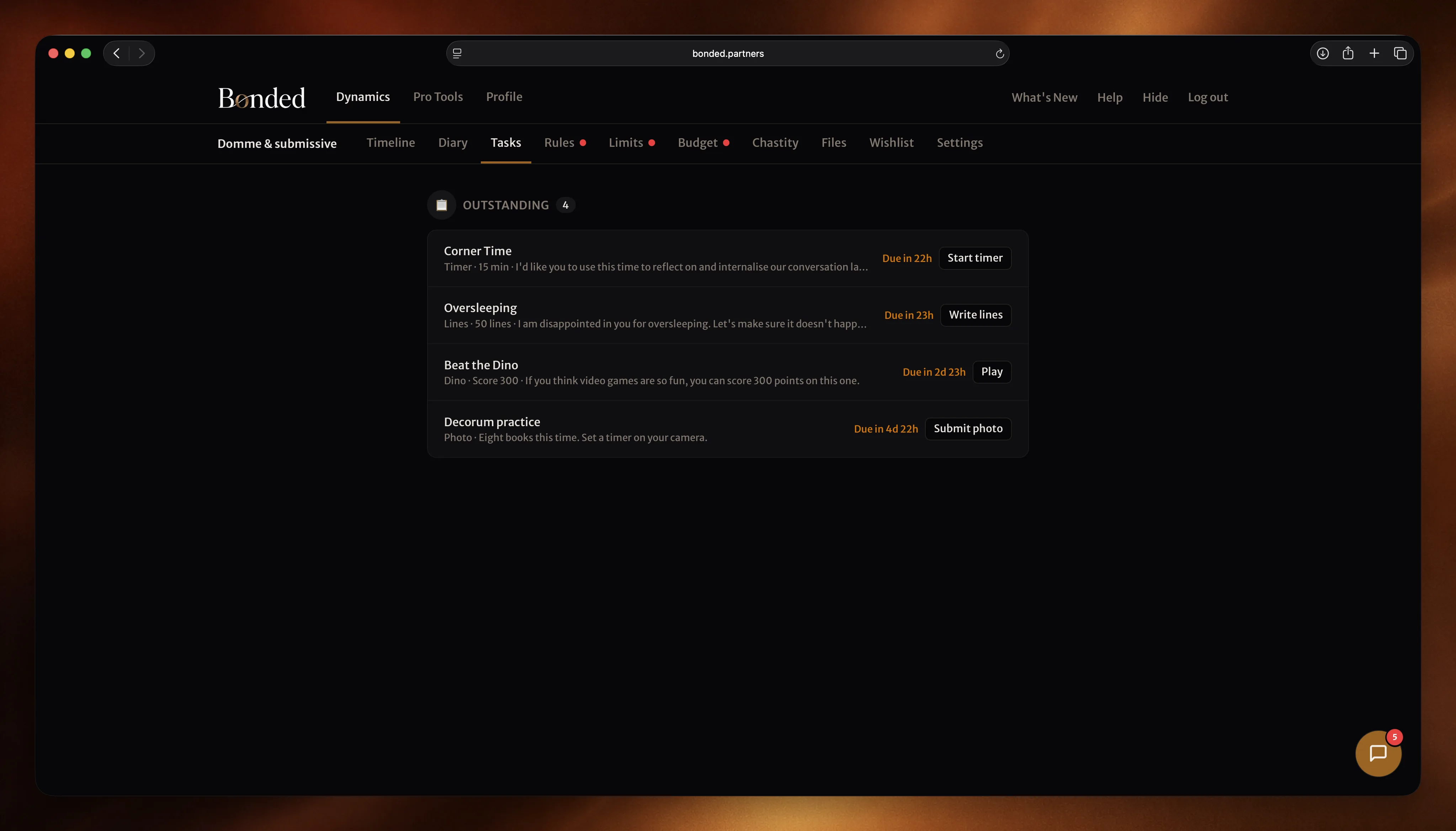
Tasks are how a Dom(me) reaches across distance and places their hand on the dynamic. Not metaphorically. A well-designed task creates a moment where the submissive is actively, physically, mentally engaging with their submission -- regardless of where they are.
Different task formats serve different purposes at distance:
Evidence tasks combine action with reporting. "Lay out tomorrow's outfit for my approval" or "Show me your workspace after you've tidied it" — submit a photo, video, or written response as proof. The Dom(me) reviews, responds, and directs. These create a feedback loop that works identically at any distance.
Lines tasks are meditative and corrective. The submissive types an assigned phrase character by character — no pasting, no shortcuts. Errors reset the line. The completion report shows exactly how long it took, how many errors occurred, and the words-per-minute pace. "I will ask before acting" written fifty times is not punishment — it's calibration. The Dom(me) sees the effort in the data, not just the outcome. Lines require nothing except the submissive and the task, which makes them perfect for distance.
Timer tasks create sustained presence. The Dom(me) assigns a duration — fifteen minutes of kneeling, thirty minutes of silent reflection, an hour of focused study. The submissive starts the countdown, and the app tracks whether they stay present. If they leave the screen, interruptions are logged. If they pause and resume, that's recorded too. The completion report tells the Dom(me) not just whether the time was served, but how it was served. At distance, timer tasks are remarkable — they create a window where the submissive is actively, verifiably in their submission, even from another continent.
The timeline becomes the record. Every completed task, every piece of evidence, every rule followed -- it accumulates into a visible history of the dynamic. At distance, this visibility is crucial. It answers the quiet doubt that can creep in: "Is this real? Are we really doing this?" The timeline says yes. Look at all of this.
Building the Full Picture
Each of these elements -- rules, diary, chat, chastity, tasks -- works on its own. But they work best together, layered into a coherent structure that makes the dynamic feel whole.
A typical day in a well-structured long-distance dynamic might look like this:
The submissive wakes up and sends a morning check-in through chat. They review their rules for the day. They complete a morning task -- perhaps lines, perhaps an outfit check with photo evidence. Throughout the day, the chastity timer runs, a quiet constant. In the evening, they write their diary entry. The Dom(me) reviews evidence submissions, responds to the diary, adjusts tomorrow's tasks based on what they've read.
Neither person was in the same room. Neither person needed to be. The dynamic happened. Structure made it happen. Technology made the structure frictionless.
This isn't coping with distance. This is a dynamic that works.
What Technology Changes (And What It Doesn't)
Technology doesn't create connection. People create connection. But technology removes friction. It takes the things that make long-distance D/s difficult -- tracking, communication, visibility, accountability -- and makes them easy enough that you can focus on the relationship instead of the logistics.
When rules live in a system that tracks compliance, the Dom(me) doesn't need to remember which rules are active. When evidence is submitted to a shared space, neither person loses track of it. When a chastity timer is visible to both parties, the submissive doesn't need to report manually. When tasks have deadlines and completion tracking, follow-through isn't a memory exercise.
What technology doesn't change: you still need to show up. You still need to communicate honestly. You still need to negotiate, check in, adjust, and care for each other. The tools carry the structure. The people carry the dynamic.
Making It Work: Practical Starting Points
If you're beginning a long-distance dynamic, or transitioning an existing dynamic to long-distance, start here:
Start with three rules that have clear evidence requirements. Not ten. Three. Make them daily. Make the evidence simple -- a text confirmation, a photo, a brief log. Build the habit of the evidence cycle before adding complexity.
Establish a diary rhythm. Daily is ideal, but every-other-day works. The point is regularity. The submissive writes. The Dom(me) reads and responds. This single practice will do more for your long-distance dynamic than any other.
Use chat deliberately. Don't let dynamic communication dissolve into your regular texting. Keep it in a space that carries the weight of the dynamic. When you message there, you're in the dynamic. That boundary matters.
If chastity is part of your dynamic, use shared tracking. The visibility alone changes the experience. Both of you seeing the same timer, both of you knowing who controls it -- that's power exchange made tangible.
Set tasks that match the distance. Not every task needs to be physical. Writing, reflection, research, self-care, skill-building -- these are all forms of service that work perfectly across any distance.
Review the timeline regularly. Together if possible, but individually too. See what you've built. Long-distance dynamics need that reinforcement because you don't get it from proximity.
The Real Advantage
Here's something that surprises people: many long-distance dynamics develop deeper communication than in-person ones. Not despite the distance, but because of it.
When you can't rely on physical presence to carry the dynamic, you're forced to articulate things that in-person couples often leave unspoken. The diary creates a level of introspection that casual conversation doesn't. The evidence cycle creates a pattern of attention that physical proximity can make lazy. The structure creates intentionality that ambient presence doesn't demand.
Distance doesn't weaken power exchange. Lack of structure weakens power exchange. Build the structure, use the tools, show up with intention -- and distance becomes what it actually is: just geography.
For a deeper dive into making long-distance dynamics work, see our complete guide to long-distance D/s.
Go deeper
Read the full guide→