



Chastity and Orgasm Denial: The Psychology of Anticipation
Explore the psychology behind orgasm denial in BDSM, from dopamine and anticipation to emotional intimacy and sustainable power exchange.

Ask someone new to chastity what the appeal is and they will usually say something about control, submission, or the eroticism of denial. Ask someone who has been practising for years and the answer shifts. It is rarely about the denial itself anymore. It is about what denial does to the space between two people.
Chastity and orgasm denial work because they exploit some of the deepest wiring in the human brain — the machinery of desire, anticipation, and reward. Understanding that machinery does not diminish the experience. If anything, it clarifies why chastity feels as intense as it does, and it helps you practise it in ways that deepen connection rather than erode it.
The Neuroscience of Wanting
To understand why denial works, you need to understand a distinction that neuroscience draws clearly but everyday language collapses: the difference between wanting and liking.
Wanting is the drive toward a reward. The pull, the craving, the motivation to pursue. It is mediated primarily by dopamine in the mesolimbic pathway — the brain's reward prediction and motivation system.
Liking is the pleasure experienced when the reward arrives. The satisfaction, the relief, the hedonic hit. It involves opioid and endocannabinoid systems, and it is neurologically distinct from wanting.
Here is the critical insight: dopamine, the wanting chemical, is not primarily released when you get the reward. It is released in anticipation of the reward. The brain generates the most dopamine when it predicts that a reward is coming but has not yet arrived. The moment of anticipation — not the moment of fulfilment — is the dopamine peak.
This is why a locked sub checking the countdown timer at the halfway mark feels more intensely aroused than they would five minutes before orgasm in an unlocked state. The sustained, structured anticipation of eventual release produces a dopamine environment that casual access to orgasm cannot replicate.
Wolfram Schultz's research on reward prediction is foundational here. His work showed that dopamine neurons fire most vigorously when a reward is expected but has not yet been delivered. When the reward arrives exactly as predicted, dopamine activity is modest. When the reward is withheld or delayed beyond expectation, dopamine signalling intensifies — the brain is recalculating, re-predicting, maintaining a heightened state of alert and motivation.
Chastity is, in neurochemical terms, a sustained reward prediction error. Your brain keeps expecting the reward. The reward keeps not arriving. And the dopamine keeps flowing.
Anticipation as the Primary Experience
Most discussions of orgasm denial frame it as a delay — you are postponing the orgasm to make it more intense when it eventually arrives. That framing is not wrong, but it misses the more interesting truth: for many people in chastity, the anticipation becomes the primary experience, not the release.
This is a psychological shift that can take a few sessions to recognise. At first, the locked sub is focused on the endpoint. When will I be unlocked? When will I come? The denial is an obstacle between them and the goal. But as they spend more time in denial — across sessions, across weeks, across a developing practice — many report that the anticipatory state itself becomes the thing they value.
The heightened sensitivity. The way every interaction with their Dom(me) carries extra charge. The vulnerability of sustained arousal with no outlet. The sharpened attention, the eagerness, the almost meditative quality of prolonged desire without fulfilment.
This is not masochism in the simple sense. It is not that they enjoy suffering. It is that they have discovered a state of consciousness that only sustained denial produces, and they have come to value it for its own sake.
Some researchers have drawn parallels to flow states — periods of deep absorption where self-consciousness recedes and the present moment fills the entire field of awareness. The sub in deep denial is not ruminating about the past or planning for the future. They are held in an eternal present of wanting, and paradoxically, that present is rich rather than empty.
The Power Dynamic Shift
Chastity changes the dynamics of power exchange in ways that go beyond the bedroom, and the psychology here is worth understanding clearly.
When one person controls another's access to orgasm, they acquire a form of leverage that is qualitatively different from other power exchange tools. A rule can be broken. A punishment can be endured. But the locked sub cannot circumvent the denial. They are physically prevented from self-regulating one of the most basic human drives.
This produces a psychological state that practitioners describe variously as deepened submission, vulnerability, surrender, or openness. What they are describing, in psychological terms, is a shift in the locus of control over a fundamental reward system. The sub has externalized the control of their own dopamine regulation to their Dom(me).
The implications ripple outward:
Increased attentiveness. A sub in denial is physiologically primed to attend to their Dom(me). The keyholder is literally the person who controls their access to reward, and the brain allocates attention to reward-relevant stimuli. This is not a metaphor — it is how the dopaminergic system works. The Dom(me) becomes the most salient thing in the sub's environment.
Heightened emotional responsiveness. Sustained arousal without release creates a state of emotional openness that many people find simultaneously vulnerable and connecting. Defences lower. Feelings surface more readily. Communication becomes more honest, sometimes uncomfortably so.
Behavioural shifts. Many Dom(me)s report that their locked sub becomes more eager to serve, more attentive to needs, more proactive in the dynamic. This is not simply obedience — it is the behavioural expression of a neurological state where the brain is oriented toward earning reward from the person who controls it.
None of this is automatic or universal. But it explains why so many couples describe chastity as the single practice that most transformed their power exchange.
Approaches to Orgasm Denial
Denial is not a monolith. How you structure it shapes the psychological experience for both partners.
Timed Denial
The simplest structure: the sub is locked for a predetermined period. One week, two weeks, a month. Both partners know the timeline.
Psychologically, timed denial produces a predictable anticipation curve. The sub knows when release is coming, so the dopamine system can calibrate. The early days are about adjustment, the middle period about settling, and the final days about intensifying anticipation as the countdown narrows.
The advantage is predictability. Both partners know what they are working with. The sub can mentally pace themselves. The Dom(me) can plan.
The risk is that predictability can become routine. If every session is exactly two weeks, the anticipation curve flattens over time as the brain learns the pattern perfectly.
Bonded's live countdown timer works naturally with timed denial. The sub can see exactly where they are in the session, and the keyholder can set a custom message that recontextualises the wait — a reminder, a tease, a declaration of ownership.
Earned Release
Release is contingent on meeting conditions. Complete a certain number of tasks, maintain a certain standard of service, accumulate enough points or achievements. The sub does not know exactly when release will come — it depends on their own performance.
Psychologically, earned release adds a layer of agency to the denial. The sub is not passively waiting; they are actively working toward a goal. This engages the brain's goal-pursuit machinery on top of the anticipation — dopamine for wanting the reward plus dopamine for making progress toward it.
The advantage is that it integrates chastity deeply into the broader dynamic. Service, obedience, attentiveness — all of these become directly linked to the reward pathway.
The risk is that the Dom(me) must be consistent and fair. If the goalposts move unpredictably, the earned structure collapses into arbitrary denial, which is psychologically corrosive rather than connective.
Indeterminate Denial
The Dom(me) decides when release happens, without a set timeline or conditions. The sub simply does not know.
Psychologically, this is the most intense form of denial for many people. The brain cannot predict the reward, so the anticipation system stays perpetually activated. There is no countdown to fixate on, no tasks to complete — just the open-ended reality of being at someone else's mercy.
The advantage is that it produces the deepest psychological surrender. The sub has no control and no information. All they can do is wait and serve.
The risk is significant. Indeterminate denial requires enormous trust and a keyholder who is actively engaged. Without a timeline, it is easy for denial to slide from intentional into neglectful — the Dom(me) simply does not get around to planning the release because there is no deadline forcing them to. If the sub feels forgotten rather than deliberately kept, the dynamic is damaged.
Edging and Ruined Orgasms
These are not strictly denial — they involve stimulation, sometimes intense stimulation — but they function within the denial framework.
Edging — bringing the sub to the brink of orgasm and stopping — exploits the anticipation system at maximum intensity. The dopamine peak of almost-reward is staggering. It also reinforces the Dom(me)'s control in visceral, immediate terms: you were about to come, and I stopped it.
Ruined orgasms — allowing the physical release but removing stimulation so the orgasm is unsatisfying — create a paradoxical reward state. The brain expected the full hedonic payoff. It got a fraction. The wanting does not resolve the way it would with a full orgasm, leaving the sub in a frustrated middle state that many find deeply submissive.
Both techniques are powerful, and both require a keyholder who can read their sub's physical responses accurately. Getting the timing wrong with edging can mean an unintended orgasm. Ruined orgasms can produce strong emotional reactions — frustration, tears, anger, deeper submission — that the Dom(me) needs to be prepared to hold space for.
The Dark Side: When Denial Becomes Harm
This is the section that too many guides on orgasm denial skip. Denial is psychologically powerful, and powerful tools can cause harm when misused or when the context changes.
Denial as Neglect
The most common failure mode. The Dom(me) locks the sub and then... disengages. Check-ins become sporadic. Teasing stops. The chastity drifts from active dynamic into background condition. The sub is not being denied as an act of dominance — they are being forgotten.
This is damaging in a specific way. The sub is in a heightened state of need with no attentive partner to channel that need. The dopamine system is activated, but the reward-relevant person — the keyholder — is absent. The result is not deepened submission. It is anxiety, resentment, and erosion of trust.
If you are a keyholder who has let things slide into neglect, the fix is honest. Acknowledge it. Re-engage. Or unlock your sub and acknowledge that you cannot give this the attention it requires right now.
Anxiety and Obsessive Thinking
Some submissives, particularly those with anxiety tendencies, find that sustained denial triggers obsessive thinking patterns. Instead of the productive anticipation that characterises healthy chastity practice, they experience intrusive, repetitive thoughts about the lock, the timeline, the uncertainty. It interferes with work, sleep, and mood in ways that go beyond the expected adjustment period.
This is not a character flaw. It is a neurological response pattern, and it means that the denial structure needs adjustment — shorter sessions, more predictable timelines, more frequent check-ins, or potentially that chastity is not the right practice for this person at this time.
Diary entries can be revelatory here. When a sub writes about their experience daily, patterns emerge that are invisible in the moment. "Day four was fine. Day five I could not stop thinking about the countdown. Day six I was distracted at work and snapped at a colleague." That is useful data for adjusting the practice.
When Denial Intersects With Shame
Some people carry shame about their sexuality, their desires, or their submission. Orgasm denial can interact with this shame in complex ways.
At its best, consensual denial within a caring dynamic can be reparative — the sub's desire is acknowledged, valued, and managed with intention by someone they trust. Their wanting is not shameful; it is beautiful and useful and controlled.
At its worst, denial can reinforce shame narratives. "I do not deserve to come. I am being punished for wanting. My desire is something to be suppressed." If the denial is being experienced through a shame lens rather than a power exchange lens, the keyholder needs to intervene — with words, with reassurance, with a reframing of what the denial means within the dynamic.
Knowing When to Stop
Sometimes the right thing to do is end a denial session before the planned date. This is not failure. Some indicators:
- The sub is consistently distressed rather than challenged
- The emotional tone has shifted from "this is hard but I am growing" to "this is damaging me"
- Physical issues are accumulating despite good hygiene practice
- The dynamic feels coercive rather than consensual — the sub is enduring rather than submitting
- The sub explicitly asks to stop, using their safe word or otherwise
A good Dom(me) holds the line when holding the line serves the dynamic. A good Dom(me) also reads when the line needs to move.
The Interplay of Denial and Intimacy
Here is what the neurochemistry does not fully capture: orgasm denial, when practised within a caring dynamic, creates a specific quality of intimacy that is difficult to replicate any other way.
The sub in denial is laid bare in a way that is hard to describe to someone who has not experienced it. They are perpetually wanting, and they cannot pretend otherwise. Defences that normally regulate how much vulnerability they show — the casual cool, the emotional armour, the self-sufficiency — become difficult to maintain when their body is in a constant state of need that only their Dom(me) can address.
And the Dom(me), if they are paying attention, gets to see their sub in this stripped-down state. Not performing submission. Not playing a role. Actually, genuinely open. It is a privilege, and treating it as one tends to produce the best outcomes for both partners.
The communication that chastity demands — the check-ins, the honesty about how it feels, the negotiation of timelines and conditions — also builds intimacy by building the habit of talking about difficult things. Couples who can navigate orgasm denial together can navigate most other difficult conversations, because they have already practised the core skills: honesty, vulnerability, attentiveness, and the willingness to adjust.
Structuring Denial in Your Dynamic
If you are considering incorporating orgasm denial — with or without a physical device — here are practical starting points.
Start with timed, bounded denial. A weekend. A week. Something with a clear endpoint that you both agree on before you begin. Build your skills and your sub's tolerance before moving to open-ended structures.
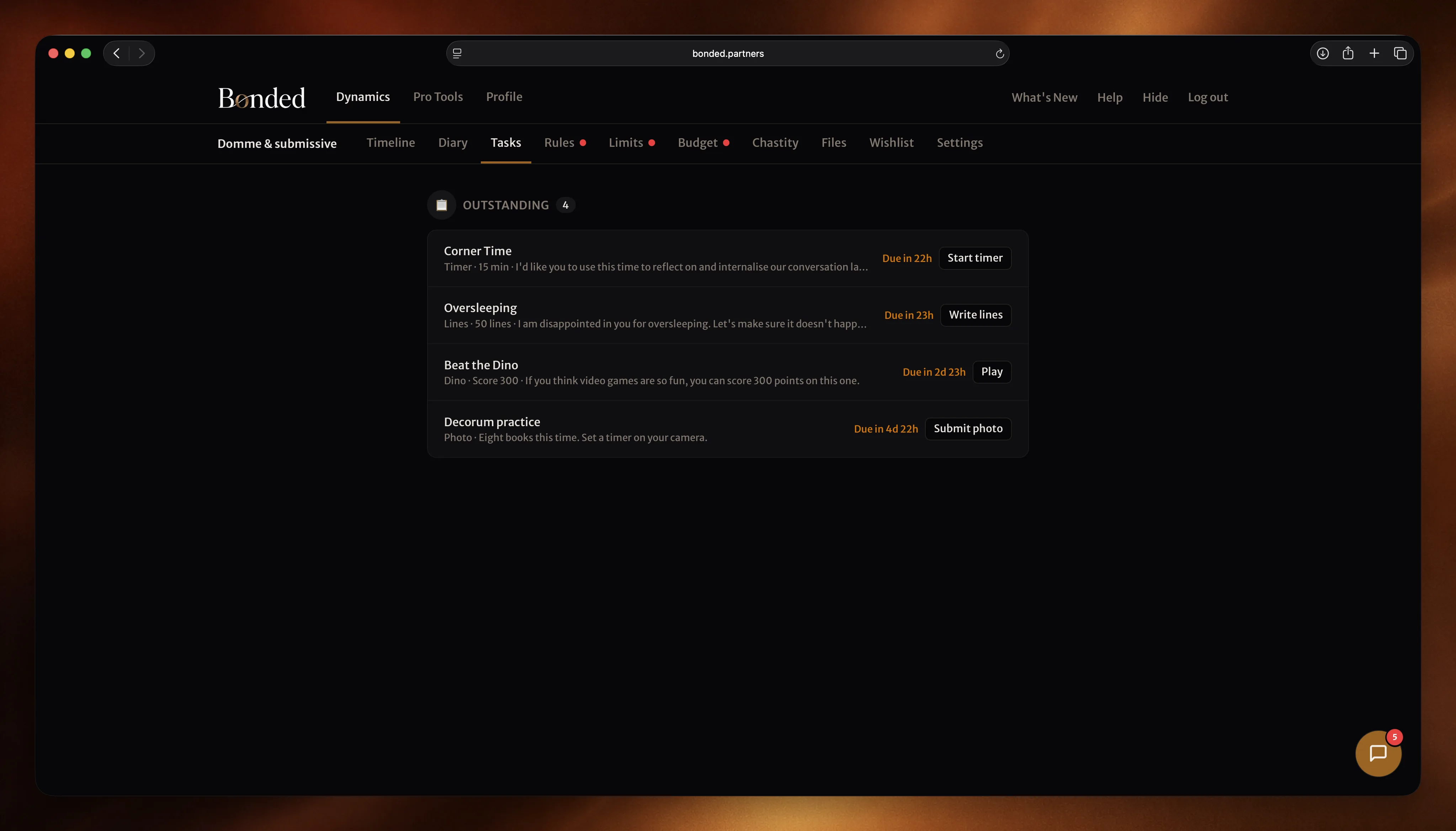
Use Rules to set expectations. Bonded's Rules feature lets you define specific expectations around orgasm control — no touching without permission, specific hygiene requirements, reporting requirements — with evidence and accountability built in.
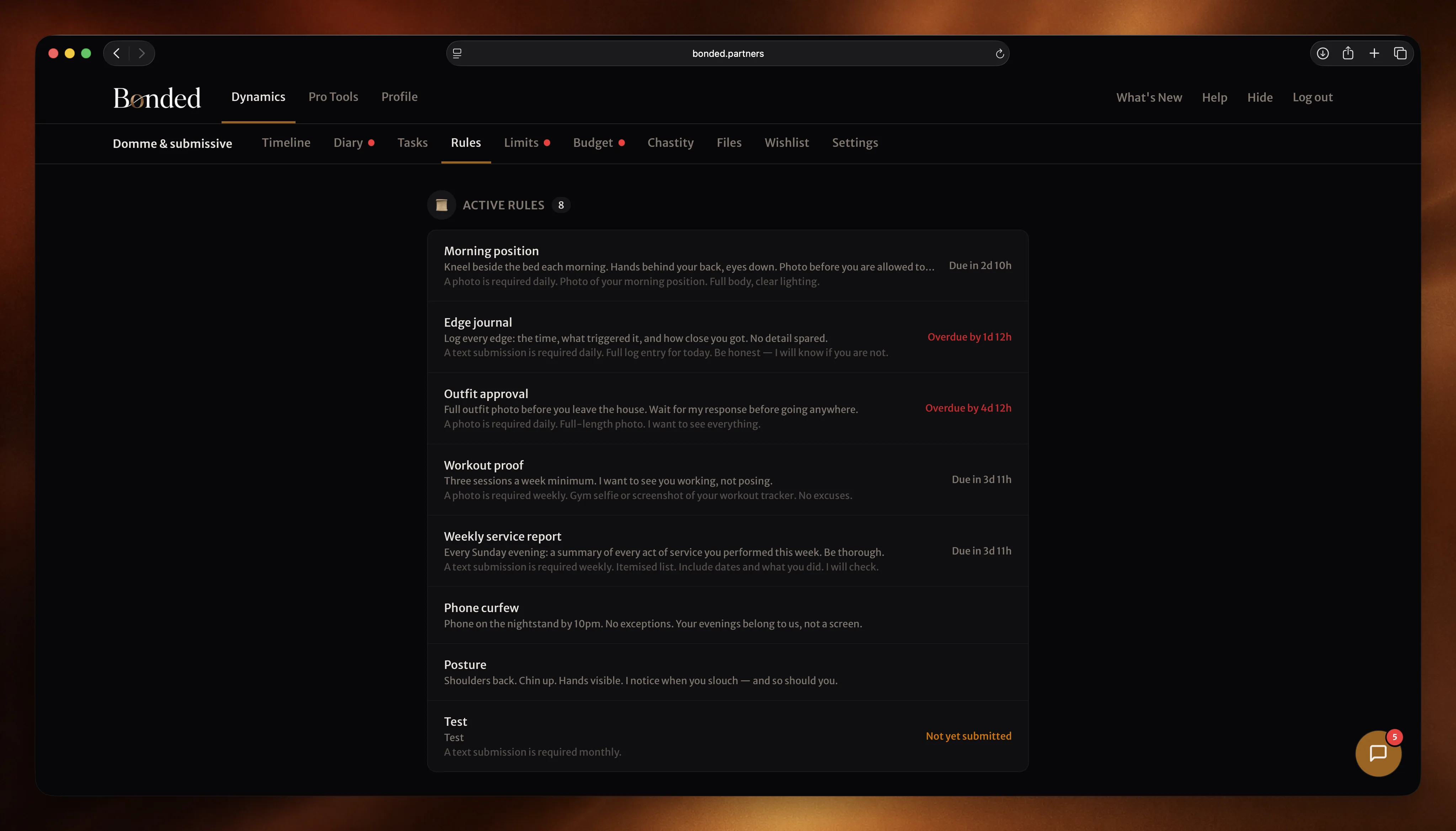
Track the experience. Session history and lifetime stats in Bonded's chastity tracking give you data. Not just how long the session was, but when during the session things felt best and worst, what the emotional arc looked like, how the dynamic shifted.
Process afterward. After each session, take time — hours or days, not minutes — to discuss what happened. What the sub felt. What the keyholder felt. What surprised both of you. The Diary gives each of you a private space to process before bringing your reflections to a shared conversation.
Iterate deliberately. Each session teaches you something. The second session should be informed by the first. The fifth by the fourth. Denial is a practice, and like any practice, it improves with reflection and adjustment.
Beyond the Lock
Not all orgasm denial requires a physical device. Some dynamics use honour-based denial — the sub is ordered not to touch or orgasm, and they obey because the Dom(me)'s word is the lock.
This is psychologically different from device-based denial. It places the locus of control inside the sub. They are choosing, moment by moment, to obey. Every time they could touch and do not, they are actively submitting. There is no cage to blame or rely on — just their own will in service of their Dom(me)'s command.
Honour-based denial can be more psychologically intense than device-based in some ways, and less in others. It requires enormous self-discipline and the kind of trust where disobedience is genuinely unthinkable, not just unwise.
Both approaches have their place. Many dynamics move between them — devices for some periods, honour for others — depending on circumstances, mood, and what the dynamic needs.
The Thing Nobody Tells You
Most writing about orgasm denial focuses on what the sub experiences. The heightened desire, the surrender, the psychological journey. And those are real and worth understanding.
But the thing nobody tells you is how much the Dom(me) changes too.
Holding someone in denial — being the person who determines when the wanting ends — changes how you think about power, responsibility, and care. The attentiveness it demands spills over. The communication skills it builds transfer. The intimacy it creates goes both directions.
The best keyholders will tell you that managing someone's denial taught them as much about themselves as it taught their sub about submission. That the key changes both hands it passes through.
That, more than the neurochemistry, more than the power dynamics, more than any technique, is why chastity and orgasm denial endure as practices. They change both people. And the change tends to be toward more honesty, more connection, and more intentional power exchange.
Which is, presumably, why you are here.
Go deeper
Read the full guide→