



Chastity in Female-Led Relationships
How chastity and orgasm control function within female-led relationships, covering FLR-specific negotiation, dynamics, and common misconceptions.

Female-led relationships and chastity have a long, intertwined history in power exchange communities. The combination feels intuitive — a relationship structured around female authority naturally gravitates toward controlling one of the most fundamental expressions of male desire. But the reality is more nuanced, more varied, and more interesting than the popular image suggests.
This is not the article that tells you FLR chastity is about a leather-clad Domme keeping her grovelling sub in a steel cage. If that is your dynamic, great — but FLR chastity encompasses everything from 24/7 device wear within an intensely structured household to a simple agreement that orgasm happens on her schedule, no device required. The common thread is female authority over sexual release, and how that authority interacts with the broader power structure of the relationship.
We are going to explore both perspectives — the Dom(me)'s and the sub's — because FLR chastity only works when both people are getting what they need from it.
Where Female Authority and Orgasm Control Intersect
In any FLR, the central premise is that the woman holds primary authority in the relationship. The scope varies enormously — some FLRs are limited to specific domestic domains, others encompass financial decisions, social life, and daily routines. But the common factor is that her authority is not roleplay. It is the actual operating structure of the relationship.
Chastity plugs into this structure in a specific way. When she controls his orgasm, she holds authority over one of the most visceral, primal drives in his body. This is not symbolic — it is literal. He cannot self-regulate this need. It exists, constantly, and she decides what happens with it.
The psychological effect is significant for both partners.
For the sub, chastity makes the power exchange physically inescapable. Other aspects of submission can be intellectualised, compartmentalised, or temporarily set aside. The locked device cannot. It is there when he wakes up, when he showers, when he goes to work, when he comes home. Her authority is written on his body at all times.
Many subs in FLR dynamics describe chastity as the thing that made the power exchange feel real in a way nothing else did. Tasks, protocols, domestic service — all of these express submission. Chastity embeds it.
For the Dom(me), chastity provides a uniquely tangible form of control. In an FLR where she makes decisions about finances, social calendar, household management, and domestic responsibilities, adding orgasm control puts authority over his inner life — his desire, his arousal, his physical release — explicitly in her hands.
Some women find this deeply satisfying. The knowledge that he is locked, that he is thinking about her because his body will not let him think about anything else, that his attentiveness and eagerness to serve are not performance but neurochemical reality — there is a quiet power in that.
Others find it more responsibility than they wanted. Both responses are valid, and we will get to the second one.
The FLR Chastity Dynamic: What It Actually Looks Like
Strip away the fantasy narratives and FLR chastity comes in roughly three patterns, each with its own character.
The Service-Oriented Model
Chastity functions as a supporting mechanism for domestic service. He is locked because denial sharpens his attentiveness and his desire to serve. The chastity is not the centre of the dynamic — the service is. The lock is a tool that makes the service better.
In this model, orgasm is typically tied to service performance. A week of exemplary service earns a release. Failing to meet standards extends the denial. The connection between behaviour and reward is explicit.
What this looks like in practice:
- Morning routines centred on her needs — coffee prepared, schedule reviewed, any domestic tasks completed before she wakes or while she gets ready
- Chastity is rarely discussed directly. It is background. The focus is on service.
- Release schedules are tied to review periods — weekly, biweekly — where she assesses his performance
- The device is a given, not a constant topic of conversation
Strengths: Chastity enhances the FLR rather than dominating it. The sub's focus stays on service, not on the device. The Dom(me) benefits from improved service without chastity consuming her attention.
Risks: The sub's experience can feel transactional — perform well, get rewarded. If the emotional connection is not maintained alongside the service structure, the dynamic can feel more like employment than partnership.
The Authority-Centred Model
Chastity is a direct expression of her authority. She controls his orgasm because controlling it pleases her. The denial is not primarily a tool for improving behaviour — it is an end in itself, an expression of the power structure.
What this looks like in practice:
- Release happens on her schedule, which may or may not correlate with his behaviour
- She may tease, deny, or offer release based on her mood, her desire, or her amusement
- The device and the denial are openly acknowledged as expressions of her authority
- Decision-making about chastity (duration, conditions, device choice) rests with her
Strengths: The dynamic is clear and honest about what it is — she holds this control because she wants to and because he consented to give it. There is no pretence that the chastity is purely functional.
Risks: Without consistent engagement from the Dom(me), this model can slide into neglect. If her authority over his orgasm is expressed primarily through absence — not getting around to deciding about release, not engaging with the denial — the authority framework rings hollow.
The Intimacy-Focused Model
Chastity is used specifically to deepen emotional and physical intimacy within the FLR. The denial creates vulnerability. The vulnerability creates openness. The openness creates connection that both partners value.
What this looks like in practice:
- Denial periods are structured around emotional goals — reconnection after a difficult period, deepening intimacy during a good one
- Check-ins focus on emotional states, not just physical comfort
- Release is often a shared intimate experience rather than a solitary reward
- The Dom(me) is actively engaged in the sub's emotional experience of denial
Strengths: This model puts the relationship at the centre. Chastity serves connection, and both partners tend to experience it as enriching.
Risks: If the Dom(me) is not naturally inclined toward emotional processing, the emotional demands of this model can feel exhausting. Not every FLR needs its chastity practice to be an intimacy exercise.
Most real dynamics are blends. Service-oriented chastity that deepens intimacy. Authority-centred control that improves service. The categories are descriptive, not prescriptive.
FLR-Specific Negotiation
Negotiating chastity in an FLR has some distinct considerations that differ from negotiation in other dynamic structures.
The Authority Paradox
In an FLR, she has authority. In negotiation, both partners have equal standing. This creates a tension that is worth naming openly.
The negotiation of chastity — its boundaries, its conditions, its limits — happens between equals. She does not get to unilaterally impose chastity any more than he gets to unilaterally refuse it. The FLR authority structure applies within the agreed-upon boundaries, not to the setting of those boundaries.
This means:
- Both partners have full veto power during negotiation
- His limits are real limits, not suggestions for her to override
- Her discomfort with any aspect is equally valid
- The negotiation establishes the container. Her authority operates within that container.
Some couples find it helpful to have a specific phrase or ritual that marks the shift from "FLR authority mode" to "equal partners negotiating." This keeps the dynamic intact while creating genuine space for honest discussion.
What to Negotiate
Duration framework. Not necessarily exact dates, but the general structure. Is this open-ended with her deciding? Is it bounded with extensions at her discretion? Is there a maximum duration?
Release conditions. Earned? Scheduled? Her whim? Some combination?
Device or honour-based. Does she want the tangible control of a device, or does she prefer the psychological dynamic of honour-based denial where his obedience is the lock?
Hygiene ownership. Who manages the schedule? In most FLR dynamics, she sets the expectation and he executes, but the specifics need to be agreed.
Integration with other FLR elements. How does chastity connect to domestic service expectations, financial management, social protocols, and other FLR structures? Is it a standalone practice or woven into the broader system?
Emergency protocols. How does he communicate a physical problem? What is the safe word or signal? How does she balance her authority with his safety?
Her boundaries. This is the one that gets missed. What does she not want from this? Some women do not want the keyholder role to be a constant demand on their attention. Some do not want detailed daily reports on how frustrated he is. Some do not want the chastity to be the thing every conversation circles back to. Her experience matters as much as his.
The Dom(me)'s Experience: What Nobody Writes About
Most FLR chastity content is written from the sub's perspective or for the sub's consumption. The Dom(me)'s experience is treated as self-evident — she enjoys the power, she enjoys the control, the end. The reality is considerably more complex.
The Labour of Keyholding
Managing a sub's chastity is work. Physical check-ins, emotional monitoring, hygiene schedules, teasing, maintaining engagement, making decisions about release — all of this requires time and attention. In an FLR where she is likely already carrying the cognitive load of managing the household, managing his chastity can feel like another item on an already long list.
This is not a complaint about keyholding. It is an acknowledgment that Dom(me)s are human and their energy is finite. A sub who hands over his key and then expects her to constantly engage with his denial while also managing everything else in the FLR is a sub who has confused submission with adding to his Dom(me)'s workload.
Practical mitigation:
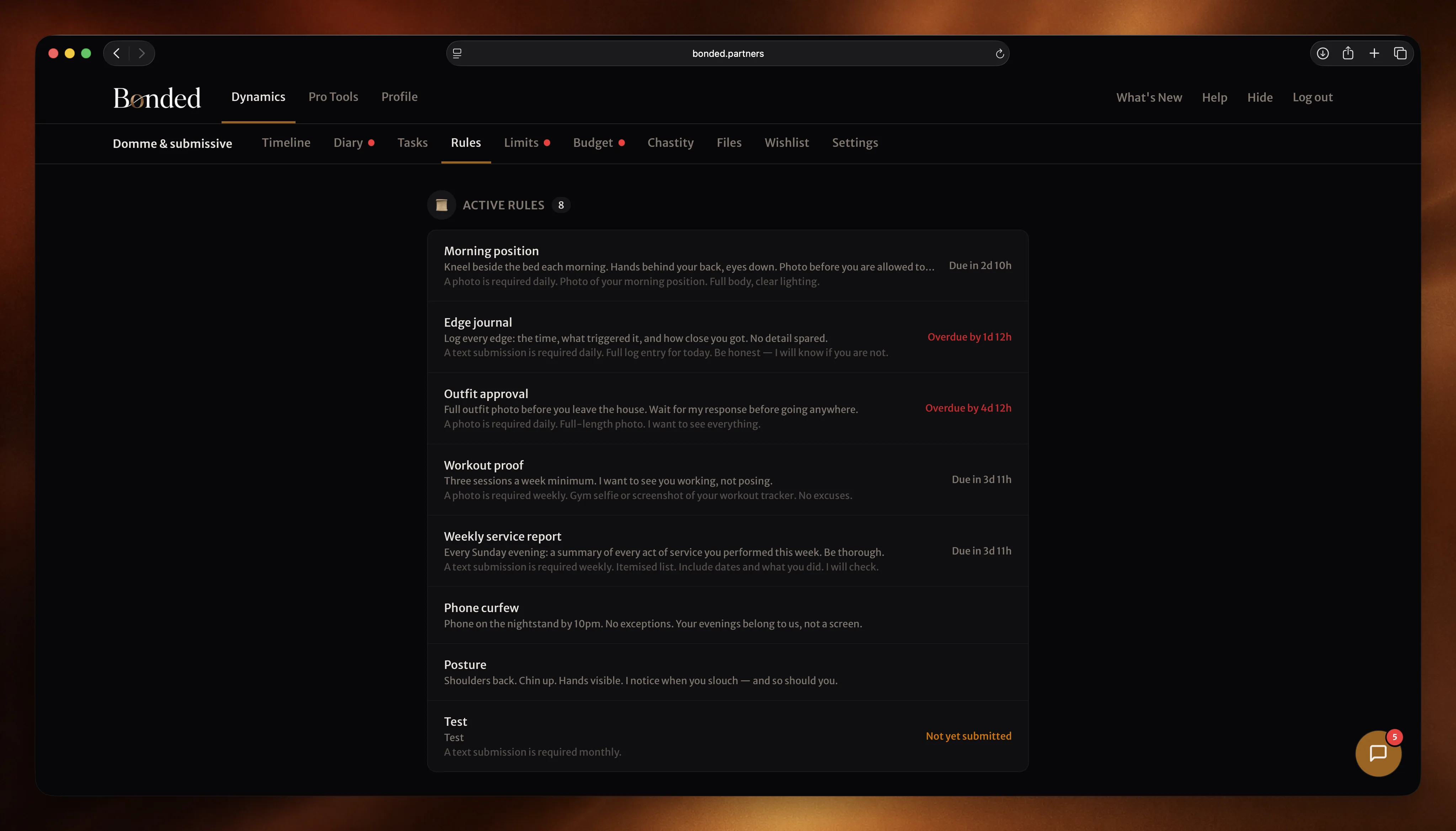
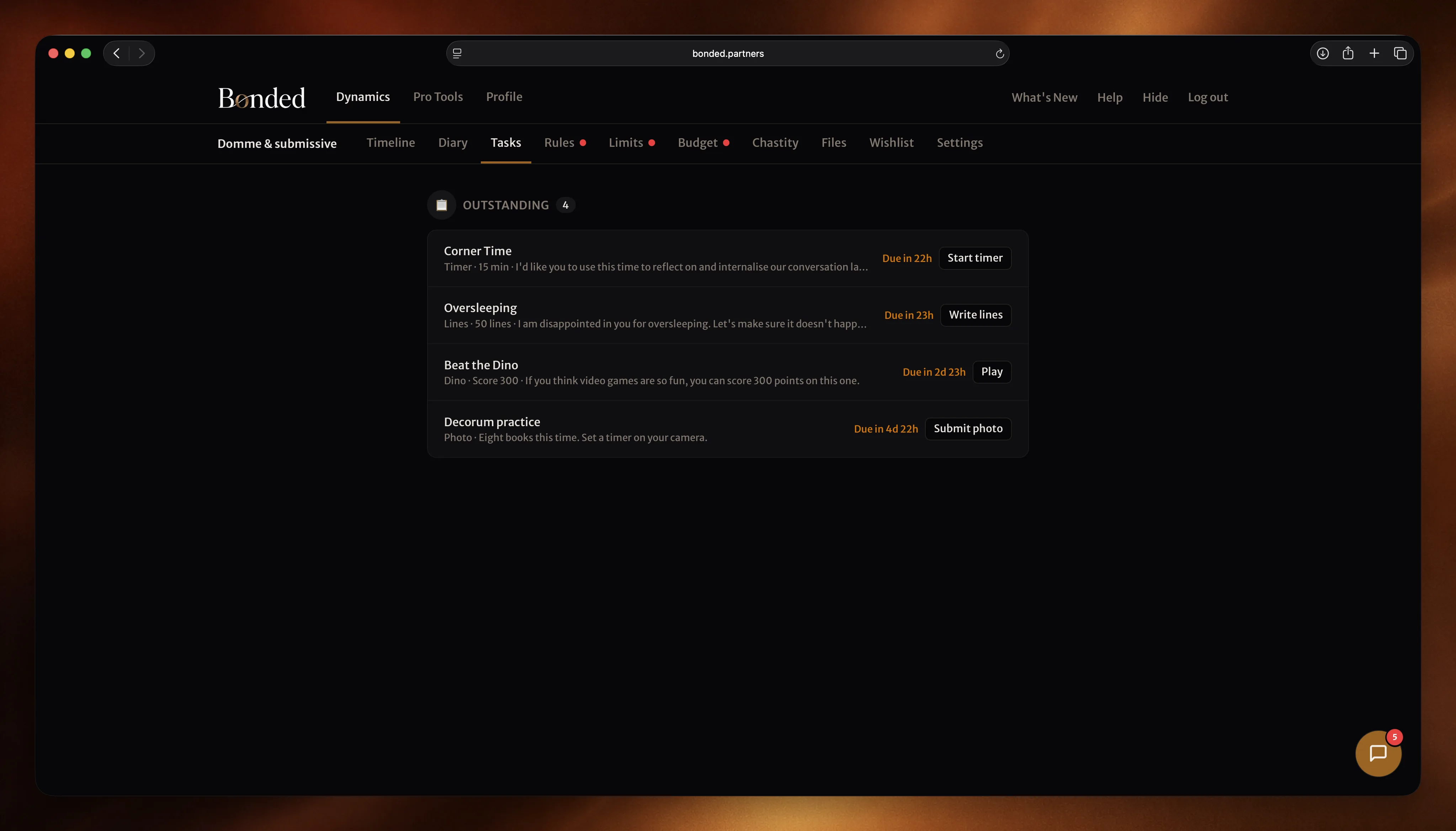
- Automate what you can. Regular hygiene schedules, recurring Rules in Bonded, check-in routines that the sub initiates rather than the Dom(me) having to remember
- Be honest about your bandwidth. If this week is not a week where you have energy for teasing and active engagement, say so. The chastity continues; the active keyholding takes a lighter touch
- Delegate the logistics. The sub manages the device maintenance, the hygiene routine, the supplies. You manage the authority
Guilt and Discomfort
Some women in FLRs feel guilt about enjoying chastity, about denying their partner, about wielding this particular kind of power. Internalised messages about what women "should" want sexually and relationally can surface when you are holding a key and actively denying someone you love.
This is worth examining, not burying. The guilt is often about cultural programming, not about the actual ethics of what you are doing. A consensual dynamic where both partners negotiated terms and either can revoke consent at any time is not harmful because one person enjoys having power. It is the entire point.
If the guilt persists, talk about it — with your sub, with a kink-aware therapist, with a trusted friend in the community. Unprocessed guilt leads to inconsistency, which destabilises the dynamic for both of you.
When She Does Not Want This
Not every woman in an FLR is interested in managing chastity. If the idea came from him and she is doing it to please him, that dynamic is inverted from what it appears to be — he is controlling the dynamic by requesting a practice she then has to manage.
This is not automatically a problem. Submissives suggesting practices for their Dom(me) to consider is normal and healthy. But if she takes on keyholding because he wants it and she does not, the dynamic will fail. She will disengage. He will feel neglected. The chastity will become a source of tension rather than connection.
The honest conversation: "I have considered it, and I do not want to manage your chastity. It does not appeal to me." This is a complete answer. His disappointment is his to manage.
The Sub's Experience in FLR Chastity
For the sub in an FLR, chastity often feels like the physical manifestation of something that was already true. She was already in charge. The device just makes it tangible.
The Attentiveness Shift
The most commonly reported effect: locked subs in FLRs become more attentive. Not because they are trying harder, but because the neurochemistry of sustained denial orients their attention toward the person who controls their release. Tasks get done before she asks. Needs get anticipated. The service that might have been slightly performative before becomes instinctive.
This is the primary reason many FLRs incorporate chastity. It is not about punishment or fetish — it is about creating a physiological state that aligns with the relationship structure. He has consented to her authority. The device makes his body cooperate with that consent.
Managing Frustration Without Burdening Her
A sub in chastity experiences frustration. This is expected and desired — it is part of the mechanism. But in an FLR, there is a specific temptation: using the frustration to demand attention.
Constant updates about how frustrated he is, how hard it is, how much he wants release — these are not communication. They are attention-seeking behaviour dressed as vulnerability, and they place the emotional labour of managing his frustration on her.
Better approaches:
- Process privately first. Use a Diary to work through the frustration before bringing it to her. "I am finding the denial harder this week, and I think it is because of stress at work amplifying it" is a processed observation. "I am so frustrated I cannot think straight" is an unprocessed dump.
- Follow her preferred format. If she wants a daily check-in, give her a check-in. If she wants to hear about it only when something is wrong, do not give her a daily frustration report.
- Channel the energy into service. The frustration is energy. Redirect it toward the FLR. Clean the house. Prepare something thoughtful. Take something off her plate. This is the chastity working as intended.
The Vulnerability of Being Seen
Long-term chastity in an FLR strips away defences. He cannot hide his desire. He cannot pretend the denial does not affect him. She sees him in a state of need that is continuous and obvious.
For many subs, this is the most powerful aspect of FLR chastity — not the physical sensation of the device, but the psychological reality of being known and seen in their wanting. It requires trust. It builds trust. And it creates an intimacy that partners in both roles often describe as transformative.
Common Misconceptions About FLR Chastity
"The man must be sexually submissive"
FLR chastity does not require sexual submission beyond the orgasm control itself. Some couples maintain a conventionally active sex life — she enjoys penetration, he provides it at her direction — with chastity governing only his orgasm, not the sexual activity itself. The device comes off for sex, she gets what she wants, and whether he gets to finish is her decision.
"It is really the sub controlling things"
This is the "topping from the bottom" accusation applied to FLR chastity. The argument: he wanted this, he asked for it, therefore he is really in charge.
This misunderstands how negotiation works. He may have introduced the idea, but she decided whether to adopt it, she sets the terms, and she holds the authority. A CEO who implements an employee's suggestion is not suddenly subordinate to that employee. Accepting input is not ceding authority.
"It will fix relationship problems"
Chastity is not couples therapy. If the relationship has communication issues, trust deficits, or resentment, adding chastity will amplify those problems, not resolve them. The heightened vulnerability and the power asymmetry require a solid foundation. Build the foundation first.
"It has to involve a device"
Honour-based orgasm control — where she simply tells him not to touch and he obeys — is equally valid and in some ways more psychologically demanding. The device is a tool. The authority is the point.
"It has to be about humiliation"
Some FLR dynamics incorporate humiliation. Many do not. Chastity in an FLR can be tender, loving, and deeply respectful. She locks him because they both benefit. He wears the device because it makes him a better partner. Humiliation is optional, not inherent.
Integrating Chastity With Other FLR Elements
Chastity does not exist in isolation within an FLR. It connects to other structures.
Domestic Service
Chastity and domestic service are natural complements. The denial-driven attentiveness channels directly into service quality. Some FLRs explicitly link them — chores completed to standard contribute to earning release, or chastity functions as a background motivator without formal linkage.
Financial Oversight
In FLRs that include financial authority, Bonded's Budget feature can sit alongside chastity as part of a comprehensive power exchange. She manages the money and the orgasm — two fundamental domains of control that reinforce each other.
Rules and Protocols
FLR-specific rules integrate naturally with chastity practice. Rules in Bonded can cover the full scope — hygiene requirements, service standards, daily protocols, orgasm control conditions — creating a single place where the FLR structure is documented and tracked.
Communication Structure
FLRs thrive on structured communication. Regular check-ins, state-of-the-dynamic conversations, and ongoing negotiation are all essential. Adding chastity increases the communication requirement — physical checks, emotional monitoring, desire management — and tools that centralise that communication prevent it from becoming overwhelming.
Starting FLR Chastity: A Practical Path
If you are in an FLR and considering adding chastity, or if you are building both simultaneously:
- Discuss it as equals. Step outside the FLR authority structure for the negotiation. Both perspectives matter equally.
- Start shorter than you think. A weekend. A few days. Build competence and trust before extending.
- Let her set the pace. If she is interested but cautious, follow her lead on escalation. Pushing for more, faster, from the sub position, is not submission — it is pressure.
- Build the support systems first. Hygiene routine, check-in schedule, emergency protocols, communication tools. Bonded's chastity tracking provides the lock/unlock controls, live countdown, and session history. Rules provide the framework. Chat keeps communication organised.
- Review and iterate. After each session, discuss what worked for both of you — emphasis on both. Her experience is not secondary to his.
- Accept that it might not work. Not every FLR benefits from chastity. If it does not serve the dynamic, it does not serve the dynamic. That is information, not failure.
A Practice, Not a Prescription
FLR chastity is one tool in a broad landscape of power exchange practices. It works brilliantly for some couples and not at all for others. The FLR provides the authority structure. The chastity provides a physical, inescapable expression of that authority. Together, when both partners are engaged and communicating, they can create a dynamic that is deeply satisfying for everyone involved.
The key — literal and metaphorical — is that it serves the relationship. Her authority. His surrender. Their connection. When chastity supports all three, it earns its place in the dynamic.
Go deeper
Read the full guide→