



Chastity Games and Challenges for Keyholders
Creative chastity games and keyholder challenges including dice games, tease-and-denial, Locktober ideas, and milestone rewards for your dynamic.

Chastity within a power exchange can be deeply meaningful on its own. The denial, the anticipation, the shifted dynamic — these carry weight without embellishment. But sustained chastity practice benefits from variety, and games and challenges offer a structured way to introduce novelty, deepen engagement, and keep both partners actively invested.
This is not about trivialising the dynamic. Games serve the same purpose as rituals in any structured relationship — they give form to the power exchange, create shared experiences, and provide concrete moments of connection within the longer arc of denial. A well-designed game makes both partners more present, more engaged, and more aware of the power structure between them.
Every game below includes rules, setup notes, and suggestions for adapting difficulty. Take what works for your dynamic, modify what does not, and discard anything that does not serve your connection.
Before You Play: Ground Rules
Games do not replace the fundamentals. Safety, hygiene, communication, and consent are not suspended for play. Before introducing any game:
- Confirm both partners are enthusiastic. A game that one partner finds fun and the other finds tedious is not a game — it is an imposition.
- Maintain all safety protocols. Physical check-ins, hygiene schedules, and emergency unlock procedures continue regardless of game state.
- Set boundaries on the game's scope. Can the game add days? Remove days? Both? Is there a maximum duration the game can produce?
- Agree on what happens if the game stops being fun. Either partner should be able to call the game off without forfeiting the chastity itself.
Game 1: The Dice Roll
Concept: Chance determines the denial period. The sub's release date is literally in the hands of fate, mediated by the keyholder.
Setup:
- One or two standard six-sided dice
- A key and a locked sub
Basic Rules:
- At the start of the session, the sub rolls the dice. The number is the number of days until potential release.
- When the period ends, the sub rolls again. On a predetermined number (e.g., rolling a 1 or a 6), they earn release. On any other number, the result becomes the next waiting period.
- Repeat until they roll the release number.
Variations:
Keyholder's Advantage: The Dom(me) rolls instead of the sub. Same mechanics, but the sub has no agency at all — not even the illusion of control that rolling the dice provides.
Escalating Stakes: Each failed release roll adds a modifier. First round: roll the dice straight. Second round: add one day to whatever is rolled. Third round: add two. The longer the game goes, the steeper the cost of each failed roll.
Double or Nothing: When the sub rolls the release number, they can choose to accept release or roll again. If they roll the release number a second time, they get a special reward (keyholder's choice). If they do not, the new number becomes the next waiting period and the release number changes (harder to hit).
Difficulty Adaptation:
- Easier: Use one die, release on any even number
- Standard: Two dice, release on doubles
- Harder: Two dice, release only on double sixes
Why it works: The randomness is genuinely exciting. Neither partner knows how long the session will last, which keeps anticipation high. The sub cannot mentally pace themselves because there is no fixed endpoint. The keyholder gets to watch their sub's face during each roll — the hope, the disappointment, the resignation when a five comes up instead of a six.
Game 2: Earned Time Off
Concept: The sub starts with a set denial period and earns reductions through service, tasks, or challenges. Every day of denial is the default. Every day removed is earned.
Setup:
- A starting denial period (e.g., 30 days)
- A list of actions and their time-off values
- A tracking method (spreadsheet, notebook, or task tracking in Bonded)
Sample Actions and Values:
| Action | Time Off |
|--------|----------|
| Complete a task without being asked | 1 hour |
| Perfect daily hygiene routine (with evidence) | 2 hours |
| Complete a specific challenge set by the keyholder | 4 hours |
| Exceptional service noted by the keyholder | 8 hours |
| One full day without complaining about the device | 1 hour |
| Write a detailed Diary entry about the experience | 2 hours |
| Complete a domestic task to an exceptional standard | 4 hours |
Rules:
- The keyholder sets the starting period and the action list at the beginning
- The sub tracks their earned time and submits it for keyholder verification
- Only the keyholder can approve time-off claims
- The keyholder can add bonus actions at any time
- The keyholder can also add penalty actions that add time back
Variations:
Time Bank: Instead of reducing a fixed period, earned time accumulates in a bank. The sub can spend banked time to request an unlock — but the keyholder sets the "price" for release, and it might go up.
Daily Cap: The sub can earn a maximum of four hours per day, forcing the engagement to be sustained over the full period rather than front-loaded.
Mystery Values: The actions are listed but the time-off values are hidden. The sub does not know how much each action is worth until the keyholder reveals it.
Difficulty Adaptation:
- Easier: Generous time-off values, shorter starting period
- Standard: As described above
- Harder: Small time-off values, keyholder can add time as well as subtract it, penalty actions for failures
Why it works: This game transforms passive denial into active participation. The sub is not just enduring — they are working, strategising, choosing where to invest their energy. It integrates chastity directly into the service dynamic and gives both partners a concrete, ongoing interaction around the denial.
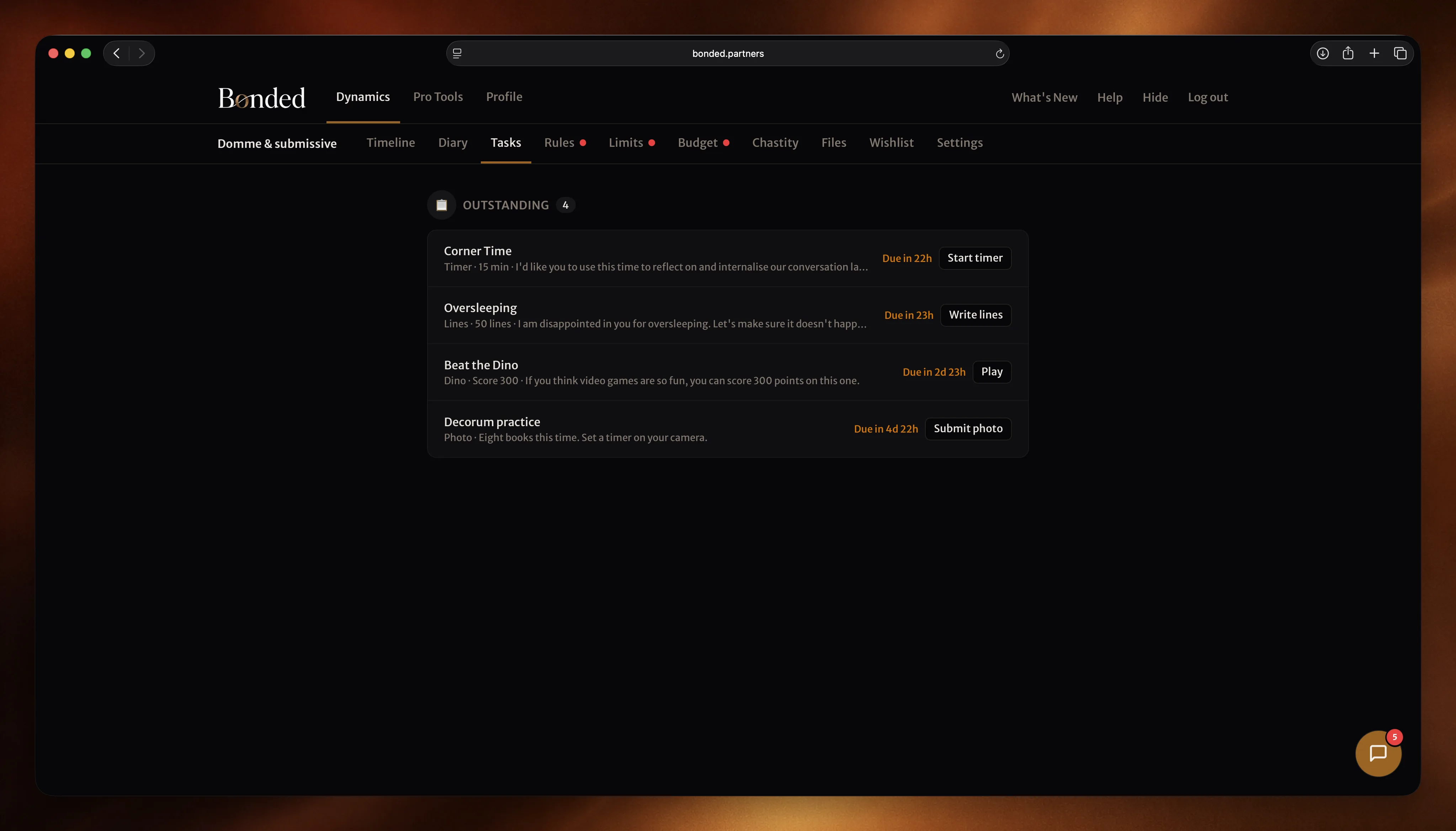
Bonded's Tasks feature is ideal for tracking the challenge actions. Set specific tasks with deadlines, mark them complete when verified, and the record creates a clear audit trail of effort and reward.
Game 3: Tease and Denial Roulette
Concept: Structured teasing sessions where the outcome is uncertain. The sub never knows if a teasing session will end in continued denial, a ruined orgasm, or (rarely) full release.
Setup:
- A method for random selection (numbered cards, a spinner, dice)
- A set of outcome cards or categories
- Time set aside for the session
Outcome Categories (adjust ratios to your desired difficulty):
Create ten cards or entries:
- Cards 1-5: "Denied." Teasing stops. Device goes back on.
- Cards 6-7: "Extended tease." Ten more minutes of stimulation, then denied.
- Card 8: "Ruined." Stimulation continues to orgasm, then stimulation stops immediately at the point of no return.
- Card 9: "Edge and deny." Brought to the very edge three times, then denied.
- Card 10: "Release." Full orgasm permitted.
Rules:
- The keyholder schedules a tease session (frequency is up to the dynamic — weekly, biweekly, or at her discretion)
- The device is removed
- The keyholder teases and stimulates as she chooses
- At the keyholder's chosen moment, the sub draws a card or the keyholder draws on their behalf
- The outcome is followed
- The device goes back on unless a full release was drawn
Variations:
Keyholder Veto: The keyholder can override any drawn outcome. Drew release but the keyholder is not in the mood to allow it? Too bad. This preserves her authority over the game itself.
Cumulative Odds: Start with only one release card in ten. Each denied session, add another release card to the deck. The longer the sub goes without release, the better their odds become — but it is never guaranteed.
Sub's Choice: After drawing, the sub can choose to keep the result or draw again — but the second draw is final. Risk and reward.
Difficulty Adaptation:
- Easier: Two or three release cards out of ten
- Standard: One release card out of ten
- Harder: One release card out of fifteen, or no release card at all — the best possible outcome is a ruined orgasm
Why it works: The tease sessions themselves are intensely connecting — physical intimacy, vulnerability, the keyholder reading and controlling the sub's arousal in real time. The random outcome adds a gambling element that spikes anticipation. And the predominance of denial outcomes means that release, when it finally comes, is genuinely extraordinary.
Game 4: Chastity Bingo
Concept: A bingo card filled with chastity-related experiences, challenges, and milestones. The sub works through the card over a denial period.
Setup:
- A 5x5 bingo grid (the centre square is a free space)
- 24 chastity-related items, appropriate to your dynamic and denial period
- Agreed-upon reward for completing a line, and a bigger reward for completing the full card
Sample Bingo Items:
| | B | I | N | G | O |
|---|---|---|---|---|---|
| 1 | Sleep through the night without waking | Complete a task while visibly frustrated | Write a Diary entry about day 3 | Go to the gym in the device | Send keyholder a "grateful" message unprompted |
| 2 | Survive a tease session without begging | Wear the device through a full workday | Complete all hygiene for a week with evidence | Handle a bad day without asking to be unlocked | Make keyholder's morning coffee for 5 days straight |
| 3 | Go 48 hours without mentioning the device | Correctly identify keyholder's mood and respond appropriately | FREE SPACE | Maintain composure during a tease | Write about what chastity is teaching you |
| 4 | Complete a surprise domestic task | Ask to be teased (and accept the denial that follows) | Go a full day redirecting frustration into service | Receive a compliment from keyholder on service quality | Handle a social situation while locked without anxiety |
| 5 | Respond to a tease message with grace | Achieve personal best on a non-chastity goal | Admit vulnerability without being prompted | Maintain perfect rule compliance for 72 hours | Thank keyholder for the denial sincerely |
Rules:
- The keyholder creates the card (or both partners create it together)
- The sub works through items during the denial period
- Items are marked off when the keyholder confirms completion
- Completing a line (horizontal, vertical, or diagonal) earns a reward — a tease session, a shortened period, a privilege, keyholder's choice
- Completing the full card earns a bigger reward
Variations:
Keyholder Bingo: A separate card for the keyholder with items she wants to accomplish — "try a new teasing technique," "surprise him with an unexpected check-in," "plan a creative denial." Both partners have a card and work through them simultaneously.
Blackout Challenge: Full card completion within the denial period earns release. Anything less means the period extends.
Progressive Difficulty: The items get harder as the period goes on. Early items are simple (hygiene compliance, basic service). Later items are challenging (vulnerability, emotional honesty, sustained excellence).
Difficulty Adaptation:
- Easier: Smaller grid (3x3), simpler items, generous rewards
- Standard: 5x5 grid as described
- Harder: 5x5 grid with more challenging items, only full card completion counts
Why it works: Bingo transforms a long denial period into a structured journey with achievable milestones. The sub has concrete goals to work toward, which channels the frustration of denial into productivity. The keyholder has a framework for engagement — checking items, acknowledging achievements, adjusting the challenge. And the shared card creates a collaborative element within the power exchange.
Game 5: Milestone Rewards
Concept: The keyholder sets specific milestones along the denial period, each with a defined reward. The rewards escalate as the milestones get further from the start.
Setup:
- A denial period of sufficient length to include multiple milestones (two weeks minimum)
- A milestone map with rewards attached
- Clear criteria for each milestone
Sample Milestone Map (30-Day Period):
| Milestone | Day | Reward |
|-----------|-----|--------|
| First Weekend | 3 | Keyholder sends a teasing photo |
| One Week | 7 | A fifteen-minute tease session |
| Ten Days | 10 | Sub chooses dinner for both partners |
| Two Weeks | 14 | Extended tease session with edging |
| Halfway | 15 | A special privilege (sub's choice from approved list) |
| Twenty Days | 20 | Keyholder writes sub a letter about what the denial means to her |
| Three Weeks | 21 | Tease session with ruined orgasm option (dice roll) |
| Twenty-Five Days | 25 | Sub is unlocked for an evening (no orgasm) |
| The Final Stretch | 28 | Keyholder reveals release plan |
| Completion | 30 | Full release + celebration of choice |
Rules:
- Milestones are set at the beginning and do not change
- Each milestone is earned only if the sub has maintained compliance (hygiene, rules, behaviour)
- The keyholder has the authority to skip a milestone reward if compliance has slipped, but must explain why
- Milestone rewards cannot be banked or traded
Variations:
Hidden Milestones: The sub knows that milestones exist but not when they fall or what the rewards are. Surprise rewards during a long denial period carry extra psychological impact.
Escalating Challenge: Each milestone requires completing a specific challenge to unlock the reward. Day seven's tease session requires a week of perfect rule compliance. Day fourteen's privilege requires completing a challenging task.
Partner Milestones: Both partners have milestones. The sub's mark denial endurance. The keyholder's mark engagement quality — check-in consistency, creative teasing, emotional attunement. Both partners are working and both partners are rewarded.
Difficulty Adaptation:
- Easier: Frequent milestones with generous rewards, including some physical contact
- Standard: As described above
- Harder: Fewer milestones, smaller rewards, stricter compliance requirements, some milestones are tease-only (no physical contact)
Why it works: Milestones break a long period into manageable segments. "Thirty days" is daunting. "Three days until my next milestone" is achievable. The escalating rewards give the sub something to look forward to at every stage, and the keyholder a structured engagement plan that does not require constant improvisation.
Game 6: Competitive Chastity
Concept: Two or more subs compete in chastity-related challenges. The keyholder (or keyholders) manage the competition.
Note: This game requires multiple subs, either within a multi-sub dynamic or between consenting friends/community members with their respective keyholders coordinating.
Setup:
- Two or more locked subs
- A coordinating keyholder (or keyholders working together)
- A challenge list and scoring system
Sample Challenges:
| Challenge | Scoring |
|-----------|---------|
| Longest streak of perfect daily hygiene | 1 point per day |
| Best service task (keyholder judged) | 5 points |
| Most graceful response to a tease | 3 points |
| Longest period without mentioning the device | 2 points per day |
| Best Diary entry about the experience | 5 points |
| Fastest completion of a surprise task | 3 points for first, 1 for second |
| Most creative way to channel frustration into productivity | 5 points |
Rules:
- Competition period is set in advance (one week, one month)
- Points are tracked and visible to all participants
- The winner earns a reward determined by the keyholder(s)
- The loser earns... a consequence. Also determined by the keyholder(s).
- Sportsmanship is required. Sabotage or undermining other subs is immediate disqualification.
Variations:
Team Competition: Two sub-keyholder pairs compete as teams. The keyholder's engagement quality counts toward the team score as well.
Endurance Competition: Simple — who can go the longest? Last sub standing wins. (Set a hard maximum to prevent unsafe escalation.)
Relay: Subs take turns being locked for a set period, passing the "baton" when their time is up. Total locked time across the team is the score.
Why it works: Competition adds an external motivator and a social dimension to an inherently private practice. For subs who respond to competitive structures, it can dramatically increase engagement and endurance. The social element — knowing someone else is going through the same thing — can also normalise the experience and reduce isolation.
Seasonal Challenges: Locktober and Beyond
Community-wide chastity events provide structure, solidarity, and a built-in timeline.
Locktober
The best-known community chastity challenge: stay locked for the entire month of October. It started online, it has become a widely recognised event, and participating connects you to a broader community of people doing the same thing.
Making Locktober work in your dynamic:
- Plan before October starts. Thirty-one days requires preparation — device fit confirmed, hygiene supplies stocked, schedule discussed, milestones set.
- Build in engagement. Thirty-one days of "you are locked, deal with it" is thirty-one days of neglect. Use the milestone structure, incorporate games, tease regularly.
- Connect with the community. Part of Locktober's value is the shared experience. Online communities, forums, and social media provide solidarity and normalise the challenge.
- Respect your limits. If you have never done more than a week, Locktober might not be your first month-long session. Build up to it. There is always next year.
Other Seasonal Ideas
No-Nut November: Already a mainstream (if watered-down) concept. For chastity practitioners, it provides another calendar-based challenge with built-in community support.
Denial December: The holidays as a denial period, with each day of an advent-style calendar revealing a challenge, a tease, or a milestone.
New Year Lock-Up: Start the year locked. Set a release date based on goals — personal, dynamic, or service-related — that must be met before the key turns.
Anniversary Lockdown: Mark a dynamic anniversary with a denial period equal to the number of years (or months, depending on your experience level). Year three earns three weeks. Year five earns five.
Birthday Denial: The keyholder's birthday as the release date. The lead-up is the gift — heightened service, deepened submission, sustained anticipation — and the release is the keyholder's birthday present to give or withhold.
Designing Your Own Games
The games above are templates. The best game for your dynamic is the one you build together, using these principles:
Serve the dynamic, not the game. If the game becomes more important than the connection between you, the game has taken over. Discard it or redesign it.
Match the difficulty to the experience level. A couple doing their second chastity session does not need competitive endurance challenges. A couple with two years of practice does not need the dice-roll beginner game. Scale appropriately.
Include engagement from both sides. Games where only the sub does things while the keyholder watches are one-sided. The best games require investment from both partners.
Build in off-ramps. Every game should have a way to stop or pause that does not feel like failure. "We are putting the game on hold because life got busy" is fine. "I failed at the game and now I feel terrible" is a design problem.
Use the tools you have. Session history in Bonded tracks the timing. Tasks set and track game challenges. Diary captures the emotional experience. Chat keeps game-related communication organised. These tools exist to support exactly this kind of structured play.
Reflect afterward. After any game or challenge, take time — individually and together — to process what happened. What was fun? What was tedious? What surprised you? What would you change? The Diary is valuable here — write your reflections while they are fresh, then share them with your partner when you are both ready.
The Point of Play
Games and challenges are not the substance of a chastity dynamic. They are the seasoning. The substance is the trust between two people, the power exchange they have built, the daily reality of one person surrendering control and another person wielding it with care.
But seasoning matters. It keeps things interesting over the long term. It provides structure for engagement when the keyholder's creative energy is low. It gives the sub something concrete to focus on beyond the unending fact of being locked. And it creates shared memories — "remember Locktober last year, when you rolled double sixes on day twenty-eight?" — that enrich the dynamic over time.
Play with intention. Play with consent. Play with the knowledge that the game serves the dynamic, not the other way around. And when the game is over, the lock remains, the key remains, and the two of you remain — which is, as always, the point.
Go deeper
Read the full guide→