



Contracts in D/s: Useful Tool or Unnecessary Theatre?
A balanced look at D/s contracts — what they include, when they help, when they don't, and how to make sure yours is a living document rather than performative decoration.

The idea of a D/s contract carries weight. There is something about putting pen to paper (or fingers to keyboard) and formalising a power exchange that appeals to the part of us that wants structure to feel real. Contracts make the dynamic tangible. They give it boundaries, definitions, and — the word matters — an agreement. Not just a feeling. Not just a conversation. A document.
But contracts also carry baggage. Some people in the community dismiss them as performative. Others treat them as sacred. The truth, like most truths in kink, is more nuanced than either extreme. A D/s contract can be one of the most useful tools in your dynamic, or it can be a piece of theatre that is written in a rush of excitement and never looked at again. The difference is not in whether you have one. It is in how you use it.
What a D/s Contract Actually Is
First, what it is not: legally binding. In virtually every jurisdiction on earth, a D/s contract has no legal standing. You cannot enforce it in court. It does not modify your legal rights. A submissive who signs a contract has not signed away their ability to withdraw consent at any time for any reason. A Dom(me) who signs one has not assumed legal liability for the submissive's wellbeing in any formal sense.
This is important to establish not because it diminishes the contract but because it clarifies what the contract actually is: a communication tool. A shared reference document that captures what both parties have agreed to, what they expect from each other, and what the boundaries of the dynamic are at this point in time.
Think of it as a relationship blueprint rather than a legal instrument. Its power comes from the conversation it represents, not from any external enforcement mechanism.
What Contracts Typically Include
There is no standard format, and the right contract is the one that serves your specific dynamic. But most functional D/s contracts address some combination of the following.
Roles and Definitions
Who is the Dom(me)? Who is the submissive? If you are in a dynamic with more than two people, who holds which role? What does each role mean in the context of this specific relationship?
This sounds obvious, but defining it on paper forces clarity. "I am the Dom(me)" can mean wildly different things depending on the couple. Does it mean 24/7 authority? Authority within specific contexts? Authority that requires maintenance through specific behaviours? Putting it in writing reveals assumptions that might otherwise go unexamined.
Limits
Hard limits (non-negotiable boundaries) and soft limits (boundaries that may be explored under specific conditions). Both partners' limits, not just the submissive's. Dom(me)s have limits too — activities they will not perform, dynamics they will not engage in — and these deserve equal documentation.
The limits section of a contract is often the most valuable to write and the most challenging, because it requires both partners to be specific about what they will not do. Specificity here protects both parties.
Rules and Expectations
What ongoing rules govern the dynamic? What does the submissive's daily compliance look like? What does the Dom(me)'s engagement look like?
This section is where many contracts become either too vague to be useful or too detailed to be sustainable. "The submissive will obey" is meaningless. A twenty-page list of every conceivable rule is overwhelming. The sweet spot is typically five to fifteen concrete, enforceable rules that capture the core structure of your dynamic.
Duration and Renewal
When does this contract start? When does it end? Is it indefinite or time-bound?
Time-bound contracts (three months, six months, one year) have a significant psychological advantage: they build in a natural renewal point. At the end of the term, both partners explicitly choose to continue, modify, or end the dynamic. This prevents the inertia problem where a dynamic continues past its healthy lifespan because neither partner initiates the difficult conversation.
Termination
How does either party end the dynamic? What are the conditions under which the contract is automatically voided? What happens after termination?
This section is uncomfortable to write. Nobody wants to plan for the end of something they are excited about beginning. But it is arguably the most important section in the contract. A clearly defined termination process protects both parties — particularly the submissive, whose position of deference makes it harder to initiate departure.
Common termination provisions include:
- Either party may terminate at any time for any reason
- Specific behaviours that automatically void the contract (consent violations, safety violations, abuse)
- A cooling-off period between termination and the return of any shared property or data
- An agreement about confidentiality after the dynamic ends
Safewords and Safety
What safewords does the dynamic use? Under what circumstances are they invoked? What happens when a safeword is called?
Many dynamics use the traffic light system (green/yellow/red), but your contract should specify whatever system you actually use and what each level means in practice. "Red means everything stops immediately" is more useful when both partners have agreed on what "everything stops" looks like — is it just the scene, or is it the entire dynamic until a check-in happens?
Renegotiation
How and when will this contract be revisited? What is the process for proposing changes?
A contract without a renegotiation clause is a snapshot, not a living document. Dynamics evolve. People evolve. A contract written in month one of a relationship may not reflect the dynamic in month twelve. Building in regular review points (quarterly is common) ensures the document stays relevant.
When Contracts Are Useful
New Dynamics
When two people are beginning a D/s relationship, a contract forces the conversations that enthusiasm might otherwise skip. It is easy, in the excitement of a new dynamic, to assume alignment. "We're both into this, so we're probably on the same page." A contract reveals where you are not on the same page, and it does so before those misalignments cause real problems.
The process of writing a contract together — not one person drafting and the other signing, but both partners contributing — is itself an act of negotiation. Every clause requires discussion. Every definition requires agreement. By the time the contract is done, you know each other's expectations in a way that conversation alone rarely achieves.
Complex Negotiations
If your dynamic involves multiple partners, polyamorous structures, or unusually complex power exchanges, a contract helps manage the complexity. When three or four people share a dynamic, the number of possible misunderstandings multiplies. A written document that everyone has reviewed and agreed to provides a reference point that memory cannot.
Long-Distance Dynamics
When you cannot rely on physical presence to maintain the felt sense of your dynamic, a contract provides an anchor. It is something you can both return to, reread, and reference. "This is what we agreed to" carries particular weight when you are separated by distance and the dynamic exists primarily through digital tools and scheduled interactions.
Dynamics With Power Imbalance Concerns
All D/s dynamics involve power imbalance by design. But some dynamics involve additional imbalances — age differences, experience differences, financial dependencies — that benefit from explicit documentation. A contract that clearly states both parties' rights, limits, and termination options provides a safeguard against the creep of unhealthy power dynamics disguised as consensual ones.
When Contracts Are Unnecessary
Established Dynamics
If you and your partner have been in a dynamic for years, have long since negotiated your limits, and communicate well, a formal contract may add nothing. Your understanding of each other is deep, your patterns are established, and the relationship itself is the document.
This does not mean established dynamics should never revisit their agreements. But the vehicle for that revisiting might be a conversation rather than a contract. Some couples benefit from annual check-ins that are structured like contract renewals without the actual document.
Simple or Casual Dynamics
A bedroom-only dynamic between an established couple does not necessarily need a contract. If your power exchange is confined to specific contexts and both of you are clear on the boundaries, the overhead of writing and maintaining a formal document may exceed the benefit.
When It Would Be Performative
Here is the honest part. Some people want a contract because it feels dramatic, ritualistic, and intense. The signing ceremony. The formal language. The weight of it. And if that ritual serves your dynamic — if both partners find meaning in the formality — then it is functional, even if the content is simple.
But if the contract is written in an evening of excitement, signed with ceremony, filed away, and never referenced again, it was theatre. Compelling theatre, perhaps. But not a tool.
The test: have you looked at your contract in the last three months? Could you summarise its key provisions without reading it? Does it inform your day-to-day dynamic? If the answer to all three is no, the contract is decorative.
The Performative Concern
Let us dig into this because it is the central tension of D/s contracts.
A contract that is never revisited is not a communication tool. It is a memento. It captures what you agreed to once, at a specific moment, in a specific emotional state. It does not reflect the growth, renegotiations, and shifts that have happened since. If you and your partner have been operating based on unspoken adjustments that deviate significantly from the written contract, the contract is not just unused — it is inaccurate.
The solution is not to avoid contracts. It is to build the practice of returning to them. A contract with a quarterly review clause, that both partners actually revisit every quarter, is a living document. It grows with the dynamic. It gets messy — clauses get struck out, provisions get added, limits get reclassified. That messiness is a feature, not a bug. It means the contract is being used.
A pristine contract is a red flag. A contract with notes in the margins, crossed-out sections, and added pages is a sign of a dynamic that takes its own agreements seriously.
A Basic Template Structure
If you decide a contract serves your dynamic, here is a starting structure. Adapt it to your needs.
Section 1: Parties and Roles
Names (or scene names). Roles. Date of agreement. Duration.
Section 2: Purpose
A brief statement of what this dynamic means to both of you. Why you are here. What you are building.
Section 3: Limits
Hard limits for both parties. Soft limits for both parties. The process for reclassifying limits.
Section 4: Rules and Expectations
Standing rules. Frequency. Evidence requirements. Consequences.
Section 5: Communication
How you will communicate about the dynamic. Check-in schedule. How to raise concerns. Safewords and their meanings.
Section 6: Privacy and Discretion
What each partner will and will not share with others. Social media boundaries. Confidentiality after termination.
Section 7: Duration and Renewal
Start date. End date (or indefinite with review points). Renewal process.
Section 8: Termination
How either party can end the dynamic. Automatic termination conditions. Post-termination agreements.
Section 9: Signatures
Both parties sign. Date it. If you want the ritual, make it a moment. If you want it simple, sign and move on.
Keep the language clear. Avoid legalistic phrasing unless it genuinely serves clarity. A contract written in plain language is more useful than one that sounds like it was drafted by a solicitor. Both partners should understand every word without interpretation.
Making It a Living Document
The contract is not the end of the conversation. It is the beginning of a practice.
Some ways to keep it alive:
Scheduled reviews. Put a quarterly review on the calendar. Sit down together, read through the contract, and discuss what is still accurate, what has changed, and what needs updating. This is an act of maintenance that honours the work you put into writing it.
Triggered reviews. Any significant change in the dynamic — a new limit discovered, a rule that is no longer serving its purpose, a major life change — should trigger a contract review. The contract adapts to the dynamic, not the other way around.
Annual renewal. If your contract is time-bound, the renewal is built in. If it is indefinite, create your own annual renewal moment. Reread, revise, and re-sign. Some couples treat this as an anniversary of sorts — a celebration of another year of deliberate power exchange.
Digital living copies. A contract stored in a shared space — Bonded's Files feature, for instance — is more accessible than one in a drawer. Both partners can reference it without asking the other person where it is. Accessibility encourages use; a document you cannot easily find is a document you will not revisit.
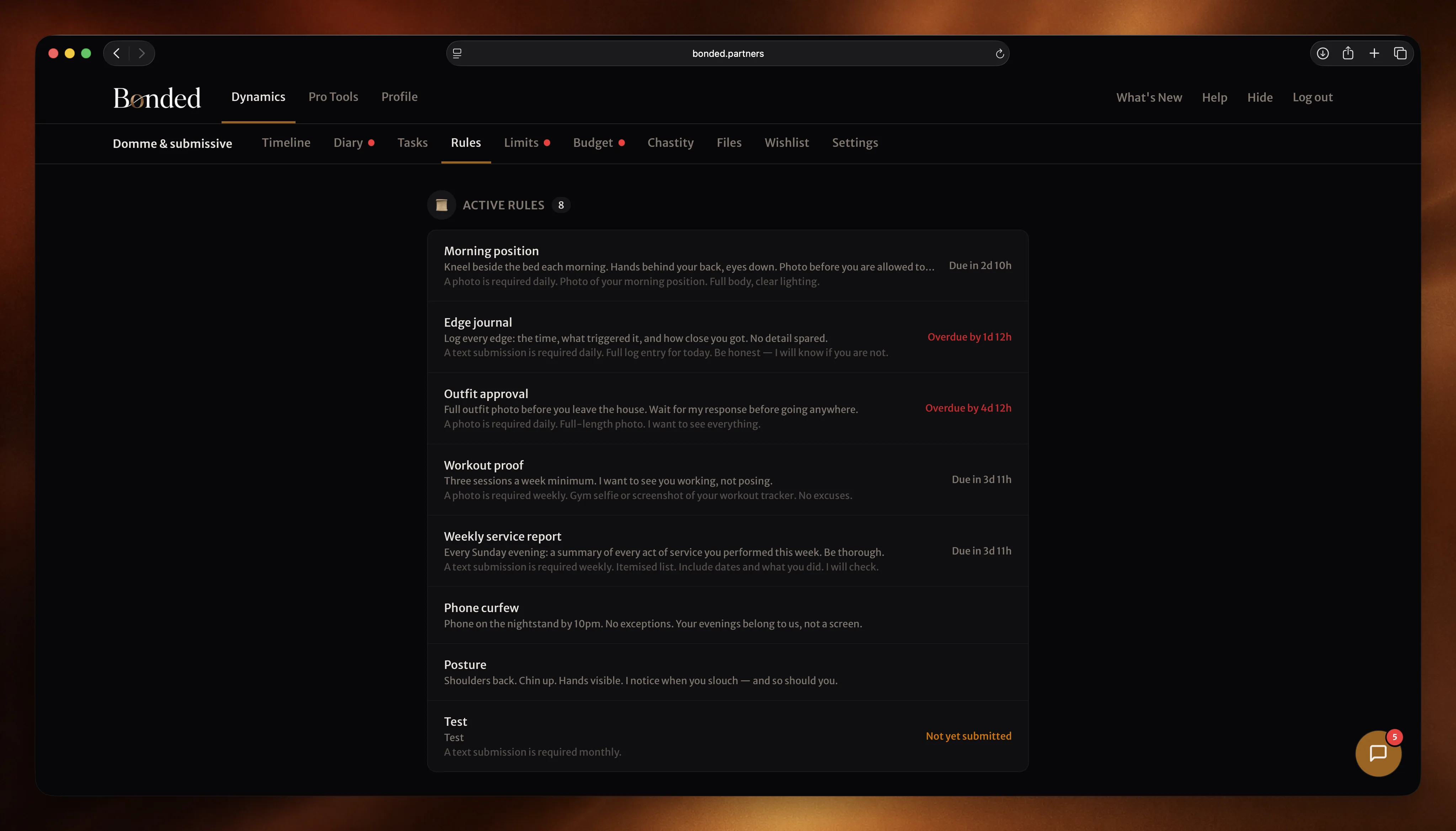
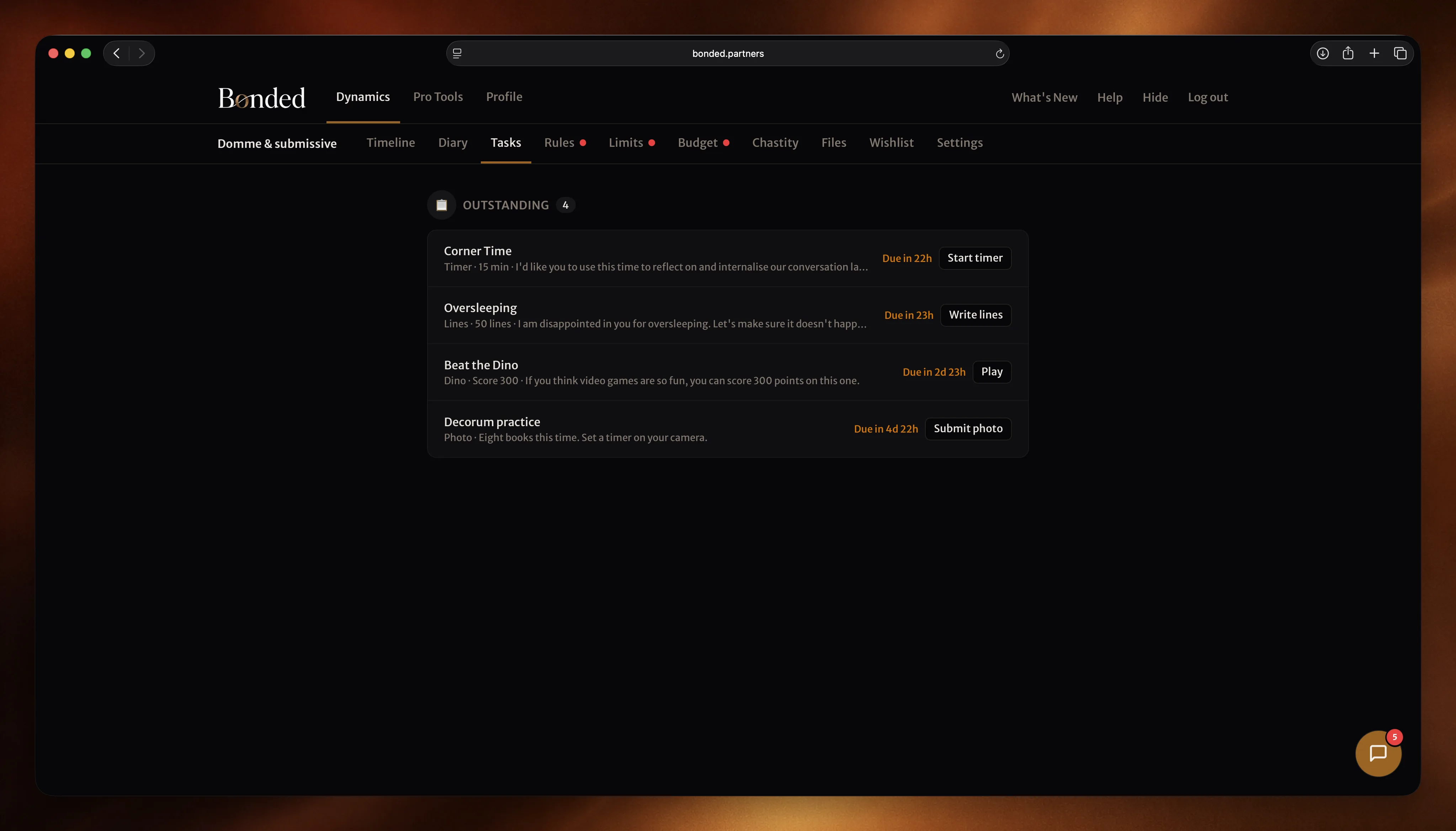
Limits can live as active, collaborative data rather than static contract text. Bonded's Limits feature lets both partners propose, classify, and reclassify limits over time, creating a living record that complements or even replaces the limits section of a traditional contract. Rules can function the same way — active in your daily tracking rather than written once in a document.
The contract frames the dynamic. The daily tools operate the dynamic. Together, they create a system where agreements are both documented and practised.
The Verdict
Useful tool or unnecessary theatre? The answer depends entirely on the practice, not the document.
A contract that is written collaboratively, revisited regularly, and actively informs your dynamic is one of the most useful tools available. It forces conversations, captures agreements, protects both parties, and creates a reference point that memory alone cannot provide.
A contract that is written once and forgotten is theatre. Potentially meaningful theatre — the writing process itself may have surfaced important conversations — but theatre nonetheless.
The question is not "should we have a contract?" The question is "will we use it?" If the answer is yes, write it. If the answer is honest uncertainty, write it anyway and build the review practice into your calendar. The worst that happens is you discover after a few quarters that the formal document is not serving you, and you let it go in favour of less structured check-ins.
The best that happens is you create a shared reference that anchors your dynamic through growth, challenges, and change. A document that both of you can point to and say: "This is what we chose. This is what we agreed to. And we are still choosing it."
That is not theatre. That is commitment with a paper trail.
Go deeper
Read the full guide→