



BDSM Safety Frameworks: SSC, RACK, and PRICK Explained
A practical comparison of the three major BDSM safety frameworks: Safe, Sane, and Consensual (SSC), Risk-Aware Consensual Kink (RACK), and Personal Responsibility, Informed Consensual Kink (PRICK).

Every community needs shared language for its values. In kink, three frameworks have emerged over the past few decades to articulate how we think about safety, risk, and consent. You'll see them referenced in profiles, at munches, in negotiation conversations, and in arguments online.
They are: SSC (Safe, Sane, and Consensual), RACK (Risk-Aware Consensual Kink), and PRICK (Personal Responsibility, Informed Consensual Kink).
None of them is perfect. All of them are useful. Understanding what each one means, where it came from, and what it gets right and wrong will make you a better negotiator, a more thoughtful practitioner, and a more engaged member of the community.
SSC: Safe, Sane, and Consensual
What It Means
SSC is the oldest and most widely known framework. It emerged in the early 1980s, primarily from the gay leather community, as a way to differentiate BDSM from abuse in the public eye. The formulation is attributed to david stein, who proposed it in 1983 for the Gay Male S/M Activists (GMSMA) in New York.
The three pillars:
Safe: Activities should not cause lasting harm. Participants take precautions to minimise risk. Safety is prioritised in planning and execution.
Sane: Participants are of sound mind. Decisions are made rationally, not under the influence of substances, extreme emotional states, or coercion.
Consensual: All participants agree to what's happening. Consent is informed, enthusiastic, and can be withdrawn at any time.
Why It Matters
SSC was revolutionary for its time. It gave the kink community a simple, memorable phrase that communicated three essential principles. It was easy to teach to newcomers. It was useful in advocacy -- when someone said "BDSM is abuse," practitioners could point to SSC and say "no, here's our ethical framework."
SSC remains the most accessible entry point for people new to kink. It communicates the right values: don't hurt people, think clearly, get agreement. For many dynamics, especially those that stay within well-established and lower-risk activities, SSC is perfectly adequate as a guiding principle.
Criticisms
SSC's simplicity is also its weakness. Each pillar has problems under scrutiny.
"Safe" is relative. No activity is absolutely safe. Walking across the street isn't safe. Rope bondage, impact play, breath restriction -- these all carry inherent risks that can be minimised but not eliminated. Calling something "safe" can create a false sense of security and discourage honest risk assessment.
"Sane" is subjective and ableist. Who defines sane? The term carries mental health baggage. It implies that there's an objective standard of rational behaviour, and that people who don't meet it shouldn't participate. It also raises uncomfortable questions: is it "sane" to want to be hit? The answer is yes, but the framework's own language invites the question.
"Consensual" is underdeveloped. SSC treats consent as a binary -- you either have it or you don't. In practice, consent is layered, contextual, and can be complicated by power dynamics, altered states (subspace), social pressure, and information asymmetry. SSC doesn't address the quality of consent, only its presence.
It can be used defensively. "It was safe, sane, and consensual" can become a shield against accountability. If something goes wrong, pointing to SSC compliance doesn't actually address what happened. The framework's checkboxes can be ticked while real harm occurs.
When SSC Works Best
SSC is a good starting point for newcomers, a good public-facing framework for advocacy, and an adequate guide for lower-risk activities between experienced partners with strong communication. Think of it as the first conversation about safety, not the last.
RACK: Risk-Aware Consensual Kink
What It Means
RACK was developed in the late 1990s by Gary Switch as a response to SSC's limitations. It shifts the focus from safety (which implies an absence of risk) to risk awareness (which acknowledges risk and demands informed engagement with it).
The components:
Risk-Aware: All participants understand and accept the specific risks involved. Risk is not eliminated but identified, assessed, and consciously accepted.
Consensual: Consent is informed by that risk awareness. You can't truly consent to something you don't understand the risks of.
Kink: The framework applies specifically to kink activities, acknowledging that what people do in BDSM involves risk that mainstream society doesn't typically encounter.
Why It Matters
RACK's core contribution is honesty. It says: what we do carries risk. Pretending otherwise is dangerous. The responsible approach isn't to claim safety but to understand exactly what can go wrong, take steps to minimise it, and accept the residual risk with open eyes.
This shifts the conversation from "is this safe?" (often answered with false reassurance) to "what are the risks and how are we managing them?" That's a more productive question. It leads to specific answers: the risk of nerve damage in this rope position is X, managed by checking for tingling every Y minutes. The risk of emotional distress in this scene is Z, managed by aftercare plan A.
RACK also implicitly addresses the "sane" problem by replacing it with "aware." You don't need to be certified as sane. You need to be informed. This is more actionable and less judgmental.
Criticisms
It can be used to justify recklessness. "I was aware of the risks and accepted them" can become a way to dismiss poor planning or reckless escalation. RACK requires genuine risk assessment, not just a handwave at the concept. In practice, people sometimes invoke RACK while doing minimal actual risk analysis.
Risk awareness has limits. You can't be aware of risks you don't know about. Newcomers, by definition, lack the experience to fully assess risk. RACK works better with experienced practitioners who have the knowledge base to actually evaluate what they're doing.
It doesn't address consent quality either. Like SSC, RACK says consent is required but doesn't deeply interrogate how consent is obtained, maintained, or potentially compromised. Can you meaningfully consent while in subspace? During NRE (new relationship energy)? Under social pressure at a party? RACK acknowledges that consent should be informed but doesn't provide tools for ensuring it remains so.
"Kink" in the name is redundant. A minor critique, but the K adds nothing meaningful. All three frameworks are about kink. The K exists to make the acronym work.
When RACK Works Best
RACK shines in edge play, high-risk activities, and situations where honest risk assessment is critical. It's the better framework for experienced practitioners engaging in activities with non-trivial physical or emotional risk. It's also more intellectually honest as a general philosophy, even if SSC is more accessible for beginners.
PRICK: Personal Responsibility, Informed Consensual Kink
What It Means
PRICK emerged in the early 2000s as a further refinement, emphasising individual accountability. Its exact origin is less clearly attributed than SSC or RACK, having developed organically within community discussions.
The components:
Personal Responsibility: Each participant is responsible for their own safety, education, and wellbeing. You don't outsource your safety to a framework, a partner, or the community. You own it.
Informed: All participants have access to relevant information about risks, techniques, and the specific activities planned. Information asymmetry undermines consent.
Consensual: Consent is ongoing and can be withdrawn. It's based on the information provided.
Kink: Again, contextualising the framework within BDSM practice.
Why It Matters
PRICK's key addition is personal responsibility -- the explicit statement that safety is not someone else's job. In D/s dynamics, there can be a temptation to place all responsibility on the Dom(me): they're in charge, so they're responsible for everything, including the submissive's safety.
PRICK pushes back. Yes, the Dom(me) has responsibilities. But the submissive also has responsibilities: to communicate honestly, to safeword when needed, to educate themselves about the activities they're engaging in, to maintain their own boundaries.
This is not about blaming submissives for harm that happens to them. It's about empowering everyone in a dynamic to take an active role in risk management rather than delegating it entirely.
PRICK also emphasises "informed" as distinct from merely "aware." Being aware that rope bondage has risks is different from being informed about which specific risks apply to which ties, what the warning signs are, and what the emergency procedures should be. "Informed" demands a higher standard of knowledge.
Criticisms
The name is unfortunate. Let's get this out of the way. The acronym is deliberately provocative, and opinions differ on whether that's clever or counterproductive. Some feel it undermines the framework's credibility, particularly in advocacy contexts where SSC's respectability is an asset. Others argue that kink shouldn't need to package itself palatably for mainstream audiences.
Personal responsibility can become victim-blaming. "You're responsible for your own safety" is empowering in theory. In practice, it can be twisted into "you should have known better" when something goes wrong. The line between empowerment and blame-shifting is real, and PRICK's emphasis on personal responsibility can cross it, particularly when invoked by someone who caused harm.
It's the least widely known. SSC is mainstream. RACK is well-known. PRICK is familiar to long-time community members but less so to newcomers. Its lower profile means it's less useful as shared language.
It doesn't address structural power. Personal responsibility frameworks struggle with situations where power imbalances -- within or outside the dynamic -- compromise someone's ability to exercise that responsibility. A submissive deep in NRE, a newcomer eager to prove themselves, a person in an abusive dynamic -- their capacity for "personal responsibility" is constrained by context.
When PRICK Works Best
PRICK is strongest as a personal philosophy rather than a community standard. It's the framework for experienced individuals who want to hold themselves to a high standard of self-education and self-advocacy. It complements RACK well -- RACK asks "what are the risks," PRICK asks "what's my responsibility regarding those risks."
Comparing the Three
| Aspect | SSC | RACK | PRICK |
|--------|-----|------|-------|
| Core philosophy | Activities should be safe | Risk should be understood | Individuals are responsible |
| Approach to risk | Minimise and avoid | Identify and accept | Own and manage |
| Consent model | Binary (yes/no) | Informed by risk knowledge | Informed and personally owned |
| Strengths | Accessible, advocatable | Honest about risk | Empowering, high-standard |
| Weaknesses | Oversimplifies risk | Can justify recklessness | Can enable victim-blaming |
| Best for | Newcomers, advocacy | Experienced practitioners | Personal philosophy |
| Emerged | 1983 | Late 1990s | Early 2000s |
How They Work Together
These frameworks aren't competitors. They're a progression. Think of them as lenses:
SSC is the wide-angle lens. It captures the big picture. Are we being generally safe? Are we thinking clearly? Do we agree? For many situations, that's enough. Use SSC when the stakes are moderate and the activities are well-understood.
RACK is the macro lens. It zooms in on the details. What specifically can go wrong? How specifically are we managing it? Do we specifically understand what we're consenting to? Use RACK when the stakes are higher or the activities are less familiar.
PRICK is the mirror. It turns the lens on you. What's my responsibility here? Am I informed enough? Am I taking ownership of my safety? Use PRICK as a personal check regardless of which other framework you're using.
You don't have to pick one. Most experienced practitioners use elements of all three, weighted by context.
Practical Application
Frameworks are only useful if they change behaviour. Here's how to actually apply these concepts:
Before a Scene or New Activity
- Identify the activity and its risks (RACK). Be specific. "Rope bondage" isn't specific enough. Which ties? Which positions? For how long? What are the nerve paths? What's the emergency procedure for a collapse?
- Assess whether it's "safe enough" given the risks (SSC). Not absolutely safe -- nothing is. But are the precautions proportional to the risk? Is someone trained? Are safety tools available?
- Check your own readiness (PRICK). Are you informed enough to consent meaningfully? Have you done your research? Are you in a clear headspace? Are you being honest about your motivations?
- Negotiate specifically. Not "we'll do some bondage." What bondage. What limits apply. What the safewords are. What aftercare looks like. Write it down if needed.
During a Scene
- Monitor actively. Both parties. The person receiving can feel things the person giving can't see. The person giving can observe things the person receiving can't feel.
- Safewords are not suggestions. They're emergency brakes. Instant compliance. No hesitation.
- Check in. Especially during longer or more intense scenes. "Colour?" takes one second.
After a Scene
- Provide aftercare. Both roles need it (see Aftercare Isn't Optional).
- Debrief when both parties are in a clear headspace. What worked? What didn't? What would you change?
- Adjust limits if needed. Not in the moment -- later, with clear minds.
In Ongoing Dynamics
Safety frameworks aren't just for scenes. They apply to the structure of your dynamic.
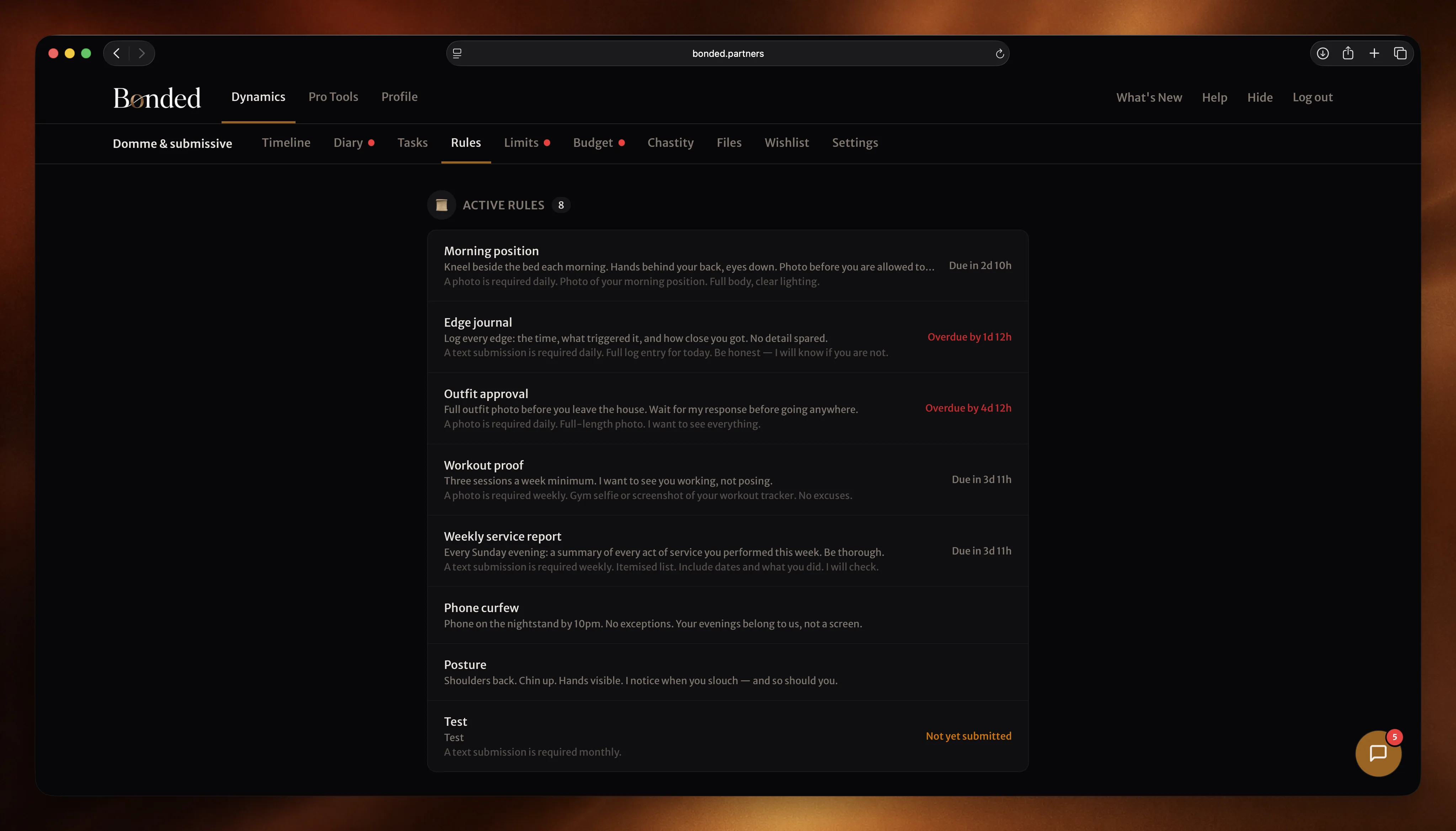
How limits are handled reflects your framework. In a system where limits are classified -- hard limits, soft limits, interests -- both parties can see and respect the map of what's negotiable and what's not. The submissive controls their own limits. The Dom(me) respects them. This is consent as architecture, not just agreement.
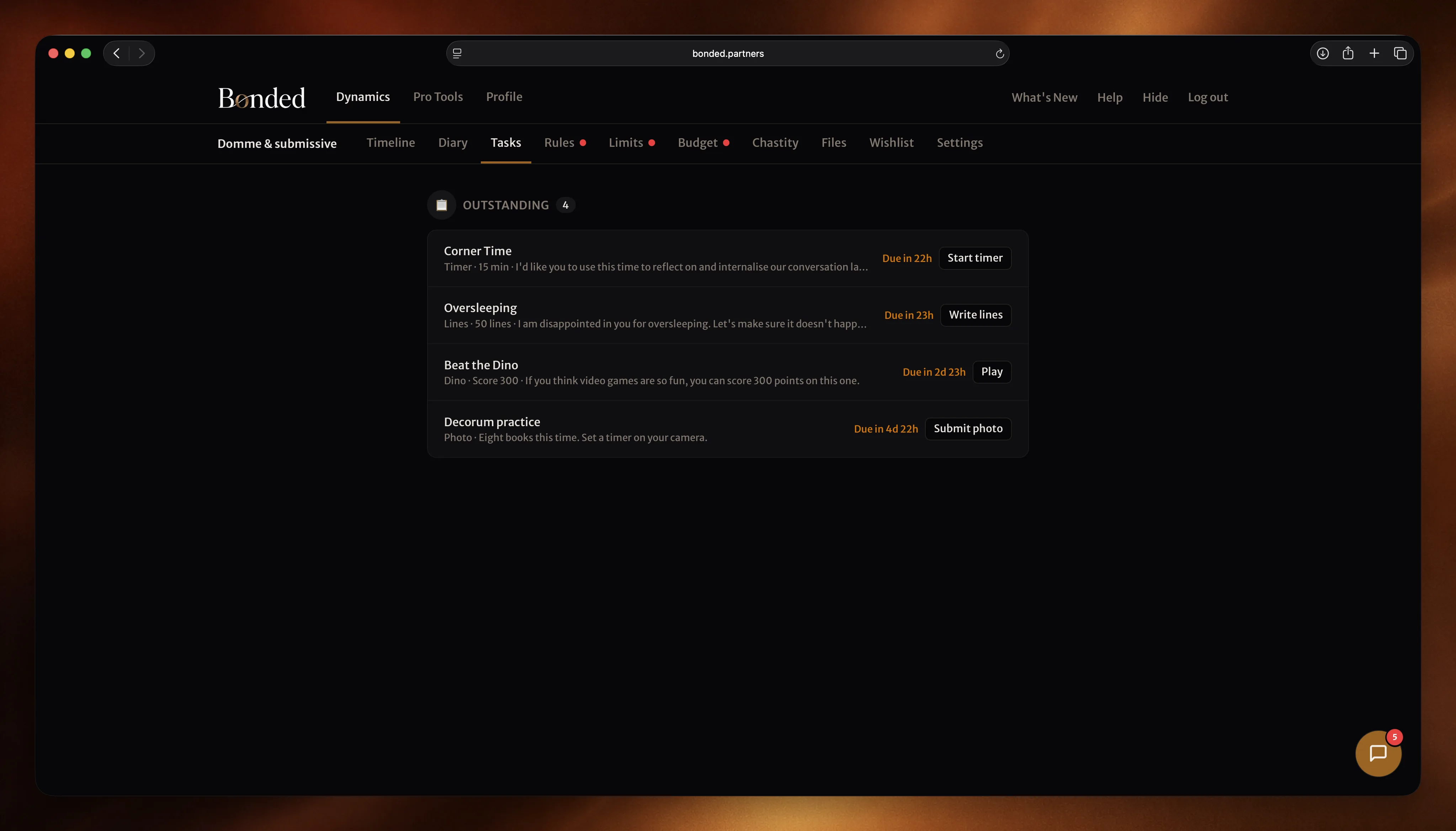
How rules are enforced reflects your framework. Rules that serve both parties are SSC-aligned. Rules with understood consequences are RACK-aligned. A submissive who maintains their own limits and communicates proactively is PRICK-aligned.
Beyond the Acronyms
There's a risk in reducing safety to acronyms. The real work of ethical kink is not in memorising three letters. It's in the ongoing, often difficult practice of honest communication, continuous consent, self-education, and mutual care.
No framework prevents all harm. People make mistakes. Accidents happen. Emotions run hotter than expected. A framework is a starting point for conversation and a standard to hold yourself to, not a guarantee.
The best practitioners are the ones who hold the frameworks lightly -- using them as tools rather than shields. They ask "is this right?" more often than "does this comply with RACK?" They check in with their partners, adjust their approach, and prioritise the person in front of them over any theoretical model.
That said, frameworks matter. They give us shared language. They set community standards. They help newcomers understand that ethical kink has principles, not just desires. And they provide a reference point when something goes wrong -- a way to identify where the failure occurred.
Learn them. Understand them. Then go beyond them, into the messy, human work of caring for the people you play with. For more on safety in practice, see our safety guide.
A Note on Consent as Architecture
One of the most significant evolutions in kink safety thinking is the move from consent as a moment (a "yes" before a scene) to consent as architecture (systems that embed consent into their structure).
This means:
- Limits that are visible, accessible, and controlled by the person they protect
- Systems where consent is not just given but documented and revisitable
- Structures that make it easy to withdraw consent and difficult to override it
- Clean exits where leaving a dynamic doesn't leave your data behind
When consent is architecture rather than just agreement, it's harder for any single person to undermine. The system itself protects the participants, not just their willingness to speak up.
This is where technology intersects with safety philosophy. A well-designed tool for D/s dynamics should reflect these frameworks in its structure: limits classified and submissive-controlled (RACK), safety features built in rather than optional (SSC), individual agency preserved even within power exchange (PRICK).
Go deeper
Read the full guide→