



Negotiation Isn't a One-Time Conversation
D/s negotiation is continuous, not a single talk. Learn practical frameworks for check-ins, debriefs, diary reflection, and quarterly reviews to maintain consent.

There is a version of D/s negotiation that looks like this: you sit down once at the beginning, hash out your limits and desires, shake on it, and then run the dynamic based on what was agreed. Maybe you revisit things if something goes dramatically wrong. Otherwise, the initial negotiation is the negotiation.
This model is clean, simple, and wrong.
Negotiation is not an event. It is a practice. It is something you do continuously, in different forms, at different depths, across the life of a dynamic. The initial conversation sets a starting point. Everything after that is the real work.
If your dynamic relies on a negotiation that happened once, weeks or months or years ago, you are operating on stale information. Both of you have changed since then. Your desires have evolved. Your trust has deepened or strained. Your life circumstances have shifted. The dynamic itself has taught you things you did not know when you started.
Continuous negotiation is not a sign that the initial conversation failed. It is a sign that your dynamic is alive.
The Problem with One-and-Done
One-time negotiation fails in predictable ways.
It cannot account for experience. When you negotiate at the start, neither of you has experienced this specific dynamic yet. You are negotiating based on theory, past experience with other partners, fantasy, and educated guesses. All useful, but all incomplete. Once you have actual shared experience, your understanding changes. One-time negotiation never captures those changes.
It assumes static people. You are not the same person you were six months ago. Neither is your partner. Moods shift, bodies change, mental health fluctuates, external stressors wax and wane. A negotiation framework that treats both of you as fixed points in a changing world is going to develop gaps.
It privileges what was easy to say. In the initial negotiation, you said the things you were ready to say. The things you had language for. The things that did not feel too vulnerable or too risky to voice. But some of the most important things in a dynamic are exactly the ones that take time and trust to articulate. One-time negotiation never creates space for those to emerge.
It creates a false sense of completion. "We've negotiated" becomes a box to tick rather than a process to maintain. Both people stop paying attention to the gaps, the drifts, the small discomforts that accumulate. By the time those accumulations become visible, they are often already problems.
What Continuous Negotiation Looks Like
Continuous negotiation is not one thing. It is a collection of practices at different frequencies and depths. Think of it as layers:
Layer 1: In-the-Moment Check-Ins
The most frequent and most lightweight form of negotiation. These happen during scenes, during everyday dynamic interactions, during moments of intensity.
"Colour?" is the most basic version. But in-the-moment check-ins can be much more nuanced than the traffic light system. A Dom(me) pausing a scene to say "I want to try something. Here's what it is. Are you in?" is real-time negotiation. A submissive saying "This is working but I need you to slow down" is real-time negotiation. A Dom(me) noticing their submissive's body language shift and adjusting without being asked is implicit negotiation based on knowledge built over time.
These micro-negotiations keep the dynamic responsive. They prevent the drift between what was agreed and what is actually happening.
Layer 2: Post-Scene Debriefs
After any significant scene or dynamic interaction, a debrief. Not immediately, sometimes you need aftercare and rest first, but within 24 hours while the experience is still fresh.
A good debrief covers:
What worked. Not just "that was good" but specifically what and why. "The way you built intensity gradually let me settle in rather than feeling shocked" is infinitely more useful than "I liked it." Specific positive feedback is a form of negotiation because it tells your partner what to do more of.
What did not work. This requires safety. If the submissive fears punishment for honest feedback, or the Dom(me) fears being seen as incompetent, the debrief becomes performative rather than useful. Create conditions where honesty is genuinely welcome.
What surprised you. Unexpected reactions, positive or negative, are valuable data. "I didn't expect to respond that way" is the beginning of learning something new about yourself and about the dynamic.
What you would change. Forward-looking feedback. Not "you did it wrong" but "next time, I'd want..." This is where the negotiation layer comes in. Each debrief subtly refines the agreements you are operating under.
Layer 3: Regular Check-Ins
Scheduled conversations outside of play that address the dynamic itself. How things are going. What is working. What feels off. Where each person's head is at.
Frequency depends on the dynamic. New dynamics might need weekly check-ins. Established ones might find monthly sufficient. The key is that they are scheduled, not improvised. "We should talk about how things are going" is easy to defer. A recurring calendar event is harder to avoid.
A check-in framework that works for many dynamics:
Temperature check. Each person rates their current satisfaction with the dynamic on a scale of 1 to 10. Not a grade. A temperature. It opens the conversation and gives both people a sense of where the other is.
Highlights. What has felt best since the last check-in? What moments stood out? This grounds the conversation in positives and reminds both people why they are doing this.
Friction. Where has there been friction, discomfort, or disconnect? Small things count. The rule that felt fine in theory but is annoying in practice. The scene that was technically within limits but did not feel right. The dynamic behaviour that lands differently than intended.
Requests. What would each person like more of? Less of? Different? This is the active negotiation component. Not renegotiating the entire dynamic, but making incremental adjustments based on lived experience.
Limits update. Has anything shifted? New curiosities? New boundaries? Anything previously soft that has moved in either direction? This does not need to be a full limits review every time. A simple "anything changed?" is sufficient most sessions.
Layer 4: Diary and Written Reflection
Not all negotiation happens in conversation. Some of the most important processing happens in private, through writing.
A submissive journaling about how a scene felt three days later often surfaces things that did not come up in the immediate debrief. A Dom(me) writing about their own experience of leading a scene might recognise patterns they could not see in the moment. Reflective writing is negotiation with yourself, clarifying your own positions so that you can communicate them more effectively when the time comes.
Shared journals add another dimension. When your partner can read your reflections (with your consent and at the level of sharing you are comfortable with), they gain access to your inner experience in a way that conversation sometimes cannot provide. The words you choose when writing to yourself are often more honest than the words you choose when speaking to someone whose reaction you can see.
Bonded's Diary feature is designed for this kind of reflective processing. Entries can be private or shared with your dynamic, and they create a record over time that shows how your thinking has evolved. That record is useful not just for your partner but for you. Looking back at what you wrote six months ago and seeing how your perspective has changed is a powerful form of self-knowledge.
Layer 5: Quarterly Reviews
The deep dive. Once a quarter, or at whatever interval works for your dynamic, a comprehensive review of the entire framework.
This is the closest thing to a repeat of the initial negotiation, but it is fundamentally different because it is informed by months of shared experience. You are not guessing anymore. You are evaluating.
A quarterly review template:
Limits list review. Go through the full list. Has anything changed? Update classifications. Discuss any shifts. This is the time for the comprehensive pass that check-ins handle at a high level.
Rules audit. Which rules are working? Which feel stale or pointless? Which need adjustment? Are there new rules that would serve the dynamic? Are there existing rules that should be retired?
Dynamic direction. Where is this going? What do both people want the next quarter to look like? More intensity? Different focus? New exploration? Consolidation of what you have? This is strategic negotiation, the kind that shapes the dynamic's trajectory.
Role satisfaction. Is each person still fulfilled in their role? Has the balance shifted? Does either person feel they are giving more than they are receiving, or receiving more than they are comfortable with?
External factors. What is happening in the rest of your lives that might affect the dynamic? Upcoming stressors, schedule changes, health considerations, relationship developments outside the dynamic if applicable.
Appreciation. Explicitly acknowledge what your partner does well. This is not negotiation in the strict sense, but it is the relational foundation that makes all the other negotiation possible. People negotiate more honestly when they feel valued.
Continuous Consent in Practice
The phrase "continuous consent" sometimes gets reduced to "you can withdraw consent at any time." Which is true, but insufficient. Continuous consent is not just about the right to say stop. It is about the ongoing, active process of ensuring that what is happening is what both people want to be happening.
In a D/s context, this gets complex. A submissive in deep protocol might not be making moment-to-moment choices about individual activities. That is part of the power exchange. But the framework within which that power exchange operates should be under continuous negotiation.
Here is a useful distinction: macro consent and micro consent. Macro consent is the big picture: the structure of the dynamic, the limits, the roles, the general direction. Micro consent is the in-the-moment stuff: this activity, right now, at this intensity.
D/s dynamics often involve the submissive delegating micro consent within boundaries set by macro consent. "You make the decisions within these parameters" is a valid consent structure. But the macro consent, the parameters themselves, needs regular renewal. That renewal is what continuous negotiation provides.
A practical way to think about it: your submissive has consented to a dynamic with a specific shape. Are you still operating within that shape? Has the shape changed without explicit renegotiation? If so, you have drifted from the consented framework, even if no individual activity has crossed a stated limit.
When Negotiation Breaks Down
Sometimes one or both people stop negotiating. The check-ins lapse. The debriefs become perfunctory. The diary goes unwritten. The quarterly review gets postponed indefinitely.
This breakdown usually signals one of a few things:
Avoidance. There is something uncomfortable that neither person wants to address. The negotiation structures are being avoided because they would surface the uncomfortable thing.
Complacency. Things are "fine," so why rock the boat? This is the most insidious form of breakdown because it does not feel like a problem until it is.
Power imbalance in the meta-dynamic. The D/s power exchange has leaked into the negotiation process itself. The submissive feels they cannot raise concerns because it would be "topping from the bottom." The Dom(me) feels they should already know what their submissive needs without being told. Both positions undermine negotiation.
Fatigue. Maintaining continuous negotiation takes energy. When life is draining energy from every other direction, dynamic maintenance is often the first thing to drop.
Whatever the cause, the fix is the same: name the breakdown and restart the practice. It does not have to be a big deal. "We haven't done a check-in in two months. Let's do one this week." That is sufficient.
Tools That Support Continuous Negotiation
Continuous negotiation is easier when you have tools designed for it rather than trying to hold everything in conversation and memory.
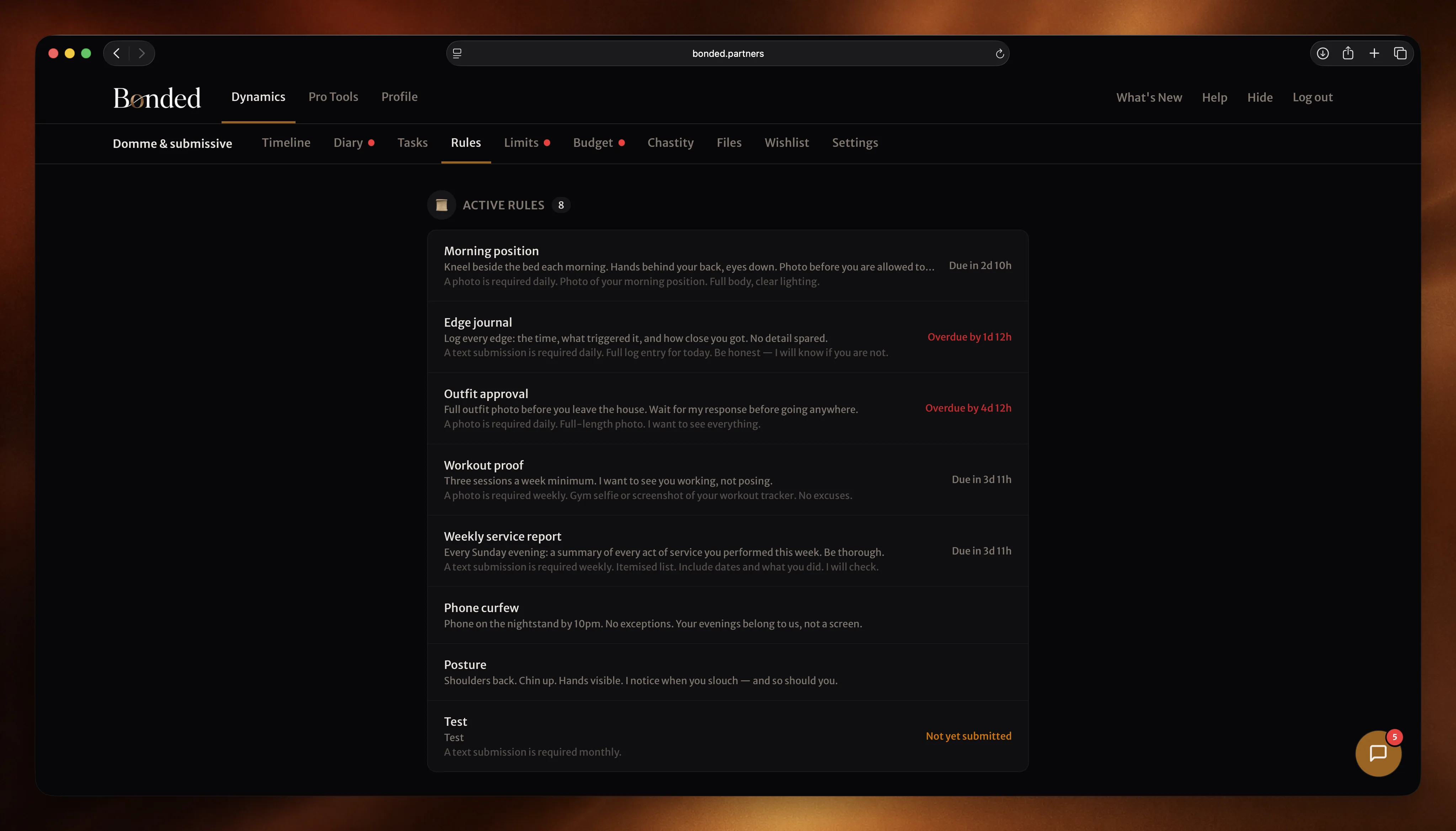
A living limits list that both people can update at any time, with notifications when changes are made. Not a document in a drawer that you pull out once a year.
A shared and private diary where both people can reflect between conversations. The Diary is where honesty has room to develop without the pressure of an immediate response.
An asynchronous communication channel that is specifically for the dynamic. Chat, separate from your regular texting, keeps dynamic conversations from getting lost in logistics about who is picking up groceries.
A timeline that shows the evolution of the dynamic over time: limit changes, rule additions, diary entries, significant events. When you can see the trajectory, you can negotiate the direction more intentionally.
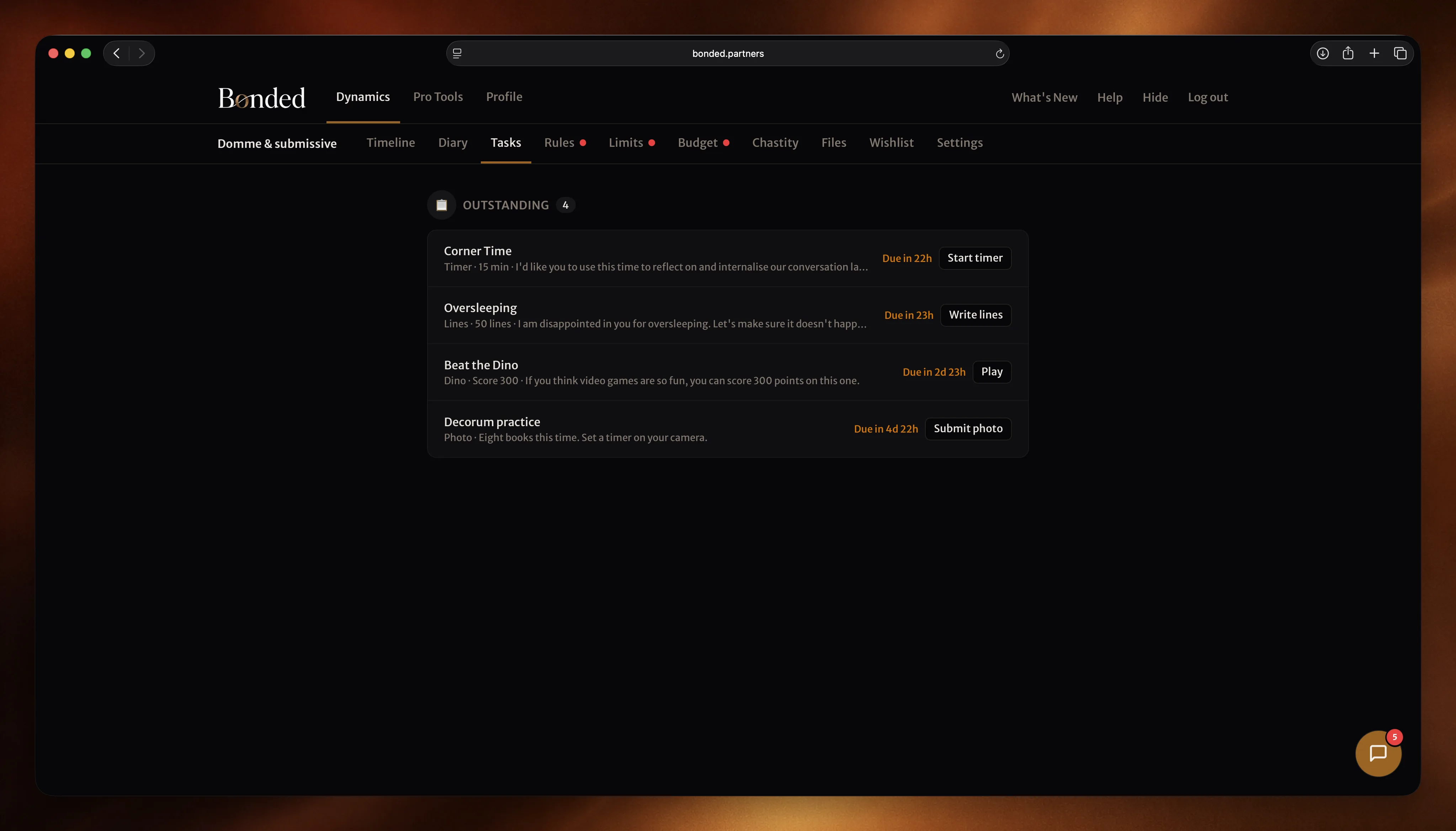
Bonded integrates all of these: a limits system with real-time change notifications, a diary for private and shared reflection, a chat channel for asynchronous dynamic conversation, and a timeline that shows how everything has evolved. These tools do not replace the human work of negotiation. They support it by making the information accessible and the patterns visible.
A Quarterly Negotiation Template
For those who want a concrete starting point, here is a template for a quarterly review conversation:
Before the review (independently):
- Review your current limits classifications. Update anything that has changed.
- Reread your diary entries from the past quarter.
- Note three things that worked well and three things you would change.
- Think about what you want the next quarter to look like.
During the review (together):
- Share highlights from the quarter. What were the best moments?
- Discuss limits changes. Walk through anything that shifted and why.
- Audit current rules and protocols. Keep, modify, or retire each one.
- Share your "three things to change." Look for overlaps and discuss differences.
- Discuss desired direction for the next quarter.
- Address any external factors that might affect the dynamic.
- Express specific appreciation for each other.
After the review:
- Each person writes a diary entry reflecting on the conversation.
- Schedule the next quarterly review.
- Implement any agreed changes within the first week.
Practical Takeaways
Schedule your negotiation. If it is not on the calendar, it will not happen. Check-ins, debriefs, and quarterly reviews all deserve scheduled time.
Use multiple layers. In-the-moment check-ins, post-scene debriefs, regular check-ins, reflective writing, and deep reviews all serve different purposes. You need all of them.
Writing supplements conversation. Some things are easier to write than to say. Use private and shared journals as negotiation tools, not just emotional outlets.
Negotiation breakdown is normal. It happens. The fix is to notice it and restart, not to treat it as a failure.
Macro consent needs regular renewal. The submissive's consent to the overall dynamic framework should be actively, not passively, maintained.
Track the evolution. Point-in-time conversations are useful. A longitudinal view of how the dynamic has developed is even more useful.
Bonded's integrated tools, Limits, Diary, Chat, and Timeline, are built around the principle that negotiation is ongoing. They create a persistent, evolving record of your dynamic's agreements, reflections, and trajectory, making continuous negotiation a practice rather than a burden.
Go deeper
Read the full guide→