



Locktober: A Keyholder's Month-Long Guide
Everything you need to plan and execute Locktober — from device preparation and ground rules to daily challenges, weekly themes, and celebrating completion.

Locktober is the kink community's annual chastity event: thirty-one days of lock-up, starting October 1st and running through the 31st. What started as a niche internet challenge has grown into one of the most widely recognised community events in the chastity world. Thousands of couples participate each year, ranging from experienced chastity practitioners looking for a structured challenge to complete beginners using the month as their first extended lock-up.
This guide is written for keyholders — Dom(me)s, partners, or anyone holding the key — because Locktober succeeds or fails based on the keyholder's preparation and engagement. The person in the device is doing something difficult. The person holding the key is doing something deliberate. Both roles require planning.
Whether this is your first Locktober or your fifth, this guide will give you a day-by-day framework for the first week, weekly themes for weeks two through four, tease and denial ideas throughout, emergency protocols, and a template for the conversations that keep the month meaningful rather than merely endured.
Preparation: The Weeks Before October
Locktober should not start on October 1st. It should start in September, with preparation that ensures the month is safe, structured, and grounded in real communication.
The Device
If your partner does not already have a chastity device they are comfortable in, September is the time to sort this out. Breaking in a new device during a month-long challenge is a recipe for injury and frustration.
The device should:
- Fit properly, with a base ring that allows one finger between ring and skin
- Be wearable 24/7 without causing injury during sleep (nocturnal erections will happen and must be accommodated)
- Be cleanable without full removal (or the cleaning schedule must include regular removal for hygiene)
- Be compatible with your partner's daily life — work, exercise, travel
If your partner has been in short-term chastity before (a few days, a weekend), a month is a significant step up. If they have never worn a device, consider a trial week in September. Locktober is not the time to discover the device does not fit.
Hygiene Protocol
Thirty-one days requires a rigorous hygiene routine. Establish this before the month begins.
Daily: Rinse the device and surrounding area with warm water in the shower. Use a mild, unscented soap. Dry thoroughly — trapped moisture causes irritation and infection. Cotton swabs help clean inside the cage.
Every 2-3 days: If your device allows, remove the cage portion (keeping the base ring locked) for a more thorough clean. If full removal is necessary for hygiene, establish that these are clinical unlocks — the device comes off, cleaning happens, the device goes back on. No prolonged freedom, no sexual contact during the unlock. Both partners should agree on this boundary before October.
Watch for: Redness, broken skin, persistent soreness, unusual odour, or any sign of infection. These are signals to unlock immediately, treat the issue, and reassess before relocking. Locktober is not worth a medical problem.
Ground Rules
Sit down together and establish the rules of your Locktober before it begins. This conversation should cover:
Unlocks. Under what circumstances will you unlock? Medical need? Hygiene? Emotional distress? Airline security? Define these in advance so that neither of you has to negotiate in the moment.
Tease and denial. Will you be actively teasing your partner during the month, or is this a more meditative, denial-focused experience? Some keyholders ramp up teasing throughout the month. Others keep things quiet and let the denial do the work. There is no right approach, but both partners should be aligned.
Communication. How will you check in? Daily? Twice daily? The person in the device needs a reliable channel to report physical issues, emotional state, and anything that needs attention. Do not rely on them to bring up problems unprompted — build the check-in into the structure.
Completion. What happens on November 1st? Some couples plan an elaborate unlock ceremony. Others keep it simple. Some extend into Nolockember (locking back up for November). Knowing what you are building toward makes the month more purposeful.
Emergencies. Your partner should have access to an emergency key at all times — sealed in a numbered container so you will know if it has been used. This is non-negotiable. A medical emergency will not wait for you to drive home with the key.
The Communication Template
Use this or adapt it for your pre-Locktober conversation.
"This Locktober, here is what I am planning for us: [describe your approach]. The device stays on from October 1st through October 31st. We will do hygiene unlocks every [frequency]. I will check in with you every [frequency] about how you are doing physically and emotionally. If at any point you need an emergency unlock, you use the emergency key and we talk about it after — no guilt, no failure. On November 1st, [describe completion plan]. Does this work for you? What would you change?"
Week One: Establishing the Rhythm
The first week of Locktober is about establishing the physical and emotional rhythm of the month. Most of the challenges will be familiar if your partner has done short-term chastity before, but the psychological weight of knowing it is thirty-one days rather than three changes the experience significantly.
Day 1 (October 1st): The Lock
This is the moment. Make it matter.
Some couples treat the October 1st lock-up as a ritual — a deliberate act with eye contact, words exchanged, and a clear moment of transfer. Others keep it understated. Either way, acknowledge what is happening. Your partner is giving you control of their sexual release for a month. That is not trivial.
Keyholder task: Lock the device. Take the key. Tell your partner what you expect from them this month. Be specific. "I expect honesty about how you are feeling, daily check-ins, and your best effort. That is it."
Challenge for the locked partner: Write a diary entry about why you are doing this. Not the sexual reason — the deeper one. What do you hope Locktober will teach you about yourself, your submission, your dynamic?
Day 2: Adjustment
The device is on. The novelty is fading. Your partner is hyperaware of the cage and probably did not sleep well last night (nocturnal erections against a cage are a rude awakening, literally).
Keyholder task: Check in. Ask about sleep, comfort, chafing. Be clinical and caring in equal measure. Adjust the hygiene routine if needed.
Challenge: A simple obedience task unrelated to chastity. Something service-oriented. The point is to establish that Locktober is about the dynamic, not just the device.
Day 3: The First Test
Day three is historically when short-term chastity attempts fail. The excitement has worn off. The discomfort has not. The month stretches ahead like an impossibility.
Keyholder task: Acknowledge the difficulty. "Day three is hard. I know it is. You are doing this for us, and I see that." Validation from the keyholder is the single most effective tool against day-three doubt.
Challenge: A tease. Not elaborate — a suggestive message, a photograph, a promise of something specific for November. Remind your partner what they are working toward.
Day 4: Settling In
By day four, most people have accepted the reality. The device is less physically intrusive (the body adapts), and the psychological shift from "I cannot do this for a month" to "I am doing this" has begun.
Keyholder task: Normal check-in. Begin establishing the daily rhythm that will carry through the month.
Challenge: Ask your partner to describe their current headspace in writing. What has shifted since day one?
Day 5: The First Milestone
Five days is longer than many people have been locked before their first Locktober. Mark it.
Keyholder task: Acknowledge the milestone. Five days. This is real.
Challenge: A denial-focused task. Edge of arousal without release — this might be mental (writing out a fantasy they cannot act on) or physical (if your device allows any stimulation). The point is to make the denial active rather than passive.
Day 6: Routine
The daily rhythm should be established by now. Check-in, challenge, diary entry, repeat. The structure matters more than the content.
Keyholder task: Review the week's diary entries. Respond to them. Show your partner that their words are being read and valued.
Challenge: A service task with a twist — something your partner does for you that explicitly references their locked state. "Prepare dinner. While you cook, think about who holds the key."
Day 7: Week One Complete
One week down. Three to go.
Keyholder task: A slightly longer check-in. Review the week together. What was harder than expected? What was easier? Any physical issues to address? Any emotional issues to explore?
Challenge: Ask your partner to write a letter to their November 1st self. What do they want to remember about this first week?
Week Two: Deepening Denial
The body has adjusted. The mind is adjusting. Week two is where the psychological dimension of chastity opens up — where denial stops being a physical state and becomes an emotional and relational one.
Theme: Awareness
Week two's theme is awareness — of desire, of the keyholder, of the dynamic. The device fades into the background physically, but the denial should not fade psychologically.
Daily tease suggestions:
- Descriptive messages about what you (the keyholder) are thinking about
- Countdown reminders: "Twenty-three days remaining"
- Small acts of physical closeness that stop just short of where your partner wants them to go
- Sharing content (written, visual) that your partner finds arousing, with the explicit reminder that they are locked
Daily challenges:
- Write about a specific desire they are denied
- Perform an act of service that demonstrates their submission
- Describe, in detail, what they would do if they were unlocked (and then sit with the fact that they are not)
- Practice gratitude — what does the lock give them that freedom does not?
Keyholder focus: Watch for emotional shifts. Week two is when frustration can turn into resentment if the keyholder is not engaged. Your partner needs to feel that you are present in their experience, not just holding a key in a drawer.
Week Three: The Middle Distance
Week three is the plateau. The initial intensity has faded. The end is not yet close enough to motivate. This is where Locktober becomes an endurance practice, and where the keyholder's creativity matters most.
Theme: Control
Week three's theme is control — the keyholder's control over the dynamic, the locked partner's control over their responses, and the mutual control both partners exercise over the direction of the month.
Daily tease suggestions:
- Escalation. Whatever your tease level was in week two, increase it slightly. The plateau needs disruption.
- Surprise. A tease at an unexpected time — a midday message when your partner is at work, a note left where they will find it
- Physical teasing during intimate but non-sexual moments — a hand on the thigh during a film, a whisper during an embrace
Daily challenges:
- A more demanding service task
- A reflective writing prompt: "What has the denial taught you about what you actually want?"
- A task that requires the partner to explicitly ask for something they know they cannot have
- Memorisation or recitation of something meaningful to the dynamic — a specific rule, a section of your contract, a passage that resonates
Keyholder focus: This is the week where you might feel the fatigue too. Maintaining a month-long challenge is work for the keyholder as well. If you need to simplify the daily challenges for a few days, that is fine. Consistency matters more than elaboration.
Week Four: The Final Push
The end is visible. Seven to ten days remaining. Your partner knows they can finish. The question is no longer whether they will make it but what state they will be in when they do.
Theme: Surrender
Week four's theme is surrender — letting go of the mental resistance that has been running in the background all month. By now, your partner has adapted to the device, adapted to the routine, and may have reached a state where the denial feels less like deprivation and more like a natural state. Lean into that.
Daily tease suggestions:
- Maximum intensity. Week four is when you bring everything you have. Detailed descriptions of what you will do on unlock day. Physical closeness. Promises. The month is earning its climax (or its conclusion, depending on your plans).
- Counter-tease: moments of deliberate calm amid the escalation. A quiet evening where the lock is not mentioned at all. The absence of teasing can be its own form of denial.
Daily challenges:
- A comprehensive reflection on the month
- A gratitude practice specifically for the keyholder
- A final letter to themselves, to be read alongside the day-seven letter on November 1st
- Preparation for unlock day — physical, emotional, practical
Keyholder focus: Plan the unlock. Do not improvise it. This is the culmination of a month of effort, discipline, and trust. Whether it is elaborate or simple, it should be intentional.
Emergencies
Physical Emergencies
Persistent pain (not discomfort — pain), broken skin, signs of infection (redness, warmth, swelling, discharge), numbness, or discoloration: unlock immediately. No discussion, no "push through it." Unlock, assess, treat.
If the issue is minor (chafing, irritation), unlock for treatment, allow the area to heal, and relock when it is safe. This is not a failure. It is responsible practice. You can note the time unlocked and extend Locktober by that duration if both partners want to, but this is optional, not expected.
If the issue requires medical attention, go to a doctor. Medical professionals have seen chastity devices before. If yours has not, a brief explanation — "it's a body-safe device worn by choice, and I need help with [the specific issue]" — is sufficient. Your health takes priority over your embarrassment.
Emotional Emergencies
Chastity affects mental health. A month of denial can surface anxiety, depression, relationship insecurities, or trauma responses that were not anticipated. Watch for:
- Persistent low mood that extends beyond frustration
- Withdrawal from the dynamic or from the partner
- Anger disproportionate to the situation
- Intrusive thoughts about the relationship or self-worth
- Loss of interest in the challenge and in the dynamic itself
If these emerge, have a conversation first. Sometimes naming the feeling is enough. Sometimes a brief unlock, a pause day, or a recalibration of the month's intensity is what is needed. Sometimes Locktober needs to end early, and that is a completely valid outcome.
An incomplete Locktober that protects your partner's mental health is a success. A completed Locktober that damages it is a failure regardless of the calendar.
Celebrating Completion
October 31st. Thirty-one days. Your partner made it. You made it. This deserves recognition.
How you celebrate depends on your dynamic. Some possibilities:
The ceremonial unlock. Make it a moment. The click of the lock opening after a month carries real emotional weight. Take your time. Acknowledge what your partner accomplished. Acknowledge what you both built over the month.
Review the month together. Read through diary entries from day one to day thirty-one. Look at the arc. The doubt of week one, the depth of week two, the plateau of week three, the surrender of week four. This record is valuable. It is the story of a month in which both of you chose something difficult and carried it through.
Physical reunion. Whether this involves immediate sexual activity or a more gradual reintroduction, let both partners set the pace. A month of denial can make the first experience overwhelming. Gentleness is appropriate even when intensity is desired.
Rest. Locktober is an endurance event. Both partners deserve rest afterward. Do not immediately launch into Nolockember unless both of you genuinely want to. Let the month settle. Process what you learned. Carry the lessons forward.
Using Bonded for Locktober
If you are tracking Locktober in Bonded, the platform's chastity features align closely with the month's structure.
Lock on October 1st and the live timer begins counting. Both the keyholder and the locked partner can see the running duration. There is something uniquely motivating about watching the hours and days accumulate in real time.
Session history tracks every lock and unlock. If you do hygiene unlocks or emergency unlocks during the month, they are logged — duration locked, duration unlocked, and the full timeline of the month.
Lifetime statistics will capture your Locktober alongside all other chastity sessions, building a long-term record that extends beyond any single month.
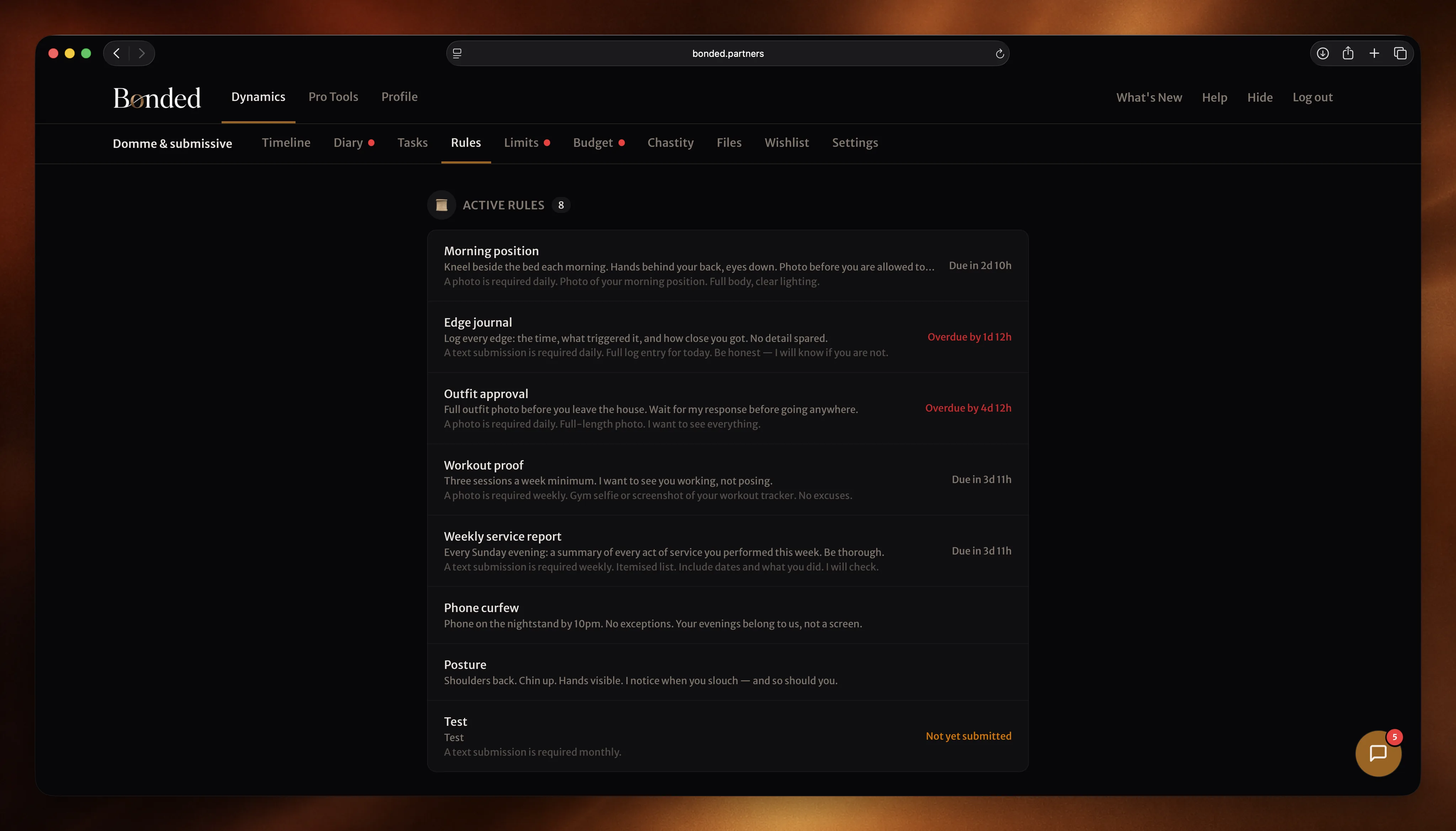
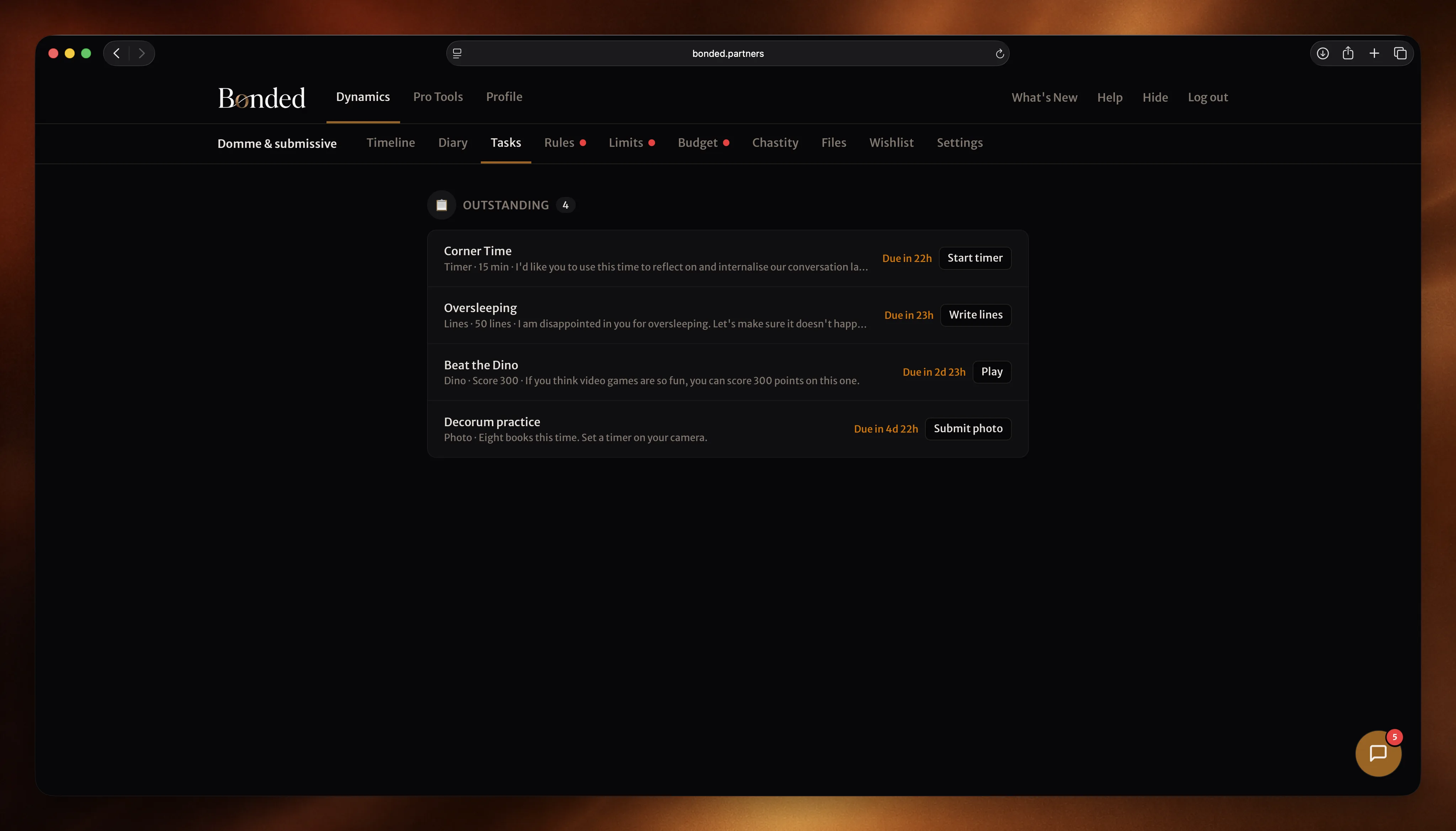
Tasks can hold your daily challenges. Set them up in advance or create them day by day. Push notifications remind your partner of their daily challenge, and evidence submission lets them respond directly.
The diary is where Locktober's emotional arc lives. Daily entries throughout the month create a narrative that is worth rereading in November and beyond.
A Final Note
Locktober is a challenge, but it is not a test. It is not about proving anything. It is about choosing a month of deliberate denial and seeing what it reveals — about desire, about discipline, about the dynamic you are building together.
Some couples discover that chastity is a permanent part of their dynamic. Others discover that a month was enough and they are glad they did it. Both outcomes are valid. The value is in the doing, not in the conclusion.
Plan well. Communicate constantly. Take care of each other. And on November 1st, whatever you decide to do next, you will both know something about yourselves that you did not know on September 30th.
That is worth a month.
Go deeper
Read the full guide→